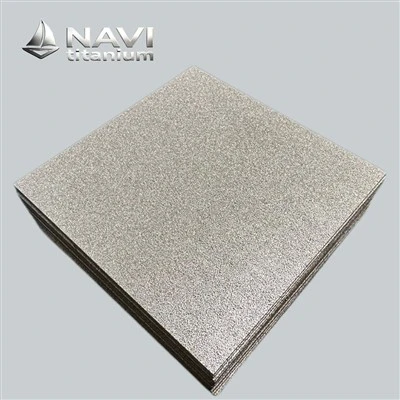
NAVI Titanium sintered candle filter is intended for fine separation duties. Customer orders are reviewed jointly by technical, purchasing, quality, and fabrication teams, allowing specifications to be cross-checked before scheduling. Technical personnel translate drawings, particle-retention requirements, and connection details into shop-floor instructions, while production staff return feedback on forming sequences and dimensional observations. This two-way communication helps identify discrepancies at an early stage. Records from previous orders can also be consulted when similar specifications recur, reducing unnecessary clarification and improving continuity between quotation, processing, and final verification.
Solution of NAVI Titanium
NAVI Titanium applies a cross-functional coordination model in which technical, purchasing, quality, and fabrication personnel review customer requirements from different perspectives. Technical staff interpret drawings, dimensional notes, surface specifications, and application parameters, then communicate key details directly with fabrication teams before processing begins. Fabrication personnel, in turn, report observations from forming, machining, joining, and inspection stages, allowing technical staff to verify whether practical conditions correspond with the original specifications. This two-way exchange reduces information gaps between departments and creates a traceable basis for reviewing customized orders.
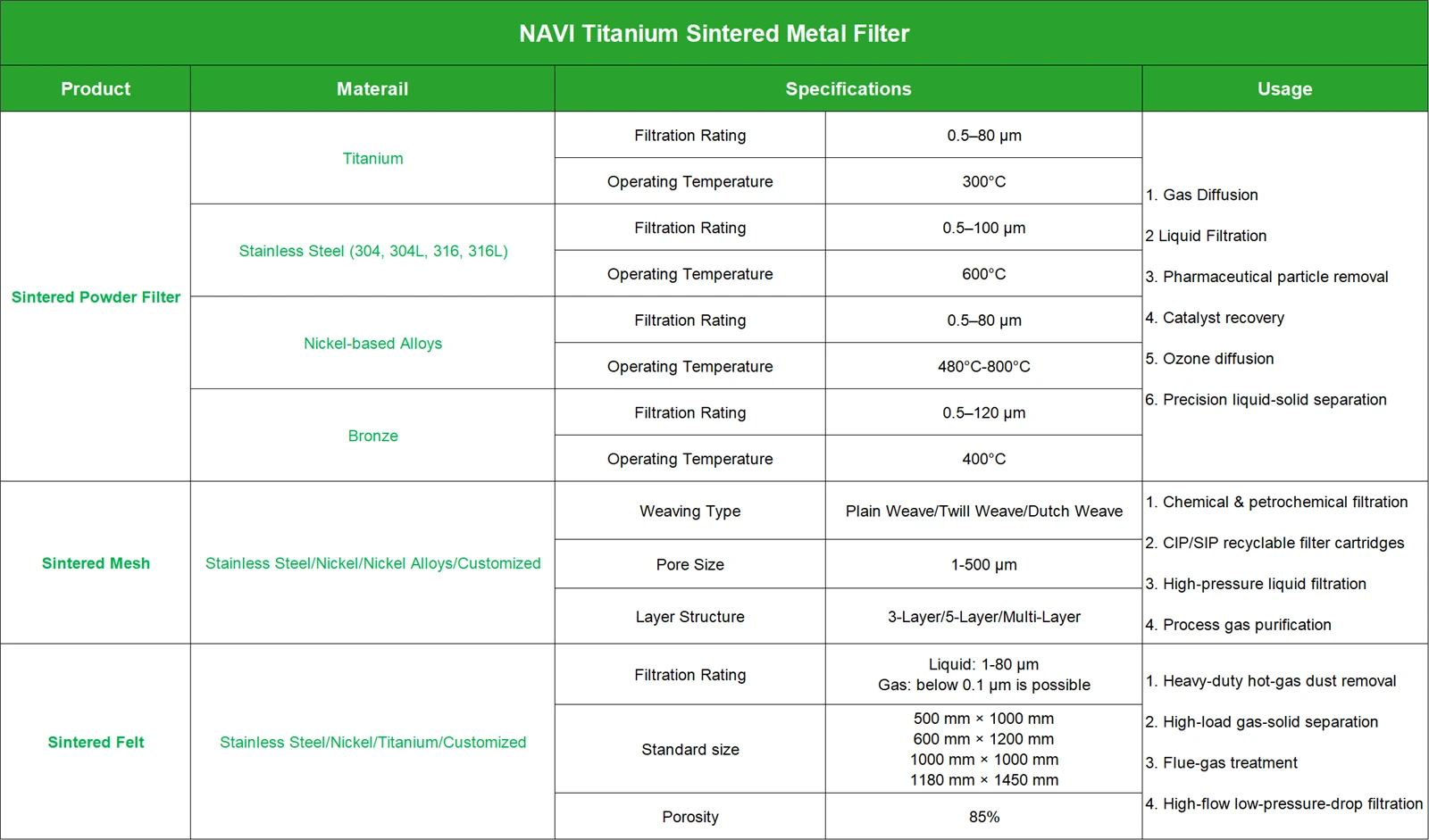


NAVI Titanium emphasizes the relationship between pore distribution, particle retention, and pressure differential in cylindrical separation applications. Collaboration between research personnel and production teams facilitates process evaluation, dimensional consistency, and performance verification across customized orders.


Application
NAVI Titanium sintered candle filter is applied in specialty materials processing and hydrometallurgical processing, where controlled separation of fine suspended matter supports pigment slurry refinement and rare-earth mother-liquor clarification.
Fine inorganic pigment suspensions require separation of residual agglomerates, oversized granules, and incidental debris without causing excessive loss of valuable solids. In facilities producing specialty ceramic colors, magnetic pigments, optical coatings, or functional mineral dispersions, NAVI Titanium columnar candle-style assemblies can be selected according to retained-particle range, liquid viscosity, solids concentration, and required throughput. Their elongated geometry offers a substantial separation area within a comparatively compact housing, which is useful where floor space is limited. A gradual rise indicates solids accumulation, whereas an abrupt increase suggests agglomerate migration or an upstream dispersion issue. Engineers may therefore evaluate particle-size distribution before and after each separation stage rather than relying solely on nominal retention figures. Surface finish, internal diameter, effective length, and connection configuration should also correspond with cleaning practice and slurry rheology. For high-value pigments, recovery rate is equally important: retained solids may be collected for evaluation instead of discarded, reducing material loss during batch transfer and improving consistency between production lots.

2. Rare-Earth Hydrometallurgical Mother-Liquor Clarification

Rare-earth separation circuits often generate chemically complex liquors containing suspended crystallization residues, insoluble mineral traces, and fine precipitated compounds. During selective precipitation and subsequent mother-liquor clarification, NAVI Titanium columnar candle-style assemblies can provide a controlled separation stage before downstream concentration, solvent extraction, or crystallization. This application is particularly relevant where dissolved-value losses must be minimized and suspended matter varies between successive batches. Rather than judging performance from nominal retention alone, process specialists examine pressure progression, recovered-solids mass, filtrate clarity, and capacity between cleaning cycles. A longer columnar format accommodates greater effective area while preserving a relatively compact vessel footprint. For crystallization circuits, the ability to remove residual nuclei and fine precipitates is especially important because uncontrolled carryover can alter subsequent crystal growth and separation behavior. Sampling at the inlet and outlet allows operators to establish a material balance and identify whether upstream precipitation chemistry requires adjustment. Such data also helps determine cleaning intervals and replacement criteria for each campaign.
Purchasing guide

Quality control (QC)
Material traceability and compositional verification are essential for cylindrical filtration assemblies, particularly where basket material compatibility affects corrosion resistance, mechanical integrity, and service performance. Chemical composition records, dimensional assessments, and relevant inspection data provide purchasers with documented evidence for incoming quality evaluation and specification compliance.

Manufacturing Process
Production begins with the selection and classification of suitable metallic feedstock according to chemical composition, granule morphology, and cleanliness. Selected granules undergo controlled blending to achieve uniform distribution before being loaded into a cylindrical mold. Compaction establishes the required geometry while preserving interconnected voids between individual granules. Subsequent high-temperature consolidation promotes bonding at granule contact points while retaining intended permeability. After cooling, the columnar body undergoes dimensional adjustment, surface treatment, and connection preparation. Particular attention is given to the NAVI Titanium basket interface, including joint compatibility, concentricity, and mechanical attachment. Throughout these stages, process records and operational parameters are documented to maintain consistency in pore distribution, structural integrity, and fluid passage characteristics.


Global Market Priorities and Packaging
- Germany: Sourcing managers in Germany's specialty chemicals, pigment processing, and mechanical separation sectors may prioritize documented dimensional tolerances, chemical compatibility, pore consistency, and traceable quality records.
- United States: Procurement teams serving specialty coatings, mineral processing, and fine chemical operations may focus on operating pressure, liquid throughput, replacement intervals, and compatibility with existing housings.
- India: Growing demand across chemical processing, mineral refining, and specialty manufacturing creates purchasing interest in columnar separation assemblies. Sourcing managers may compare unit pricing, customization options, cleaning requirements, and lead times.
- South Korea: Specialty chemical and electronic-material processing sectors may require close attention to dimensional conformity, granule retention, and surface cleanliness.
- Japan: Sourcing manager may emphasize detailed technical documentation, consistent specifications, and long-term procurement continuity.

Niche Packaging Detail

Removable End-Cap Protection: Long cylindrical assemblies require particular attention to their open ends, where contact damage, foreign granules, and deformation may occur during handling. Custom-fitted polymer caps can shield threaded connections and exposed edges, reducing the risk of contamination before installation. Internal Contamination Prevention: Protective inserts positioned at both ends to minimize the entry of dust, fibers, and residual debris. For NAVI Titanium assemblies with narrow internal passages, clean, non-shedding protective materials are preferable to loose cushioning that may leave fragments behind. Moisture Monitoring: For extended storage or humid distribution environments, a humidity indicator card placed inside the sealed outer carton can provide a visual reference for moisture exposure. Desiccant quantity should be determined according to enclosure volume, storage duration, and ambient humidity. Identification and Traceability: Individual labels record model references, connection specifications, campaign lot numbers, and handling instructions. Separating identification labels from direct-contact surfaces helps prevent adhesive residue or marking contamination.
Cleaning, Regeneration & Maintenance
For purchasers, cleaning strategy should be evaluated together with contaminant loading rather than selected solely from the initial purchase specification. Reverse-flow cleaning may be suitable when retained solids are loosely attached and can be displaced by a controlled pressure differential. Ultrasonic treatment can be considered for deposits lodged within narrow passages, particularly when mechanical contact could cause unwanted surface damage. Chemical washing may be appropriate when deposits are chemically bonded or difficult to remove by physical means, provided that the cleaning agent is compatible with the columnar body, joints, and basket material. Cleaning frequency is closely related to slurry concentration, granule characteristics, viscosity, operating pressure, and accumulated contaminant mass. A rising pressure differential between cleaning cycles can provide a practical indicator of fouling progression. Procurement teams can compare the number of operating hours between cleaning events, labor required per regeneration, cleaning-agent consumption, and water usage. Establishing these parameters before purchase helps sourcing managers estimate recurring maintenance expenditure rather than judging value from unit price alone.

Recovery Performance and Total Cost of Ownership

Post-cleaning performance is a key purchasing criterion because a lower initial price may become less attractive when recovery after repeated regeneration is poor. Sourcing managers should compare permeability before service, immediately after cleaning, and following multiple regeneration cycles. The percentage of recovered flow capacity can indicate whether retained deposits are being removed effectively or whether irreversible fouling is accumulating. Dimensional checks and examination of joints are also useful after repeated cleaning, especially where pressure pulses, ultrasonic energy, or chemical exposure are involved. From a NAVI Titanium perspective, total cost of ownership should include acquisition price, cleaning labor, consumables, replacement frequency, spare-unit inventory, and production downtime. If a cleaning cycle requires extended disassembly, specialized labor, or lengthy drying, these indirect expenses can exceed the apparent saving at purchase. A practical purchasing assessment compares cost per operating hour or cost per regeneration cycle across several service periods. Records give procurement teams a clearer basis for selecting specifications according to long-term operating economics rather than upfront expenditure alone.
Micron-Retention Selection
For procurement, micron selection should be based on the particle-size distribution of the process stream rather than a nominal value alone. A sintered candle filter rated at 1 μm is generally considered when very fine particulate removal is required, whereas 5 and 10 μm grades may provide a practical balance between retention and flow capacity. At 20 μm, the emphasis shifts toward removing medium-sized suspended solids while reducing the frequency of cleaning. A 50 μm grade is more appropriate for comparatively coarse particulate capture and upstream clarification. NAVI Titanium recommends assessing the target granule fraction, viscosity, solids loading, pressure differential, required flow rate, and acceptable retained-solid concentration before specification. Actual retention can also vary with granule shape, concentration, surface characteristics, and test methodology; therefore, the stated micron rating should not be interpreted as an absolute cutoff for every operating condition.
| Nominal Rating |
|
Procurement Focus |
|---|---|---|
| 1 μm |
|
High retention |
| 5 μm |
|
Balanced capacity |
| 10 μm | Fine-to-medium solids | General clarification |
| 20 μm |
|
Lower cleaning frequency |
| 50 μm |
|
Upstream separation |
Micron selection should reflect actual granule distribution and operating requirements, with retention, pressure differential, cleaning frequency, and service cost evaluated together.
FAQ
1. What industry experience is relevant when selecting a supplier for columnar separation assemblies?
+
-
Experience across specialty chemicals, mineral processing, pigment preparation, and precision liquid clarification is valuable because each field presents different granule loads, viscosity ranges, cleaning practices, and operating pressures.
2. What practical experience should sourcing managers examine for columnar separation assemblies?
+
-
Sourcing managers can review experience with different micron ratings, columnar dimensions, connection forms, basket configurations, and retained-solid characteristics.
3. How should technical requirements be handled before production begins?
+
-
Technical personnel can first examine drawings, micron requirements, flow targets, pressure parameters, cleaning methods, and installation details. Relevant parameters are then discussed with production personnel to assess practical feasibility.
4. What role does semi-automated production play in customized orders?
+
-
Semi-automated processing combines programmed operations with skilled personnel at stages requiring judgment or adjustment. Repetitive columnar processing can follow preset parameters, while operators monitor dimensional readings, connection alignment, surface condition, and process records.
5. What is the typical production flow for columnar separation assemblies?
+
-
The sequence generally starts with feedstock classification and preparation, followed by controlled blending, mold loading, compaction, high-temperature consolidation, cooling, dimensional adjustment, connection preparation, surface treatment, and quality verification.
Hot Tags: sintered candle filter, China sintered candle filter manufacturers, suppliers, factory, instrumentation porous metal filter, Sintered Air Filter, Sintered Brass Filter, Sintered Metal Tube, Sintered Porous Filter, uniform pore metal filter disc