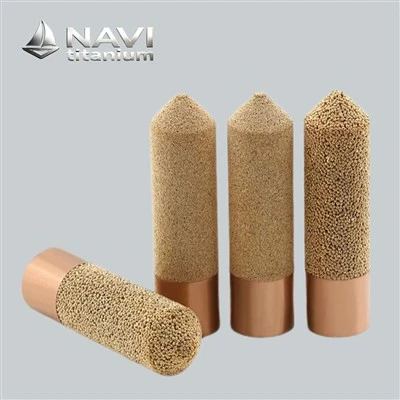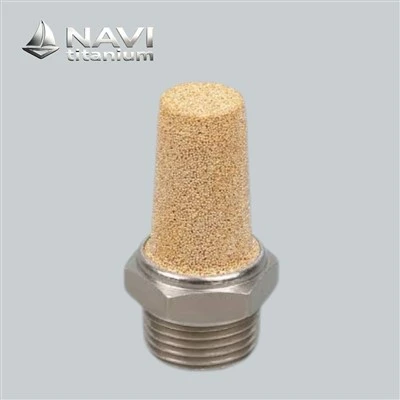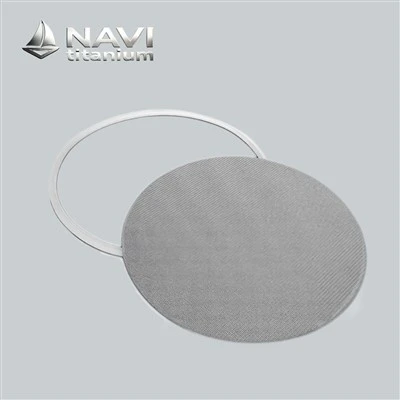


NAVI Titanium supplies sintered metal sheet for applications requiring controlled openings, clean surfaces, and consistent gas or liquid passage. Buyers can specify raw material grade, dimensional tolerance, surface finish, and opening range according to operating needs. Batch inspection covers dimensions, appearance, density, and air-flow performance, providing useful traceability for procurement teams. Custom sizing and sample evaluation are available before volume orders, helping customers confirm suitability without committing to large quantities.
Solution of NAVI Titanium
The sintered porous metal materials produced by NAVI Titanium are manufactured using a proven metal powder sintering process. These engineered open-cell components function as precision-grade substrates for demanding fields such as fluid purification, electrochemical devices, bioprocessing equipment, and elevated-temperature separation systems. Their interconnected channel architecture offers strong tolerance against acidic and alkaline media while maintaining suitability for healthcare-related environments. The controlled void network promotes in-situ cleaning capability and supports extended service cycles under challenging conditions involving corrosive fluids, elevated temperatures, and pressure variations. The following specifications and technical data are provided for product evaluation and reference purposes only:


NAVI Titanium presents a research-oriented view of a finely consolidated granular material, where particle bonding and controlled void formation determine gas passage, liquid distribution, and mechanical response. Microscopic observations reveal how grain size, compaction level, and thermal treatment alter the resulting physical characteristics.


Application
Sintered metal sheet has evolved from conventional powder metallurgy techniques into an engineered permeable platform featuring precisely tailored internal morphology. This distinctive architecture enables regulated fluid transmission, particulate capture, and mechanical reinforcement through its interconnected channels. Driven by ongoing engineering advancements, these components are increasingly adopted in Semiconductor & Electronics for ultra-clean filtration and precision assemblies, while Medical & Biomedical fields utilize them for implantable frameworks and regenerative solutions through adjustable pore configurations and favorable biological characteristics.
NAVI Titanium Sintered plate are widely utilized in semiconductor fabrication, electronic purification, and precision fluid handling applications where ultra-clean media management and chemical adaptability are critical. Representative products include Ti-based porous filters, diffusion membranes, and alloy support plates designed for high-purity gas treatment, semiconductor wet chemistry, and precision plating equipment. Typical specifications cover open volume ratios of 20–50%, filtration grades ranging from 0.5–100 μm, thickness dimensions of 0.5–5 mm, and geometry options tailored to equipment requirements. The interconnected channel network enables uniform fluid transmission while preserving mechanical robustness under challenging operating conditions. These components assist in particulate regulation, environmental consistency, and dependable operation across semiconductor production lines, photovoltaic manufacturing, and electronic chemical handling facilities.

medical & biomedical

In medical and biomedical engineering, open-cell implant platforms are utilized for orthopedic devices, filtration elements, and regenerative solutions requiring adjustable permeability and biological compatibility. Representative products include Ti-based implant components, bone integration frameworks, and precision permeable membranes fabricated through particle consolidation techniques. Typical specifications include open volume ratios of 30–60%, channel dimensions ranging from 50–500 μm, thickness ranges of 0.3–3 mm, and geometry options adapted to different clinical designs. The interconnected internal network creates favorable space for tissue attachment and bone integration while retaining lightweight mechanical characteristics and load-bearing capability. Due to the inherent biological affinity and physiological adaptability of Ti-based alloys, these engineered configurations are increasingly adopted in orthopedic reconstruction, dental restoration, surgical devices, and regenerative medicine platforms.
Purchasing guide

Quality control (QC)
Engineered as a flat, rigid panel with uniformly distributed porosity, this sintered metal sheet combines structural integrity with precise flow control for demanding filtration and separation duties. Every panel is supported by documented verification of thickness, density, and pore uniformity, ensuring complete traceability and material consistency. This rigorous quality assurance delivers dependable performance, extended service life, and compliance with strict industrial specifications. Well suited to chemical processing, polymer filtration, and high-temperature applications where flat, stable filtration media are essential. The outcome is a reliable, precisely specified sheet you can specify with full confidence.

Manufacturing Process
1. Flat-Layer Preparation
A carefully classified metallic feedstock is distributed evenly across a level work surface, creating a consistent layer suited to producing a broad, flat profile.
2. Controlled Compaction
The layer is compressed within a rectangular mold, with uniform force applied across the surface to retain straight edges, balanced density, and a stable sheet-like geometry.
3. Solid-State Bonding
The compact is placed in a controlled furnace cycle, allowing individual particles to bond at their contact points while preserving the interconnected openings throughout the flat structure.
4. Edge & Surface Refinement
After cooling, the broad panel is trimmed and leveled to achieve clean perimeter lines, consistent flatness, and accurate corner geometry. Subsequent sizing work prepares the sheet for cutting, mounting, or integration into filtration and flow-control assemblies.
Product Principle
Sintered metal sheet combines a precisely controlled interconnected pore network with excellent structural integrity to meet the stringent requirements of semiconductor and electronics manufacturing. Its homogeneous porous architecture enables uniform fluid distribution and deep particle retention, while the metallurgically bonded framework preserves pore geometry under chemically aggressive conditions. The all-metal inert construction minimizes material release and secondary contamination, supporting ultra-clean processing environments.
NAVI Titanium In semiconductor and electronic fabrication environments, open-cell filtration media serve as precision purification elements through their engineered three-dimensional internal architecture. The interconnected micro-channel network enables liquid and gas transmission across the full thickness, facilitating depth filtration rather than simple surface capture. Flow behavior can be tailored by adjusting particle characteristics, compaction pressure, and thermal bonding parameters, achieving a balanced relationship between permeability and contaminant retention. This internal separation mechanism gradually removes trace impurities, reduces localized blockage risks, and preserves uniform media movement during wafer-scale operations where submicron particles may influence device quality and production yield.

2. Stable Porous Framework for Corrosive Media

For semiconductor wet fabrication and electronic chemical handling environments, stainless alloy filtration elements must withstand aggressive acids, alkaline solutions, and ultra-clean process fluids while preserving their designed geometry. Typical examples include sintered stainless steel sheet and sintered bronze plate, which are selected for high-purity filtration tasks requiring controlled fluid transmission and reliable dimensional retention. Their integrated alloy framework retains internal channel arrangements through particle-to-particle metallurgical bonding, preventing deformation or collapse during prolonged service periods. Compared with polymer-based separation media, these rigid metallic architectures offer broader temperature adaptability, enhanced geometric preservation, and improved compatibility with chemically active conditions involving reactive compounds and high-purity fluid circulation.
The inorganic open-cell framework of advanced filtration components creates a clean media platform for semiconductor and electronic environments where contamination management is critical. Unlike polymer-based alternatives that may release extractable substances or generate aging by-products, this alloy-based architecture minimizes unwanted transfer when exposed to sensitive fluids over extended periods. The absence of additional surface treatments and bonded composite interfaces reduces possible contamination sources, while the consolidated metallic body preserves chemical purity and dimensional accuracy. These characteristics make thermally processed alloy components suitable for wafer-scale applications requiring strict regulation of particulate release, elemental migration, and manufacturing consistency.

Troubleshooting Support for Issues

When an unexpected voltage increase is observed, several operating factors can be reviewed together rather than assigning the issue to a single cause. Useful information may include current, electrolyte status, electrical connection, electrode spacing, and surface appearance. Comparing these records with the intended operating range can help determine which areas require further checking. For uneven electrochemical activity, the review may include active area, current distribution, electrode positioning, and electrolyte circulation. Differences in any of these areas may affect the observed output, so relevant operating records and visual observations are useful when assessing the situation.
Visible surface damage should also be reviewed from several angles. Relevant factors may include operating parameters, mechanical contact, cleaning method, and chemical exposure. Photos of the affected area, operating hours, current, voltage, temperature, electrolyte information, and the approximate time when the change appeared can provide additional reference. Rather than assuming that one factor is responsible, the available data can be compared with the specified operating range and previous operating records. This evaluation-based approach helps identify which factors may require closer inspection and whether further testing, installation checks, or specification review should be considered.

Product Development

NAVI Titanium develops open-cell alloy components specifically designed for semiconductor and electronic fabrication environments, where microscopic contaminants can significantly influence device yield and reliability. Through optimized particulate consolidation techniques and refined thermal bonding methods, the interconnected internal network enables uniform fluid transmission and depth-level separation rather than simple surface capture. This engineered pathway effectively removes fine particles while preserving consistent permeability during uninterrupted operation. The inorganic alloy framework also demonstrates strong compatibility with high-purity chemical media, supporting dependable use in filtration assemblies, gas transfer modules, chemical circulation units, and precision equipment requiring strict cleanliness standards.
Semiconductor fabrication frequently exposes filtration components to concentrated acids, alkaline solutions, oxidizing agents, and ultrapure chemical media, creating strict demands for separation reliability. NAVI Titanium responds to these challenges with metallurgically integrated alloy frameworks that retain internal channel geometry and mechanical integrity during extended contact with aggressive environments. Unlike polymer-based alternatives that may experience swelling, ageing, or contaminant release, this inorganic configuration minimizes unwanted migration and preserves dimensional precision. The combination of mechanical robustness, thermal endurance, and chemical adaptability helps regulate fluid handling conditions, reduce replacement frequency, and extend service intervals in high-value electronic manufacturing facilities.


NAVI Titanium develops sintered metal sheet based open-cell biomedical frameworks with precisely engineered pore dimensions, void distribution, and interconnected channels to meet the demanding needs of modern implant engineering. The three-dimensional internal network facilitates nutrient exchange and creates suitable conditions for cellular attachment and bone integration while retaining adequate load-bearing capability. By adjusting particulate characteristics and thermal bonding parameters, each implant-grade element can be tailored to specific clinical requirements, achieving a balanced combination of lightweight design, fluid permeability, and mechanical robustness. These characteristics make the resulting configurations suitable for implantable devices and next-generation regenerative medicine solutions.
Medical implants must preserve their mechanical integrity and biological compatibility throughout prolonged physiological exposure. NAVI Titanium develops open-cell implant frameworks from high-purity feedstock through refined fabrication routes that create uniform internal geometries and reliable metallurgical bonding. The absence of organic binders or polymer-based additives reduces the risk of degradation or unwanted release, while the chemically inert alloy framework retains dimensional precision under physiological conditions. Combined with strong chemical durability, mechanical resilience, and consistent fabrication quality, these engineered configurations offer dependable options for orthopedic reconstruction, dental restoration, surgical instruments, and emerging regenerative medicine applications.

FAQ
1. Can you provide an MTC and third-party inspection report?
+
-
Yes. An MTC can be supplied with each batch, recording traceable information such as heat number, batch reference, chemical composition, density, dimensions, and relevant physical data. If an independent verification is required, a qualified third-party laboratory can be appointed according to the buyer's request. Electronic copies may be shared for review before shipment.
2. Can you provide English technical documents and export paperwork?
+
-
Yes. English-language technical files and export documents are available for international orders. Commercial invoices, packing lists, MTCs, inspection records, and other requested paperwork can be prepared in English. Electronic copies can be sent before dispatch for buyer approval, while the finalized documents can accompany the shipment according to the agreed terms.
3. How are these granular products packaged for international shipping?
+
-
Packaging is selected according to dimensions, quantity, destination, and transportation method. Individual pieces can be protected with suitable wrapping before placement in cartons or wooden cases. Moisture-resistant protection and cushioning can also be added when necessary. Export packing is arranged to reduce abrasion, deformation, contamination, and movement during long-distance transportation.
4. How can I verify quality before placing a bulk order?
+
-
Buyers can request samples for visual inspection and application testing before confirming a larger order. Dimensional checks, density verification, surface examination, and relevant performance tests can be arranged according to the required specification. Sample approval can also be used as a reference standard for subsequent batches, giving purchasing teams a clearer basis for final confirmation.
5. Can the porous architecture be customized for different engineering requirements?
+
-
Yes. Key parameters including pore size, porosity, thickness, permeability, and overall geometry can be engineered according to specific operating conditions. By optimizing powder characteristics and sintering parameters, the internal architecture can be tailored for precise fluid transmission, mechanical support, or biological integration. This flexibility enables customized solutions for advanced semiconductor manufacturing, biomedical engineering, and other applications requiring controlled porous performance.
Hot Tags: sintered metal sheet, China sintered metal sheet manufacturers, suppliers, factory, Porous Metal Filter, Sintered Filter Plate, Sintered Metal Powder Filter, Sintered Stainless Steel, Sintered Steel Filter, Titanium Filter