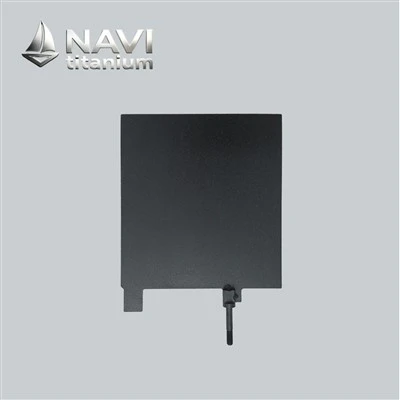


NAVI Titanium supplies titanium anode plate for electrochemical applications requiring consistent current distribution and dependable operation. Our service extends beyond supply: technical staff can assist with electrode inspection, coating condition assessment, cleaning and maintenance guidance, and replacement planning. For long-term projects, we help customers evaluate operating conditions and recommend suitable anode specifications to reduce avoidable downtime. From initial selection to after-sales support, NAVI Titanium provides practical technical assistance throughout the service life of the anode.
Solution of NAVI Titanium
MMO coated anode plates are designed by integrating a metallic substrate with a specialized surface layer to form a complete functional electrode structure. The specification table below provides essential product parameters, including structural dimensions, material configuration, and customization options, helping customers evaluate product suitability and select the appropriate solution according to different installation environments, system designs, and service requirements.


NAVI Titanium supplies application-focused coated electrodes for demanding electrochemical processes, with material combinations selected according to operating chemistry and service requirements. Our production capabilities cover flat forms and other customized configurations, allowing the electrode body and surface treatment to be adapted to different installation environments. Each order can be supported by technical evaluation, coating selection, substrate preparation, and finishing control.


Application
Titanium anode plate from NAVI Titanium are components made from high-grade titanium with functional surface coatings. They serve as a conductive and active platform that supports electrical conversion processes without being consumed during operation. They are applied in electroplating lines, electrochemical metal recovery and cathodic protection. Their structure and coating design allow NAVI Titanium to provide consistent performance under demanding operating conditions, making them a key element in modern electrochemical equipment across multiple engineering applications.
For PCB fabrication and semiconductor component production, platinum coated plates serve as specialized electrode components in advanced metal finishing systems. The structure combines a Grade 2 metal base with a dense 0.5–2.5 μm platinum layer, creating a refined surface suitable for demanding manufacturing environments. During operation, the plate supports controlled metal deposition processes where surface quality, dimensional accuracy, and equipment compatibility are critical factors. With thicknesses ranging from 0.8–2.0 mm, these plates are designed for fine circuit manufacturing and electronic component processing, meeting the requirements of high-value production systems with strict material and structural standards.

2.Electrochemical Metal Recovery

For valuable metal recovery from industrial waste streams, NAVI Titanium MMO coated plates featuring an IrO₂–Ta₂O₅/TiO₂ system are designed as key components in specialized recovery equipment. The structure incorporates a Grade 1 metal foundation with a 3–10 μm mixed metal oxide functional layer, providing a suitable surface design for demanding processing environments. These plates support controlled metal extraction procedures, including the recovery of non-ferrous resources from residues and mining-related materials. Standard configurations include thicknesses ranging from 1.5–3.0 mm, with plate dimensions engineered to match different equipment structures, production requirements, and NAVI Titanium system integration conditions.
Purchasing guide

Quality control(QC)
Formed as a flat, uniform sheet with a catalytically active oxide layer, this plate-style anode provides stable current output and even potential distribution across its entire working surface. Its planar geometry suits close-proximity installations, simplifies mounting, and supports consistent coating adhesion under repeated polarization. Every lot is supported by documented verification of sheet thickness, coating loading, and surface flatness for complete material traceability.
| Certificate of Analysis | ||
| Titanium Base Material Suppliers: | Coating Precursor Suppliers: | COA of product: |
|
|
|
|


Manufacturing process
For a flat-plate electrode, production begins with cutting the titanium substrate into a clean, even sheet, followed by edge deburring and controlled surface preparation. Particular attention is given to the plate's flatness, edge profile, and contact areas because these features influence installation and current distribution inside the electrolytic cell. The prepared sheet then receives an electrocatalytic oxide layer through repeated application and curing cycles, allowing the active deposit to build uniformly across the broad working face. Areas around holes, slots, corners, and mounting points are treated carefully to avoid uneven coverage. After curing, the plate is gently cleaned and checked for coating continuity, dimensional conformity, electrical contact, and visual defects. The completed electrode can then be fitted with drilled holes, threaded sections, tabs, or other connection details according to the cell configuration.


Product history
1. Emergence of ICCP Systems: The Beginning of Titanium Anode Plate Technology
The emergence of ICCP technology was driven by the growing need for advanced protection methods in marine vessels, offshore facilities, and underwater metal structures. Early designs combined external power sources with specially developed electrode components to replace conventional consumable materials. NAVI Titanium metal-based plate electrodes gradually gained recognition because of their suitable structural characteristics and compatibility with seawater environments. During this initial period, engineers concentrated on building fundamental system frameworks, including control equipment, reference monitoring devices, and protective components for submerged structures.
2. Initial Standardization of ICCP Systems: Formation of Technical Specifications
As marine engineering projects continued to grow, ICCP technology gradually moved toward a more standardized development phase. Manufacturers established clearer specifications for plate dimensions, surface treatment systems, output requirements, and installation arrangements. MMO coated plate electrodes became an important configuration for seawater protection projects due to their suitability in marine environments. Engineering experience contributed to improved design methods for determining component quantities, positioning strategies, and control settings, enabling ICCP solutions to transition from project-specific designs into standardized protection systems for vessels, offshore structures, and harbor facilities.
3. Engineering Standardization and Advanced ICCP
Development: MMO Technology Advancement, Platinum Coated Solutions, and Distributed Plate Protection Systems
Modern ICCP technology has progressed toward more advanced engineering solutions with improved plate-based protection designs. NAVI Titanium MMO coated electrode technology has achieved greater maturity through refined surface formulations, material processing, and structural optimization. Meanwhile, platinum coated electrode solutions have been introduced into specialized fields that require enhanced output capability, compact configurations, and demanding marine environments. The latest generation of ICCP systems incorporates distributed plate arrangements, where multiple protection elements are strategically positioned to provide comprehensive management for large vessels, offshore facilities, and complex submerged structures. NAVI Titanium supports these evolving approaches through its electrode manufacturing capabilities.
Application
Plate-type titanium electrodes are commonly incorporated into buried pipeline protection networks, functioning as important elements in deep well ground beds, shallow buried structures, and distributed protection arrangements. Their configuration is determined by pipeline dimensions, soil characteristics, external coating conditions, and structural factors. Different plate sizes, connection designs, and installation methods allow integration with oil transmission lines, gas pipelines, water supply systems, and underground utilities, while supporting modern protection solutions equipped with remote supervision and intelligent control functions.
In buried pipeline protection projects, plate electrodes are integrated into ICCP networks as key elements for controlling protection zones across underground infrastructure. The system configuration relies on the coordination of power supply equipment, reference monitoring devices, and buried protection stations. For large pipeline routes, engineers evaluate factors including soil composition, pipeline distance, external coating condition, installation depth, and maintenance planning. These plate components are commonly positioned in deep well ground beds, shallow buried arrangements, or distributed protection locations, supporting oil transportation lines, gas networks, water supply facilities, and underground utility systems.


With the advancement of smart infrastructure, ICCP pipeline solutions have increasingly adopted remote supervision and automated control functions. The configuration of plate electrodes is determined by pipeline routing, geological characteristics, and specific protection objectives. Multiple protection stations can be positioned along extensive pipeline networks to manage different sections and reduce areas lacking adequate coverage. Engineering designs may involve adjustments to plate dimensions, connection arrangements, installation methods, and system capacity, enabling protection strategies to suit various environments, including coastal zones, urban underground facilities, and challenging soil conditions.
Second-Source Support
A secondary supply channel gives purchasing teams an alternative when one supplier faces capacity limitations, extended lead times, unexpected supply interruption, or sudden order increases. NAVI Titanium can review existing drawings, dimensions, quantities, surface requirements, and operating specifications to assess whether a comparable electrode group can be prepared. This option is particularly useful for buyers seeking to reduce dependence on a single source while keeping purchasing specifications consistent. It can also provide additional leverage when reviewing unit costs, order quantities, and delivery schedules, helping purchasing teams respond to price pressure without immediately changing the entire sourcing plan.

Emergency Replacement & Capacity Backup

Second-source support is also useful when an urgent replacement is required or the primary supplier cannot meet the requested schedule. Buyers can provide previous drawings, reference samples, photographs, dimensional data, or existing specifications for review. Based on the available information, the required configuration, quantity, and delivery target can be assessed before quotation and order confirmation. For recurring orders, maintaining a secondary source can also provide additional capacity during peak demand, unexpected shortages, or short-notice purchasing. This approach gives procurement teams a practical backup channel without requiring them to rely entirely on a new specification or completely different purchasing route.
Product development
In ICCP solutions, nano-scale surface engineering provides an effective approach for optimizing the cost structure of electrode components. By accurately controlling material formulation, precious metal usage, and layer thickness at the microscopic scale, manufacturers can improve resource utilization while meeting required service expectations. Advanced manufacturing methods help reduce material waste and enhance production value. NAVI Titanium combines refined coating technologies with advanced manufacturing expertise to develop economical electrode solutions, supporting customers in achieving a balanced relationship between investment requirements and project objectives.


From a technical engineering viewpoint, nano-scale surface optimization contributes to lowering maintenance demands during the service period of ICCP projects. Improved surface treatment methods enable manufacturers to develop titanium anode plate solutions according to seawater environments, soil conditions, and structural factors. By integrating advanced preparation techniques with controlled production procedures, these plates can achieve a practical balance between material costs, service expectations, and overall project investment. This approach offers a valuable solution for creating economical protection systems across different infrastructure sectors.
FAQ
1. How Can the Electrode Surface Be Maintained in Marine and Hydrometallurgical Environments?
+
-
Long-term exposure to seawater, mineral-bearing liquids, or aggressive electrolytes can cause deposits to accumulate on the working surface and may gradually affect electrochemical behavior. Regular visual inspection should therefore focus on salt deposits, mineral buildup, discoloration, scratches, or localized surface changes. Cleaning should follow the chemistry of the operating medium and avoid methods that could damage the functional surface.
2. What should be checked on a used electrode before deciding whether to reuse or replace it?
+
-
A used unit should first be examined for surface discoloration, deposits, scratches, edge damage, exposed base material, and areas where the functional surface has deteriorated. The connection points and mounting areas should also be checked for corrosion or mechanical damage. If deposits are present, cleaning should be considered before making a replacement decision. After cleaning, the surface condition can be reassessed to determine whether continued service is practical. For severely damaged or heavily worn units, replacement is generally preferable to continued use, particularly when unexpected shutdowns could affect the process.
3. What factors should be considered when selecting an anode plate for an ICCP project?
+
-
The selection of an anode plate depends on multiple engineering factors, including the size of the protected structure, installation environment, surrounding medium, system design requirements, and expected service conditions. Engineers usually evaluate plate dimensions, installation method, connection configuration, and layout planning to ensure the anode unit matches the requirements of ships, offshore structures, underground pipelines, and other protection systems.
4. Where are anode plates commonly used in ICCP protection systems?
+
-
Anode plates are commonly integrated into protection systems for marine vessels, offshore platforms, buried pipelines, harbor facilities, and large underground structures. According to different project conditions, they can be installed in seawater environments, deep well structures, shallow buried systems, or distributed protection networks. Their configuration can be customized according to structural dimensions, environmental factors, and system design requirements.
5. How can anode plate solutions help optimize ICCP project costs?
+
-
Anode plate solutions contribute to overall project cost control through optimized structural design, customized configuration, and improved material utilization. For large-scale protection projects, proper selection of plate size, installation layout, and system integration method can reduce unnecessary investment and simplify maintenance planning. Customized designs allow engineers to achieve a balance between initial construction costs and future service requirements.
Hot Tags: titanium anode plate, China titanium anode plate manufacturers, suppliers, factory, DSA Electrode, Mixed Metal Oxide Anodes, Platinized Titanium Anode, Platinized Titanium Mesh Anode, Platinum Titanium Electrode, Titanium Electrodes for Electrolysis