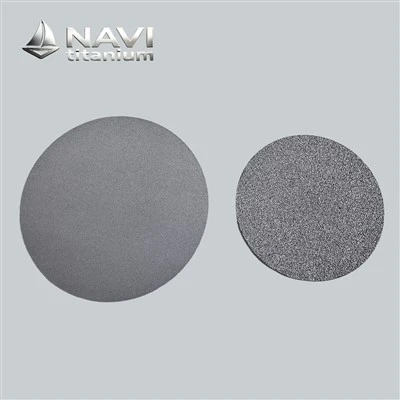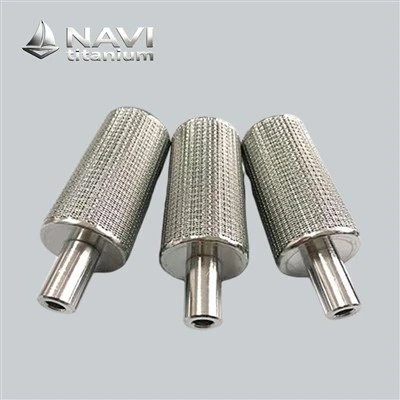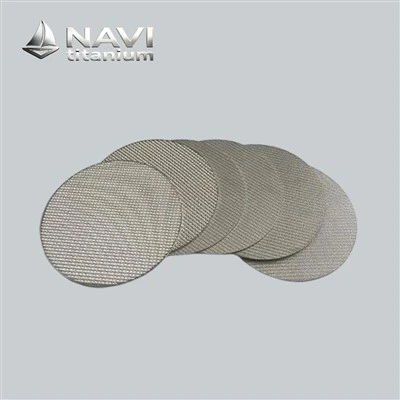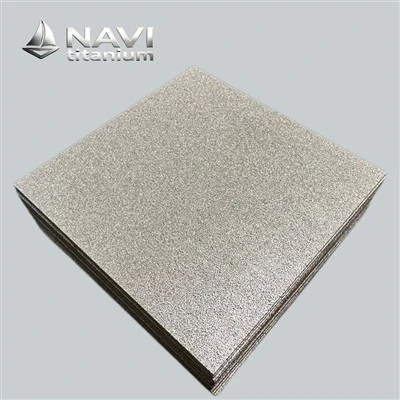

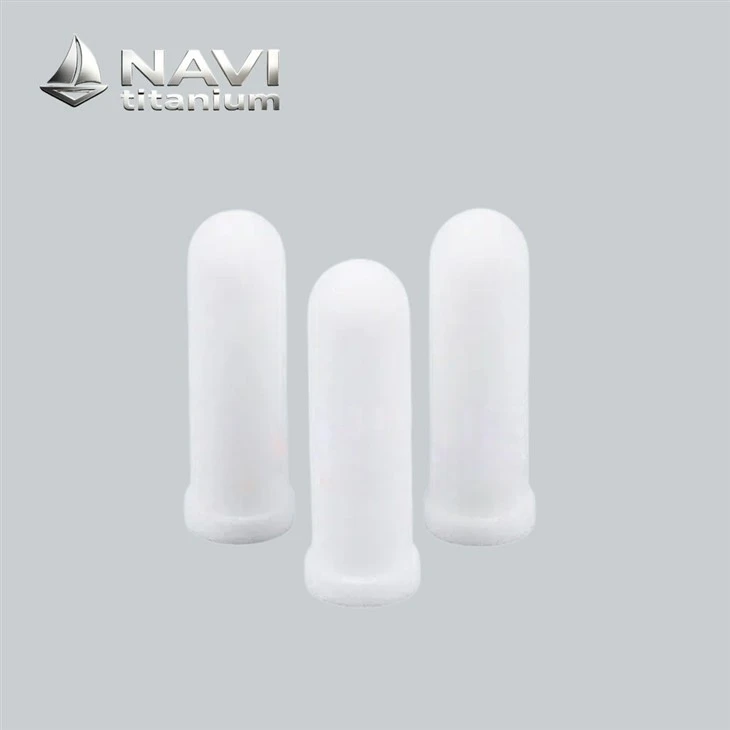
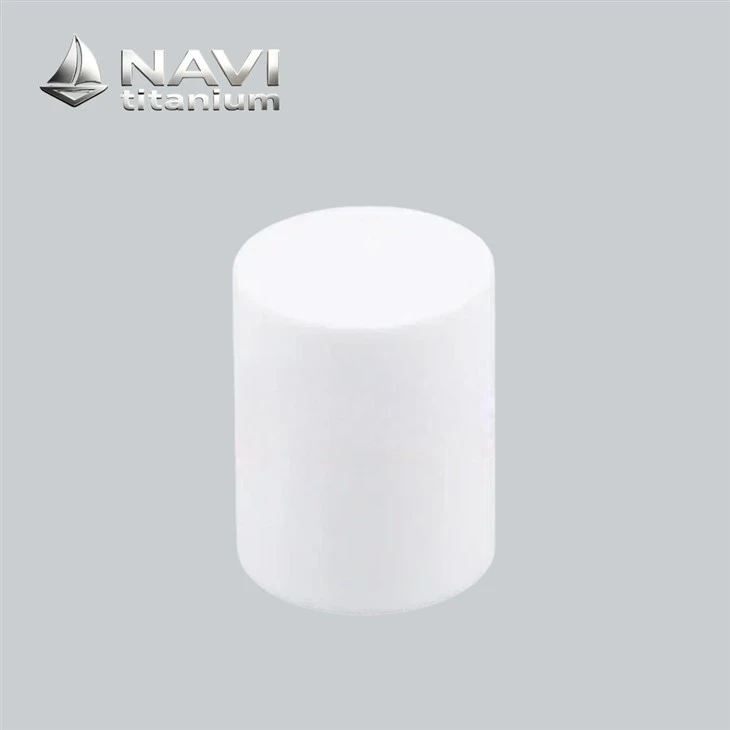
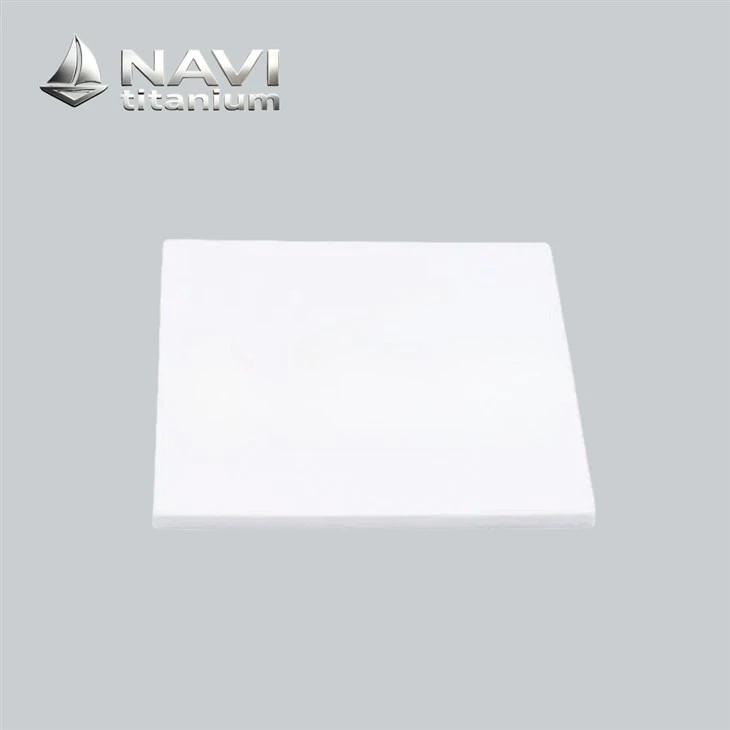
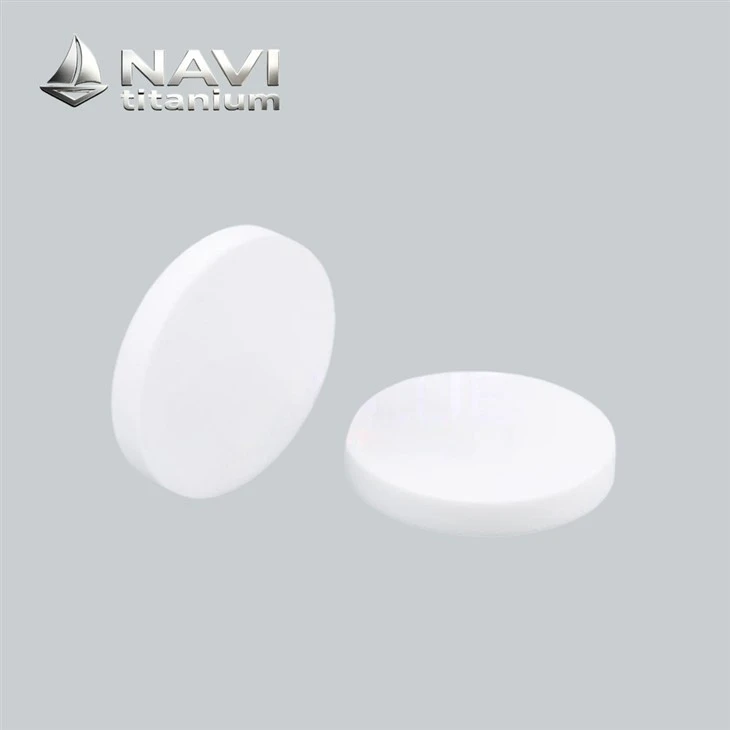
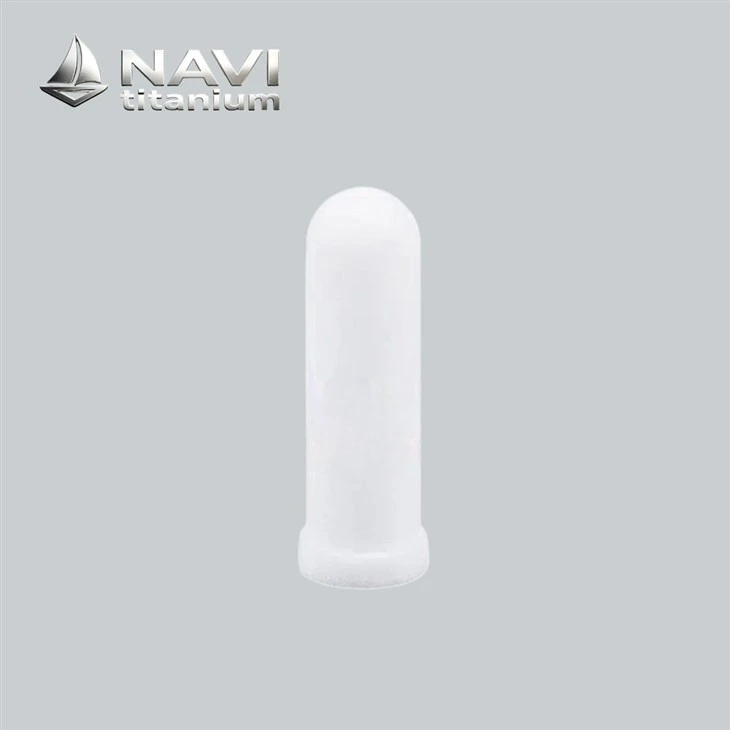
NAVI Titanium's sintered PE filter is a rigid, self-supporting porous element moulded from ultrahigh-molecular-weight polyethylene powder, whose interconnected pore channels capture particles across the wall thickness without any binder or adhesive. Commercially, we deliver what maintenance managers budget for: roughly half the freight weight of metal equivalents, no metal ion pickup that can shift product taste or colour, quiet fit inside plastic and lined housings, and a unit price that makes scheduled replacement painless rather than a capital decision.
Solution of NAVI Titanium
NAVI Titanium builds these porous bodies through a proven sintering route: graded powder is compacted and bonded grain to grain, leaving uniform, controllable pore channels and no binder residue to contaminate your product. The result tolerates most acids, alkalis and salt solutions, stays dimensionally stable under pressure, meets food-contact expectations, and accepts in-situ regeneration by backwash or chemical rinse. Share your working micron, permeability and flow: we will tune grade, wall and geometry accordingly.


NAVI Titanium moulds PE media as straight tubes, closed-end candles, flat discs, threaded bosses, bayonet caps and stepped multi-diameter bodies. Send a drawing or STEP file: we shape it to your housing, tank bottom or vessel internals while pore grade and wall integrity stay unchanged, then ship prototype samples before any tooling. Low tooling cost keeps short runs economical, too.


Application
Two questions decide whether PE beats metal: how aggressive is the chemistry, and how hot does it get. When it is corrosive and cool, polymer usually wins. Across liquid clarification, tank venting and powder recovery, NAVI Titanium PE elements win where stainless corrodes, costs too much or simply weighs too much. Pharmaceutical clarification and beverage-grade water show the difference best.
Pharmaceutical Liquid Clarification
Pharmaceutical clarification is usually the dirtiest step nobody plans for: after decolourisation, a stream loaded with spent activated carbon, catalyst fines and colloidal haze arrives at the polish stage. Because NAVI Titanium sintered PE filter in depth rather than on the surface, it holds far more cake per unit volume than a pleated element of the same footprint, which means fewer change-outs inside a campaign. The polymer is chemically inert in the pH range most oral liquids, syrup bases and intermediate washes occupy, and it releases no metal ion that could complicate an impurity profile. Every lot can ship with lot-traceable extractables data and supporting statements referenced to food-contact and pharmacopoeial expectations, so validation teams get documentation instead of assurances. A spent element lifts out by hand, so change-outs finish faster and housings stay unscratched. Element cost stays low enough that most plants replace the bank rather than validate cleaning.


Food, Beverage & Drinking Water
Bottling plants, breweries and municipal skids have one requirement chemical engineers often overlook: taste neutrality. Stainless is excellent until a chloride-rich CIP cycle or a low-pH juice line starts etching it; NAVI Titanium PE filters simply ignore most acids, alkalis and cleaning salts used there, adding no metallic note and no rust carryover into product contact downstream. Typical duties include polishing water ahead of reverse osmosis, filtering syrup and edible oil, clarifying wine and beer, catching carbon fines from dosing systems, and protecting filling nozzles from scale and sand. The low density of polyethylene also matters on the logistics side: a carton of PE elements costs a fraction to air-freight compared with the same count in steel, which distributors notice immediately. Grade changes are handled by swapping the whole element set between runs, so there is no cross-contamination risk between batches. That freight saving alone often justifies switching to polymer.
Purchasing guide

Quality control (QC)
Every sintered PE filter leaving NAVI Titanium's ISO 9001 certified facility ships with documentation you can trace. Each resin lot and production batch is logged, then verified for pore grade, dimensions, weight, visual standard, extractables and food-contact declaration. Please click the button below to review our sample certificates of analysis and inspection reports. Batch copies travel with every order.

Manufacturing Process
Our sintered PE (Polyethylene) filters are produced through a strict standardized powder sintering process, with precise control over raw material grading, compression molding, constant-temperature sintering and post-treatment. The whole procedure ensures uniform open-pore structure, stable filtration accuracy, excellent chemical resistance and consistent batch quality for industrial filtration applications.
1. High-purity PE Powder Preparation & Screening
We adopt high-molecular-weight polyethylene raw materials with high purity and stable particle activity. All PE powders are strictly sieved, cleaned and classified according to different filtration precision requirements. Uniform particle size distribution guarantees consistent pore size, permeability and filtration efficiency of the final filter products, avoiding pore blockage and uneven flow rate caused by irregular powder particles.
2. Precision Mold Filling & Compression Forming
Qualified PE powder is quantitatively filled into customized precision molds for disc, plate and tube shapes. Adopting balanced cold pressing and hot pressing technology, the powder is compacted evenly under controlled pressure to form a integrated and smooth green body. This step stabilizes the original pore structure and ensures uniform density without internal gaps or loose layers.

3. Constant-temperature Thermal Sintering
The molded PE green bodies are sent to professional sintering furnaces for segmented low-temperature sintering. Under strictly controlled temperature and stable atmosphere, PE particle surfaces soften and fuse tightly at contact points without full melting.
The particles retain their original skeleton while forming uniform, interconnected open pores. This core process endows the filter with rigid structural strength, stable porosity and excellent integral molding performance.
4. Precision Trimming & Shaping
After sintering and natural cooling, finished blanks undergo fine trimming, deburring, cutting and dimension calibration. We remove surface excess materials and polish edges to ensure flatness, dimensional tolerance and assembly accuracy of PE filter discs, plates and tubes. All finished parts maintain smooth surface and no residual particles.

Cleaning, Inspection & Finished Packaging: Each batch of sintered PE filters goes through high-pressure cleaning and dust removal to eliminate residual powder inside pores. Strict full-inspection procedures cover pore size uniformity, air permeability, structural strength and appearance defects. Only qualified products are vacuum-packed and stored, ensuring zero impurity, high cleanness and long-term stable service performance for industrial filtration, chemical separation, liquid and gas purification scenarios.
How to Select: Sparger Types & Filter Materials
Choosing NAVI Titanium sintered PE filter is rarely about the best datasheet; it is about which failure mode you can live with. The table compares sintered PE with three alternatives for the same duty, including our own stainless line, across chemistry, temperature, weight and annual spend. We left the metal column in deliberately: PE is not the answer everywhere. Typical values, reference only.
Sintered PE vs Alternative Filter Media
|
Item |
NAVI Titanium Sintered PE |
Sintered SS 316L |
Pleated PP Cartridge |
Ceramic Element |
|
Purchase-cost index per element* |
1.0 (baseline) |
4.5 – 7.0 |
0.5 – 0.8 |
3.0 – 5.0 |
|
Typical service life |
8 – 24 months |
2 – 5 years |
1 – 8 weeks |
12 – 24 months |
|
Max. continuous temperature |
80 °C |
400 – 600 °C |
60 – 80 °C |
800 – 1000 °C |
|
Weight per unit volume |
Very light, floats |
Heavy |
Very light |
Heavy, fragile |
|
Resistance to acids / alkalis |
Excellent across most acids and alkalis |
Good except halides |
Moderate |
Excellent except HF |
|
Weak point |
Strong oxidants, chlorinated solvents, steam |
Chloride pitting |
Temperature, pleat collapse |
Thermal shock, breakage |
|
Steam sterilisation |
Not suitable |
Suitable |
Not suitable |
Suitable |
|
Metal ion release |
None |
Trace if passivation is poor |
None |
Trace depending on binder phase |
|
Typical annual cost incl. labour index* |
1.0 (baseline) |
2.5 – 4.0 |
3.5 – 6.0 |
3.0 – 4.5 |
*Index normalised to NAVI Titanium sintered PE, based on a continuous-duty low-temperature line. Reference only.
Chemical Compatibility of NAVI Titanium PE Media
|
Medium |
Rating at 25 °C |
Rating at 60 °C |
Note |
|
Hydrochloric acid ≤ 30% |
Excellent |
Good |
Widely used in pickling-line pre-filtration |
|
Sulphuric acid ≤ 50% |
Excellent |
Good |
Above 70% consult us first |
|
Sodium hydroxide ≤ 40% |
Excellent |
Excellent |
Common in CIP caustic circulation |
|
Ethanol, glycol, glycerol |
Excellent |
Good |
No measurable swelling |
|
Mineral oil, vegetable oil |
Good |
Good |
Slight swelling acceptable for most duties |
|
Nitric acid ≥ 30% |
Avoid |
Avoid |
Strong oxidiser attacks polyethylene |
|
Chlorinated solvents, aromatics |
Avoid |
Avoid |
Swelling and stress cracking |
|
Free chlorine / ozone above 5 ppm |
Fair |
Poor |
Shortens service life; monitor oxidation |
NAVI Titanium - Where PE Filters Earned Their Repeat Orders
At NAVI Titanium, our sintered PE filter and titanium PI filter lines build lasting client loyalty through consistent, application-matched filtration performance that eliminates costly mid-production failures. Unlike generic polymer filters prone to swelling, pore deformation or early clogging in mildly corrosive aqueous streams, our precision-sintered PE elements feature uniformly controlled micropores from 0.5μm to 100μm, delivering stable flow rates and reliable particle retention for electroplating liquids, food syrup clarification and pharmaceutical pre-filtration. Every filter undergoes bubble point and compressive strength testing before shipment to guarantee batch-to-batch consistency, removing the guesswork engineers face with inconsistent off-brand alternatives. Clients immediately notice fewer unplanned shutdowns, extended service cycles between cleaning and zero media shedding that ruins high-value process materials. This rock-solid operational stability becomes the core reason industrial facilities place recurring bulk orders, as predictable filtration directly safeguards their production yield and bottom-line profitability year after year.


NAVI Titanium's dual material portfolio-cost-effective sintered PE paired with heavy-duty porous titanium PI filters-solves the full spectrum of harsh industrial filtration demands, a versatile advantage competitors cannot match, driving steady repeat purchasing across chemical, water treatment and hydrometallurgy sectors. Sintered PE serves mild acid, alkali and low-temperature workflows with FDA-compliant, reusable media affordable for high-consumption routine filtration tasks. When processes involve strong oxidizers, high temperatures or chloride-rich brines where PE softens and degrades, our sintered titanium PI filters step in, boasting self-healing passive oxide layers that resist severe corrosion and withstand temperatures up to 300°C. Our engineering team delivers free custom dimensioning, pore tuning and end-cap modification tailored to each client's existing filter housing. Customers value this one-stop sourcing capability, eliminating the hassle of coordinating multiple suppliers for mixed-process filtration lines and simplifying procurement to a single trusted partner for all filter replenishment needs.
Long-term lifecycle value and responsive global after-sales support cement NAVI Titanium's repeat-order reputation among filtration plant operators worldwide, turning one-time trial purchases into multi-year supply contracts. Our sintered PE filter and titanium PI filters support repeated regeneration via backwashing, ultrasonic washing and chemical soaking, slashing annual consumable spending by cutting replacement frequency compared to disposable filter media. We maintain robust stock of standard filter cartridges and discs for fast 7–15 day lead times, while dedicated technical specialists provide 24/7 remote troubleshooting to minimize client production downtime during filter maintenance or system adjustment. Full material certification, ISO 9001 quality documentation and transparent bulk pricing further reduce procurement administrative burdens. Plant managers consistently return to NAVI Titanium because we deliver more than filter components-we deliver dependable, cost-saving filtration solutions backed by consistent quality and attentive service they cannot secure from competing manufacturers.

FAQ
Our line uses solvents and oxidising agents. Will PE survive?
+
-
It depends entirely on which ones. The media is comfortable with most inorganic acids, alkalis and alcohols, including hydrochloric and sulphuric acid at process concentrations, plus caustic cleaning solutions. It is not comfortable with concentrated nitric or chromic acid, aromatic hydrocarbons, ketones of low molecular weight, or chlorinated solvents such as trichloroethylene, all of which swell or attack the polymer. Send us your full medium list with concentrations and temperature, and our engineers will mark each line safe, limited or prohibited.
How do I pick the right micron grade, and how many units do I need?
+
-
Start from the particle you must remove, not from the finest number available. Choosing one grade finer than necessary doubles pressure drop for no quality gain. Tell us flow rate, fluid viscosity and target throughput, and we calculates the filtration area required, then converts it into element count and housing length. As a working rule, doubling area roughly halves initial differential pressure and doubles the interval between washes. We happily review existing installations where consumers complain about short cycles.
Can the element handle thermal or steam sterilisation?
+
-
No, and we prefer to say so early. Polyethylene softens long before autoclave temperatures, so our PE media is rated for 80 °C continuous duty with short excursions to 100 °C. Hot water below that limit is fine; steam is not. If your process requires SIP or autoclaving cycles, ask instead for PVDF or stainless variants, which we also produce. Several customers split the duty: polymer elements on ambient streams, metal elements wherever steam enters the picture.
Can we trial before ordering, and what is the minimum quantity?
+
-
Yes. We ship sample elements in two or three adjacent grades so you can compare cycles side by side on your own line rather than trusting a datasheet. There is no minimum for stocked sizes, and mixed quantities are fine: distributors routinely combine several grades, lengths and end fittings in one carton or container to test their market. Custom geometry from a drawing carries a small tooling charge, quoted before any work starts and refunded against subsequent volume orders.
Any precautions during installation, and how is spent media disposed of?
+
-
Seat the element by hand first; a strap wrench torque beyond finger tight deforms the seating face and nothing else is required. Never lever against the porous body. Because these filters are light and do not shatter like ceramic, change-out needs one operator and no lifting gear. Spent elements carry process residue, so disposal follows your local rule for that residue; where the contamination permits, polyethylene itself incinerates cleanly or enters polyolefin recycling streams, unlike resin-bonded composites.
Hot Tags: sintered pe filter, China sintered pe filter manufacturers, suppliers, factory, high porosity polyethylene filter, sintered plastic filter element, sintered polyethylene filter sheet, sintered polypropylene filter cartridge, sintered porous plastic filter plate, sintered PTFE filter plate