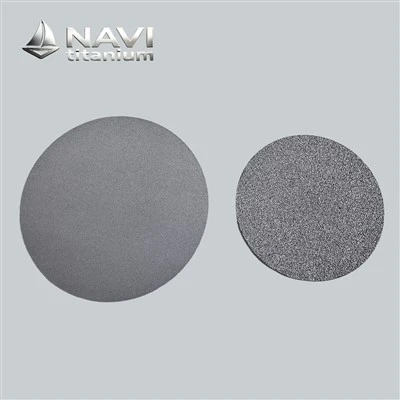


NAVI Titanium provides sintered components for specialized applications, featuring carefully prepared forms and application-oriented specifications. The company operates a dedicated base in Baoji, where specialized workshops maintain organized processing areas and professional facilities. Multiple forming lines, thermal systems, and inspection instruments assist daily operations from raw material preparation to final assessment. Experienced teams preserve detailed records, project information, and quality documents, allowing international buyers to understand factory capability, production capacity, and long-term cooperation potential.
Solution of NAVI Titanium
For industrial components requiring controlled material structure, dimensional consistency, corrosion resistance, and stable performance, NAVI Titanium combines laboratory evaluation with production-scale processing. Five hot-air circulation trolley furnaces, two 4,500-ton hydraulic presses, more than 10,000 sets of electrocatalytic oxidation equipment, and over 60 additional processing units cover forming, thermal treatment, surface preparation, machining, and inspection sourcing criteria. The quality system is further supported by spectrometers, universal testing machines, metallographic microscopes, ultrasonic flaw detectors, and coordinate measuring equipment.
From an order-management perspective, engineering, production, inspection, and sales personnel coordinate specifications, drawings, production schedules, inspection sourcing criteria, and delivery documentation. For repeat purchasing, previously confirmed technical information can be retained as a reference, reducing unnecessary specification changes between batches.


NAVI Titanium applies controlled particulate consolidation to obtain functional bodies with tailored density, interconnected void geometry, and application-specific mechanical characteristics.


Bespoke Application Calibration
NAVI Titanium provides custom sintered components with tailored specifications and specialized production capabilities, helping global buyers achieve application-specific performance requirements through controlled characteristics, consistent quality records, and professional customization support.
Custom fabrication of these specialized units at NAVI Titanium focuses on matching individual project sourcing criteria through controlled dimensions, material selection, connection methods, and functional targets. Each request may involve unique shapes, installation spaces, operating ranges, or interface preferences, requiring careful evaluation before production begins. Custom orders allow purchasers to obtain items that fit specific application scenarios rather than selecting from fixed standard options. Technical discussions usually include drawings, sample references, usage conditions, and expected service goals. This approach helps establish clear communication between suppliers and buyers during the entire cooperation cycle. For international purchasers, customized supply also reduces adaptation issues during assembly, substitute planning, and long-term procurement. A professional supplier should maintain complete records of specifications, inspection data, and order history, allowing repeated purchases to follow the original sourcing criteria. Such capability is especially valuable for projects involving specialized machinery, laboratory systems, process lines, and customized industrial applications where consistency and traceability are essential.

2. Functional Characteristics in Specialized Production Fields

The unique formation method behind these items at NAVI Titanium creates a controlled internal arrangement that can be adjusted according to different application needs. Variations in opening size, thickness, shape, and overall geometry affect flow behavior, pressure response, heat transfer, and mechanical performance. Because every application has different operating demands, selection requires a thorough understanding of physical properties and service environments. These units are commonly considered for separation tasks, sound reduction devices, gas distribution systems, thermal processes, and specialized assemblies requiring controlled passage characteristics. Their adaptability allows purchasers to evaluate factors such as cleaning methods, substitute cycles, installation compatibility, and operating efficiency before final approval. From an international procurement perspective, attention to raw material records, dimensional verification, and quality documentation helps maintain consistent results across different orders. The combination of customized parameters and specialized production knowledge makes these items suitable for demanding applications where standard options cannot fully satisfy project expectations.
Purchasing guide

Quality control (QC)
NAVI Titanium incorporates batch-level inspection records into the quality management of sintered components, giving purchasers a traceable reference for each production lot. The documentation can cover material identification, dimensional verification, density, permeability, surface condition, mechanical characteristics, and other project-specific checkpoints according to the component design and intended service environment.

Manufacturing Process
Feedstock Preparation & Classification
Selected alloy feedstock is screened and classified according to particle-size distribution and application requirements. Chemical composition, particle morphology, and cleanliness are reviewed before forming to establish a stable starting condition.
01
Mold Filling & Compaction
The prepared feedstock is accurately distributed into dedicated tooling and compacted under controlled force. Filling density, component geometry, and compaction uniformity are managed together to reduce dimensional variation and preserve the intended internal structure.
02
Controlled Thermal Consolidation
The formed body undergoes a programmed heating cycle under carefully regulated atmosphere and temperature conditions. Adjacent particles bond progressively while the designed internal passages remain functional. Heating rate, holding period, and cooling sequence are adjusted according to alloy characteristics and component geometry.
03
Sizing, Machining & Final Inspection
After thermal treatment, critical dimensions can be corrected through sizing or precision machining. Edges, mounting interfaces, thickness, flatness, and other drawing-specific features are subsequently inspected. Functional checks may also be incorporated where flow behavior, density, permeability, or mechanical performance is relevant.
04
Repeat Orders
Long-term procurement of sintered components depends on more than the first delivery. NAVI Titanium retains key information associated with confirmed orders, including dimensional sourcing criteria, material grades, connection details, drawing versions, approved samples, batch identification, and inspection records. This historical reference gives procurement representative a defined basis for future purchasing instead of restarting technical communication from the beginning. When the same specification is requested again, previous records can be consulted to verify critical details before a new production cycle is arranged. Drawing preservation is particularly useful when purchasing teams change, original files become difficult to locate, or several similar variants have entered service. Batch references also help trace earlier supply information when procurement representative need to investigate differences between earlier and later deliveries. For companies managing multiple installations, retained specifications simplify internal purchasing communication and reduce the possibility of ordering an unsuitable variant. The objective is continuity: the original sourcing criteria remain identifiable even when considerable time has passed between individual orders.

Replacement Matching Years Later

Replacement demand often appears long after the original installation, particularly when machinery remains in service for many years or the original supplier has stopped offering a particular item. NAVI Titanium can review earlier drawings, dimensional data, production notes, and historical order information when procurement representative request repeat supply or discontinued-model substitutes. Instead of relying solely on a current catalogue description, the purchasing team can compare the requested item against archived specifications and clarify any differences before production begins. This approach is valuable when an old unit must be reproduced for an existing installation, when several generations of machinery use slightly different dimensions, or when an original reference number is no longer available. Repeat orders can therefore follow an established information trail, covering quantity, geometry, connection format, material selection, and applicable inspection requirements. For overseas buyers, this continuity can simplify communication between procurement, maintenance, and technical departments. The practical goal is straightforward: a specification confirmed today should remain traceable enough to facilitate an accurate substitute order years later.
Non-Standard Geometry
Non-standard geometry becomes important when a component must fit an existing machine rather than follow a catalog dimension. NAVI Titanium can work from customer drawings, dimensional sketches, sample references, or defined interface sourcing criteria when an irregular profile is required. Typical configurations include stepped sections, recessed areas, raised sections, concentric forms, offset openings, asymmetric outlines, and multi-level profiles. Thin-wall sections and complex cross-sections can also be considered where available installation space is limited. From a buyer's perspective, the key question is not simply whether an unusual shape can be produced, but whether its dimensions correspond with the surrounding parts. Outer contour, opening location, seating height, fastening position, clearance, and insertion direction may all affect final fit. A geometry review before production can therefore identify dimensional relationships that are more important than overall size alone. This approach is particularly useful for substitute orders, retrofit projects, and machinery with limited internal space, where changing the surrounding assembly would create additional cost or delay. The result is a custom-made form intended to match the customer's established installation interface rather than forcing the application to accept a standard shape.

Mounting Features and Multi-Level Forms

For project-based orders, geometry often includes functional details beyond the main outline. Recessed areas may create clearance around neighboring parts, while raised sections can establish a defined seating position. Stepped sections can accommodate different heights within one installation area, and concentric forms may correspond with circular mating surfaces or rotational layouts. Offset openings are useful when fastening points cannot remain centered, while asymmetric profiles can follow the actual envelope of a machine cavity. Integrated mounting features may include holes, slots, shoulders, locating areas, threaded interfaces, or other customer-specified details. Each feature needs to be considered in relation to adjacent parts, access direction, fastening method, and removal sourcing criteria. For substitute purchasing, retaining these dimensional relationships is especially valuable because the next order may need to match an existing unit without modifying the surrounding assembly. NAVI Titanium can retain approved drawings and key dimensional records for repeat orders, helping procurement representative avoid repeatedly redefining the same geometry. This is particularly relevant for OEM programs, retrofit work, maintenance parts, and low-volume applications where a standard catalog form cannot satisfy the installation sourcing criteria.
Tailored Geometries for Functional Fit
The examples show how sintered components can move beyond conventional circular or rectangular forms toward application-specific geometries, including irregular outlines, offset openings, perforated sections, narrow extensions, ring-shaped profiles, hanging tabs, and multi-level features. From the perspective of a professional team, geometry is evaluated according to its relationship with the customer's existing assembly: overall envelope, locating points, opening position, mating height, clearance, fastening method, and insertion direction can all be defined around the intended installation.
Products


| Geometry | Buyer Focus | Key Check |
| Irregular outline | Clearance | Profile |
| Offset holes | Fastening | Position |
| Ring form | Seating | Diameter |
| Perforated face | Flow | Opening layout |
| Thin section | Fit | Thickness |
NAVI Titanium can assess drawings, samples, dimensional sketches, or interface sourcing criteria and translate these references into a controlled specification for repeat orders. This is particularly valuable where replacing surrounding parts is impractical or where a standard catalogue shape would require additional machining after delivery. The examples also illustrate how different functional areas can coexist within one small-format piece, reducing the need for separate parts and simplifying installation. For procurement representative, the value of tailored geometry therefore lies less in visual complexity and more in achieving the required fit, positioning, access, and interchangeability within an established assembly.
FAQ
1. What technical documents can be provided for a customized specification?
+
-
Technical documentation can cover dimensional drawings, material grades, opening-size ranges, density data, tolerance records, processing notes, inspection results, and application-specific reference parameters.
2. How is accumulated parameter data used for repeat industrial orders?
+
-
Comparing these records across earlier batches helps technical teams identify suitable ranges before a new order is released. Rather than starting from an isolated quotation, procurement representative can refer to historical data when reviewing substitutes, modifying specifications, or planning larger quantities.
3. How does application experience affect the selection of these components?
+
-
Application experience helps link physical parameters with actual operating sourcing criteria. Different sectors may place greater emphasis on flow capacity, pressure resistance, dimensional fit, opening distribution, thermal exposure, or cleaning frequency.
4. How can opening characteristics be controlled across different batches?
+
-
Opening characteristics are assessed through factors such as nominal opening range, distribution, density, thickness, and overall geometry. These parameters are considered together because two parts with identical external dimensions may exhibit different internal flow characteristics.
5. Can non-standard specifications be produced when standard sizes are unsuitable?
+
-
Yes. The technical team can then assess manufacturability, establish key dimensional references, prepare trial pieces, and review measured results against the procurement representative's sourcing criteria.
Hot Tags: sintered components, China sintered components manufacturers, suppliers, factory, Porous Stainless Steel Plate, Sintered Bronze Air Muffler, Sintered Filter Plate, Sintered Powder Filter, Sintered Stainless Filter, Sintered Stainless Steel Sheet