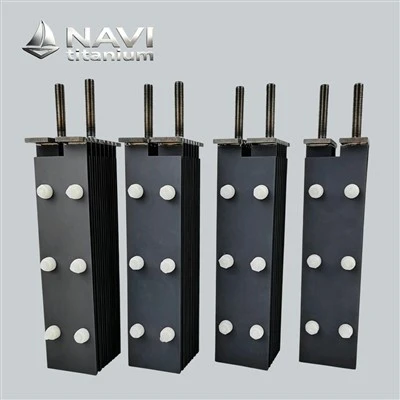


The core of the titanium anode rod is industrial pure titanium (TA1/TA2 grades), with a layer of precious metal oxide coating (such as ruthenium, iridium, tantalum, etc.) brushed on the surface, and the coating thickness is usually between 2-15 microns. NAVI Titanium also produces another type of titanium coated copper composite rod, which is coated with a layer of titanium (usually 1.0-1.2mm thick) on the outside of the copper rod, which can conduct electricity and resist corrosion. Ordinary titanium itself has an average conductivity, but with precious metal coatings, the resistance can be as low as ≤ 0.02 Ω, and the working current density range is wide, from 10-50A/m ² to 2000-5000A/m ². Please tell me what specifications of rods you need?

Solution of NAVI Titanium
The chlor alkali industry was the earliest field to be used, and now the adoption rate of the chlor alkali industry exceeds 70%. In sewage treatment, it is used for electrolytic oxidation degradation of organic matter, which can effectively degrade COD and remove ammonia nitrogen. The electroplating industry is used for copper plating, chrome plating, gold plating, etc., which is more environmentally friendly than traditional lead anodes. Electrolysis of water for hydrogen production and electrolytic metallurgy for extracting non-ferrous metals (copper, zinc, nickel, etc.) are also commonly used. There is also a cathodic protection system used for anti-corrosion of metal equipment in soil and seawater, with a lifespan of over 50 years. The rod used for anti-corrosion of water heaters can sterilize, disinfect, and eliminate odors, and its service life can even reach the entire service life of the water heater.


NAVI Titanium's titanium anode rods use high-quality titanium as the base with a high-performance precious metal coating. The coating sticks well, the electrochemical potential is stable, and they resist all kinds of corrosive electrolytes. They have low wear during use and a long lifespan, making them suitable for seawater desalination, pipeline cathodic protection, water treatment electrolysis, and other electrochemical applications.


Application

The anode rod is a key auxiliary electrode component used in electrochemical engineering to form an electric field and optimize reactions. In addition to stainless steel or titanium alloy, its materials also include magnesium alloy, aluminum magnesium alloy, lead tin alloy, and high silicon cast iron. As a consumable component, the application scenarios of anode rods cover electroplating, micro arc oxidation, cathodic protection of water heaters, as well as cathodic protection fields such as offshore drilling platforms and underground pipelines.
In the cathodic electrophoretic coating system, the anode rod and the workpiece cathode form an electric field, which achieves uniform coating on the inner wall of the workpiece by solving the Faraday effect inside the cavity. Its structure is designed with a combination of multiple anode rods to enhance the uniformity of electric field distribution, and has improved designs such as dual tube electrodes, gear transmission clamping, and detachable hollow cores to enhance performance or facilitate maintenance. The loss rate of anode rods is related to production intensity, and their lifespan is generally 3-5 years. In applications such as water heaters, it is recommended to inspect and replace them after more than 5 years.

Purchasing guide

Quality control(QC)

| Titanium Base Material Suppliers: | Coating Precursor Suppliers: |
|
|
|


(2) COA of product
NAVI Titanium provides previous COAs for reference, and issue a COA for each purchased product based on its test results.

Manufacturing Process

The following is a comparison table of the advantages of NAVI Titanium's Titanium Anode Rod compared to peer products:
| Comparison Dimension | NAVI Titanium Titanium Anode Rod | Ordinary Peer Products in the Industry |
| Coating Process | Customizable noble metal coating formulations such as IrO₂-Ta₂O₅/Ru-Ir for specific working conditions, delivering over 30% longer service life in high-salinity and highly corrosive scenarios | General standardized coatings without scenario-specific optimization, leading to rapid performance degradation in strong corrosive environments |
| Structural Design | Customizable slender special-shaped anodes with standard threaded ends, directly compatible with special scenarios such as confined tank spaces and built-in installation of heating components | Only standard-sized anodes are available, making installation and adaptation highly difficult under special working conditions |
| Energy Consumption Performance | Features low oxygen evolution overpotential, which can actually reduce DC power consumption by 10%-20% with remarkable long-term power-saving benefits | The electrolyzer voltage is relatively high with no targeted energy consumption optimization, resulting in higher long-term operating electricity costs |
| Full-lifecycle Cost | Supports re-coating of active layers for used titanium substrates, cutting the overall operating cost by an extra 30%, and ensures stable continuous operation for over 5 years without failure | Only brand-new anode products are provided with no re-coating service, the average service life is only 2-3 years, leading high consumable replacement costs |
| Delivery Efficiency | Standard products can be delivered within 72 hours, and the delivery cycle of non-standard customized products is 40% shorter than the industry average | The delivery cycle of standard products ranges from 7 to 15 days, and non-standard customized orders have long scheduling periods that cannot meet urgent demands |
| Technical Service | A team of engineers with over 16 years of industry experience provides exclusive working condition adaptation plans within 48 hours, with on-site installation and commissioning guidance included | Only basic products are offered, no supporting engineering-level technical services, and customers have to complete model selection and adaptation on their own |
| Quality Inspection & Traceability | Full-process QC inspection, with traceable titanium substrate COA and coating test reports, all core performances are verified by third-party actual tests | No clear unified quality inspection standards, no complete test documents, and the stability of product performance cannot be guaranteed |
| Entity & Project Experience | A source factory based in Baoji established in 2008, its supporting products are selected by over 95% of modern chlor-alkali production lines worldwide, with sufficient experience in head benchmark project implementation | Most players are traders or small and medium-sized processing plants, with no verification in large-scale industrial scenarios and a lack of head benchmark project cases |
Application

In the subdivision track of the water treatment industry, special water treatment is a subdivision field aimed at extreme water environments and high difficulty treatment needs that are difficult to adapt to conventional processes. Such scenarios generally have the characteristics of high salt, high chlorine, strong acidity and alkalinity, complex pollutant structures, and extremely high treatment accuracy requirements. Traditional graphite anodes and stainless steel anodes are prone to corrosion and dissolution, short service life, and low treatment efficiency, which cannot meet the requirements of long-term stable operation. Titanium anode rod has become a core electrode material in the field of special water treatment due to its strong electrochemical stability, ultra-low oxygen evolution overpotential, and long service life. Its applications have covered multiple segmented scenarios that are difficult to break through with conventional processes, providing efficient and reliable solutions for high difficulty water treatment needs.
Firstly, there is a special treatment scenario for high salt and high chlorine organic wastewater, which is widely generated in industries such as coal chemical, pharmaceutical intermediate production, and pesticide synthesis. The total dissolved solids content in the wastewater usually exceeds 30000mg/L, and the chloride ion concentration is as high as 10000mg/L. At the same time, it contains a large amount of benzene ring and heterocyclic difficult to degrade organic pollutants, with extremely poor biodegradability. Traditional biochemical processes are almost unable to directly treat it. Ordinary electrochemical anodes can experience severe corrosion in such high chlorine environments in just a few months, and even problems such as electrode dissolution and heavy metal exceeding standards can occur. In such scenarios, with the special MMO coating, it has extremely strong resistance to chloride ion penetration and can stably electrocatalytically generate strong oxidizing substances such as hydroxyl radicals and hypochlorite ions in high chlorine water environments.


Through indirect oxidation, it efficiently breaks down the molecular chains of difficult to degrade organic matter, decomposes large molecule difficult to degrade pollutants into biodegradable small molecule substances, and even directly mineralizes them into carbon dioxide and water. In the high salt wastewater treatment project of a large coal chemical enterprise in China, customized ruthenium iridium coated product were used as the core electrocatalytic components. They operated continuously and stably for more than 5 years in extreme water environments with a chloride ion concentration of 12000mg/L. The COD removal rate of the wastewater remained stable at over 45%, increasing the B/C ratio of the wastewater, which originally had almost zero biodegradability, from 0.08 to over 0.35. This opened up a pathway for subsequent biochemical treatment and completely solved the problem of high salt and difficult to degrade organic wastewater treatment that had plagued the industry for many years. At the same time, heavy metal ions such as iron and chromium will not precipitate into the wastewater, completely avoiding the problem of excessive sludge production caused by traditional iron electrode electrocoagulation.
The sludge production of the entire treatment process is only 1/10 of that of traditional processes, greatly reducing the cost of hazardous waste disposal.
The second core scenario is the special treatment of extreme water environments with strong acidity and alkalinity. This type of scenario is commonly found in wet metallurgy, mining acidic wastewater, and special chemical production wastewater. The pH value of the wastewater is often lower than 2 or higher than 12 for a long time. Ordinary metal and non-metal electrodes will quickly corrode and dissolve in this environment, making it impossible to achieve continuous operation. The titanium substrate of the titanium anode rod itself has extremely strong resistance to acid and alkali corrosion. Coupled with an inert precious metal oxide coating, it can maintain structural stability in the entire water environment with a pH value of 0-14, without problems such as electrode dissolution and coating peeling. In the acid mine wastewater treatment project of a large copper mine in the south, the pH value of the wastewater remains stable at around 1.5 for a long time, and it contains a large amount of heavy metal ions such as copper, arsenic, and lead.


The traditional neutralization and precipitation process requires the addition of a large amount of lime, resulting in a huge output of heavy metal hazardous waste and extremely high subsequent disposal costs. The project uses titanium anode rods to build an electrodeposition treatment system, which operates stably in a strong acidic environment. Through electrochemical reduction reactions, copper ions in wastewater are directly electrodeposited and recovered, with a recovery rate of over 98% for metallic copper. At the same time, heavy metals such as arsenic and lead are simultaneously converted into stable solid forms. The concentration of heavy metals in the effluent is much lower than the national emission standards, achieving the resource recovery of valuable metals and significantly reducing hazardous waste production. The project has been running steadily for 4 years without significant corrosion losses, and the operation and maintenance costs are only 30% of traditional processes.
In some highly alkaline special chemical wastewater treatment scenarios, it can also play a stable role by removing organic amine pollutants from wastewater through electrocatalytic oxidation, solving the pain point of the sharp decline in treatment efficiency of traditional processes in highly alkaline environments.
The third key application scenario is the special disinfection treatment of epidemic and high biological risk wastewater, which is mainly concentrated in infectious disease hospitals, disease control centers, biological laboratories, vaccine production workshops and other areas. The wastewater contains a large amount of highly pathogenic viruses, drug-resistant bacteria, and bioactive factors. Conventional sodium hypochlorite addition and ultraviolet disinfection processes are prone to the risk of incomplete disinfection, virus residue, and possible disinfection by-products. Highly active oxidizing substances can be generated in situ through electrochemistry, without the need for additional storage or chemical disinfectants.


The hydroxyl radicals and active chlorine generated by electrocatalytic reactions can instantly destroy the nucleic acid structure of viruses, achieving a sterilization rate of 99.999% and completely inactivating highly pathogenic microorganisms in wastewater. In the wastewater renovation projects of multiple designated infectious disease hospitals in China in 2022, it is widely used as the core electrochemical disinfection component to complete deep disinfection before the wastewater enters the municipal pipeline network. Even in the case of significant fluctuations in wastewater quality, it can stably achieve complete virus inactivation without producing disinfection by-products caused by traditional chlorine based disinfection. The entire disinfection process has no secondary pollution, and the electrode's service life exceeds 3 years, fully meeting the safety treatment requirements of high-risk biological scenarios.
In addition, it also plays an irreplaceable role in other special water treatment scenarios such as seawater desalination pretreatment and radioactive wastewater treatment. In the pre-treatment scenario of seawater desalination, trace amounts of effective chlorine are generated in situ by electrolyzing seawater, which can continuously inhibit the adhesion of marine organisms in seawater pipelines without the need for additional chemical agents, avoiding pipeline blockage and microbial contamination of reverse osmosis membranes, greatly extending the service life of seawater desalination membranes. In the treatment of low-level radioactive wastewater, titanium anode rods can enrich and separate radioactive nuclides in the wastewater through electrocoagulation and electrodeposition, significantly reducing the volume of radioactive wastewater and reducing the cost of subsequent solidification and disposal. At the same time, their extremely low corrosion rate does not introduce additional impurities into the wastewater, avoiding increasing the difficulty of subsequent treatment of radioactive wastewater.

FAQ
What is the most common anode rod?
+
-
There are several options for replacing your anode rod, with magnesium, aluminum, or a combination of aluminum, zinc and tin being the most common anode rod materials. (Most water heaters come with an aluminum rod as standard equipment.
What operations can shorten the anode's lifespan?
+
-
Running at too high current, reverse polarity, scratching the coating with hard objects, long-term high temperatures, not cleaning scale, and having high fluoride content in the electrolyte.
Advantages of MMO titanium anodes compared to stainless steel and graphite anodes?
+
-
Stainless steel corrodes and gets holes in seawater; graphite keeps shedding particles and pollutes the water. MMO titanium anodes resist chloride corrosion, last longer, and the titanium base can be recoated, making long-term maintenance cheaper.
How to clean scale off the anode surface?
+
-
Soak briefly in dilute sulfuric acid, then rinse with pure water. Do not use sandpaper or wire brushes to scratch the coating, as scratches will cause the anode to fail early.
If the titanium base is intact, can old anode rods be recoated?
+
-
Yes, as long as the base has no cracks or severe corrosion pits, you can remove the old coating and reapply it. It's cheaper than buying a new anode.
Hot Tags: titanium anode rod, China titanium anode rod manufacturers, suppliers, factory, DSA Coating Titanium Anode, Iridium Tantalum Titanium Anode, MMO Titanium Anode, Platinum Plated Titanium Anode, Titanium Anode Mesh Basket, Titanium Cathode