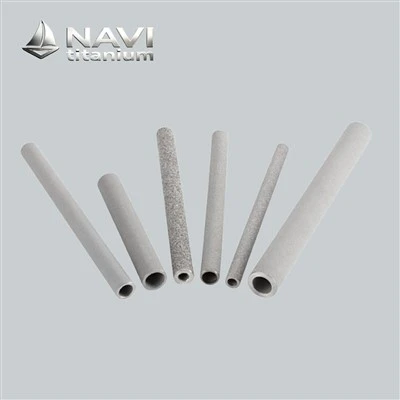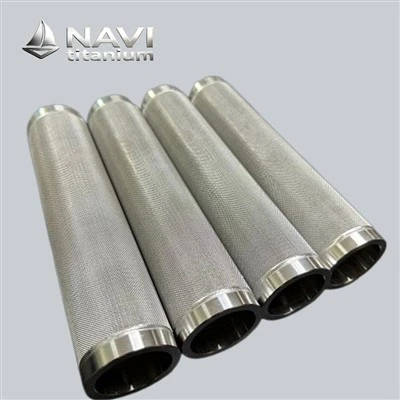


NAVI Titanium sintering titanium produces a rigid porous metal structure by consolidating titanium powder under controlled thermal conditions. The resulting component combines the inherent corrosion resistance of titanium with a stable interconnected pore network, making it suitable for demanding gas and liquid processing where polymeric media or conventional materials may have limitations. NAVI Titanium focuses on B2B supply, providing customized porous titanium components according to application conditions, drawings, dimensions and performance requirements rather than offering only standard catalog parts.

Solution of NAVI Titanium


NAVI Titanium supplies custom sintering components manufactured through controlled powder metallurgy and sintering processes. Available in sheets, discs, flanges and various special-shaped designs, these components feature a uniform interconnected pore structure, stable permeability, excellent corrosion resistance and high-temperature performance.


Application
Sintering titanium components are suited to industrial processes where filtration performance must be combined with material stability, controlled permeability and resistance to demanding operating conditions. The interconnected pore structure allows fluids or gases to pass through while supporting particle retention, and the titanium material provides reliable performance in corrosive and high-temperature environments. Depending on the process requirements, different component forms, pore ratings and configurations can be developed for filtration and high-purity processing applications.
Porous titanium filtration components are designed for process environments where chemical compatibility and structural stability are critical. Their fixed pore network provides controlled particle retention while allowing liquid or gas to pass through the component. Typical requirements include fine filtration of aggressive chemicals, process liquids, compressed gases, steam and other media where corrosion resistance is a key selection factor. Depending on the application, buyers can specify pore rating, porosity, dimensions, connection design and operating conditions to achieve the required balance between filtration performance and pressure drop. The rigid metallic structure also allows cleaning or backwashing in suitable systems, supporting repeated operation rather than relying solely on disposable media. For engineering procurement teams, selection should consider actual fluid composition, contaminant characteristics, flow rate, differential pressure, temperature and cleaning method instead of selecting a pore size alone. Filtration area, component thickness and installation configuration may also influence flow capacity and overall system performance.

Pharmaceutical, Food & High-Purity Processing

Titanium porous components can also be considered for high-purity process filtration where resistance to corrosion, mechanical stability and controlled particle retention are important. Typical applications include process liquid clarification, gas filtration, steam filtration, purified water systems and filtration stages associated with pharmaceutical, biotechnology and food processing equipment. Compared with flexible polymeric media, a rigid metallic structure can maintain its geometry under suitable pressure and cleaning conditions, while the pore network can be manufactured within a defined filtration range. For B2B projects, the final component should be selected according to the process medium, required cleanliness level, temperature, pressure, flow rate, connection method and applicable documentation requirements. Product geometry can also be adapted to existing housings or equipment layouts, including discs, plates, tubes and cartridge-style elements. These characteristics make titanium porous media useful when standard disposable filter media cannot provide the required combination of chemical resistance and mechanical durability.
Purchasing guide

Quality control (QC)


Manufacturing Process

NAVI Titanium's B2B Solution Approach
NAVI Titanium approaches laser sintering titanium projects from the application and component level. Component configuration is determined by the relationship between filtration rating, pore structure, permeability, flow rate and pressure drop rather than by micron rating alone. A finer pore structure may improve particle retention but can increase flow resistance, while component thickness and effective filtration area influence pressure loss and mechanical stability. Buyers can provide the filtration medium, target particle size, flow rate, operating pressure and temperature, dimensions, connection type, drawings or reference samples for evaluation. Based on these parameters, discs, plates, tubes, cartridges and other configurations can be considered for the intended system. Material properties, porous structure and geometry are therefore evaluated together to establish a practical component specification. This approach helps prevent unsuitable selection based only on a nominal filtration rating and provides a clearer technical basis for developing components for specific filtration, separation or gas-handling equipment.


For filtration projects, selection should also consider contaminant characteristics and the operating method. Particle concentration, particle shape, fluid viscosity, gas velocity, filtration area and cleaning method can influence actual performance. A component handling a high contaminant load may require a different pore structure or available filtration area from one used for relatively clean process media. Similarly, continuous operation, intermittent service and backwashing can place different demands on permeability and structural stability. NAVI Titanium can evaluate these conditions together with the required component dimensions and connection configuration when defining a customized specification. This allows filtration performance to be considered alongside pressure drop, flow capacity and service conditions instead of focusing on one parameter independently. For equipment manufacturers and process engineers, providing the actual operating conditions at the design stage can therefore help establish a more suitable component configuration and reduce the risk of performance differences after installation.
Quality Control & Specification Confirmation
The performance of a sintered titanium filter depends closely on the consistency of its internal pore network, not simply its external appearance or dimensional accuracy. Pore size distribution, porosity, permeability and structural uniformity influence how efficiently the component allows fluid or gas to pass while retaining particles. Manufacturing conditions therefore need to be controlled from powder preparation and forming through thermal processing and final inspection. Dimensional tolerances are equally important for components installed in housings, manifolds or other equipment, particularly where sealing or mechanical connections are involved. Differences in thickness, diameter or connection dimensions can affect installation even when filtration characteristics remain unchanged. For this reason, material grade, filtration rating, dimensions, thickness, porosity or permeability requirements and connection configuration should be clearly defined before production. Establishing these parameters provides a consistent reference for evaluating samples, finished components and subsequent production batches, while helping maintain reliable performance and dimensional compatibility throughout the supply process.


For customized and repeat components, quality confirmation should cover both material characteristics and finished-part specifications. The approved drawing, technical requirements and agreed inspection criteria provide the reference for production and final verification. Depending on the application, inspection may include dimensional checks, visual examination, surface condition and specified permeability or filtration-related requirements. Critical mounting areas and connection sections can also be checked when dimensional compatibility is important. For repeat orders, maintaining the same specification is particularly significant because changes in pore structure, thickness or geometry may alter flow behavior or equipment fit. Batch consistency is also important when components are installed across the same equipment series or production line. Where documentation is required, inspection records or other agreed quality information can be prepared according to the project requirements. By defining measurable acceptance criteria before manufacturing, NAVI Titanium helps ensure that samples, production parts and subsequent orders are evaluated against the same technical basis rather than appearance alone.
Packaging & Product Protection
Porous titanium components require careful packaging because their functional surfaces and interconnected pore openings can be affected by contamination, impact or improper handling during transportation. Before packing, components should be inspected and separated according to their shape, dimensions and surface configuration. Protective plastic bags can help reduce exposure to dust, moisture and handling contaminants, while cushioning materials can limit movement and collision inside the package. For discs, plates and sheets, separation between individual pieces can help prevent surface contact and scratching. Tubes, cartridges and components with threaded or machined sections may require additional protection around connection areas and exposed edges. The packaging method should also avoid excessive compression or contact with the filtration surface that could damage the component or introduce foreign particles into the pore structure. For customized parts, packaging can be adapted to the component geometry so that sensitive areas remain protected throughout handling, storage and transportation.


For international shipments, packaging should be selected according to product size, weight, quantity and transportation conditions. Small and lightweight components may be arranged in reinforced cartons with internal cushioning and separation, while larger or heavier parts can be secured in reinforced export wooden cases. Components with precision dimensions, machined surfaces, threaded connections or exposed filtration areas may receive additional protective measures before being fixed inside the outer package. Internal positioning is important because repeated movement during long-distance transportation can cause collision between individual parts even when the outer package remains intact. Packaging labels and product identification can also be arranged according to the shipment requirements to support receiving and inspection. Air, sea and land transportation may involve different handling conditions, so the packaging method should be selected accordingly. For project orders, packaging requirements can be confirmed together with product specifications before production and shipment, ensuring protection is considered as part of the overall delivery process.
FAQ
What information is needed for a quotation?
-
Please provide the application, medium, filtration rating, flow requirement, operating pressure and temperature, dimensions, quantity and connection details. A drawing, photo or existing sample is helpful for customized components.
Can the pore size and dimensions be customized?
-
Yes. The component can be discussed according to the required filtration rating, geometry, dimensions and equipment interface. Final feasibility depends on the requested configuration and production requirements.
How is product quality checked?
-
Quality requirements can be established according to the order specification. Typical checks may include material, dimensions, appearance and relevant porous-structure or performance-related requirements agreed before production.
How are the products packaged?
-
Products can be individually protected with suitable plastic packaging and cushioning materials. Reinforced export cartons or wooden cases can be used for larger or long-distance shipments, with additional protection for sensitive surfaces and connections when necessary.
Can NAVI Titanium supply samples before mass production?
-
Sample or prototype production can be discussed according to the required geometry and specification. For customized components, providing drawings, dimensions and application information in advance helps determine the most suitable production approach.
Hot Tags: sintering titanium, China sintering titanium manufacturers, suppliers, factory, Sintered Air Filter, Sintered Brass Filter, Sintered Bronze Fuel Filter, Sintered Metal Plate, Sintered Stainless Steel Plate, Sintered Steel Filter