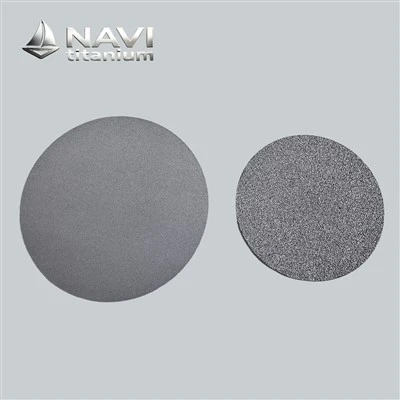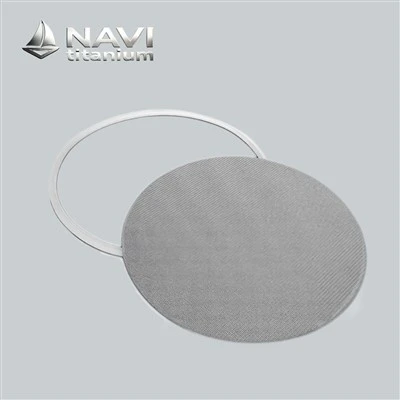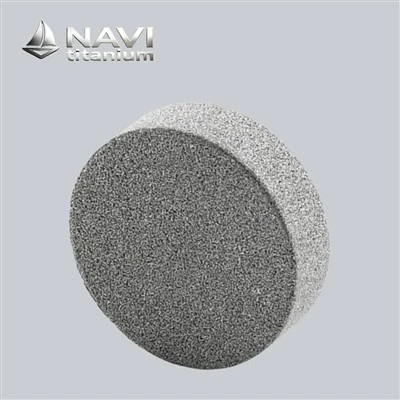


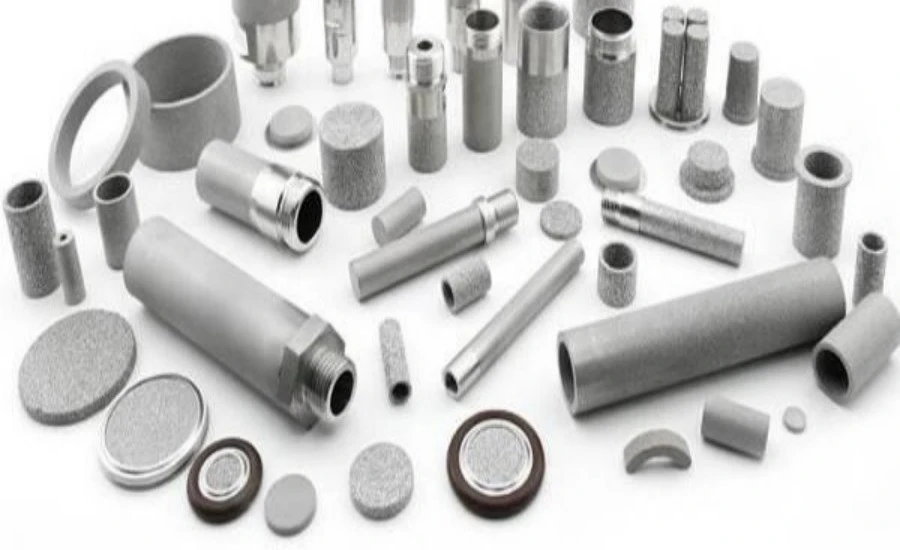
NAVI Titanium sintered stainless steel tube is a hollow cylindrical porous body produced by compacting stainless steel powder into a tubular form and consolidating it through high-temperature solid-state sintering. This manufacturing route creates a continuous metallic tube with a unified wall body and precise cylindrical form. Different from flat panels or laminated mesh constructions, the tube is developed around an axisymmetric profile that efficiently transfers radial and axial forces while preserving geometric precision.
Solution of NAVI Titanium
NAVI Titanium manufactures sintered ss tube from carefully selected metal powders through a controlled sintering process. The porous structure supports precision filtration, gas-liquid separation, air permeability, and demanding industrial flow applications. Customized pore sizes, dimensions, wall thicknesses, and material grades are available to match specific operating requirements. Corrosion resistance, controllable porosity, and cleanable construction support reliable service in corrosive, high-temperature, and high-pressure environments. The following table summarizes key specifications and performance data for reference.
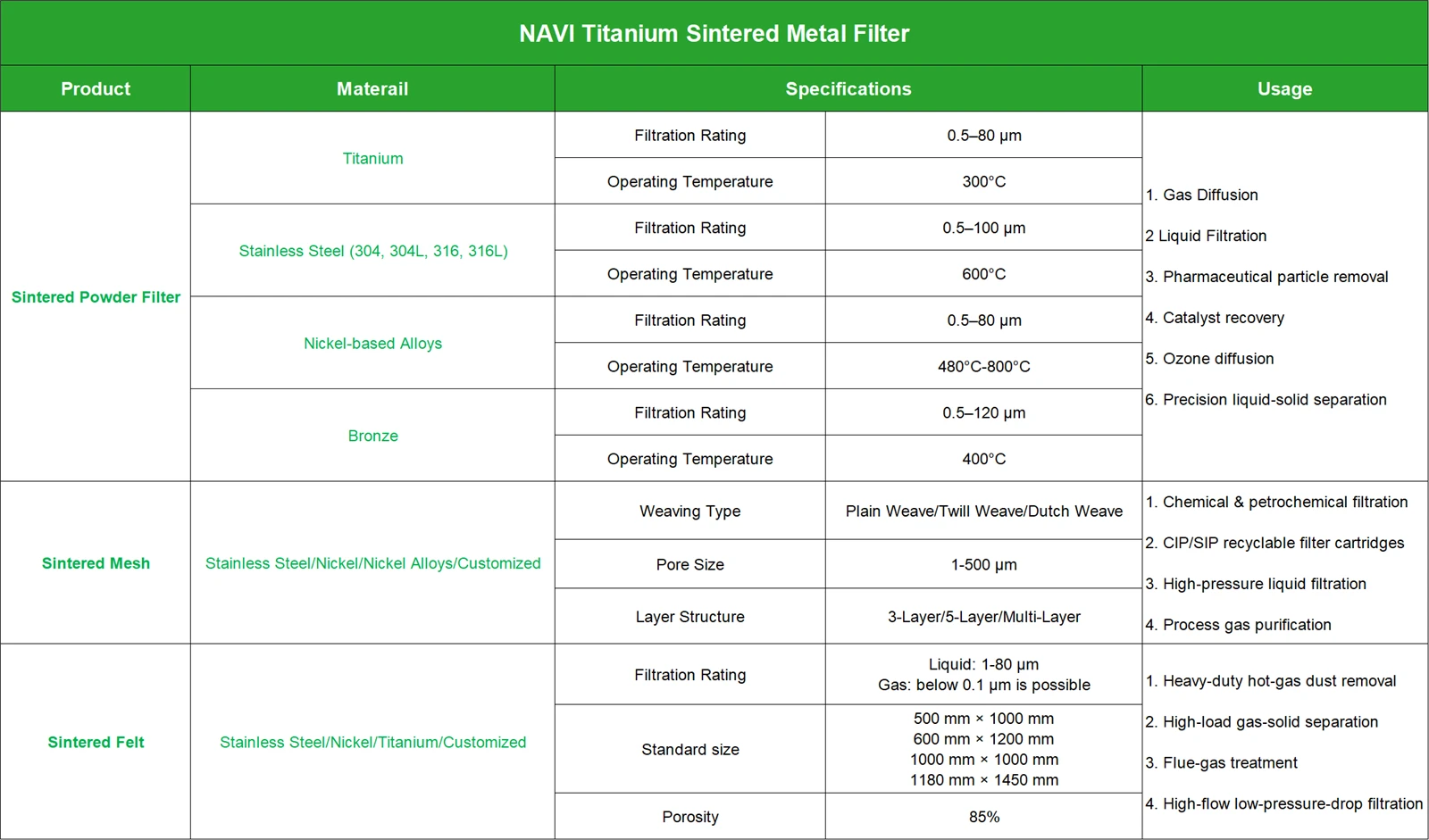


NAVI Titanium has developed specialized sintered stainless steel filters for demanding filtration, gas-liquid separation, flow control, and porous media applications. We offer custom processing in various stainless steel grades, pore sizes, diameters, wall thicknesses, and lengths, supporting different operating conditions while providing consistent permeability, mechanical strength, and long-term service performance.


Application
NAVI Titanium sintered stainless steel are incorporated into various technical modules where cylindrical form, continuous body design, and balanced force transmission are important. Their hollow configuration supports coaxial arrangement while accommodating different size ranges, connection approaches, and mounting layouts. Beyond functioning as basic tubular elements, these products contribute to positional alignment, force transfer, and compact construction within specialized mechanical platforms developed for demanding working environments.
Many mechanical modules are arranged along a common axis, making tubular elements a practical option for connecting adjacent sections while preserving alignment. NAVI Titanium sintered stainless steel tube provides a rigid cylindrical carrier that simplifies coaxial positioning and supports continuous force transmission between connected parts. Its circular profile enables surrounding housings, sleeves, and mounting structures to distribute external forces more evenly, reducing concentrated stress near connection areas. By selecting appropriate diameter ranges, lengths, and wall dimensions, engineers can adapt the tube for compact units or larger integrated platforms where cylindrical continuity and positioning accuracy are important.

Pressure-Bearing Tubular Modules

Tubular forms are naturally suitable for structures exposed to forces acting around the circumference. NAVI Titanium sintered stainless steel functions as a mechanically stable shell capable of receiving radial forces while preserving its circular profile under demanding service conditions. Consistent wall formation promotes balanced force distribution across the cross-section, resulting in predictable behavior during mechanical loading and thermal cycling. Various end connection methods, joining techniques, and size options allow the tube to be incorporated into specialized modules where continuous body support, coaxial positioning, and dependable connection are essential objectives.
Purchasing guide

Quality control (QC)
NAVI Titanium manufactures sintered ss tube under an ISO 9001-certified quality management system. To help you verify material grade, dimensional accuracy, pore characteristics, permeability, and inspection results, we provide selected Certificates of Analysis (COA) for reference. Click the button below to review available COA documents and confirm product quality before discussing your requirements with our technical team confidently.

Manufacturing Process
NAVI Titanium manufactures sintered stainless steel tubes through a controlled powder metallurgy process. Each production stage is designed to manage material composition, pore structure, dimensional accuracy, and filtration performance. From stainless steel powder selection to final inspection, our team follows defined processing and quality control procedures to support customized industrial filtration requirements.
1. Stainless Steel Powder Selection and Grading
We select stainless steel powders according to the required material grade, pore size, permeability, and application conditions. Common options include SS304, SS316, and SS316L. Powder particle size distribution is assessed before production to support consistent pore formation and filtration characteristics.
2. Mold Preparation and Powder Loading
The selected powder is loaded into a dedicated mold according to the tube dimensions and required wall thickness. Mold design and filling control help maintain uniform material distribution and support dimensional consistency throughout the subsequent forming and sintering stages.

3. Compaction and Preforming
The loaded powder is compacted under controlled conditions to create a preliminary tube structure. Processing parameters are adjusted according to the material, geometry, and density requirements. This stage helps establish the shape and structural uniformity needed for the sintering process.
4. High-Temperature Sintering
The formed tube is placed inside a controlled-atmosphere or vacuum sintering furnace. During heating, stainless steel particles bond metallurgically while interconnected pores are retained within the material. Temperature, holding time, and atmosphere conditions are managed according to the selected stainless steel grade and product specifications.

5. Machining and Dimensional Finishing
After sintering, tubes may undergo machining, cutting, surface finishing, or other customized processing. These operations help achieve the specified outer diameter, inner diameter, length, connection design, and dimensional tolerances required for installation in filtration systems.
6. Cleaning and Surface Treatment
The tube is cleaned to remove processing residues and unwanted contaminants. Depending on the application, additional surface treatment or passivation may be considered to support cleanliness and corrosion resistance requirements.

7. Inspection and Quality Verification
NAVI Titanium evaluates finished tubes according to applicable product requirements. Certificates of Analysis (COA) can be provided for reference, subject to product specifications and customer requirements.
8. Packaging and Delivery
After inspection, qualified tubes are carefully packaged to protect their surfaces and porous structures during transportation. Packaging methods are selected according to tube dimensions, quantity, and shipping requirements, supporting safe delivery for industrial filtration applications.

Tubular Mechanical Engineering
The behavior of NAVI Titanium porous metal tube is strongly influenced by its cylindrical profile, wall dimensions, and response under radial and axial forces. Parameters including tube rigidity, connection methods, dimensional control, and thermal characteristics collectively determine its suitability for integrated components. The following sections discuss the fundamental principles behind tubular configuration, shell behavior, joining approaches, and precision control in complex component arrangements.
The primary feature of sintered stainless steel tube is its axisymmetric tubular shape. Compared with planar components or circular elements, this form distributes material around a central axis, creating balanced force distribution in multiple directions. The continuous curved profile reduces sudden changes in force transmission and allows external influences to be transferred smoothly through the tube wall.
Diameter, wall size, and overall length are selected according to the functional demands of different applications while maintaining accurate tubular dimensions. Since the body is produced as a unified porous component, the finished tube maintains consistent form throughout its length, making it suitable for coaxial systems and precision-fit components.

2. Radial Load Distribution

Circular geometries naturally transfer external forces around the circumference instead of concentrating stress within isolated regions. When radial loads are applied, the tube wall develops circumferential stress that is shared continuously throughout the cylindrical body. This balanced mechanical response reduces localized deformation and contributes to predictable structural behavior under compression. The relationship between diameter and wall thickness influences radial stiffness, allowing designers to optimize the tube for different loading conditions. Uniform stress transfer across the entire circumference is one of the primary mechanical advantages of tubular construction.
Long tubular members must maintain stability when subjected to axial compression. One important design consideration is preventing structural buckling before the material reaches its allowable mechanical limit. Buckling behavior depends on tube length, outside diameter, wall thickness, and end support conditions. Increasing structural rigidity or modifying geometric proportions can significantly improve resistance to column instability. NAVI Titanium engineers also consider slenderness ratio during product development because excessively long tubes may become susceptible to lateral deflection under compressive loading. Proper dimensional selection ensures stable structural performance while minimizing unnecessary material usage.


Tubular structures experience different mechanical responses depending on whether loading originates inside or outside the cylinder. Internal loading generally produces circumferential tensile stress, while external loading increases the possibility of wall collapse if geometric proportions are not properly balanced. Wall thickness, tube diameter, and material properties collectively determine burst resistance and collapse resistance. Structural analysis therefore considers both loading directions during product development rather than focusing on only one service condition. Proper dimensional matching helps achieve an appropriate balance between mechanical safety, structural efficiency, and material utilization.
The connection between NAVI Titanium sintered stainless steel tube and neighboring assemblies has a direct influence on overall structural reliability. Different installation methods require different end geometries, including threaded ends, welded joints, flanged interfaces, socket connections, or compression fittings. Each joining method introduces unique mechanical loads that must be accommodated without affecting dimensional accuracy or alignment. Edge preparation, machining precision, and joining technique are therefore considered together during fabrication. Well-designed end connections simplify installation while ensuring that mechanical loads transfer smoothly between the tube and surrounding structures.

6. Tube Wall Thickness Optimization

Wall thickness is one of the most influential parameters in tubular engineering. Increasing thickness generally enhances structural rigidity and load capacity, while reducing thickness lowers weight and material consumption. Excessive thickness may introduce unnecessary mass, whereas insufficient thickness can reduce resistance to deformation under mechanical loading. Designers therefore balance stiffness, structural safety, dimensional requirements, and manufacturing efficiency when selecting wall dimensions. Appropriate wall optimization enables the tube to satisfy mechanical objectives while maintaining practical fabrication and assembly characteristics.
Accurate cylindrical geometry depends not only on diameter but also on concentricity and straightness throughout the full tube length. Concentric tube walls promote balanced mechanical loading during installation, while good straightness simplifies alignment within long assemblies and rotating equipment. Manufacturing variables such as powder filling, compaction uniformity, thermal shrinkage, and finishing operations all influence these geometric characteristics. NAVI Titanium careful dimensional inspection verifies that the tube maintains consistent alignment from end to end. High concentricity and straightness improve assembly repeatability and reduce installation adjustments in precision mechanical systems.

8. Radial Support and Circumferential Stiffness

The circular cross-section of sintered stainless steel tube provides inherent radial support capability that distinguishes it from flat porous components. When external forces act around the circumference, the curved wall distributes the applied load through continuous hoop response rather than concentrating stress at isolated locations. This circumferential stiffness allows the tube to resist radial deformation while preserving its original cylindrical profile during mechanical loading.
The radial behavior of a tubular body is influenced by tube diameter, wall thickness, porosity level, and overall manufacturing consistency. A balanced wall distribution helps the cylindrical section respond uniformly when subjected to external compression, vibration, or contact forces from surrounding parts. Compared with open-frame structures requiring additional reinforcement, the continuous circular wall provides natural support along the entire circumference.
NAVI Titanium – Pure Performance, Proven Reliability
Our sintered stainless steel filter tubes are manufactured from high-purity 316L powder through advanced vacuum sintering and precisely controlled thermal cycles, producing a uniformly distributed, three-dimensional pore structure with filtration ratings from 0.1 to 100 microns. This unique metallurgical bond delivers outstanding mechanical strength, exceptional permeability, and reliable performance under extreme conditions-withstanding temperatures up to 816°C, pressures beyond 3 MPa, and aggressive chemical environments. The rigid, non-shedding porous matrix ensures >99% filtration efficiency while maintaining stable differential pressure over extended service periods, making these tubes an indispensable component for critical applications in petrochemical, pharmaceutical, and high-purity gas industries.
Choosing NAVI Titanium means investing in long-term operational reliability and reduced total cost of ownership. Our all-metal sintered tubes are designed for aggressive backwashing, ultrasonic cleaning, and chemical regeneration, enabling multiple reuse cycles that dramatically extend service life compared to conventional disposable filters.

Every batch is rigorously inspected per ISO 4003 (bubble point) and ISO 4022 (permeability) standards, ensuring precise pore size distribution and consistent flow resistance. With thousands of units successfully deployed across refineries, chemical plants, and hydrogen production facilities worldwide, our track record demonstrates proven durability and separation performance that major industry players have come to trust for their most demanding process streams.
What truly distinguishes NAVI Titanium is our dedicated team of materials scientists, powder metallurgists, and fluid dynamics specialists who bring decades of collective expertise to every project. From initial media selection and custom-engineered designs-including non-standard diameters, lengths, and end-fitting configurations-to on-site commissioning support and root-cause failure analysis, we provide end-to-end technical collaboration. Our in-house R&D database enables rapid simulation of specific process conditions, allowing us to recommend the optimal porosity and wall thickness for your unique application. This deep technical competence, combined with agile responsiveness,
ensures that is not merely a supplier but a strategic engineering partner committed to solving your most challenging separation problems with integrity and precision.
Frequently Asked Questions
What is the best way to inspect a sintered tube after long-term use?
+
-
Inspection should cover both the outside and inside of the tube. Customers can check for visible deposits, deformation, cracks, blocked areas, discoloration, dimensional changes, and changes in flow behavior. For critical parts, measured operating data before and after cleaning can provide a more useful indication of condition than appearance alone.
Can the inside of the tube be cleaned without damaging the porous material?
+
-
Cleaning is possible when the method is compatible with the stainless steel grade and the material that has accumulated inside the tube. Excessive mechanical force, unsuitable chemicals, or overly aggressive treatment may affect the tube. The cleaning procedure should therefore be selected according to the actual contaminant and material specification.
How do I know whether 304 or 316/316L stainless steel is more appropriate for my tube?
+
-
The choice should be based on the working medium, temperature, pressure, chemical exposure, and expected service conditions rather than simply selecting the more commonly used grade. For projects involving corrosive or chemically demanding media, customers should provide the relevant operating information so we can evaluate the material choice.
How should I store the tubes before installation?
+
-
Store the tubes in clean, dry packaging and protect them from impact, bending, dust, moisture, oil, and other contamination. Long or thin tubes should be supported appropriately during storage so that their own weight does not cause deformation. Keeping the original packaging until installation is recommended.
Can the tubes be individually marked with part numbers or batch information?
+
-
Individual or batch-level identification can be discussed when traceability is important to the customer's purchasing or production process. Marking requirements should be agreed in advance because the available marking method depends on the tube dimensions and the area available for identification.
Hot Tags: sintered stainless steel tube, China sintered stainless steel tube manufacturers, suppliers, factory, Microporous Water Filter, Porous Media Filter, Porous Stainless Steel Tube, Sintered Brass Filter, sintered metal filter, Sintered Steel Filter