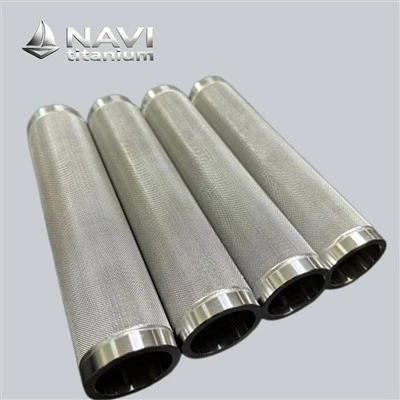
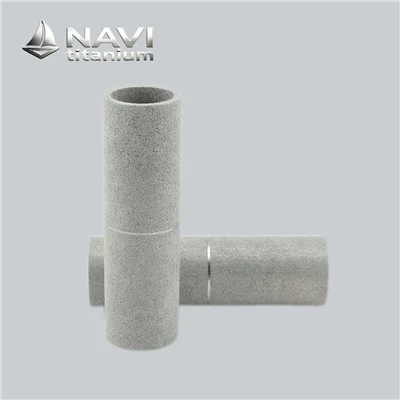
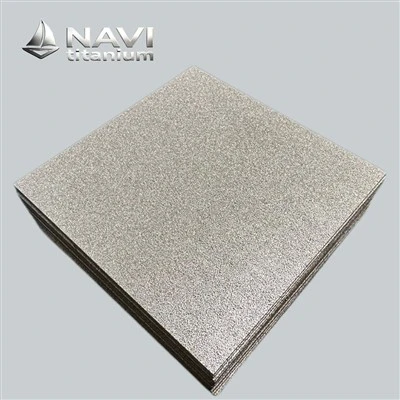
NAVI Titanium sintered steel filter provides a finely controlled passage body for demanding separation duties. Calibrated openings support consistent particle retention, while the bonding process helps preserve shape during thermal cycling and pressure variation. Each batch undergoes dimensional checks and appearance inspection thoroughly before shipment. The technical R&D team has over 40 members,5 doctors, 65% of the staff hold master's degrees or above, and 12 hold intermediate or senior technical titles.
Solution of NAVI Titanium
NAVI Titanium maintains a coordinated dispatch environment where finished orders are checked, protected, labeled, and arranged according to the confirmed shipping schedule. For stainless-steel powder metallurgy products, particular attention is given to surface condition, structural integrity, dimensional conformity, and packaging separation before handover. Packing records, product photographs, and shipment documents can be reviewed with overseas purchasers before the goods leave the facility, helping both sides confirm the order status clearly.
For projects involving custom specifications, we also provides video meeting support for direct communication with engineers and sales representatives.
The following table further summarizes our current principal titanium products.


NAVI Titanium presents three complementary views. The dimensional image further indicates controlled thickness and geometric accuracy, providing visual evidence for consistent fabrication quality across examined samples and supporting assessment of permeability, retention characteristics, and mechanical integrity.


Application
NAVI Titanium sintered steel filter applies a thermally bonded alloy matrix developed for circulation systems exposed to mechanical stress, chemical interaction, and repeated service cycles. Its bonded composition maintains dimensional consistency during vibration, pressure fluctuation, and continuous media movement. In offshore engineering environments, this specialized medium responds effectively to salt exposure, changing loads, and prolonged operational demands. The internal pathway arrangement promotes balanced media transport and controlled particle movement.
Hydraulic circuits and lubrication assemblies rely on continuous media circulation to maintain precision across valves, servo mechanisms, bearings, and actuating devices. During prolonged operation, wear fragments, oxidation residues, and machining particles may accumulate within the circulating oil, influencing pressure response and energy transfer efficiency. A thermally bonded alloy medium managed by NAVI Titanium handles these conditions through controlled internal pathways and consistent dimensional behavior during repeated loading cycles. Its interconnected transport routes support impurity interception while allowing smooth oil movement during reverse cleaning and cyclic operation. This approach supports transmission equipment, mobile machinery, railway power units, aerospace auxiliary assemblies, and heavy-duty mechanical systems requiring continuous fluid management.

Marine & Offshore Engineering

Offshore propulsion units and ocean-based processing facilities operate under complex exposure involving saline surroundings, suspended particles, biological residues, and fluctuating mechanical loads. The increasing scale of offshore operations requires circulation media capable of maintaining consistent behavior throughout extended deployment cycles. A thermally bonded alloy medium used in sintered filter applications maintains balanced internal pathways during repeated cleaning and alternating flow directions, supporting effective particle retention without excessive restriction. This approach is widely adopted in ballast handling units, subsea hydraulic packages, energy platforms, fuel circulation circuits, and auxiliary systems where dimensional consistency, service endurance, and reduced maintenance demands are essential.
Purchasing guide

Quality control (QC)
Built from premium stainless steel and manufactured through a high-temperature sintering process, this filter delivers outstanding mechanical strength, corrosion resistance, and consistent pore structure. Every batch is fully traceable and tested to meet strict industrial standards, ensuring dependable performance in the most demanding environments.

Manufacturing Process
Selected steel powder is first screened for particle-size consistency and chemical composition, with alloy grade chosen according to the intended mechanical and corrosion environment. The powder is then evenly filled into a precision mold and compacted under controlled pressure to establish the required geometry and green strength. During vacuum or protective-atmosphere heating, adjacent steel particles develop metallurgical bonds as the temperature approaches the alloy's sintering range. The heating profile is carefully managed to limit distortion while retaining the designed internal openings. After cooling, the formed piece may undergo sizing, surface finishing, edge correction, and dimensional verification. This sequence preserves the characteristic strength, hardness, and structural stability associated with the selected steel grade.


Factory Audit Support
Before placing an order, buyers may need to assess whether a supplier can meet their purchasing requirements through a Remote Audit or On-Site Audit. A remote assessment can be arranged through a video meeting and guided walkthrough covering the production area, inspection area, warehouse, and relevant operating locations. Buyers can ask questions about production flow, quality checks, batch identification, storage arrangements, order handling, and supporting records during the session. For customers who prefer an on-site visit, the assessment can provide a closer view of the actual production environment, inspection activities, storage areas, and personnel involved in order execution. This gives Purchasing and QA teams more direct information than relying only on website images or written descriptions.
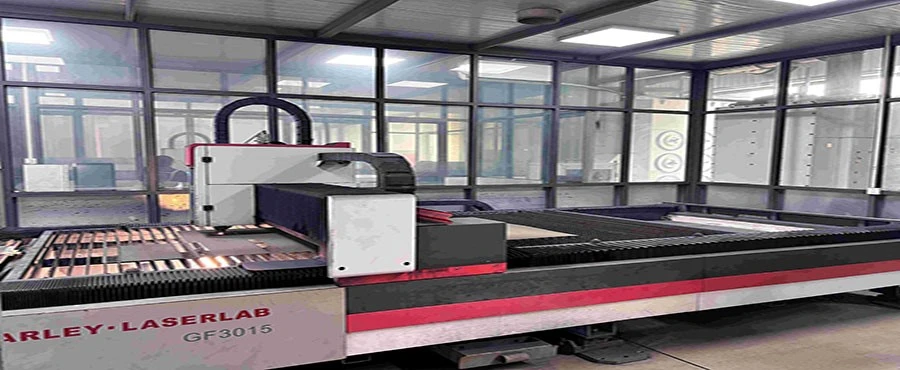
Production, QC & Documentation Review

A factory assessment can also focus on the records behind each order. Buyers may review the production process, QC process, documentation, facility assessment, material records, inspection records, batch identification, and applicable certificates according to their purchasing requirements. Documentation review can help confirm whether key information is recorded consistently from incoming material through processing and final inspection. During a remote assessment, relevant areas and records can be presented through live video, allowing overseas buyers to ask questions and request clarification in real time. This approach gives procurement teams a practical opportunity to evaluate the supplier before placing an order and provides QA teams with a clearer basis for supplier qualification, especially when direct travel to China is not convenient.
Product Principle
Sintered steel filter operates through a thermally bonded alloy medium developed for lubrication circuits requiring precise impurity management and fluid preservation. The internal passage arrangement maintains balanced fluid movement while assisting the removal of abrasive residues, carbon deposits, and unwanted particles. NAVI Titanium provides this configuration with application-focused customization for synthetic lubricants and specialized fuels, supporting continuous circulation demands in mechanical systems where operational consistency and extended service capability are essential.
Power transmission equipment relies on continuous lubricant circulation to preserve the accuracy of gears, bearings, and hydraulic actuators. During extended operation, wear debris, carbonized residues, and machining particles may accumulate within the circulating medium, accelerating surface abrasion and altering fluid behavior. A thermally bonded alloy medium responds to these challenges through durable bonding characteristics and controlled internal pathways that maintain consistent media movement under cyclic pressure changes. NAVI Titanium provides application-specific configurations for this type of operating environment, supporting effective impurity interception without significantly affecting lubricant circulation. This approach is applied in hydraulic assemblies, transmission units, compressors, and transportation machinery requiring sustained operating continuity and reduced service interruption.

2. Resistance Performance in Oil-Immersed Operating Environments

Lubrication circuits operate with complex fluid compositions containing oxidation residues, chemical additives, high-viscosity oils, and continuously circulating media. During extended service cycles, these factors may alter lubricant properties and accelerate surface degradation within mechanical assemblies. A bonded alloy medium maintains its physical integrity through stable metallurgical characteristics, limiting unwanted interaction between the circulating oil and the separation medium. Its reusable nature allows repeated cleaning and recovery procedures while preserving functional consistency after multiple operating cycles. This capability supports hydraulic power units, fuel handling assemblies, and precision circulation equipment where controlled lubricant quality and prolonged operational continuity are required.
Modern transportation platforms increasingly adopt synthetic lubricants, specialized fuels, and customized fluid blends with complex chemical characteristics. These circulating media may experience viscosity variation, additive interaction, and impurity generation throughout continuous operation. A bonded alloy medium maintains consistent internal behavior when exposed to diverse petroleum-based and synthetic fluids, allowing controlled movement without significant deformation during repeated loading cycles. NAVI Titanium provides application-specific configurations that support resistance to erosion effects and mechanical impact caused by dynamic circulation. This capability contributes to aviation auxiliary equipment, propulsion assemblies, railway machinery, and heavy-duty vehicles requiring precise fluid management under demanding operational scenarios.

Product Development

Offshore facilities are moving toward larger operating scales, deeper deployment zones, and more complex mechanical networks, creating new requirements for circulation management. Propulsion units, fuel routes, and auxiliary assemblies must handle continuous media movement under variable external influences. Thermally bonded alloy media demonstrates consistent metallurgical behavior when exposed to saline surroundings, vibration, and repeated operational cycles. NAVI Titanium supports tailored pathway configurations that help regulate fluid transport and particle migration during extended service. Current research focuses on improving material adaptability and lifecycle efficiency for future offshore infrastructure where reduced maintenance access and continuous operation remain critical considerations.
Offshore operating environments create complex interactions between circulation media, external exposure, and mechanical loading. Continuous vibration, salt accumulation, pressure variation, and repeated operation cycles may gradually influence the functional behavior of fluid handling assemblies. A thermally bonded alloy medium responds to these factors through stable metallurgical bonding and controlled internal pathways, maintaining consistent media transport during prolonged usage. Research into alloy composition and fabrication methods continues to focus on improving resistance to environmental stress and operational fluctuation. These developments contribute to subsea machinery, propulsion assemblies, and offshore energy facilities requiring sustained functionality in remote operating locations.

3.Future Trends in Marine Applications

The expansion of offshore renewable energy, deep-sea exploration, and autonomous platforms is reshaping requirements for fluid circulation management. Developed by NAVI Titanium, sintered steel filter utilizes a thermally bonded alloy medium that maintains dimensional consistency and supports repeated recovery procedures during complex fluid handling cycles. Future offshore equipment increasingly requires compact separation units with reduced manual attention and extended operational autonomy. Research activities focus on internal pathway optimization, surface characteristics, and lifecycle performance under variable service scenarios. These developments support offshore platforms, subsea vehicles, and next-generation propulsion equipment seeking improved energy utilization and more predictable maintenance planning.
FAQ
1. Do you support OEM manufacturing?
+
-
Yes. OEM orders are welcome for different sizes, shapes, dimensions, opening specifications, material grades, surface treatments, and connection methods. For projects without a finalized specification, our team can discuss the required operating conditions and recommend a suitable configuration before quotation.
2. How do you control quality before shipment?
+
-
Each order is checked according to its agreed specifications before dispatch. For customized orders, inspection items can be confirmed before production so that both sides have a clear acceptance basis.
3. How do you protect the goods against impact during transportation?
+
-
Packaging is selected according to the size, shape, weight, and fragility of each order. Individual pieces can be separated with protective materials to reduce rubbing, movement, and collision during handling. For larger or customized items, reinforced cartons, wooden cases, internal supports, and fixed positioning can be considered. The outer package can also carry handling marks when necessary. Before dispatch, the package condition can be photographed for customer confirmation.
4. Can your technical team help customers select the right specification?
+
-
Yes. Our technical team can review the intended application, operating temperature, pressure, flow rate, required opening size, dimensions, installation method, and expected service period. Based on these details, we can suggest suitable options and explain the reasons behind the recommendation. This is particularly useful for first-time buyers or projects where the final specification has not yet been confirmed.
5. What material characteristics influence its compatibility with complex fluid environments?
+
-
The suitability of this alloy medium in demanding fluid applications is primarily determined by its chemical composition, bonding quality, and resistance to external influences. During contact with oils, fuels, chemical liquids, or mixed media, the alloy surface maintains strong resistance against oxidation, corrosion effects, and mechanical abrasion. Its stable metallurgical characteristics reduce unwanted reactions between the medium and surrounding fluids, helping preserve fluid purity throughout operation. This makes it applicable for systems involving variable chemical compositions, cyclic loading, and strict requirements for contamination control where conventional materials may experience accelerated degradation.
Hot Tags: sintered steel filter, China sintered steel filter manufacturers, suppliers, factory, Porous Metal Filter, Porous Stainless Steel Plate, Sintered Bronze Bar, Sintered Filter Plate, Sintered Metal Plate, Titanium Filter