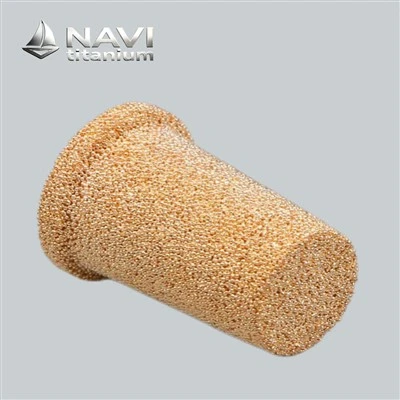
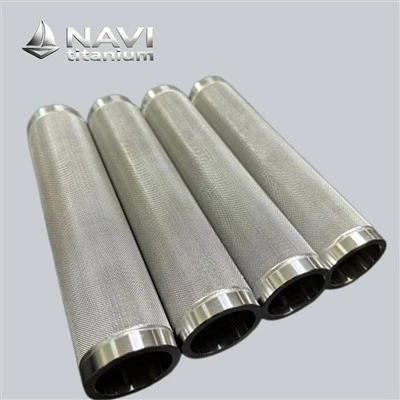
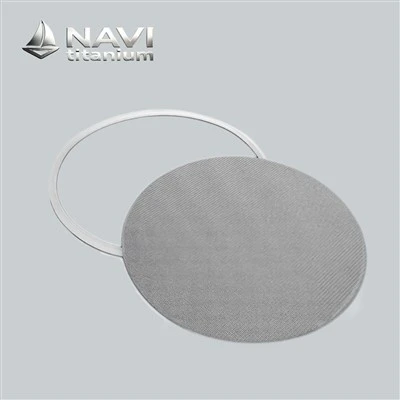
Porous metal sheet from NAVI Titanium is a flat porous component with interconnected internal passages for controlled gas or liquid flow. Its continuous pore network enables precise management of permeability, pressure distribution, and particle movement. We offers customized pore sizes, dimensions, and structures to meet diverse filtration, diffusion, and fluid-control requirements across industrial applications.
Solution of NAVI Titanium
NAVI Titanium's porous sheet is manufactured using a proven metal powder sintering process, providing a high-performance porous substrate with uniform, controllable pore structures. Suitable for precision filtration, electrochemistry, biomedicine, and high-temperature fluid separation, it exhibits excellent acid-alkali corrosion resistance, biocompatibility, and in-situ regeneration capability for stable operation under harsh conditions. Customized solutions are available for diverse filtration, permeability, and flow requirements. Detailed specifications are shown in the table below.


NAVI Titanium provides engineered porous filters designed for controlled gas and liquid transport, filtration, diffusion, and separation applications. By tailoring alloy selection, pore structure, thickness, and sheet geometry, we offer customized porous solutions for demanding industrial environments.


Application
Food & Beverage Processing

Food production requires components that combine hygiene requirements, mechanical durability, and compatibility with frequent sanitation procedures. NAVI Titanium porous metal filter are used in beverage clarification, fermentation equipment, gas dispersion units, and ingredient processing lines. Their rigid metallic body maintains dimensional stability during repeated CIP and SIP procedures, allowing consistent performance throughout multiple production cycles. The controlled internal channels support uniform media distribution while assisting with suspended solid separation. Stainless steel porous sheets are widely considered for food-contact environments because they tolerate temperature changes, cleaning agents, and repeated sanitation processes. In fermentation and carbonation applications, their planar format also provides controlled gas distribution, supporting consistent interaction between gas and liquid phases.
Precision hydraulic and aerospace equipment requires components capable of maintaining cleanliness under vibration, pressure fluctuation, and demanding mechanical conditions. Porous filter are incorporated into hydraulic circuits, lubrication units, fuel management assemblies, and precision fluid-control devices.
Their continuous metallic framework provides resistance against deformation caused by pressure changes and mechanical loading. Unlike flexible filtration media, sheet-based porous components maintain dimensional accuracy, which is important for protecting sensitive valves, pumps, and precision mechanisms.
Their flat geometry also allows integration into compact assemblies where space utilization is critical. Through different thicknesses, dimensions, and internal characteristics, NAVI Titanium porous metal sheets can be adapted to various fluid control requirements in aerospace and advanced machinery.

Purchasing guide

Quality control (QC)
NAVI Titanium's manufacturing factory is ISO 9001 certified, and every sheet undergoes strict quality inspection for porosity, permeability, and mechanical strength. To fully demonstrate our rigorous quality assurance system, we present these inspection reports for reference. Click the button below to view the COA and confirm the certified quality of our products.

Manufacturing Process
Our porous metal sheet is produced through a strictly controlled multi-stage process:
1. Raw Material Selection
High-purity metal powders (titanium, stainless steel, nickel, etc.) are selected and graded to ensure consistent particle size distribution and chemical purity.
2. Powder Screening & Batching
Powders are precisely sieved and blended according to target thickness, porosity, and pore size requirements, ensuring uniform and controllable pore structures.
3. Forming / Compaction
The powder is rolled or pressed into flat sheets with uniform green density and precise thickness using specialized forming equipment.
4. Sintering
Sintered at high temperatures in a protective atmosphere, the powder particles bond at their contact points, forming a strong, interconnected porous network while keeping the pores open.
5. Post-Processing
Sheets are cut, leveled, and surface-treated according to customer requirements, with options for rolling, welding, or multi-layer lamination.
6. Quality Inspection & Testing
Each sheet is tested for porosity, permeability, bubble point, and flatness, ensuring full compliance with specifications before shipment.
Difference Between Sheet, Disc and Plate
Although porous metal disc, sheet,and plate are all manufactured with interconnected porous structures, they are distinguished primarily by their geometry, dimensional characteristics, and intended functional role rather than by the porous material itself. Each form is developed to accommodate different installation methods, available space, and mechanical requirements. A sheet generally emphasizes broad planar coverage with a relatively thin profile, a disc is designed for circular interfaces and localized media transfer, while a plate typically incorporates greater thickness to provide additional rigidity and support. Understanding these differences helps engineers select the most suitable component according to assembly layout, flow path configuration, and operational demands instead of considering the three products as interchangeable alternatives.
porous metal Sheet

NAVI Titanium sintered metal sheet usually refers to a flat, thin porous metallic element with a rectangular or customized outline. Its primary characteristic is the combination of broad planar dimensions and relatively low-profile design. The sheet form is commonly considered when the component needs to cover a larger area or fit into a space where height limitation exists. Because of its planar geometry, it provides flexibility for cutting, shaping, or integration with other parts.
The main design considerations include:
- Overall dimensions
- Thickness requirement
- Internal passage characteristics
- Flatness control
It is a circular component designed around diameter-based dimensions. Compared with sheet products, discs usually provide a more standardized form that fits naturally into round housings, pipes, or compact assemblies. The circular shape simplifies positioning and sealing because the outer edge follows a consistent geometry. For systems where flow enters from one direction and exits through another, the disc format provides a convenient installation solution.
Key characteristics include:
- Circular geometry
- Defined diameter specification
- Compact installation footprint
- Convenient integration with round structures

porous metal Plate

It generally indicates a thicker and more rigid component. Compared with sheet products, plates place greater emphasis on dimensional strength and shape retention under mechanical loading.
Because of increased thickness, a porous plate can maintain its form when exposed to pressure differences, mechanical stress, or repeated handling. This makes it suitable for designs where the element itself needs to act as a structural component rather than only a functional insert.
Typical characteristics include:
- Greater thickness range
- Higher rigidity
- Stronger dimensional retention
- Suitability for supporting roles
Design Characteristics
The defining feature of porous metal sheet is the interconnected passage network inside the metallic body. These microscopic channels create multiple routes for fluid movement instead of relying on fixed openings.
During operation, different portions of the incoming medium may experience different travel distances. Some molecules or particles may move through relatively direct routes, while others encounter longer internal pathways. This variation influences the movement pattern inside the component and determines how the material interacts with passing media.
Therefore, the performance of a sheet is closely related to internal pore distribution rather than only the visible appearance of the product. Two sheets with similar external dimensions may demonstrate different flow behaviors because their internal passage arrangements are different.

Flat Form and Installation Adaptability

The sheet format provides a large planar area, making it suitable for designs where space utilization and contact area are important factors. Compared with cylindrical or circular forms, a flat sheet can cover a wider region while maintaining a relatively compact profile.
This configuration is often selected when the component needs to be positioned between different sections of an assembly, integrated into a panel-type structure, or used as a functional separation element.
The dimensional flexibility of porous sheet also allows designers to consider factors such as mounting position, available space, flow direction, and connection method during product development.
Applications
It is widely used as a liquid filtration medium in systems that require controlled fluid passage together with particle retention. Instead of relying on a single filtering surface, the interconnected pore network creates numerous internal routes that influence how liquid travels through the material. As fluid moves inside the porous body, suspended particles interact with the internal passages and may be retained at different depths according to their size and movement behavior.
This three-dimensional transport increases the available internal volume for contaminant capture while maintaining continuous liquid transmission. The flat sheet geometry also allows the component to be incorporated into modular assemblies where consistent flow across a broad area is required.

Gas Sparging

NAVI Titanium porous metal sheet is frequently used for gas sparging, where gases are introduced into liquids through a controlled porous medium. As gas passes through the interconnected pore network, it is divided into numerous smaller flow paths before entering the surrounding liquid. This promotes more uniform gas release across the entire sheet rather than concentrating flow at a few openings. The planar configuration provides a large active area, allowing gas to be distributed over a wider region while occupying relatively little installation space. Different pore characteristics and sheet dimensions can be selected to produce specific gas dispersion behaviors according to process requirements and operating conditions.
It serves as an effective flow distribution element in systems where liquids or gases need to be delivered evenly across downstream components. Incoming media often enters through a limited inlet area, creating localized velocity differences. The internal network redistributes the flow by directing it through numerous interconnected pathways before it exits the sheet. This transition reduces concentrated streams and produces a more balanced outlet profile across the available surface. Such characteristics are particularly valuable where downstream performance depends on consistent media delivery, making the porous sheet an important intermediate component between the inlet source and the following process stage.

Fluid Separation

It is also applied in fluid separation where different phases or unwanted solid materials need to be isolated during media transfer. The interconnected pore structure provides controlled passage for selected fluids while limiting the movement of larger particles or dispersed materials. Rather than functioning as a simple barrier, the porous body creates a gradual separation throughout its internal volume, allowing interaction between the transported medium and the pore network.
This characteristic helps manage complex fluid systems involving gas-liquid or liquid-solid mixtures. The sheet format further supports integration into compact assemblies requiring broad coverage and stable separation performance across the entire working area.
Our Professional Maintenance & Service Life Guarantee
With years of in-depth expertise in sintered metal sheets, we has established a complete and standardized maintenance system to solve common industrial pain points of improper upkeep, premature wear and shortened service life. Tailored strictly to the structural characteristics of vacuum-sintered porous Ti, our exclusive maintenance standards differ from ordinary metal maintenance solutions. Verified by thousands of industrial application tests, our systematic guidelines fully adapt to scenarios including chemical filtration, new energy aeration and water treatment. This professional standardized maintenance mechanism effectively avoids micropore blockage, plate deformation and reduced air permeability caused by irregular operation, ensuring stable and consistent working performance of porous sheets in long-term industrial operation.
Supported by a professional material R&D and technical team, we provide refined, full-scene maintenance guidance for all clients using sintered porous sheets. We formulate standardized operation rules covering daily operation, system start-stop and long-term shutdown scenarios, specifying core maintenance procedures such as low-pressure backwashing and regular micropore dredging,


while prohibiting damaging operations including high-pressure direct flushing and strong acid or alkali immersion. According to clients' actual working conditions, medium concentration and operating frequency, we customize exclusive maintenance cycles and usage suggestions. Scientific and standardized daily maintenance steadily maintains original porosity and permeability, greatly improving overall durability and effectively extending the service cycle of porous metal sheets.
NAVI Titanium offers lifelong free professional technical support and after-sales maintenance consultation to fully safeguard clients' long-term usage benefits. Every batch of our sheets is delivered with a detailed official maintenance manual, clearly clarifying daily upkeep key points, forbidden operations and common fault troubleshooting methods to lower your operational and technical threshold. Our experienced engineers provide rapid remote guidance and targeted optimization solutions for micropore blockage and performance attenuation. Continuous updated maintenance techniques help clients reduce replacement frequency, cut operational costs, and achieve stable, efficient and cost-effective long-term industrial production.
FAQ
How can I check whether a porous sheet is suitable before placing a bulk order?
+
-
Before committing to a large quantity, buyers should confirm the material grade, sheet dimensions, pore size range, permeability requirement, working temperature, pressure conditions, and the type of media passing through the sheet.
How do I know when a porous sheet needs to be replaced?
+
-
A noticeable increase in pressure drop, reduced flow, repeated blockage, permanent deformation, cracking, or difficulty returning to the previous permeability level after cleaning can indicate that the sheet is approaching the end of its usable period.
Can I order a porous sheet with a specific thickness, pore size, or sheet dimension?
+
-
Yes. Porous metal sheets can be produced according to agreed dimensional and performance requirements. Buyers may specify sheet length and width, thickness, material grade, pore range, permeability target, or additional machining requirements.
Can you provide samples before a customized order?
+
-
For customized porous metal sheets, sample evaluation can be arranged before a larger production order when the project requirements permit. Customers can use the sample to check dimensions, fitting, permeability, cleaning behavior, and compatibility with their process.
How do you help customers maintain consistency across repeat orders?
+
-
For recurring purchases, keeping the same material grade, dimensional requirements, pore range, inspection criteria, and batch records is important. We can retain the agreed technical specification for repeat orders and coordinate inspection requirements according to the customer's purchasing standard.
Hot Tags: porous metal sheet, China porous metal sheet manufacturers, suppliers, factory, Microporous Water Filter, Porous Stainless Steel Plate, Sintered Brass Filter, Sintered Bronze Filter Disc, Sintered Bronze Sheet, Sintered Stainless Steel Tube