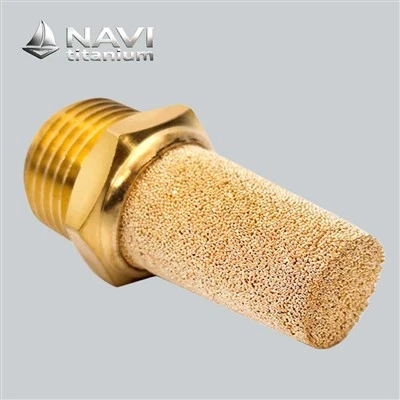
NAVI Titanium sintered bronze fuel filter is a reusable porous-flow part intended for small engines and marine supply lines, helping intercept unwanted particles before they enter sensitive passages. Its compact form suits space-limited assemblies, while the brass composition offers good resistance to routine exposure and repeated servicing. Buyers can request customized dimensions, connection formats, and retention grades according to the application. Batch-to-batch consistency and inspection records can also be discussed during procurement.
Solution of NAVI Titanium
NAVI Titanium maintains an organized warehouse and dispatch area where finished components, semi-finished stock, and titanium products are separated according to specification, batch, and order status. For filtration components used in fuel circuits, storage conditions matter because contamination, moisture, and careless handling can affect cleanliness before installation. Bronze powder-based elements are therefore packed individually or with protective inner layers before carton or reinforced outer-case packing. Each shipment is checked against the confirmed dimensions, quantity, identification marks, and packing records before carrier handover. This workflow helps keep compact filtration parts protected during transportation while giving purchasing teams clearer traceability from warehouse release to final delivery. Fuel-related duties commonly involve gasoline, diesel, lubricants, pumps, injectors, generators, and small engines, where stable flow and removal of rust or solid debris are important considerations.


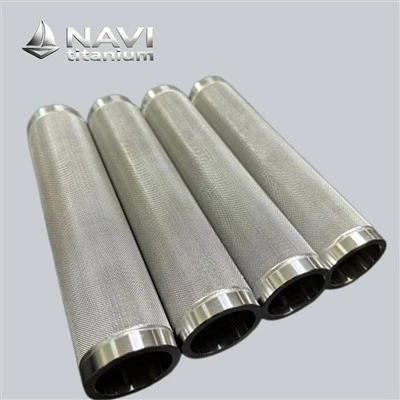
NAVI Titanium presents a compact flow-control insert shaped for demanding engine supply applications. The images highlight its uniform appearance, carefully formed passages, and practical cylindrical configuration, giving buyers a closer view of dimensional consistency and surface finish.


Application
Sintered bronze fuel filter is selected for compact power machines exposed to frequent startups, outdoor dust, vibration, and long storage intervals. Its internal configuration, supported by NAVI Titanium, helps maintain smoother liquid movement when supply conditions vary during daily use or seasonal operation. This solution is suitable for gasoline-powered machines used in landscaping, leisure activities, and portable power applications.
Compact gasoline-powered machines used in landscaping, agricultural tasks, emergency power generation, and leisure activities may encounter liquid containing dust particles, oxidation residue, or deposits formed during storage. Over time, these impurities can gather inside narrow carburetor channels and supply routes, resulting in uneven combustion, delayed startup, or reduced output performance.
A bonded granular body with numerous microscopic routes captures foreign particles while allowing smooth liquid movement through repeated usage periods. Unlike disposable alternatives, this reusable unit can be cleaned and returned to service, helping reduce replacement frequency over longer intervals. Its ability to tolerate heat exposure and common hydrocarbon liquids makes it suitable for generators, lawn cutters, chain saws, portable pumps, and other compact machines operating in demanding outdoor surroundings.

Marine Fuel Setups

Propulsion setups used in coastal and offshore applications often face moisture exposure, continuous vibration, and long storage periods. During extended idle stages, oxidation residue, sediment, and external particles may enter internal supply routes and gradually gather near injectors, carburetors, or pump assemblies. This accumulation may increase maintenance frequency and create uneven combustion results during prolonged journeys.
A diffusion-bonded granular body features multiple microscopic transfer paths that capture unwanted solid particles while allowing smooth liquid movement under changing load situations. NAVI Titanium supports this application with corresponding material selection and sizing guidance. Its resistance to hydrocarbon contact and repeated pressure variation makes it suitable for onboard supply applications requiring service. Common installations include outboard motors, inboard propulsion units, auxiliary generators, and onboard transfer setups operating in coastal or offshore surroundings.
Purchasing guide

Quality control (QC)
This porous metal element is engineered specifically for fuel delivery and combustion systems, where consistent flow, fine contaminant capture, and long service life under vibration and thermal cycling are essential. The structure is formed from copper-tin alloy particles bonded into a single rigid matrix, eliminating the risk of fiber migration or media breakdown associated with conventional pleated or wound elements.

Manufacturing Process
Bronze powder is first selected according to the intended fuel medium, operating temperature, filtration grade, and required flow behavior. Particle grading is then adjusted to establish a controlled internal passage network while retaining sufficient mechanical integrity for handling and installation. The classified powder is blended uniformly before being loaded into a precision mold shaped to the required cylindrical, tubular, or custom geometry. Controlled compaction gives the green body its preliminary dimensions and density distribution, with particular attention to wall consistency around fuel-flow passages. The compact is subsequently subjected to a carefully regulated sintering cycle, allowing adjacent bronze particles to form metallurgical bonds while preserving the interconnected openings needed for fluid transmission. Furnace atmosphere, heating rate, holding period, and cooling conditions are monitored because excessive consolidation can restrict fuel flow, whereas insufficient bonding may reduce structural stability. After thermal consolidation, sizing or light machining corrects critical dimensions, connection areas, and mounting surfaces.


Supply Continuity Planning
Supply continuity begins with visibility into future demand. For recurring purchasing, buyers can provide estimated quantities, expected order frequency, project schedules, or upcoming demand changes so that production planning can be arranged with greater awareness of the demand replenishment cycle. Previous order quantities and confirmed specifications can provide useful references when preparing repeat orders, while changes in quantity or requested delivery dates can be communicated before the next order is released. For customers with multiple purchasing stages, order timing can also be coordinated around project milestones rather than treating every purchase as an isolated transaction. Upstream partner coordination becomes particularly important when demand changes unexpectedly. A sudden increase in quantity, accelerated delivery request, reduced demand, or revised project schedule can be communicated before the next batch is arranged.

Documentation Continuity & Demand-Change Communication

Long-running supply relationships also depend on keeping purchasing information consistent from one order to the next. Confirmed drawings, specifications, inspection requirements, batch records, and related documentation can be retained as references for repeat purchasing. This reduces the risk of losing important information when a new buyer, QA reviewer, project manager, or purchasing contact becomes involved. Previous records can also help distinguish an unchanged repeat order from a revised requirement, particularly when several order versions exist over time.
When demand or specifications change, the updated information can be identified and confirmed before the next production release. Communication may cover quantity changes, delivery timing, revised drawings, inspection requirements, documentation requests, and project schedule adjustments.
Application
Complex Fuel Quality
Compact gasoline-powered machines may obtain liquid from portable containers, seasonal storage vessels, or temporary sources where cleanliness levels may change. During transportation and repeated refilling, airborne dust, rust fragments, damaged sealing residues, and organic deposits can gradually enter the circulation route.
The sintered bronze fuel filter is used in these situations to capture unwanted solid particles before they move toward sensitive internal areas. NAVI Titanium provides corresponding sizing guidance for different application requirements. Since many compact machines rely on narrow channels, even small accumulations may interrupt smooth liquid movement and affect combustion quality. Its bonded granular body with evenly distributed microscopic routes creates more balanced transfer conditions while lowering the possibility of gradual blockage during extended usage.

Long-Term Storage Challenges

Compact outdoor power units may stay inactive for extended periods between seasonal use cycles, with some remaining stored for several weeks or even multiple months. During these idle stages, gasoline contained in storage vessels may gradually lose its original quality as lighter substances evaporate and adhesive deposits or insoluble particles accumulate inside. Moisture trapped within partially filled containers can accelerate chemical changes and generate further unwanted residues.
When operation resumes after storage, these accumulated substances may move into circulation routes and interfere with narrow openings. A three-dimensional internal channel arrangement, supported by NAVI Titanium, gathers deposits produced during inactive periods and assists in recovering smoother liquid movement after lengthy downtime. This reusable approach helps decrease replacement demand while extending service intervals for compact power units exposed to seasonal storage patterns.
Portable power machines often operate across changing output demands, different temperatures, continuous vibration, dust exposure, and uneven outdoor surfaces. These external variations may alter liquid requirements, pressure patterns, and the quantity of unwanted particles moving through circulation routes.
The internal channel arrangement, with NAVI Titanium support, spreads incoming liquid across multiple microscopic paths rather than allowing concentrated movement in limited areas. This distribution method helps reduce localized accumulation and promotes smoother transfer when surroundings continue to change. With varying outdoor usage conditions, the internal configuration assists in preserving balanced supply performance and more consistent machine operation.

NAVI Titanium Engineering Expertise

NAVI Titanium focuses on improving liquid transfer performance through material adjustment and application-based optimization. Compact power machines are frequently exposed to dust, aged deposits and external impurities, which may gradually accumulate inside narrow internal routes and increase maintenance requirements.
The specially prepared internal matrix captures unwanted particles before they enter sensitive areas, helping preserve smoother circulation conditions over longer usage periods. This method reduces cleaning frequency, simplifies inspection tasks and assists outdoor machines that experience frequent startup cycles or extended idle stages. By controlling contamination sources at an early stage, the assembly helps lower long-term upkeep demands for compact engines operating in changing surroundings.
Effective liquid management has a direct connection with overall running costs for compact power machines. Frequent replacement of disposable parts, unexpected interruptions and additional maintenance activities may increase expenses throughout the service lifespan.
The reusable concept behind this passage unit allows cleaning and repeated application under suitable circumstances, reducing replacement requirements while keeping transfer quality at an acceptable level. Its internal arrangement balances particle capture capability with smooth circulation, helping limit unnecessary energy consumption caused by restricted routes. Longer service intervals and reduced resource usage create additional economic benefits for users seeking practical cost control.

Adaptation to Challenging Surroundings

Outdoor engines often operate under changing temperatures, continuous vibration, dust exposure, and extended storage periods. These external factors place higher requirements on liquid transfer paths, especially when machines experience repeated startup cycles and variable usage patterns.
The fused bronze retention unit features an internal arrangement with multiple connected routes that adapt to different supply demands while limiting the movement of external particles. NAVI Titanium provides application-oriented sizing guidance for such configurations. Its resistance to hydrocarbon contact and temperature variation allows compact machines to perform across farmland, remote areas, and recreational locations. This adaptable capability helps preserve smooth liquid circulation even when surrounding conditions shift during outdoor applications.
Consistent liquid supply is important for achieving stable combustion and continuous power generation in compact engines. Suspended particles, uneven liquid quality and changing demand levels may disturb combustion efficiency and create fluctuations during operation.
The internal route arrangement distributes incoming liquid through multiple channels instead of concentrating movement in a limited area. This approach helps reduce sudden restrictions and creates more even supply during acceleration, long running periods and frequent startup cycles. Through controlled internal circulation, engines can achieve smoother performance and reduced output variation across different outdoor applications.

FAQ
1. Can your team review our drawings before quotation?
+
-
Yes. Customers can send drawings with dimensions, material requirements, tolerances, connection details, and application information for review. Our team can check whether the requested specifications are suitable for production and identify any details that may need clarification before pricing.
2. Can you reproduce a product supplied by our previous supplier?
+
-
Yes. An existing item can be evaluated using a drawing, sample, photographs, or available specification data. This option is useful when customers need a replacement for an existing supplier, discontinued model, or imported part.
3. Can you maintain consistent performance between different batches?
+
-
Batch consistency is treated as an important purchasing consideration, especially for customers placing repeat orders. Key specifications are checked against the confirmed requirements before shipment, with attention given to dimensions, material characteristics, opening parameters, and functional performance.
4. Can this product be reused after cleaning?
+
-
Yes. After proper cleaning, this unit can continue to be applied for repeated service cycles. Removing collected impurities restores smoother internal liquid movement and helps reduce replacement frequency during long-term usage.
5. Why is this product suitable for outdoor power applications?
+
-
Outdoor power machines are frequently exposed to vibration, temperature variation, airborne dust, and long storage periods. This product is designed for these demanding surroundings, with an internal passage arrangement that helps preserve steady physical performance and resist contact with hydrocarbon liquids.
Hot Tags: sintered bronze fuel filter, China sintered bronze fuel filter manufacturers, suppliers, factory, Porous Media Filter, Sintered Air Filter, Sintered Bronze Filter Disc, Sintered Metal Sheet, Sintered Metal Tube, Sintered Powder Filter