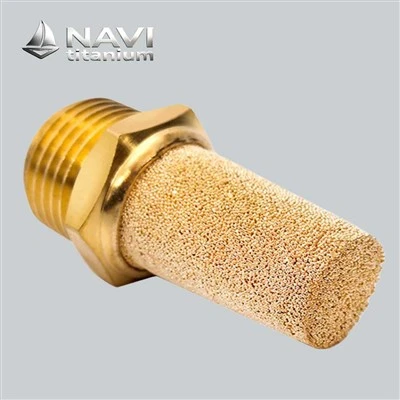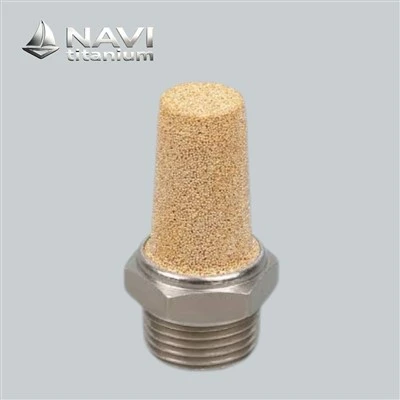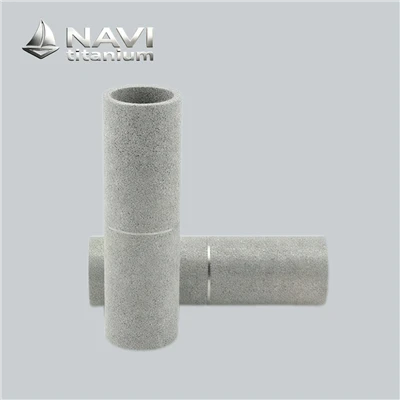


NAVI Titanium sintered powder filters are manufactured through advanced powder metallurgy processes, where carefully selected metal powders are transformed into rigid porous structures through controlled thermal bonding. Unlike conventional metal components produced by melting or machining, NAVI Titanium filters rely on solid-state diffusion during the sintering process. Precisely classified spherical or irregular metal powders are compacted by isostatic pressing or customized molding methods, followed by vacuum or inert-atmosphere sintering at approximately 60%–80% of the material melting temperature. During heating, atomic diffusion occurs between adjacent powder particles, forming stable sintering necks and gradually converting individual particles into an integrated metallurgical structure. NAVI Titanium manufacturing mechanism enables precise control of pore size distribution, mechanical strength, and long-term structural stability without introducing liquid-phase melting or altering the intrinsic properties of the base metal.
Solution of NAVI Titanium
The integrated metallurgical structure formed during powder sintering provides sintered filters with excellent dimensional stability, mechanical strength and long-term structural reliability. Compared with conventional porous materials assembled by bonding or surface coating methods, the fully fused metal framework maintains consistent pore geometry under repeated pressure changes, thermal cycling and regeneration processes. The combination of controlled pore distribution, high structural integrity and durable material properties enables the filters to achieve stable performance throughout extended service periods, making them suitable for demanding industrial filtration systems requiring long-term reliability.


Application
NAVI Titanium sintered powder filters are manufactured through a high-temperature sintering process, in which metal powder particles are metallurgically bonded together to form a uniform and continuous metal framework. Under temperature fluctuations, moisture is less likely to form a long-lasting stable condensation layer on the surface; when wet dust contacts the surface, it is less likely to undergo wetting, bonding, or caking. Attached particles can be more easily removed through operating airflow disturbance, back-purging, or cleaning processes. This fundamentally reduces the accumulation of deposits, localized blockage, and continuous increase in operating resistance under high-humidity, high-dust, and temperature-variable conditions.
Coal-fired boilers, biomass boilers, gas-fired boilers, and various industrial furnace exhaust systems are continuously exposed to harsh conditions characterized by both high dust loading and high humidity. Equipment start-up and shutdown, load fluctuations, and day-night temperature variations can cause frequent changes in flue gas temperature, easily resulting in condensation inside the equipment. When conventional purification components encounter moisture, dust particles tend to absorb water and form sticky deposits, gradually developing into mud-like scale or even hardened agglomerates. As operation continues, the deposited layer accumulates, causing reduced gas flow channels, continuously increasing system resistance, higher induced draft fan loads, and frequent shutdowns for cleaning and maintenance, seriously affecting continuous production.


NAVI Titanium sintered powder structure provides a stable metal framework and uniform surface characteristics, reducing the risk of long-term moisture retention and wet dust adhesion in humid flue gas environments. Even under high humidity and continuous temperature fluctuations, the surface is less likely to form a stable condensation layer, preventing dust particles from combining with moisture to create sticky contaminants. A small amount of particles attached to the surface mainly remains in a loose state and can gradually detach through system cleaning, back-purging, or airflow disturbance, effectively reducing continuous contaminant accumulation. It helps solve condensation and dust accumulation issues caused by low winter temperatures and frequent start-stop operation of boilers and furnaces, enabling long-term stable operation and significantly reducing shutdown maintenance frequency.
Purchasing guide

Quality control (QC)
Quality assurance is maintained throughout manufacturing, with each production batch supported by a corresponding inspection report. Depending on the product and application, inspections may cover chemical composition, mechanical properties, dimensions, surface condition, and corrosion resistance. Test records are documented and traceable, giving customers clear technical evidence for evaluating material conformity and product suitability.
|
|

Manufacturing Process
Craftsmanship is the core foundation of product quality, and it has been core strength in the industry for over a decade. Throughout the entire production process, NAVI Titanium sticks to meticulous control at every step, from selecting raw materials, melting and forging, precision processing, fine polishing, surface treatment to final shaping. Every procedure has its own set of craft standards and operating norms to ensure detailed management throughout. Unlike the industry's standard manufacturing processes, we can flexibly adjust the process based on customers' custom needs, optimizing product structures and performance parameters to precisely match the material requirements for various high-end applications. The article below will give a full look at the core crafting techniques, process flows, advantages, and tech highlights of the entire product line, clearly showing how each product transforms from raw material to finished piece.
|
|
|
 |


Products Comparison
Sintered plastic and sintered metal both use porous structures for filtration and flow-control applications, but their material characteristics suit different operating conditions. The table is for your reference.
| Feature | Sintered Plastic | Sintered Metal |
| Typical Materials | PP, PE, PA, PTFE, PVDF | Titanium, SS304, SS316/316L, Ni alloys |
| Temperature Resistance | Generally lower | Generally higher |
| Pressure Capability | Suitable for moderate-pressure applications | Better suited to higher-pressure conditions |
| Porosity Control | Available in different pore ranges | Wide range of controlled pore structures |
Application Cases
Chemical process exhaust gases contain not only fine particulate matter but also large amounts of saturated water vapor, light volatile components, and complex reaction by-products. The gas composition is complicated, and some contaminants have strong adhesion characteristics. Under alternating hot and cold operating conditions, conventional equipment surfaces are prone to forming condensation layers. Fine dust combined with liquid phases can form highly viscous deposits that gradually adhere to internal equipment surfaces. Long-term accumulation may create difficult-to-remove contamination layers, causing system pressure fluctuations and increased operating resistance. This not only increases energy consumption but also affects the stability of exhaust gas treatment.


NAVI Titanium sintered powder filter component adopts an integrated sintered structure, avoiding localized accumulation areas caused by conventional processing or connection methods. The surface exhibits excellent stability and contamination resistance. The material itself has a low tendency for water vapor and fine particles to adhere, preventing condensed moisture from remaining for long periods and forming continuous coverage layers. Dust particles are also less likely to become sticky agglomerates after absorbing moisture. Regardless of changes in exhaust gas composition or alternating temperature conditions, the component maintains strong resistance to deposit formation, reduces blockage risks during long-term operation, and meets the requirements of continuous and uninterrupted chemical production processes.
Metallurgical melting, heat treatment quenching, and forging heating furnaces often operate under intermittent production conditions, involving frequent start-stop cycles and significant fluctuations in exhaust gas temperature. Furnace gases contain fine metal particles, oxide dust, and other particulate matter. These particles are small in size, lightweight, and highly prone to adhesion. Combined with condensation generated during start-stop operations, they can create repeated cycles of dust accumulation and deposition inside equipment. Long-term operation may lead to restricted airflow passages, unstable operating resistance, and increased maintenance frequency.


Based on the overall sintered powder metallurgical structure, this component offers excellent thermal stability and structural integrity, allowing it to withstand repeated thermal cycling caused by frequent temperature variations. The uniform and stable metal surface reduces the possibility of mechanical embedding and long-term adhesion of dust particles, preventing fine particles from forming continuously growing deposits. During equipment cleaning, airflow disturbance, or purging processes, attached contaminants can be more easily removed, reducing the thickening and hardening of dust layers. It is well suited for intermittent and fluctuating furnace operating conditions, effectively improving condensation and dust accumulation issues caused by temperature changes.
Waste incineration, food waste treatment, and solid waste combustion exhaust gases represent some of the most complex industrial treatment environments. These gases typically feature high humidity and complex compositions, with dust containing large amounts of organic matter, salts, and adhesive components. After absorbing moisture, these particles tend to exhibit strong adhesion characteristics. During long-term operation, conventional equipment surfaces are easily covered by wet dust layers, which gradually develop into sludge-like deposits or hardened residues. This can restrict airflow channels, increase operating resistance, and require frequent cleaning, making it a typical high-contamination and high-maintenance application.


NAVI Titanium component adopts an integrated sintered powder metallurgical structure, and the metal surface has low moisture adsorption and low dust adhesion characteristics, effectively reducing the long-term retention of wet contaminants on the surface. Moisture in high-humidity flue gas is less likely to form stable adhesion layers, while dust containing organic matter and salts is less likely to rapidly wet, bond, and develop into stubborn deposits. Even under long-term exposure to high-humidity, high-viscosity, and chemically complex exhaust gases, attached contaminants can be more easily removed through airflow disturbance or cleaning processes, reducing deposit-related blockage and extending maintenance intervals. It is suitable for long-term high-load operation in solid waste treatment systems.
OEM Manufacturing for Porous Metal Components
NAVI Titanium provides OEM manufacturing for sintered powder filters and porous metal components used in industrial equipment and process systems. Manufacturing can be based on customer drawings, technical specifications, reference samples, or application requirements. The production scope covers material selection, powder grade, pore size, porosity, outer diameter, length, wall thickness, filtration area, connection structure, and other dimensional details. Different shapes, including cartridges, discs, plates, tubes, rings, and specially shaped porous parts, can be developed for integration into existing equipment. Threaded ports, welded sections, mounting structures, and other functional features can also be incorporated into the design according to the customer's assembly requirements.


OEM cooperation can cover the complete process from initial concept and prototype development to trial production and recurring orders. Before production, technical requirements are reviewed to determine a suitable powder composition, forming method, sintering process, and machining route for the intended working conditions. For customers with an existing component, reverse engineering can be used to reproduce the required geometry and functional specifications from a sample. Prototype quantities can be arranged for testing and equipment verification before larger production runs. Once the specification and manufacturing parameters are confirmed, the same production route can be maintained for subsequent orders to improve batch consistency. This approach is suitable for equipment manufacturers, filtration system integrators, engineering companies, and industrial buyers looking for a long-term OEM manufacturing partner rather than an off-the-shelf filter supplier.
FAQ
01.Can sintered filters be customized in different shapes?
02.Can the dimensions and filtration specifications be customized?
03.Can sintered metal filters be customized with different connection structures?
04.Does NAVI Titanium support integrated sintered filter assemblies?
05.Can NAVI Titanium develop sintered metal filters from existing samples?
Hot Tags: sintered powder filter, China sintered powder filter manufacturers, suppliers, factory, Bronze Filter Element, Porous Stainless Steel Plate, Sintered Filter Plate, Sintered Metal Filter Cartridge, Sintered Metal Powder, Sintered Powder Filter Cartridge