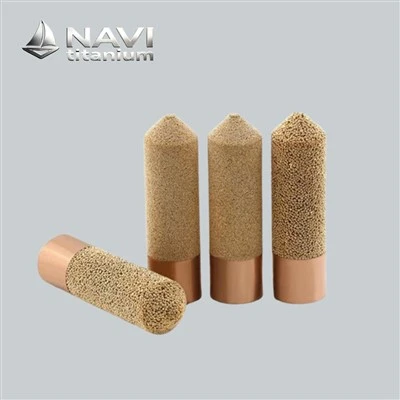
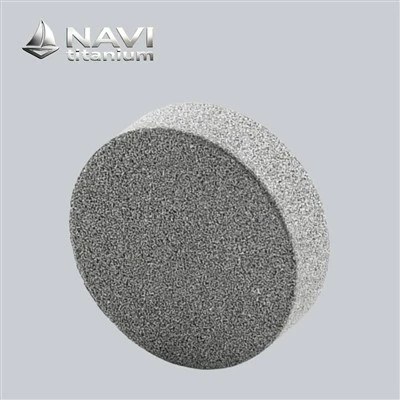
Sintered bronze bar of NAVI Titanium are cylindrical metal bodies produced by powder metallurgy using carefully graded copper-alloy powder that is compacted and thermally bonded below the alloy's melting point. During thermal consolidation, neighboring powder grains form diffusion bridges while continuous microscopic passages remain throughout the body. This manufacturing route creates a rigid metallic matrix that supports uniform passage of gases and liquids through the entire cross-section rather than only along the exterior.
Solution of NAVI Titanium
Sintered copper bar from NAVI Titanium is made by a proven metal powder sintering process, delivering high-performance porous metal substrates for precision filtration, electrochemistry, biomedicine, and high-temperature fluid separation. It offers excellent acid and alkali corrosion resistance, biocompatibility, uniformly distributed and controllable pore structure, and in-situ regeneration for stable operation under harsh, corrosive, high-temperature, and high-pressure conditions. Customized filtration, air permeability, and flow solutions are available. See specifications below.



NAVI Titanium has developed specialized sintered bronze tailored for different filtration, flow-control, and gas or liquid distribution requirements. We offer customized processing for bars in various diameters, lengths, pore sizes, and configurations, suitable for pneumatic systems, fluid filtration, gas diffusion, silencers, and industrial equipment.


Application
NAVI Titanium bronze elements are frequently installed inside pneumatic exhaust devices, acoustic silencers, and gas dispersion assemblies where smooth airflow and even gas release are essential. Their three-dimensional passage architecture divides compressed air into numerous microscopic streams, transforming turbulent discharge into a more uniform outlet while minimizing vibration and acoustic emissions.
In many manufacturing systems, regulating fluid movement is equally important as removing unwanted contaminants. Sintered bronze bar are commonly employed as integrated restrictors that moderate the movement of gases or liquids by producing a predictable resistance throughout their internal passage architecture. Unlike small drilled orifices that can clog easily or create unstable discharge characteristics, the distributed passage system spreads hydraulic resistance across the entire body, allowing fluids to travel evenly through thousands of microscopic channels.
This volumetric resistance creates smoother transport behavior, minimizes abrupt operating fluctuations, and maintains consistent performance when inlet conditions change. Because resistance is generated throughout the full body rather than at a single opening, these bronze rods deliver repeatable transport characteristics while remaining less sensitive to localized blockage.


2.Sensor Protection And Process Instrumentation

NAVI Titanium bronze porous rods are widely incorporated as protective interfaces for sensing devices and analytical instruments operating in demanding environments. Pressure transmitters, thermal probes, flowmeters, and analytical sensors may encounter dust, condensed moisture, suspended contaminants, and mechanical disturbances that can influence measurement accuracy or affect sensitive internal elements.
A bronze porous rod creates an intermediate separation layer between the process stream and the sensing device, allowing gases or liquids to access the instrument while reducing the impact of external contamination and sudden variations in operating conditions.
The rigid metallic body provides physical protection while maintaining necessary exchange between the surrounding environment and the instrument. At the same time, its fine internal passage arrangement supports gradual environmental adaptation and helps minimize localized disturbances that could otherwise influence measurement stability.
Purchasing guide

Quality control (QC)
NAVI Titanium's ISO 9001-certified factory ensures every sintered bronze rod meets strict quality standards. Click below to view the COA and quality inspection reports, confirming its pore structure, permeability, and corrosion resistance. Review the documents and request your quotation today.

Manufacturing Process
NAVI Titanium's sintered bronze bar is manufactured through a controlled metal powder sintering process. Bronze powder is precisely graded, uniformly mixed, and filled into molds, then sintered at high temperature in a vacuum or protective atmosphere. During sintering, powder particles bond into a rigid, porous structure with uniformly distributed, controllable pores. The bars are then cooled, machined, cleaned, and inspected for pore size, permeability, and mechanical strength. This process delivers strong, corrosion-resistant, biocompatible porous bronze substrates suitable for precision filtration, electrochemistry, biomedicine, and high-temperature fluid separation. Customized pore sizes, dimensions, and flow rates are available.


Invisible Interface Between Media and Mechanical Systems
NAVI Titanium bronze porous rod performs one of these hidden roles. Installed inside pneumatic units, lubrication assemblies, analytical instruments, and process installations, it serves as a transition element rather than simply separating contaminants. By moderating the exchange of fluids and gases between adjacent sections, it reduces sudden operating variations and promotes smoother interaction throughout the entire assembly.
Whenever gases or liquids enter an enclosed assembly, rapid changes may occur around sensitive mechanisms. Direct exposure can create localized disturbances that influence operating consistency or measurement accuracy.
NAVI Titaniumsintered bronze rod provide an intermediate passage that redistributes incoming fluids before they reach critical areas. Instead of concentrating movement through a single opening, countless microscopic passages disperse the incoming stream across the entire body, creating a smoother transition between external conditions and internal mechanisms.
This design is especially suitable for compact pneumatic devices, regulators, and analytical instruments where additional valves or dedicated regulating hardware would increase design complexity or occupy valuable installation space.

Regulating Fluid Behavior Inside Mechanical Assemblies

Movement of gases and lubricants rarely remains constant during operation. Exhaust cycles, intermittent lubrication, pressure variation, and repeated start-stop sequences continually alter internal operating conditions. Rather than actively controlling these changes, a bronze porous rod passively moderates how gases, lubricants, and process liquids travel through an assembly. Distributed resistance throughout the metallic body transforms abrupt movement into a steadier transfer process, helping create more uniform operating conditions.
Within pneumatic exhaust units, this approach promotes smoother air discharge. Inside lubrication assemblies, it encourages more even distribution between lubricant reservoirs and moving mechanisms without relying on additional regulating devices. Although the element contains no moving parts, its presence reshapes the interaction between surrounding fluids and mechanical hardware.
Modern machinery increasingly integrates multiple functions into increasingly limited installation space. Conventional solutions often require several individual parts such as throttling devices, diffusion chambers, or auxiliary regulators.
NAVI Titanium bronze porous rods combine several passive functions within a single cylindrical body, allowing straightforward installation inside miniature pneumatic assemblies, precision instruments, portable machinery, and compact automation devices. Their simple geometry makes integration easier while reducing overall design complexity.
For engineers working with space-constrained assemblies, this approach provides an effective alternative without introducing additional mechanical hardware.

Alternative to Conventional Passive Hardware

Certain operating conditions demand more than simple orifices, protective screens, or diffuser plates. Traditional hardware may be unable to distribute gases or liquids evenly while simultaneously protecting sensitive internal parts.
Sintered bronze bar offer another solution by combining gas dispersion, lubrication distribution, exhaust conditioning, and contamination shielding within one metallic element. Instead of functioning as a conventional screening device, they become part of the fluid-management pathway itself, allowing the surrounding assembly to perform multiple tasks using fewer individual parts.
Rather than acting as a direct substitute for a conventional filter, they provide a different approach: allowing the component itself to become part of the media management process.
The influence of a bronze porous rod often remains unnoticed because it operates without visible movement or external adjustment. Nevertheless, it continuously shapes how compressed air, lubricants, and processing fluids interact with surrounding mechanisms. From moderating pneumatic exhaust to supporting lubricant distribution and stabilizing process conditions, these passive metallic elements quietly influence everyday machine performance.
The success of many mechanical systems depends not only on active devices but also on carefully designed transition elements that connect different operating zones in a gradual and predictable manner. Rather than being viewed simply as a metallic porous product, NAVI Titanium bronze porous rod serves as an engineering interface that quietly governs the movement of fluids and gases throughout complex mechanical assemblies.

Reducing Disturbance in Sensitive Operating Environments

Many precision systems rely on delicate mechanisms that must function under carefully maintained operating conditions. Measuring instruments, regulating valves, pneumatic actuators, and miniature assemblies are designed to respond accurately without being affected by sudden changes in surrounding gas or liquid movement.
Sintered bronze rod acts as a passive transition element between the outside environment and these sensitive areas. Instead of allowing gases or liquids to enter directly, it redistributes incoming streams through numerous microscopic passages, creating a smoother exchange process and minimizing abrupt operating variations.
This function is especially valuable in analytical instruments, precision control devices, laboratory assemblies, and pneumatic units, where gradual fluid movement helps maintain consistent operating behavior and protects delicate mechanical elements from unexpected disturbances.
NAVI Titanium - Engineered for Longevity, Maintained for Life
Choosing a sintered bronze rod is an investment in reliability, and at NAVI Titanium, we ensure that investment pays dividends for years. Every rod we produce undergoes rigorous density, porosity, and hardness testing before leaving our facility, giving you complete confidence in consistent quality batch after batch. Our sintered rod is self-lubricating by design, with a controlled pore structure that retains oil and releases it gradually during operation, dramatically reducing wear in bearings, bushings, and sliding components. Customers across automotive, industrial machinery, and marine sectors have trusted our materials for over a decade, with documented field performance exceeding industry standards. We back every shipment with full material certification, traceable production records, and responsive technical support. When you specify our sintered bronze rods, you are not simply buying a component - you are partnering with a manufacturer committed to your operational success. Proper maintenance is the key to unlocking the full service life of your sintered bronze bars, and the good news is that upkeep is straightforward.


Because the material's interconnected pores hold lubricating oil, regular re-oiling is the single most important task: inspect components every 500 to 1,000 operating hours and replenish with a compatible mineral or synthetic oil when reserves run low. Avoid using solvents or aggressive degreasers, as these can strip oil from the pores and cause premature wear. Keep the working environment free from abrasive dust and metal particles, which can embed in the surface and accelerate abrasion.
Operating temperatures should stay below 120°C to prevent oil degradation and loss of self-lubricating properties. Following these simple guidelines typically extends component life by 30 to 50 percent, protecting your equipment and your budget simultaneously.
Even with excellent upkeep, periodic inspection helps you catch small issues before they become costly failures. Check for dimensional changes, surface scoring, or unusual noise during operation - these are early indicators of lubrication loss or overload conditions.
If a bar requires cleaning, use only mild soap solutions and allow thorough drying before re-oiling, ideally through vacuum impregnation for maximum pore saturation. Store spare sintered bronze rods in their original packaging, in a dry, cool location away from direct sunlight, and keep them lightly oiled to prevent oxidation. Should you ever encounter a maintenance challenge, our engineering team provides free consultation, detailed care documentation, and replacement recommendations tailored to your application.
At NAVI Titanium, service does not end at delivery - we remain available throughout your product's entire lifecycle, ensuring your confidence in every order.
Frequently Asked Questions
How do I choose the right bronze grade for my working conditions?
+
-
The bronze grade should be selected according to the medium, temperature, pressure, mechanical requirements, and expected service conditions rather than by appearance alone. If the material grade is not already specified in your drawing, we can review the operating information and help identify a suitable option.
Will the working medium affect the choice of sintered bronze rod?
+
-
Yes. Different liquids and gases can interact differently with bronze materials. When requesting a quotation, customers should identify the medium, concentration if applicable, temperature, and whether other chemicals are present. This information is important when checking material compatibility before production.
What if the operating pressure changes during production?
+
-
Pressure fluctuation should be considered during product selection. A bar designed around one fixed pressure may not be the best choice when the actual process repeatedly moves between different pressure levels. Providing the normal pressure, peak pressure, and frequency of pressure changes allows us to make a more appropriate recommendation.
Will cutting the sintered bronze rod change its filtration characteristics?
+
-
Potentially. Cutting or modifying a porous component exposes new internal passages and may change the behavior at the cut area. If a bar needs to be shortened or modified after delivery, customers should first confirm whether the modification is acceptable for their intended process.
Can the same specification be used for both gas and liquid service?
+
-
Not automatically. Gas and liquid processes can have different flow, pressure, contamination, and retention requirements. A specification that works well in one medium should not simply be transferred to another without checking the operating conditions.
Hot Tags: sintered bronze bar, China sintered bronze bar manufacturers, suppliers, factory, Porous Stainless Steel Tube, Sintered Bronze Filter, Sintered Bronze Plate, Sintered Metal Powder, Sintered Metal Powder Filter, Sintered Metal Tube