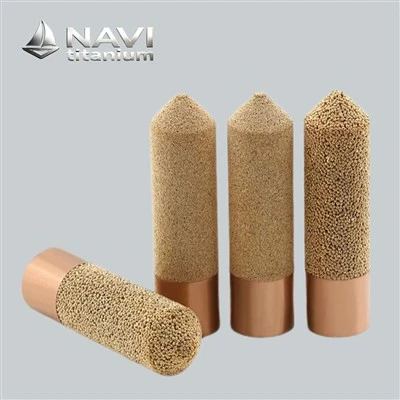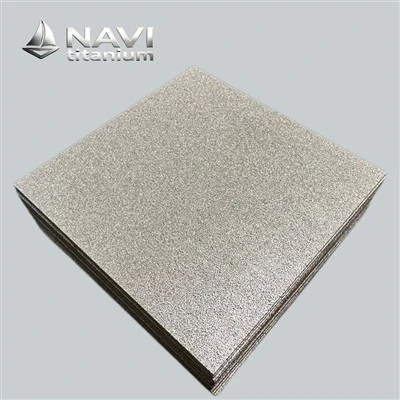


NAVI Titanium sintered metal filter cartridge is an advanced filtration component with a three-dimensional, interconnected pore structure, formed through a high-temperature sintering process. The materials include metal powder, metal fiber mesh, metal particles, or porous metals. Since its establishment, NAVI Titanium has relied on its own production base to support custom processing for non-standard sizes, special-shaped structures, and welded assembly components. They can complete prefabricated products according to drawings, significantly reducing the amount of on-site secondary processing for customers.

Solution of NAVI Titanium


Application
Seawater is an extremely complex, highly corrosive, highly polluted, and biologically active natural fluid system. Compared with ordinary industrial water filtration, seawater filtration faces challenges not only from suspended particles and sediment pollution, but also from high concentration chloride ion corrosion; Multiple salt crystal deposits; Microbial attachment and biofilm formation; Marine organic pollution; Material fatigue caused by temperature changes; High pressure, high flow velocity impact; Long term unmanned maintenance operation. Therefore, precision filtration of seawater is not simply about "filtering particles", but a comprehensive system involving materials science, corrosion engineering, fluid dynamics, surface interface engineering, and pollution control technology. Traditional filtering materials, such as PP filter cartridges; Fiberglass filter cartridge; Filter cloth; Ordinary stainless steel mesh; Although it can meet some of the seawater pretreatment needs, it is prone to intensity decline in long-term marine environments;


Aperture variation; Corrosion failure; Biological pollution; Frequent replacement. And the sintered metal filter uses titanium powder sintering; Hastelloy sintering; Nickel based alloy sintering; High grade 316L stainless steel sintering; Forming a stable three-dimensional porous structure, the filter element simultaneously possesses the ability to resist seawater corrosion, high-precision filtration, long term operation, and renewable circulation. Especially sintered metal filter cartridge, due to the formation of a stable TiO ₂ passivation film on their surface, exhibit strong stability in chloride ion, high salt, and high oxygen environments, and are considered important materials in seawater filtration, high-purity water preparation, marine engineering, and seawater desalination fields.
Purchasing guide

Quality control (QC)


Technical Specification Table
NAVI Titanium manufactures sintered metal filter cartridges in titanium, stainless steel, nickel and other metal materials for demanding liquid and gas filtration applications. Filter rating, pore structure, dimensions, connection configuration and operating parameters can be customized according to the filtration medium and system requirements. The specifications below provide a general selection framework; application-specific parameters should be confirmed through engineering evaluation.
| Specification | Details |
| Product | Sintered Metal Filter Cartridge |
| Materials | Titanium / Stainless Steel / Nickel / Bronze / Custom |
| Filtration Rating | Customizable |
| Pore Size | Customizable |
| Filter Structure | Sintered porous metal |
| Shape | Cylindrical / Tubular / Disc / Plate / Custom |
| Dimensions | Custom according to drawing or application |
| Operating Temperature | Material and application dependent |
| Operating Pressure | Design and application dependent |
| Cleaning Method | Backwashing / Ultrasonic / Chemical Cleaning* |
| OEM / ODM | Available |
| Customization | Material / Micron Rating / Dimension / Connection / Structure |
NAVI Titanium doesn't just sell a single standard size filter; it can be custom-engineered based on working conditions.
| Engineering Selection Parameters | ||
| Parameter | Why It Matters | Information Required from Customer |
| Filter Rating | Determines target particle retention | Required micron rating |
| Flow Rate | Determines effective filtration area | L/min, m³/h or Nm³/h |
| Operating Pressure | Determines structural design and pressure resistance | Normal / Maximum pressure |
| Operating Temperature | Affects material stability and sealing | Normal / Maximum temperature |
| Filter Medium | Determines chemical compatibility | Liquid / Gas + composition |
| Particle Type | Influences retention and loading behavior | Particle size / concentration |
| Filter Dimensions | Determines installation compatibility | OD / ID / Length |
| Connection | Determines system integration | Thread / Weld / Flange / Custom |
| Cleaning Method | Influences pore structure and service life | Backwash / Ultrasonic / Chemical |
| Material Requirement | Determines corrosion resistance and durability | Titanium / 316L / Nickel / Custom |
| Annual Quantity | Helps determine production and quotation | pcs/year |
Marine & Offshore Engineering
The marine water environment is one of the most demanding corrosion and filtration operating conditions in the industrial sector. Unlike conventional freshwater and industrial recirculating water media, natural seawater exhibits five key characteristics: high salinity, high chloride ion activity, the presence of multiple coupled impurities, dynamic fluctuations in operating conditions, and biofouling. These characteristics pose a comprehensive and rigorous challenge to the corrosion resistance, precision, stability, and durability of filtration elements. In the field of precision seawater filtration, sintered metal filter cartridge primarily encompass four mainstream material systems: 316L stainless steel, duplex stainless steel, high-purity titanium alloys, and Hastelloy. These materials can be precisely selected and matched based on seawater salinity, temperature, pressure, impurity characteristics, and corrosion intensity. Their integrated sintered structure completely eliminates the problems of delamination, wire breakage, and deformation common in woven filter screens. The controllable gradient pore structure enables an efficient filtration logic of "coarse on the outside, fine on the inside, with layer-by-layer retention," balancing high filtration precision, high flow rate, low pressure drop, and strong dirt-holding capacity. At the same time, the metal matrix's excellent mechanical strength, temperature and pressure resistance, and impact resistance enable comprehensive coverage of all seawater operating conditions-including nearshore, deep-sea, high-temperature, high-pressure, high-salt-fog, and alternating wet-dry environments-overcoming the limitations of traditional filtration materials in adapting to such conditions.
Differences in Corrosion and Filtration Characteristics Across Different Seawater Operating Zones
All seawater operating conditions can be precisely divided into five core zones: the marine atmosphere zone, the splash zone, the tidal zone, the fully submerged zone, and the deep-sea high-pressure zone. Each zone exhibits significant differences in corrosion intensity, impurity characteristics, and operating parameters, resulting in entirely different core performance requirements for filter elements. These differences serve as the fundamental basis for filter element material selection, structural design, and process optimization.


Marine Atmosphere Zone: This primarily involves open-air conditions for offshore equipment that is not directly submerged in seawater. The main factors here are salt fog corrosion, alternating wet and dry cycles, and UV aging. Salt fog from the air settles on the filter element's surface, forming a thin liquid film of electrolyte. During the alternating wet and dry cycles, salinity concentrates, causing a significant increase in chloride ion concentration. The passivation film is repeatedly disrupted and regenerated, which can easily lead to minor pitting and rusting. Under these conditions, impurity levels are low, and filtration pressure and flow rates are stable. The core requirements are resistance to salt fog corrosion and aging, as well as a surface that is resistant to dust accumulation and scaling.
Seawater Splash Zone: Filter elements are subjected to prolonged exposure to seawater splashes without continuous immersion. This zone experiences the most frequent wet-dry cycles and exhibits an extremely strong salt fog concentration effect, making it the most severe marine corrosion environment. This area has an abundant oxygen supply, resulting in intense electrochemical corrosion reactions. At the same time, continuous seawater splashing causes high-speed erosion and wear. The dual effects of corrosion and physical wear are highly likely to cause continuous damage to the passivation film on the filter element's surface and rapid corrosion and degradation of the substrate.


Impurities in this operating environment consist primarily of sediment and suspended particles carried by sea spray. The instantaneous scouring intensity is high, placing extremely high demands on the filter element's corrosion resistance, surface wear resistance, and structural strength.
Seawater Tidal Zone: Subject to periodic submersion and exposure with the tides, this zone exhibits a distinct pattern of alternating wet and dry conditions. During the submerged period, electrochemical corrosion by seawater and biological fouling occur.
Sintered Metal Material Specifically Designed for Seawater
The resistance of sintered metal filter cartridge to seawater corrosion primarily depends on the alloy composition of the base material and the characteristics of the passivation film. To address seawater environments with varying degrees of corrosion severity, a four-tier material system has been established, comprising 316L stainless steel, duplex stainless steel, high-purity titanium alloys, and Hastelloy. Through precise alloying element ratios, each material develops a unique passivation protection mechanism, making it suitable for all seawater operating conditions, including varying salinity, temperature, and pressure levels. 316L stainless steel serves as the general-purpose core material for standard seawater conditions. Its key corrosion resistance advantages stem from a precisely engineered composition characterized by low carbon, high chromium, and high molybdenum content.


Carbon content is strictly controlled at ≤0.03%, completely eliminating the issue of chromium carbide precipitation caused by the combination of carbon and chromium, and preventing intergranular corrosion caused by chromium depletion in the grain boundaries.This performance is verified by the ASTM A262 Practice E corrosion resistance test standard. The chromium content is maintained at 16%-18%, allowing a dense, stable Cr₂O₃ passivation film to form spontaneously on the metal surface. This film is uniform in thickness and possesses self-healing properties, isolating the seawater electrolytes from the base metal and breaking the electrochemical corrosion circuit. The addition of 2%-3% molybdenum significantly enhances the passivation film's resistance to chloride ions, effectively inhibiting their penetration and destruction of the film, and substantially improving resistance to pitting and crevice corrosion.
With a PREN (Pitting Resistance Equivalent Number) of ≥25, it can withstand conventional seawater salt spray corrosion, and has been verified through testing to pass a neutral salt spray test of over 5,000 hours without any noticeable corrosion defects. The 316L stainless steel sintered filter cartridge is suitable for near-shore seawater conditions at ambient temperature, normal pressure, and typical salinity, covering applications such as marine seawater cooling, general seawater pretreatment, and primary filtration for coastal desalination. It offers both cost effectiveness and excellent adaptability to various operating conditions.

Comparison of Material-Operating Condition Matching Limits and Performance Differences

Based on the compositional characteristics, corrosion resistance mechanisms, mechanical properties, and temperature and pressure resistance parameters of various materials, the suitability limits for all seawater operating conditions can be precisely defined, forming a tiered selection system that prevents filtration failure and cost wastage caused by material redundancy or insufficient performance.
316L Stainless Steel Sintered Filter Cartridges: Suitable for clean seawater under ambient conditions (≤60°C), normal pressure (≤1.6 MPa), and standard salinity (30‰–35‰).
These are applicable in marine atmospheric zones, shallow stable fully submerged zones, and standard seawater pretreatment applications. Key advantages include high cost-effectiveness, mature manufacturing processes, and excellent regeneration performance; limitations include reduced passivation film stability under high-temperature, high-pressure, and highly corrosive wet-dry cycling conditions, making them prone to localized pitting corrosion. They are not suitable for splash zones, tidal range zones, or contaminated seawater conditions.


2205/2507 Duplex Stainless Steel Sintered Filter Cartridges: Suitable for medium-to-high temperature (≤90°C), medium-to-high pressure (≤6.4 MPa), high salinity, and alternating wet-dry seawater conditions; applicable to splash zones, tidal zones, high-temperature seawater cooling, and high-pressure reverse osmosis pretreatment applications. Key advantages include excellent resistance to alternating corrosion, stress corrosion, and erosion wear, as well as high strength and operational stability; limitations include continued shortcomings in corrosion resistance under extreme high-temperature and heavily polluted seawater conditions, and a higher cost compared to 316L stainless steel.
High-Purity Titanium Alloy Sintered Filter Cartridges: Suitable for the full temperature range (-200°C to 600°C), the full pressure range (≤10 MPa), high salinity, deep-sea high-pressure, long-term full immersion, and highly bioactive seawater conditions, covering more than 95% of all seawater operating scenarios. Key advantages include comprehensive corrosion resistance with no weaknesses, exceptional structural stability, resistance to biofouling, and an extremely long service life; limitations include high processing costs and strong suitability for high-end operating conditions, making their use in routine applications cost-inefficient.


Hastelloy sintered filter elements: Suitable for all extreme operating conditions, including heavily contaminated seawater, industrial seawater containing acidic or alkaline impurities, ultra-high-temperature and high-pressure seawater, and extreme corrosion conditions in the deep sea, offering comprehensive corrosion resistance with no blind spots. Key advantages include exceptional chemical stability, zero risk of corrosion failure, and resistance to extremely complex media; limitations include extremely high costs, making them suitable only for high-end, specialized marine engineering applications.
In terms of filtration performance differentiation, filter elements made from all four material types can achieve precise filtration ranges of 0.2–100 μm, with porosity controllable between 30% and 50%, striking a balance between flow rate and precision; Mechanical strength increases progressively with material grade: 316L has a compressive strength of 10–20 MPa, duplex steel 20–35 MPa, titanium alloy 30–45 MPa, and Hastelloy can reach over 50 MPa; Salt spray resistance duration is ≥5,000 hours for 316L, ≥8,000 hours for duplex steel, while titanium alloys and Hastelloy offer permanent salt spray resistance without corrosion.

Frequently Asked Questions
Can bulk purchases ensure stable performance for each batch of filter elements?
+
-
We use automated constant-temperature sintering production lines with closed-loop control of process parameters. Batch-to-batch deviations in pore size, flux, and pressure drop are kept within 3%, and each batch comes with a factory inspection report, meeting the long-term stable replacement needs of large-scale equipment.
If the filter surface accumulates a lot of salt scale crystals, should we just replace it or clean it?
+
-
Clean surface salt scale first. We use a combination of reverse water rinsing, mild weak acid soaking, and ultrasonic cleaning, achieving up to 95% flux recovery. Only if the salt scale is deeply cured in the micro-pores and the pressure drop still exceeds limits after multiple cleanings should the filter be replaced.
Without professional technicians, can filter replacement and regeneration be done independently?
+
-
The procedure is simple and easy to learn. Replacement steps: shut down and depressurize → remove end cap and take out old filter → check model and install new filter → replace seals → tighten and pressure test. Regeneration only requires backflushing, rinsing, soaking, and drying. We can provide illustrated and video operation guidance.
For coastal salt-spray conditions, what are the daily maintenance points for new filters?
+
-
Regularly remove salt deposits from the filter surface; for long-term shutdown, thoroughly clean and dry the filter before storing it sealed, and do not expose it to salt-laden air, to slow down corrosion and aging, preventing premature filter failure.
How to choose between 316L stainless steel sintered filters and pure titanium filters?
+
-
For normal water, regular gases, and weak acid/alkaline conditions, 316L stainless steel is more cost-effective; for high temperature, seawater, high-salinity brine, highly corrosive media, hydrogen energy, and semiconductor gas conditions, pure titanium sintered filters are preferred.
Hot Tags: sintered metal filter cartridge, China sintered metal filter cartridge manufacturers, suppliers, factory, Microporous Filter, Porous Media Filter, Porous Stainless Steel Plate, Sintered Bronze Sheet, Sintered Metal Tube, Sintered Stainless Steel Sheet