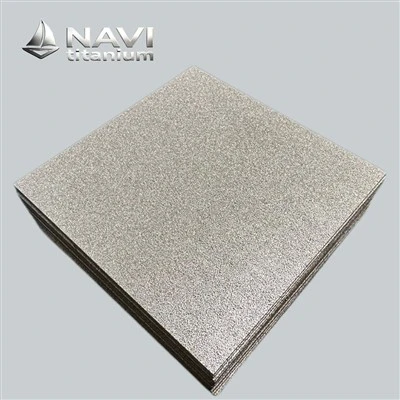
NAVI Titanium sintered stainless steel plate is a rigid porous plate manufactured by compacting stainless steel powder into a flat profile and consolidating it through high-temperature solid-state sintering. During this process, individual powder particles form permanent metallurgical bonds, creating a monolithic plate with a continuous internal metallic framework. Unlike flexible mesh materials or tubular porous elements, its flat geometry provides excellent dimensional uniformity across large working areas while maintaining mechanical integrity.
Solution of NAVI Titanium
Sintered ss plate from NAVI Titanium is produced by a proven metal powder sintering process, delivering high-performance porous metal substrates for precision filtration, electrochemistry, biomedicine, and high-temperature fluid separation. It provides excellent acid and alkali corrosion resistance, biocompatibility, uniformly distributed and controllable pore structure, and in-situ regeneration for stable operation under harsh, corrosive, high-temperature, and high-pressure conditions. Customized filtration, air permeability, and flow solutions are available. See specifications below.


NAVI Titanium specializes in high-performance sintered plates designed for controlled filtration, gas-liquid separation, flow regulation, and porous media applications. We provide customized processing for different stainless steel grades, pore sizes, thicknesses, dimensions, and shapes, supporting demanding industrial environments while delivering reliable permeability, mechanical strength, and long service life.


Application
NAVI Titanium sintered stainless steel are selected not only for their material properties but also for their ability to function as large-area structural elements within integrated assemblies. Their rigid, flat geometry enables stable load transfer, broad contact surfaces, and reliable module integration across a wide variety of engineered designs. Instead of serving a single purpose, these plates often perform multiple mechanical roles simultaneously, including structural support, load distribution, interface positioning, and thermal accommodation.
Many engineered assemblies rely on rigid internal surfaces capable of carrying mechanical loads while maintaining accurate alignment between adjacent modules. NAVI Titanium sintered stainless steel plate provides a continuous support surface that distributes external forces across a broad contact area instead of concentrating stress at isolated locations. Its flat geometry simplifies installation between adjoining parts, allowing accurate positioning of seals, compression members, and structural housings. Because the plate behaves as a single monolithic body, it contributes to stable load transmission during assembly and operation. Various plate dimensions and thicknesses allow designers to match different module layouts while preserving consistent contact conditions throughout the assembled structure.

Large-Area Distribution Panels

Large structural panels are frequently used wherever gas or liquid must spread evenly across broad working surfaces before entering subsequent functional zones. The plate serves as a rigid distribution platform that encourages balanced flow across its entire area instead of creating localized concentration regions. The flat panel geometry also provides uniform pressure transfer, helping connected assemblies experience similar loading conditions over wide surfaces. During thermal cycling, the plate continues to support stable mechanical contact while reducing uneven expansion between neighboring assemblies. This combination of load distribution, structural rigidity, and thermal support makes large porous plates valuable in many customized mechanical platforms.
Purchasing guide

Quality control (QC)
NAVI Titanium's ISO 9001-certified factory ensures every sintered plate meets strict quality standards. Click below to view the COA and quality inspection reports, confirming its pore structure, permeability, and corrosion resistance. Review the documents and request your quotation today.

Manufacturing Process
NAVI Titanium's sintered stainless steel plate is manufactured through a controlled metal powder sintering process. Stainless steel powder is precisely graded, uniformly mixed, and filled into molds, then sintered at high temperature in a vacuum or protective atmosphere. During sintering, powder particles bond into a rigid, porous structure with uniformly distributed, controllable pores. The plates are then cooled, flattened, trimmed, cleaned, and inspected for pore size, permeability, and mechanical strength. This process delivers strong, corrosion-resistant, biocompatible porous stainless steel substrates suitable for precision filtration, electrochemistry, biomedicine, and high-temperature fluid separation. Customized pore sizes, thicknesses, dimensions, and flow rates are available.


Structural Engineering of Stainless Steel Porous Plates
The mechanical behavior of NAVI Titanium sintered stainless steel is determined by far more than its material composition. Factors such as panel geometry, thickness uniformity, thermal response, edge processing, and structural stiffness all influence how the plate performs once integrated into an assembly. Unlike flexible porous materials, a plate must preserve its geometry across a relatively large surface while resisting deformation under mechanical and thermal loading.
The engineering concept of a NAVI Titanium sintered stainless steel plate differs fundamentally from woven materials or cylindrical porous elements. Instead of relying on multiple flexible layers, the finished product is manufactured as a single rigid plate with uniform thickness extending across the entire panel. This monolithic construction distributes mechanical loading throughout the body rather than concentrating stress within localized regions. Large-area geometry also provides stable contact surfaces for adjacent assemblies, allowing accurate positioning during installation. By combining stainless steel powder with carefully controlled consolidation parameters, the finished plate achieves a balance between structural rigidity, dimensional precision, and overall mechanical reliability for demanding engineered assemblies.

2. Flatness Control During Sintering

Maintaining flatness throughout thermal consolidation is one of the most important manufacturing objectives for porous stainless steel plates. During sintering, thermal expansion, material shrinkage, and internal stress release occur simultaneously, creating the possibility of warpage or distortion if these effects are not carefully balanced. Furnace temperature distribution, support methods, heating rate, and cooling profile all influence the final geometry. Careful process control minimizes dimensional deviation across the entire plate while maintaining consistent thickness from edge to edge. NAVI Titanium stable flatness simplifies later machining, assembly alignment, gasket positioning, and mechanical integration into large engineered installations.
Unlike thin mesh products, NAVI Titanium sintered plates are designed to withstand significant compressive and bending loads across broad surfaces. Mechanical response depends on plate thickness, powder characteristics, and overall density rather than wire geometry. Under compressive loading, the rigid body distributes stress throughout the entire section, reducing localized deformation. During bending, the plate exhibits measurable flexural strength while maintaining predictable elastic recovery after moderate loading. Proper structural design also minimizes the possibility of permanent deformation caused by continuous mechanical stress. These characteristics allow porous plates to function as reliable load-bearing elements in demanding structural assemblies.


One advantage of porous stainless steel plates is their adaptability to various secondary machining and joining operations. After sintering, panel edges may be processed by laser cutting, waterjet cutting, CNC machining, or precision grinding to obtain project-specific dimensions. Depending on assembly requirements, the finished plate can also be integrated through welding, brazing, bolted frames, or custom mechanical fixtures. Careful edge preparation supports accurate alignment while minimizing residual stress introduced during fabrication. These flexible joining methods allow NAVI Titanium engineers to incorporate porous plates into complex equipment without extensive redesign of surrounding structural elements.
NAVI Titanium large porous plates experience thermal expansion differently from compact porous components because temperature distribution may vary across the panel surface. Local thermal gradients can generate unequal expansion rates, creating internal stress concentration when different regions respond at different speeds. Material thickness, panel dimensions, and support conditions all influence this behavior. Proper structural design considers thermal movement from the earliest development stage, reducing expansion mismatch between connected assemblies. Attention to thermal behavior helps preserve dimensional accuracy, minimize distortion, and maintain reliable structural contact throughout repeated heating and cooling cycles encountered during service.

6. Structural Support Without Additional Frames

The inherent rigidity of NAVI Titanium sintered stainless steel plate enables many assemblies to operate without extensive supporting frameworks. Instead of relying on multiple reinforcing ribs or separate backing plates, the porous panel itself carries a substantial portion of the applied mechanical load. This self-supporting capability simplifies structural layouts while reducing the number of auxiliary parts required during installation. Fewer supporting members also provide greater design flexibility for customized equipment configurations. By integrating load-bearing capability directly into the porous plate, engineers can achieve compact assemblies with improved structural efficiency and simplified mechanical construction.
Surface planarity and parallelism are critical quality characteristics for large porous plates intended for precision assemblies. Uniform surface geometry promotes even contact between adjoining parts while reducing localized mechanical loading during clamping. NAVI Titanium parallel plate faces also simplify alignment with seals, compression members, and mounting surfaces. Achieving these characteristics requires careful control of powder filling, pressing conditions, thermal consolidation, and subsequent finishing operations. Consistent geometric accuracy improves assembly repeatability and allows neighboring components to share mechanical loads more uniformly across the entire contact area, contributing to reliable long-term structural performance.

NAVI Titanium Large Scale & Stable Supply Capacity

NAVI Titanium owns a large-scale standardized production base dedicated to sintered stainless steel filter, equipped with a complete set of advanced automatic pressing, high-temperature vacuum sintering and precision testing production lines. Our factory features standardized workshop management and mature mass production processes, supporting stable and continuous large-volume manufacturing. With standardized production procedures and intelligent equipment operation, we effectively shorten production cycles while maintaining consistent product quality. Our robust production scale lays a solid foundation for bulk order fulfillment, enabling us to undertake super-sized industrial orders that most small manufacturers cannot support, delivering reliable production strength to global industrial buyers.
We maintain sufficient raw material reserves and finished product inventory to ensure uninterrupted and flexible product supply of sintered plates. We stock a full range of conventional specifications with different pore sizes, porosity rates and plate sizes, supporting fast delivery of spot orders within 3 to 7 working days.
For customized non-standard products with special sizes and technical parameters, our flexible production scheduling system can quickly adjust production plans to meet personalized bulk procurement demands. Abundant inventory and flexible production scheduling completely avoid out-of-stock delays and delivery shortages, solving clients' urgent procurement and long-term stocking troubles perfectly.
NAVI Titanium has established a complete and stable industrial supply chain system to support long-term cooperative supply for global clients. We have long-term strategic cooperation with high-quality raw material suppliers, ensuring stable raw material quality and price advantages without supply interruptions. Relying on standardized production management and efficient team operation, we steadily supply sintered stainless steel filters for industrial filtration, gas distribution and chemical separation industries worldwide.
We support annual framework cooperation orders with fixed delivery cycles, providing clients with stable, sustainable and cost-effective bulk supply solutions and building long-term trustworthy procurement partnerships.

Frequently Asked Questions
How do I know whether a sintered stainless steel plate is suitable for my existing equipment?
+
-
The best starting point is not the product name, but the actual working conditions. NAVI Titanium recommends checking the required dimensions, filtration or flow requirements, working temperature, pressure conditions, fluid or gas composition, and connection method before ordering. If an existing part is already in service, drawings, photographs, dimensions, or a sample can also be provided for review.
What information should I provide when requesting a quotation?
+
-
For a more accurate quotation, customers should provide the plate dimensions, stainless steel grade, required pore or permeability range, thickness, quantity, operating conditions, connection details, and any drawing or tolerance requirements. If some information is unavailable, NAVI Titanium can help identify the key specifications that need to be confirmed before production.
What stainless steel grade should I choose for my working conditions?
+
-
The choice depends on the environment rather than the grade name alone. Common options include stainless steel grades such as 304, 316, and 316L, while more demanding environments may require other alloy selections. NAVI Titanium can review the working medium, temperature, pressure, and expected exposure conditions before recommending a suitable material option.
Can NAVI Titanium manufacture non-standard dimensions?
+
-
Yes. Sintered stainless steel plates can be discussed in customized dimensions, thicknesses, shapes, hole patterns, and connection arrangements according to the customer's requirements. Providing a technical drawing or sample is recommended when the part must match an existing assembly.
What dimensional tolerances should I specify for a custom plate?
+
-
The required tolerance depends on how the plate interfaces with the customer's equipment. Tight tolerances may be necessary for parts that must fit precisely into a holder or sealing arrangement, while less restrictive dimensions may be sufficient for other installations. NAVI Titanium can review the drawing and confirm practical tolerances before production.
Hot Tags: sintered stainless steel plate, China sintered stainless steel plate manufacturers, suppliers, factory, Bronze Filter Element, Sintered Air Filter, Sintered Bronze Filter, sintered metal filter, Sintered Metal Powder Filter, Sintered Stainless Steel