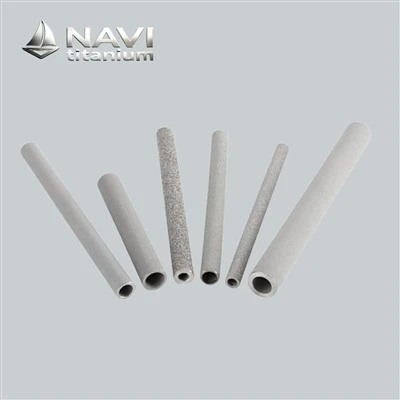
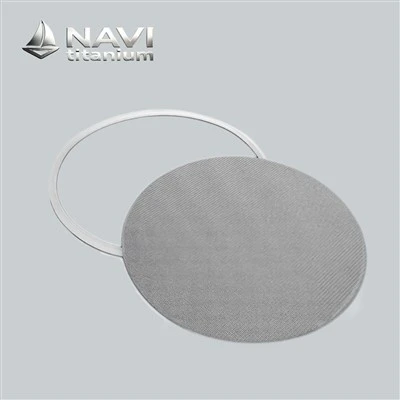
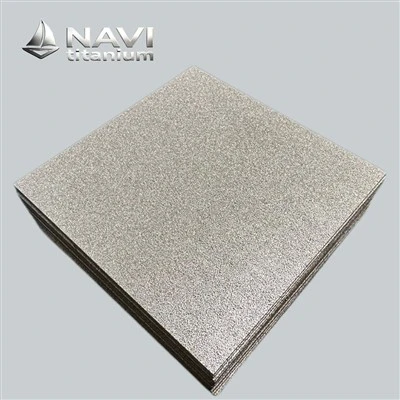
Sintered porous metal filter element is a mechanical engineering term released in 2021. It is a metal porous filter element made from metal powders such as stainless steel, titanium alloy, nickel based alloy, etc., through cold isostatic pressing, high-temperature vacuum sintering, and welding processes. It belongs to precision components in industrial filtration equipment. It can filter impurities in liquids and gases, achieve micrometer level precision filtration, and has the characteristics of efficient filtration, corrosion resistance, high mechanical strength, high temperature resistance, and reusability. It does not require adhesives and can control the pore structure by adjusting the powder particle size and sintering parameters. The filtering accuracy is 0.5-200 μ m. These are the specifications produced by NAVI Titanium. If you have different specifications, you can send them to our sales team, and we will contact NAVI Titanium's senior technical personnel to provide customized services for you.
NAVI Titanium specializes in sintered porous materials manufactured from various metal powders. We offer customized solutions to meet the filtration, air permeability, and flow requirements of diverse industrial applications.
Solution of NAVI Titanium
The following technical specifications are intended as general engineering references and may be adjusted to meet the requirements of individual projects.

NAVI Titanium® offers diverse fabrication-grade options engineered to align with varying service conditions and performance demands. The comparison table below summarizes the available material options, typical characteristics, and recommended selection considerations, providing engineers with a practical reference when specifying filtration components for industrial applications.


NAVI Titanium High Precision Sintered Porous Metal Filter: Customizable 316L stainless steel, titanium, nickel sintered filter elements, with micron-level stable filtration accuracy, no material shedding risk, ideal for harsh working conditions such as high temperature, strong acid and high pressure. We accept both small-batch lab sample orders and large-scale industrial bulk orders, with fast delivery guaranteed.


Application
The sintered porous metal filter element, with its core advantages of three-dimensional through gradient porous structure, high temperature resistance, strong corrosion resistance, and repeatable high-temperature regeneration, covers dozens of sub sectors from high-end strategic emerging industries to traditional industrial upgrading in all scenarios. Its core applications can be divided into five categories:
Special process gas terminal purification: intercepting 0.003 μ m nanoparticles in special gases such as silane and tungsten hexafluoride, reducing particle defects on the surface of CVD wafers by 85% and increasing yield by 7 percentage points.
Ultra pure wet chemical filtration: terminal purification of photoresist and etching solution, controlling metal ion precipitation at ppb level, reducing photoresist spot defects by 90%.
Vacuum system particle protection: installed at the inlet of the ion implantation machine vacuum pump to block the backflow of dopant dust from contaminating the wafer. The maintenance cycle of the vacuum pump has been extended from 6 months to 24 months.
FOUP wafer transfer box microenvironment circulation filtration: Maintain the internal cleanliness level of the transfer box at ISO level 1 for a long time to avoid particle contamination during wafer transfer.

Purchasing guide

Quality control (QC)
NAVI Titanium strictly controls quality throughout the entire process, and every batch of products comes with a complete quality inspection report. From raw material composition analysis and mechanical performance testing to corrosion resistance verification, all test data is real and traceable, providing reliable quality proof for your project selection.

AVI Titanium Exclusive Clean Filtration Solution Value:
Customized zero precipitation filter elements for targeted semiconductor high cleanliness scenarios.
Customization of micro shaped parts suitable for confined spaces.
Support over 100 high-temperature washings and regenerations.
Help users reduce the cost of long-term filtering consumables by over 60%.
Comparison Table of Different Aperture Grades of NAVI Titanium
| Pore Size Grade | Nominal Filtration Rating | Gas Absolute Rating | Typical Porosity | Reference Permeability (m³/m²·h·KPa) | Dirt Holding Capacity |
| Ultra-Precision Grade | 0.2μm | 0.1–0.3μm | 25–35% | 3–10 | Very low |
| Precision Grade | 0.5μm | 0.3–0.5μm | 28–38% | 5–15 | Low |
| High Accuracy Grade | 1μm | 0.5–1μm | 30–40% | 10–30 | Low to medium |
| Standard Precision Grade | 2μm | 1–2μm | 32–42% | 20–60 | Medium |
| Standard Grade (most common) | 5μm | 2–5μm | 35–45% | 50–150 | Medium to high |
| Medium-Coarse Grade | 10μm | 5–10μm | 35–45% | 100–300 | High |
| Coarse Filtration Grade | 20μm | 10–20μm | 38–48% | 200–550 | Very high |
| Pre-Filtration Grade | 40μm | 20–40μm | 40–50% | 400–900 | Extremely high |
| Coarse Particle Retention Grade | 100μm | 40–100μm | 42–52% | 700–1300 | Highest |
Data for reference only
Application
The cleanliness control of semconductor procedures is the core lifeline that determines chip yield, performance, and long-term reliability. With advanced procedures advancing to 7nm, 3nm, and even more advanced nodes, nanoscale granules, trace metal ions, and chemical impurities below 0.1 μ m in the production environment may directly cause open circuits, short circuits, or performance drift in wafer circuits. Traditional percolator materials are no longer suitable for extremely demanding cleanliness requirements.
The sintered porous metal filter relies on a three-dimensional through gradient porous structure formed by high-temperature sintering of metal powder. With its core advantages of high temperature resistance, corrosion resistance, controllable porosity, and repeated high-temperature regeneration, it has become a key component for improving the cleanliness of the entire semconductor procedure chain. From special gas transportation in wafer manufacturing, ultra pure fluid purification to granule interception in vacuum systems, it comprehensively constructs a nano level clean protection barrier and is an irreplaceable core percolatoring element in advanced chip manufacturing production lines.

Application of nanoscale particle interception in the transportation of special procedure gases
Dozens of special procedure gases such as silane, ammonia, argon, tungsten hexafluoride, etc. used in semconductor procedures are the media that directly contact the core procedures of wafer lithography, etching, and deposition. Even nanometer granule impurities in the gas at the billionth level can form fatal circuit defects on the wafer surface. Traditional fiberglass and polymer percolators are prone to fiber detachment and insufficient high-temperature resistance under long-term erosion by high-purity specialty gases, becoming new sources of impurity pollution. However, percolators are completely formed by high-temperature sintering of metal powders such as 316L stainless steel, high-purity nickel, and titanium, with no risk of fiber detachment. The three-dimensional interconnected porous structure can achieve an interception efficiency of over 99.99999% for 0.003 μ m nanoscale granules, cutting off the granule pollution path in the procedure gas from the source.
At the end of the silane gas delivery pipeline in the chemical vapor deposition (CVD) procedure, it is directly installed at the inlet position of the reaction chamber to completely intercept the residual nanoscale silicon powder granules in the silane gas, avoiding the formation of randomly distributed small granule defects on the wafer surface. The operation data of a domestic advanced procedure production line for 12 inch wafers shows that after using high-precision percolators to purify silane gas at the terminal, the number of granule defects on the wafer surface in the CVD procedure decreased by more than 85%, and the yield of chips directly increased by 7 percentage points. Unlike ordinary percolator materials, its gradient pore structure design gradually reduces the aperture of the percolator element from the inlet side to the outlet side, which not only has ultra-high dust holding capacity, but also achieves ultimate colation accuracy.


In the long-term operation of high flow special gases, there will be no problem of granule penetration, and the continuous and stable service life can reach more than 3 years, which is more than 6 times that of traditional polymer percolators.
In the high-purity argon shielding gas system of the photolithography procedure, not only can solid granules in the gas be intercepted, but it can also withstand occasional instantaneous high temperature impacts in the pipeline, without the problem of material deformation and release of organic volatiles at high temperatures like polymer percolators, avoiding organic impurities from contaminating the surface of the photoresist and preventing fatal defects such as distortion and pinholes in the photolithography pattern. In the highly corrosive special gas pipelines such as tungsten hexafluoride used in the etching procedure, high-purity nickel percolators are used, which can withstand the long-term erosion of highly corrosive fluorine gas. The percolator itself will not corrode and precipitate metal ions, completely eliminating the risk of ion pollution of wafer circuits by metal ions.
Deep purification application of ultra pure chemicals and wet procedure fluids
In the wet procedure loop of semconductor manufacturing, the cleanliness of various ultrapure fluids such as ultrapure water, photoresist, developer solution, and etching solution directly determines the surface quality of the wafer. Traditional polymer percolator membranes are prone to membrane dissolution and additive precipitation in highly corrosive wet electronic chemicals, releasing trace amounts of organic impurities and metal ions into the fluid, directly affecting the circuit performance of the chip. After special ultra pure electrolytic polishing and passivation treatment, the percolator element controls the overall metal ion precipitation at ppb level, without introducing additional impurities into the ultra pure fluid. At the same time, it can withstand long-term immersion in high-temperature wet chemicals at 180 ℃, which is suitable for the purification needs of all semconductor procedure wet chemicals.


In the circulation purification system of wet etching solution, it can withstand the corrosion of strong acidic and strong alkaline etching solution for a long time, continuously intercept the metal etching product granules generated during the etching procedure, avoid these granules from forming re deposition defects on the wafer surface, extend the circulation life of the etching solution by more than three times, and significantly reduce the chemical consumption cost of wet procedure. Unlike disposable polymer colation membranes, regeneration can be achieved through reverse ultrapure water flushing and high-temperature nitrogen blowing. The difference in colation flux after regeneration compared to a brand new percolator element is less than 2%, and it can be repeatedly regenerated and used more than 100 times, significantly reducing the long-term comprehensive cost of semconductor procedure colation consumables and minimizing the generation of colation waste, in line with the green production requirements of the semconductor manufacturing industry.
Particle protection application of wafer carriers and vacuum systems
The wafer transfer carriers and vacuum reaction chambers in semconductor procedures are the areas where wafers are exposed for the longest time. Once tiny granules in these areas fall onto the surface of the wafer, they can directly cause circuit failure. In these scenarios, a comprehensive dynamic clean protection system is established. In the micro environment gas circulation system of the FOUP (Front Open Wafer Transfer Box) for wafer transfer, a miniaturized burn-in percolator serves as the purification core of the circulating air, continuously percolatoring the protective gas inside the transfer box, and maintaining the granule concentration inside the transfer box at the ultra clean level of ISO 1 for a long time.


Even if the wafer is briefly exposed to a non ultra clean environment during the transfer procedure, there will be no granule pollution problem. In the exhaust system of the high vacuum reaction chamber of the ion implantation machine, it is installed at the inlet end of the vacuum pump to intercept a large amount of high-energy metal granules and dopant dust generated during the ion implantation procedure. On the one hand, it prevents these granules from flowing back into the vacuum chamber and contaminating the wafer. On the other hand, it also protects the expensive vacuum pump blades from being eroded and worn by high-speed granules, greatly extending the maintenance cycle of the vacuum pump. The actual operation data of an advanced procedure production line shows that after installing a sintered porous metal filter at the vacuum inlet of the ion implantation machine, the average maintenance cycle of the vacuum pump has been extended from 6 months to 24 months.
At the same time, the background concentration of granules inside the vacuum chamber has decreased by two orders of magnitude, and the number of wafer granule defects in the ion implantation procedure has decreased by 75%. In the polishing solution supply system of chemical mechanical polishing (CMP) procedure, percolator is used to intercept large-sized polishing granules that aggregate in the polishing solution online, avoiding deep scratch defects caused by large granules in the wafer polishing procedure, and reducing the surface roughness of the polished wafer to below 0.1nm, fully meeting the requirements of advanced procedure wafer surface flatness. At the end of the FFU fan colation unit in the clean room of semconductor manufacturing, a high-temperature resistant percolator element with a metal sintered porous structure is used, which can withstand the high-temperature steam disinfection conditions in the workshop and will not cause fiber breakage and detachment after repeated high-temperature disinfection like fiberglass percolators. It can maintain the stable granule concentration in the clean room for a long time to meet the standard.

The streaming service of NAVI Titanium
NAVI Titanium accepts laboratory small batch sample orders and large-scale industrial batch orders, ensuring stable and fast delivery. Conventional standard specification products can be matched with corresponding priority logistics solutions to reduce your production downtime waiting risks.
For customized sintered porous metal filter products with irregular shapes and large sizes, NAVI Titanium can be matched with corresponding special packaging schemes to avoid deformation of the porous structure during transportation, ensuring that the pore integrity and overcurrent performance of the components fully meet the factory quality inspection standards upon arrival at the user's site.
As a source factory for global industrial customers, NAVI Titanium can adapt to different types of cross-border logistics needs such as sea freight, air freight, and international express delivery. It can also provide targeted logistics transportation solutions for semiconductor scene filters with extremely high cleanliness requirements, matched with dust-free exclusive sealed packaging, to avoid introducing additional impurities during transportation that may affect product performance.
You can directly contact the NAVI Titanium sales team, provide your shipping address, order size, and delivery time requirements, and obtain exclusive customized logistics solutions, accurate logistics quotations, and estimated delivery times.
Performance Characteristics
1
Has good filtering performance (1-400 µ m, porosity 30% -70%);
2
Stable shape and components with high strength;
3
High temperature resistance (can work up to 700 ℃);
4
Strong corrosion resistance;
5
High impact resistance and alternating load;
6
Good breathability and separation effect;
7
Good backwashing effect, easy regeneration of components, etc;
8
The colation efficiency is high.
FAQ
What is the expected service life of the sintered porous metal filter?
+
-
Service life depends on filtration media, particle loading, temperature, pressure, flow rate, and cleaning frequency. With proper operation and cleaning, the filter can provide long-term service.
How often does the filter need to be cleaned?
+
-
Cleaning frequency depends on the contamination level and pressure drop. The filter should generally be cleaned when the pressure differential reaches the recommended limit.
Can the sintered metal filter be cleaned and reused?
+
-
Yes. One major advantage of sintered porous metal filters is their ability to be cleaned and reused, provided the filter structure and pore network are not damaged.
What cleaning methods can we use?
+
-
Depending on the application, backwashing, ultrasonic cleaning, air or gas back-pulsing, solvent cleaning, or other approved methods may be used. The method should be selected according to the filter material and contaminants.
How do we know when the filter needs to be replaced?
+
-
Replacement may be necessary when cleaning no longer restores the required flow rate or pressure drop, or when the filter has mechanical damage, corrosion, deformation, or permanent blockage.
Hot Tags: sintered porous metal filter, China sintered porous metal filter manufacturers, suppliers, factory, Porous Stainless Steel Plate, Sintered Bronze Air Muffler, Sintered Bronze Plate, Sintered Metal Disc, sintered metal filter, Sintered Metal Filter Cartridge