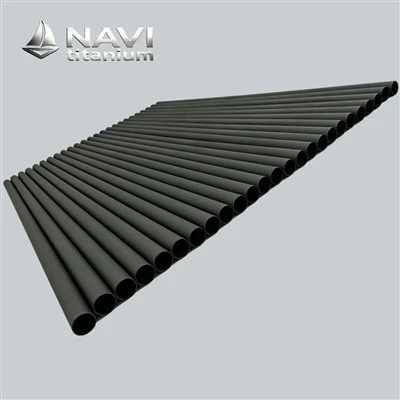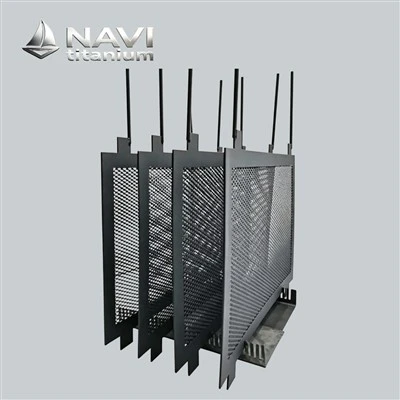


NAVI Titanium ruthenium iridium titanium anode feature a high-purity Ti base with a carefully engineered Ru-Ir oxide coating built for demanding electrochemical applications. Beyond manufacturing, we provide full-lifecycle technical support, from use selection and coating condition assessment to maintenance, recoating, replacement, and performance troubleshooting. Backed by experienced manufacturing, sales, and engineering teams, NAVI Titanium delivers consistent supply capacity and one-on-one engineering assistance to optimize anode service life and minimize unexpected downtime across desalination, water treatment, chlor-alkali, and other demanding factory systems.
Solution of NAVI Titanium
In seawater electrochemical conversion, high-salinity wastewater treatment, and other demanding environments, selecting the right anode is essential for consistent output and controlled operating costs. NAVI Titanium combines a titanium base with a carefully formulated Ru-Ir mixed oxide compound coating to support Cl2 formation, uniform current distribution, and dependable electrochemical performance. We provide customized dimensions, base structures, coating formulations, and connection designs for different equipment requirements. From prototype samples to repeat manufacturing, our technical team reviews running conditions before manufacturing. The table below introduces specifications, feedstocks, configurations, and use options for project evaluation.


NAVI Titanium's Ru-Ir anodes can be customized as plates, mesh, tubes, and shaped parts to support reduced energy consumption and consistent long-term performance in chlor-alkali processing, hypochlorite generation, and cathodic protection.


Application
NAVI Titanium ruthenium iridium titanium anode are extensively incorporated into Cl−-bearing process systems where sustained ionic transformation and phase interaction are essential. Within membrane-integrated assemblies, their oxide framework moderates local ionic flux while reducing spatial concentration heterogeneity across confined reaction domains.
Biofouling in seawater systems starts with organic molecule adsorption, followed by microbial attachment and biofilm development. As biofilms mature, they hinder mass transfer, increase flow resistance, and promote the accumulation of marine organisms on equipment exterior areas. Reactive disinfecting species generated from Cl−-containing seawater disrupt this process by damaging microbial membranes and inhibiting extracellular polymeric substance (EPS) formation, thereby limiting biofilm growth at an early stage. Proper oxidant management maintains effective biofouling control while avoiding unnecessary chemical consumption. This dynamic mechanism improves hydraulic efficiency and supports reliable running in desalination plants, cooling systems, and marine water intake facilities.

2. Sodium hypochlorite Generator

Factory sodium hypochlorite generation involves the oxidation of Cl− ions in dilute brine, followed by aqueous reactions that produce hypochlorous acid (HOCl) and hypochlorite ions (OCl⁻).
Their relative proportions are governed primarily by liquid pH, directly influencing disinfection efficiency. HOCl penetrates microbial cell walls more readily than OCl⁻, making pH regulation essential for effective microbial control.
Cl− concentration, hydraulic residence time, and liquid circulation further affect disinfectant composition and conversion efficiency. NAVI Titanium anode plate supports continuous Cl2 conversion while maintaining reliable long-term running.
Purchasing guide

Quality control(QC)
For every Ru-Ir anode project, NAVI Titanium verifies material identity, substrate specifications, coating requirements, and inspection results. We provide Certificates of Analysis (COA) to help customers review material composition and quality data before ordering. Click the button below to access available COA documents and examine the information supporting your procurement decision for selected anode production batches and specifications.
| Certificate of Analysis | ||
| Titanium Base Material Suppliers: | Coating Precursor Suppliers: | COA of product: |
|
|
|
|


Manufacturing Process
NAVI Titanium manufactures Ru-Ir titanium anodes through controlled substrate preparation, Ru-Ir coating application, high-temperature sintering, and final inspection. Each stage is aligned with the customer's operating conditions, design specifications, and electrochemical requirements.
Substrate Selection & Precision Machining
Grade 1 or Grade 2 titanium bases are selected according to the required dimensions, mechanical structure, and working environment. Our manufacturing team performs laser cutting, drilling, bending, and other machining procedures based on approved drawings. Dimensional checks verify base accuracy before pretreatment.
Surface Cleaning & Pretreatment
Titanium bases undergo alkali degreasing, acid pickling, and sandblasting to remove contaminants and prepare the interface for coating deposition. Controlled pretreatment helps establish suitable bonding conditions for the Ru-Ir coating and supports consistent coverage.
Ru-Ir Mixed Metal Oxide Coating
The Ru-Ir coating is applied using a controlled brush-coating process. Coating formulation, application quantity, and layer distribution are managed according to the specified electrochemical requirements. Multiple coating cycles may be applied to achieve the required coating structure.
High-Temperature Sintering
After coating application, the substrates undergo segmented high-temperature sintering in a sealed furnace. Temperature control and process scheduling support the formation of the MMO coating and help maintain consistency between production batches.
Quality Inspection & Performance Verification
Finished anodes undergo dimensional inspection, visual checks, coating assessment, and relevant quality testing. Inspection records and COA documentation can be provided to support customer verification of material specifications and production quality.
Final Assembly & Packaging
After inspection approval, anodes are assembled according to the approved connection and structural requirements. Protective packaging is selected to minimize surface damage during transportation and maintain product condition until installation.
Application
NAVI Titanium's ruthenium iridium titanium anodes are used in sodium chloride electrolytic processing, support continuous active oxidant generation in swimming pool disinfection systems, and serve chloride-bearing liquid systems in factory water treatment and chemical processing.
During sodium chloride electrolytic processing, Cl⁻ ions migrate toward the anodic region, where oxidation generates Cl₂. The generated gas quickly dissolves in water and undergoes a series of equilibrium reactions, forming hypochlorous acid (HOCl) and hypochlorite ions (OCl⁻). Their relative distribution depends primarily on liquid pH and Cl⁻ concentration, directly influencing disinfectant yield and oxidation efficiency.
Gas formation, electrolyte circulation, and mass transfer collectively regulate reactant availability and reaction continuity within the cell. These coupled physicochemical phenomena make the anode plate well suited for continuous sodium hypochlorite generation.


In saltwater swimming pools, disinfectant formation is governed by a sequence of aqueous equilibrium reactions rather than the direct accumulation of a single oxidizing compound. Once generated, dissolved oxidizing species continuously interconvert among molecular Cl₂, hypochlorous acid (HOCl), and hypochlorite ions (OCl⁻), with liquid pH determining their relative distribution. Because HOCl exhibits greater microbial penetration than OCl⁻, pH regulation is a key factor influencing disinfection efficiency. Sunlight exposure, organic loading, and nitrogen-containing contaminants further alter disinfectant demand by consuming reactive species and forming chloramines. Understanding these dynamic chemical equilibria is essential for maintaining effective sanitation while minimizing unnecessary disinfectant consumption.
The effectiveness of fruit and vegetable sanitation depends on the interaction between reactive disinfecting species and biological contaminants attached to produce interfaces. Oxidative molecules first diffuse through the thin water film surrounding microorganisms before disrupting membrane permeability, enzyme activity, and intracellular metabolic pathways. Simultaneously, oxidation weakens extracellular polymeric substances (EPS), reducing microbial adhesion and promoting biofilm detachment. The disinfection process is influenced by contact time, organic load, liquid pH, and hydrodynamic mixing, all of which affect oxidant availability at the produce interface. Optimizing these reaction pathways supports microbial reduction while preserving the texture, color, and nutritional quality of fresh produce.

Packing & Handling Considerations
Packaging for Different Product Forms

NAVI Titanium packaging for an anode begins with separating the working area from component-to-component contact during transit. Flat pieces can be placed between non-abrasive sheets, while mesh versions may require soft supports that prevent unwanted folding or localized pressure. Connection points, threaded sections, and mounting holes can receive additional sleeves or caps so packing materials do not catch on them during unpacking. For small batches, individual compartments make counting easier and reduce contact between pieces. Larger orders may use internal spacers inside a wooden case to limit movement when shipments are lifted, transferred, or exposed to road vibration. The packing method can therefore be selected according to shape, quantity, and handling route.
Moisture control is another less visible consideration for exported ruthenium iridium titanium anodes. During ocean freight, warehouse transfer, or movement between air-conditioned and warmer areas, temperature changes can create condensation inside a closed package. For this reason, packing may include moisture-resistant bags, desiccant, and a suitable internal barrier, especially when transit takes several weeks. The goal is not to seal the product tightly, because trapped humid air can remain inside the package. Package ventilation, sealing sequence, and storage conditions should be considered together. When shipments reach a warmer destination, allowing the package to acclimate before opening can also reduce condensation. These details are useful for overseas deliveries where the shipment may pass through several climates before reaching the receiving warehouse.

Package Identification for Easier Receiving

NAVI Titanium package identification can be made more useful than a product name. For Ru-Ir titanium anodes, a label may include the purchase order number, part reference, quantity, package count, net weight, gross weight, and handling direction. An identification sheet inside the package can repeat information for warehouse staff after the carton or wooden case has been removed. This is helpful when several anode shapes are delivered under the same order, when mesh, plates, strips, or custom pieces are packed separately. For export shipments, matching the package mark with the packing list also reduces searching during receiving. Clear identification is a detail, but it can make incoming inspection, inventory entry, and internal distribution easier for purchasing and warehouse teams.
Why Ru-Ir Coatings Favor Chlorine Evolution?
The preferential Cl₂ generation behavior of NAVI Titanium Ru-Ir coatings is attributed to their carefully engineered electrochemical interface and reaction characteristics.
Reduced Chlorine Oxidation Polarization
RuO₂ facilitates Cl⁻ oxidation with relatively low anodic polarization compared with many conventional electrode materials. As a result, the chlorine oxidation reaction (COR) proceeds more readily, allowing Cl⁻ ions to react before the oxygen oxidation reaction becomes dominant.
Synergistic Coating Composition
While RuO₂ promotes rapid Cl₂ generation, IrO₂ reinforces the coating against oxidative degradation and preserves its structural integrity during prolonged electrolytic processing. This synergistic oxide combination sustains oxidant output while improving coating durability under demanding factory-scale running conditions.
Engineered Interface Architecture
The ruthenium iridium titanium anode develops a uniform catalytic interface with a large number of electrochemically accessible reaction centers. This interface architecture facilitates Cl⁻ ion adsorption and charge transfer, encouraging Cl₂ formation while limiting the competing oxygen oxidation pathway.
FAQ
1. How do I know when the anode should be replaced?
+
-
A noticeable rise in working voltage, uneven gas generation, changes in process output, or visible deterioration of the active area can indicate that a unit is approaching the end of its usable period. Operating hours alone are not a reliable criterion for replacement, as actual service duration varies between applications.
2. What maintenance is required for titanium anode during long-term operation?
+
-
Routine maintenance mainly involves keeping the active area free from deposits, checking the electrical connection and base condition, and monitoring changes in working voltage and current distribution. The cleaning method should be selected according to the electrolyte and type of deposit. Abrasive tools or aggressive chemical treatments should generally be avoided because they may damage the MMO oxide.
3. How long can the anode typically last?
+
-
Expected service duration varies from one application to another. Factors such as workload, electrolyte chemistry, temperature, operating frequency, and process control can all influence how quickly the working area is consumed. Instead of relying on a universal number of operating hours, buyers should provide the supplier with their actual process details.
4. How should I replace the worn anode without affecting my process?
+
-
Before removal, shut down the power supply and follow the equipment manufacturer's safety procedure. The new unit should have the appropriate dimensions, connection arrangement, active area, and installation position for the existing cell. Once fitted, inspect the connections and alignment before restarting.
5. What quality information should I check before purchasing an anode?
+
-
A reliable purchasing assessment should cover more than appearance. Customers can ask for information about the titanium base, pretreatment, dimensional accuracy, connection details, inspection records, and applicable quality controls. For demanding applications, additional verification such as bond strength or dimensional checks may be appropriate.
Hot Tags: ruthenium iridium titanium anode, China ruthenium iridium titanium anode manufacturers, suppliers, factory, MMO Mesh, MMO Tubular Anode, Platinized Titanium Mesh Anode, Platinum Titanium Electrode, Titanium Anode Group, Titanium Cathode