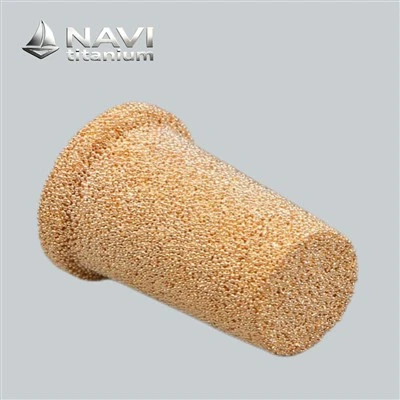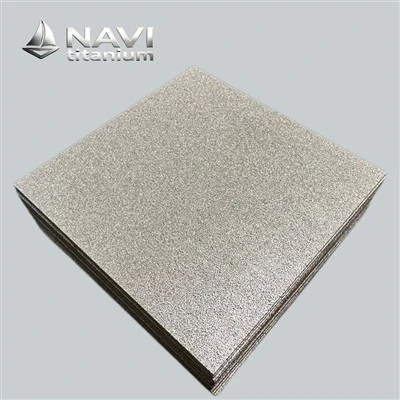


Sintered metal flame arrestor is made from metal powder as the raw material. The powder is screened, molded, and then vacuum-sintered at high temperatures to create an integrated porous metal component with a three-dimensional interconnected microstructure. Combined with a housing and sealing components, it forms a complete flame arresting device. As the core industrial safety product of the NAVI Titanium brand, we control the entire production process ourselves-from powder formulation, mold development, vacuum sintering, performance testing, to finished machining-ensuring stable and scalable production. Our production base is equipped with multiple large vacuum sintering furnaces, constant temperature molding equipment, CNC machining centers, and a fully equipped testing lab, allowing us to handle both bulk orders of standard parts and custom non-standard projects at the same time.
Solution of NAVI Titanium
In the field of titanium applications, most brands focus only on standardized product output, often overlooking the hidden shortcomings and long-term stability issues of materials under complex industrial conditions. NAVI Titanium always centers on the hidden demands of global high-end industrial upgrades, focusing on niche extreme conditions, special media environments, and high-precision equipment support in specific areas. To address common pain points for industry customers-such as difficulties in material selection, mismatched working conditions, and fragmented parameter information-and to prevent problems like equipment wear, safety hazards, and rising maintenance costs caused by improper material selection or insufficient parameter matching, the table below provides a complete summary of NAVI Titanium's main titanium products, including detailed specifications, standard size parameters, highlights of different condition adaptations, and specific application areas, helping customers accurately match and select professional products.


NAVI Titanium, built to create a reliable flame barrier for extreme conditions
From tiny instrument piping fittings to large-diameter complete flame arresters, NAVI Titanium can customize shapes, threaded ferrule connections, apertures, and porosity to meet different combustible gas MESG explosion-proof ratings. All of our products support porosity inspections, air permeability pressure drop tests, and metallographic sampling, and our explosion-proof models can help customers complete ISO16852 and ATEX compliance testing.


Application
In industries like chemical, new energy, oil and gas, pharmaceuticals, and gas analysis, where flammable gases, volatile vapors, and explosive substances exist, flashbacks and flame propagation are hidden but extremely hazardous safety threats. NAVI Titanium has been focusing on powder metallurgy titanium for over ten years, developing a full range of sintered metal flame arrestor. The materials can be titanium, titanium alloys, 316L stainless steel, Hastelloy, and more, covering everything from tiny sampling lines to large-diameter tank breather pipes.
The oil and gas industry is one of the earliest sectors to implement large-scale applications. It is widely used in crude oil, gasoline, diesel, and solvent oil tank breather valves, vent pipelines, and loading/unloading tail gas pipelines. In tank breathing systems, tanks experience day-to-night temperature changes, causing the internal medium to evaporate and form an oil-gas space, with tank pressure rising and falling cyclically. Breather valves are responsible for balancing the pressure inside and outside the tank. If an open flame appears outside the tank, the flame can travel backward through the breather line into the tank, igniting the oil-gas mixture inside and causing tank explosions. Installing sintered metal flame arresters can block external flames from entering the tank, keeping the tank itself safe.


Conventional corrugated flame arresters in oil and gas scenarios tend to accumulate oil mist on the corrugated gaps over long-term operation, forming sludge that blocks the flow paths. Repeated pressure shocks can also cause deformation of the corrugations. In contrast, NAVI titanium sintered metal flame arresters have a porous structure that not only blocks flames but also intercepts tiny liquid droplets and solid impurities in the oil-gas mixture, slowing down blockage. If blockage occurs, the core can be removed, cleaned, and regenerated without replacing the entire unit, reducing tank maintenance costs. Meanwhile, in oil-gas sampling pipelines, vehicle-mounted oil-gas recovery lines, and wellsite associated gas vent branches, miniature sintered metal flame arresters can protect on-site instruments and pressure sensors, preventing ignition from traveling through small pipelines into sampling cylinders and downhole equipment.
Purchasing guide

Quality control (QC)
For safety components like sintered metal flame arresters, which are responsible for process explosion prevention, quality control is not just the final spot check on finished products, but a systematic process that runs through the entire chain-from powder screening, molding, vacuum sintering, and machining to final performance verification. Any deviation in material composition, uneven pore distribution, or substandard mechanical properties can directly weaken the flame quenching capability, creating irreversible safety risks in high-risk conditions. NAVI Titanium insists on full-process closed-loop quality control, moving away from the industry's common end-point inspection approach, locking in the quality of raw materials from the source, and providing complete quality inspection reports for every batch of products. From raw material composition analysis, mechanical performance testing, and corrosion resistance verification, to sintered core porosity, air pressure drop, and metallographic structure inspection, all test data is real and traceable, providing solid and reliable quality proof for customer project selection, engineering approvals, and international compliance audits. Customers can directly download COA analysis certificates to check various product indicators (for reference only) and quickly complete qualification verification during project bidding, equipment acceptance, or third-party audits.
|
|

Manufacturing Process
The lower limit of the performance of sintered metal porous components is determined by the raw material powders, while the upper limit is defined by the entire powder metallurgy process chain. When choosing products, customers often focus only on the finished pore size and pressure resistance indicators, but overlook the hidden differences caused by powder pre-treatment, pressing and forming, vacuum sintering, and post-processing steps-such as sintering temperature fluctuations, deviations in holding time, and uncontrolled powder particle size distribution. These can all cause distortions in the internal microporous structure, directly weakening the flame-quenching ability of the flame arrestor and creating long-term safety risks in explosion-proof conditions. NAVI Titanium has been deeply involved in powder metallurgy for over a decade, building dedicated process chains for products like sintered metal flame arrestor and porous titanium filters, distinct from the conventional melting and forging routes of dense titanium materials. From titanium powder sieving, powder formulation, and mold pressing, to high-temperature vacuum sintering, precision machining, and surface passivation treatment, every step has independent process thresholds and operating standards. With our own sintering production line, we can flexibly adjust forming pressure and sintering curves based on customer requirements, accurately controlling porosity, air permeability, and mechanical strength, so that the product's microscopic porous structure matches the explosion-proof level, corrosive medium, and pressure drop requirements of the corresponding working conditions. Below, we will fully break down NAVI Titanium's sintered product processing logic from powder raw materials to finished assemblies, highlighting core technologies and process differentiation advantages, clearly showing how each step shapes a stable and reliable porous framework for sintered metal flame arrestors. Click the button to learn more:
|
|
|
|


Selection Guide
In the flame arrester safety design for the chemical and oil & gas industries, the structural stability, explosion resistance, and corrosion resistance of the flame arrester core material directly determine the long-term reliability of the whole flame arrester system. Traditional wire mesh and corrugated aluminum flame arresters are widely used due to their low cost, but under harsh conditions such as high pressure, chlorine-containing environments, or those with solid particles, they commonly suffer from deformation, channel collapse, corrosion failure, and difficulty in cleaning and regeneration, which pose safety risks. NAVI Titanium's sintered metal flame arrestor use an integrated metallurgically sintered gradient porous titanium structure. Leveraging titanium's excellent corrosion resistance and overall high strength, it overcomes the performance limitations of traditional flame arrester elements. The table below intuitively shows the differences and advantages of NAVI Titanium compared to traditional wire mesh and corrugated aluminum flame arresters in terms of structure, explosion resistance, corrosion resistance, regenerability, and service life, helping with selection and evaluation based on on-site conditions. The data is for reference only.
| NAVI Titanium vs Traditional Wire Mesh vs Corrugated Aluminum Strip Flame Arrester | |||
| Comparison Items | NAVI Titanium | Traditional Metal Wire Mesh Flame Arresters | Corrugated Aluminum Strip Flame Arrestor |
| Core Structure | Integrated sintered porous titanium base with a gradient pore structure, metallurgically bonded with no loose layers. | Multiple layers of metal mesh are simply stacked, only physically fitting together | Made by rolling and assembling corrugated aluminum foil, with gaps between the corrugations serving as channels. |
| Pressure Resistance and Blast Impact Performance | High strength, fully sintered integrated structure, resistant to alternating pressure shocks, not easy to deform or delaminate. | Low, under pressure differences and impact the wires easily shift or loosen | Aluminum is soft, so shock from detonation can easily crush or deform it. |
| Resistance to Medium Corrosion | Excellent performance, NAVI titanium self-healing oxide film, resistant to chloride ions, mild acids, and organic solvents, no pitting corrosion. | Ordinary, 304/316L easily corrodes or suffers stress corrosion in chlorine-containing media | Its resistance is poor, and it corrodes quickly when exposed to alkali or chloride ions, and it's not resistant to most chemical solvents. |
| Pore / Channel Stability | Stable pore size, pores don't expand under high temperatures or pressure fluctuations, flame-arresting performance remains long-term. | After multiple heat treatments or impacts, mesh holes misalign, reducing flame arrester reliability | Corrugations can easily stick together under pressure, causing the flow path to collapse and significantly reducing flow capacity. |
| High-Temperature Condition Tolerance | Can be used continuously up to 280°C, short-term high temperature resistance is high, doesn't soften when hot. | Strength decreases at high temperatures above 200℃ | Suitable for low temperatures, but softens and melts at high temperatures. |
| Clogging and Contamination Resistance | Gradient structure, higher dirt-holding capacity, easy to clean with backflushing. | Single-layer pores, surface easily clogs quickly | Narrow channels are easily clogged by viscous materials or dust, making cleaning difficult. |
| Reusability | Can be cleaned multiple times with high-pressure backwash or ultrasonic cleaning, performance stays basically the same after regeneration. | After cleaning, wires loosen easily, limited lifespan | Aluminum corrugations deform easily during cleaning, so they are mostly single-use. |
| Applicable Conditions | Ideal for high-pressure, highly corrosive chemical and oil & gas liquid/gas flame-arresting with particulate impurities. | Suitable for low-pressure clean gases and weakly corrosive environments | Suitable for low-pressure clean air and ordinary gas, with no corrosion or particles. |
| Service Life | Lasts 3-5 years. | 6-18 months | 3-12 months. |
Frequently Asked Questions
Q: Will NAVI Titanium offer technical witness testing support before bulk shipment?
+
-
A: Yes. Our sales service covers witness test arrangement. We can record porosity and pressure-drop test data for your audit, not only supply static COA documents, to meet third-party project inspection requirements.
Q: What is your production capacity limit for small-batch custom sintered flame arrestor cores?
+
-
A: Our sintering line supports low-volume pilot batches. Unlike many factories that reject tiny orders, we can produce small test samples without excessive non-recurring engineering charges.
Q: Can NAVI adjust pore structure to balance flame quenching and low gas pressure drop for IIC hydrogen service?
+
-
A: Yes. Customization is not limited to external dimensions. We tune powder grading and sintering curves to match your MESG requirement, optimizing pore architecture to avoid unnecessary flow resistance while maintaining full IIC flame arresting performance.
Q: How do you protect the fragile porous sintered core during long-sea transit?
+
-
A: Each porous element is individually shock-isolated. We separate the sintered core from metal housings before packing to prevent pore damage caused by vibration during ocean shipping.
Q: Is after-sales technical guidance available for on-site cleaning and regeneration of used sintered flame arrestors?
+
-
A: Yes. Our service includes field operation guides. We supply recommended ultrasonic cleaning and bake-out procedures to help reuse the sintered core and extend component service life.
Hot Tags: sintered metal flame arrestor, China sintered metal flame arrestor manufacturers, suppliers, factory, Bronze Filter Element, Porous Stainless Steel Tube, Sintered Bronze Sheet, Sintered Copper Filter, Sintered Powder Filter, Sintered Powder Filter Cartridge