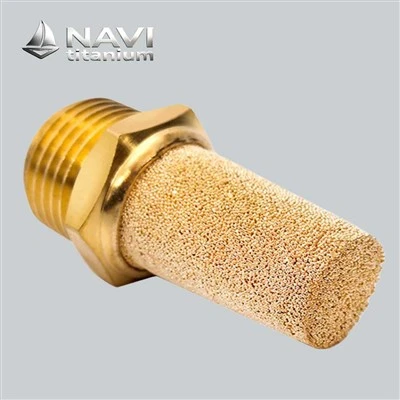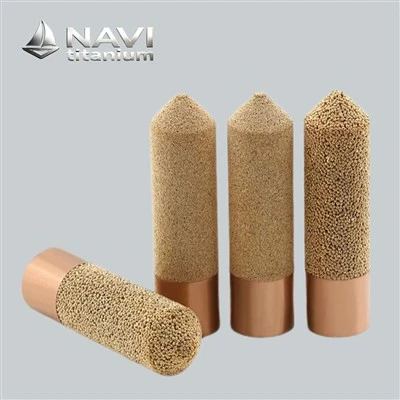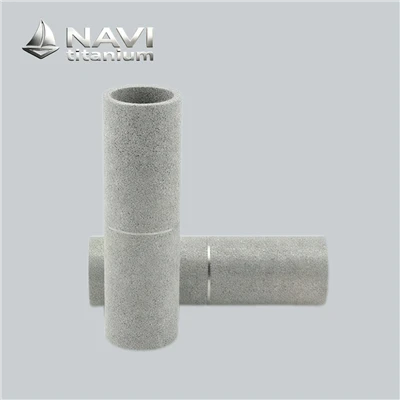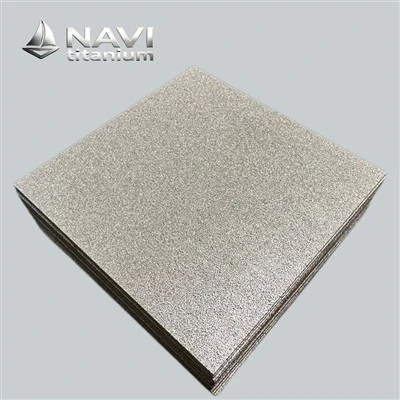


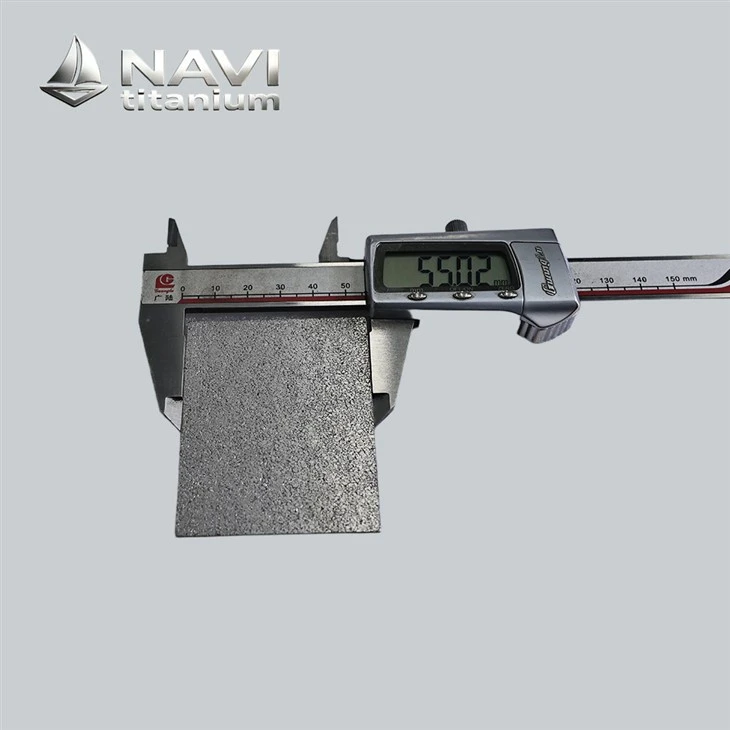
NAVI Titanium sintered metal powder filter cartridges are made from metal powders like stainless steel, titanium alloy, and nickel-based alloy through cold isostatic pressing, high-temperature vacuum sintering, and welding processes, creating porous metal filters. All NAVI Titanium products are fully certified, and the factory strictly follows ISO9001 quality management and ISO14001 environmental management standards.Since 2008, NAVI Titanium has delivered sintered metal powder filters for over 180+ projects covering PEM water electrolysis hydrogen production, semiconductor gas purification, chemical petrochemical filtration across Europe, Southeast Asia and North America.
NAVI Titanium specializes in sintered porous materials manufactured from various metal powders. We offer customized solutions to meet the filtration, air permeability, and flow requirements of diverse industrial applications.
Solution of NAVI Titanium
The sintered porous metal materials produced by NAVI Titanium are manufactured using a proven metal powder sintering process. They serve as high-performance porous metal substrates suitable for a wide range of applications, including precision filtration, electrochemistry, biomedicine, and high-temperature fluid separation. These materials exhibit excellent resistance to acid and alkali corrosion, as well as biocompatibility. Their internal pore structure is uniformly distributed and controllable, and they support in-situ regeneration, enabling long-term, stable operation under harsh, corrosive, high-temperature, and high-pressure conditions. The following are the detailed specifications and performance data for this product, provided for reference only:
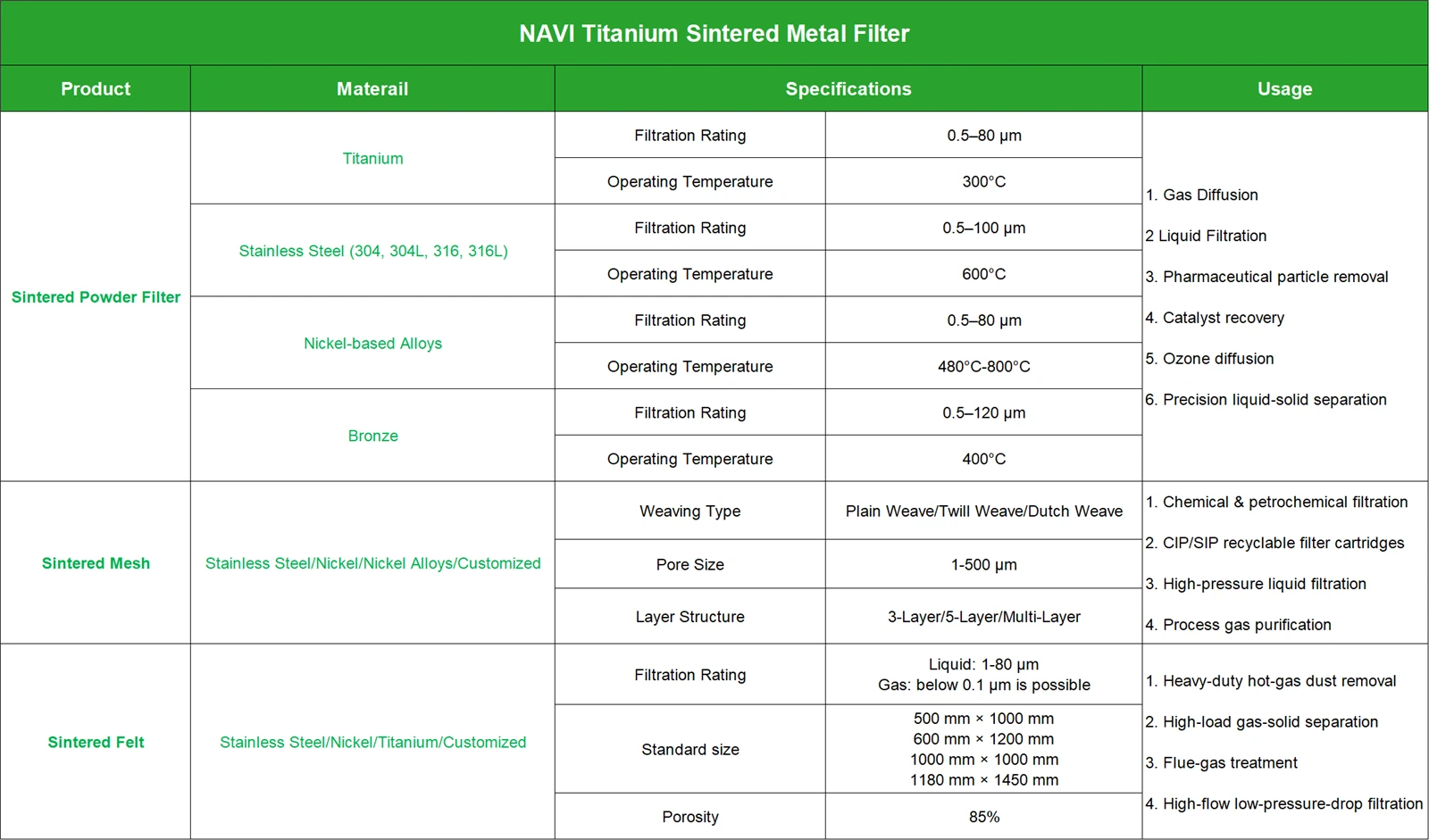

Custom Sintered Titanium Components | Any Shape, Any Size, Engineered for Performance
The porosity of NAVI Titanium products is controllable, with a uniform pore size distribution, offering both breathability and strength. They're free of welding and splicing, making the overall structure more reliable. Available forms include round, square and hexagonal sheets, filter tubes, filter rods, rings, cylinders, cones as well as custom-shaped components.Thickness, diameter, and interface sizes can all be customized according to drawings or samples, and they can be washed and reused multiple times.


Application
NAVI Titanium sintered metal powder filter element is mainly used to filter and separate gases, liquids, powders, and high-temperature media because it's corrosion-resistant and can handle high temperatures. It can also help even out gas flow, fill gas, reduce noise, prevent fire, and protect equipment, making it an important filter material for complex industrial environments.
In PEM fuel cells, filters produced by NAVI Titanium can be installed in front of hydrogen pressure reducing valves; After the hydrogen pressure regulation system; Inlet of hydrogen circulation pump; Anode gas supply pipeline; Before the hydrogen injector; Entrance of fuel cell test bench. Its main function is to protect the hydrogen injector; Proportional valve; Pressure regulating valve; Hydrogen circulation pump; Anode channel; Membrane electrode and catalytic layer. In the PEM system, unreacted hydrogen gas is circulated back to the anode inlet, which contains multiple impurities. The filter can trap solid particles, reduce the wear of the circulation pump, prevent liquid water from entering the pump body, stabilize the hydrogen circulation flow rate, and reduce the risk of anode channel blockage.

Semiconductor & Electronics

The metal filters made by NAVI Titanium are widely used in semiconductor wafer manufacturing, packaging and testing, display PCB, electronic components, and high-purity chemical supply systems. They can filter the precursor carrier gas and reaction gases entering the end of the reaction chamber, helping to distribute the gas evenly and reduce local high-flow areas or dead zones in the gas supply. At the same time, they can improve the gas concentration distribution on the wafer surface, reducing uneven film thickness, particle defects, and edge effects. Plus, even under high temperatures, in a vacuum, or with frequent thermal cycling, they stay structurally stable, which helps lower long-term maintenance costs.
Purchasing guide

Quality control (QC)
NAVI Titanium manufacturing factory has obtained ISO 9001 certification. In order to fully demonstrate our strict quality assurance system, the following are some of the quality inspection reports NAVI Titanium have presented for reference only:
 |
|||||||||
| Certificate of Analysis | |||||||||
| Certificate No.: HL2026-07-0001 | Inspection Date: Jul 14th, 26 | ||||||||
| Product Name | Grade | Condition | Specification | Quantity | |||||
| Sintered Metal Powder Filter | Ta0 | S | Φ100 × 1 mm | 30 | |||||
| Technology Standard | GB/T 6886-2008 Filtration Precision: 20 μm |
||||||||
| Chemical Composition(%) | |||||||||
| Ti | O | N | H | C | |||||
| ≥99.7 | 0.048 | 0.007 | <0.003 | <0.02 | |||||
| Cl | Si | Fe | Mg | Mn | |||||
| 0.045 | <0.006 | 0.024 | <0.01 | 0.002 | |||||
| Performance Test Data (3 Samples) | |||||||||
| Parameter | Sample 1 | Sample 2 | Sample 3 | ||||||
| Maximum Pore Size | 51 μm | 50 μm | 48 μm | ||||||
| Relative Air Permeability Coefficient | 260 m³/h·kPa·m² | 260 m³/h·kPa·m² | 258 m³/h·kPa·m² | ||||||
| Final Judgement | All Inspection Items Have Passed. | ||||||||
| Remark: 1. The certificate only includes basic inspection items that conform to internal quality standards of NAVI Titanium. 2. For further evaluation involving material properties, dimensional accuracy, permeability, and other performance parameters, please consult our technical department. 3. Furthermore, NAVI Titanium is committed to providing customized sintered titanium solutions and professional technical support to meet different application requirements. |
|||||||||
| Signature of QC |  |
||||||||
| This Inspection Certificate is issued in accordance with the Quality Management System of NAVI Titanium The information contained herein is derived from our quality inspection records and shall not be construed as a legal warranty. This Inspection Certificate is not transferable and is intended solely for the use of the customer to whom it is issued. No rights shall be conferred upon any third party by virtue of this Inspection Certificate. |
|||||||||
Checked by: |
Approved by:  |
|||
Manufacturing Process
The core production process of this product produced by NAVI Titanium is: raw material screening → ingredient mixing → molding and pressing → high temperature vacuum sintering → special process.
Ⅰ. Raw material preparation: The main raw material for sintered metal powder filter cartridges is metal powder, usually made of metal materials such as stainless steel, aluminum alloy, copper, etc. These metals are processed through powder preparation techniques to produce powders of the desired particle size. The particle size and shape of powder have a significant impact on the performance of filter cartridges, and therefore powder preparation is a key step in filter cartridge production.

Ⅱ. Ingredients: Mix the powder with other binders, burning aids, etc. in a certain proportion to form a uniform material. Adhesive is mainly used to bond powder particles together to form a stable structure; the sintering aid helps to increase the sintering temperature and promote crystal growth.
Ⅲ. Forming: Place the prepared materials into the mold and shape them into the desired filter element shape through pressure or vacuum adsorption. The shape and size of the filter element will affect its filtration performance, so the molding process needs to be strictly controlled. Common shapes include cylindrical, square, conical, etc.

Ⅳ. Sintering: Place the formed filter element into a sintering furnace, heat it to a certain temperature (usually 800-1200 degrees Celsius), and maintain it for a period of time (usually 30-60 minutes). During the sintering process, powder particles melt at high temperatures to form a dense metal matrix. The sintering temperature and time have a significant impact on the mechanical properties and corrosion resistance of the filter element, and need to be adjusted according to the specific material.

Ⅴ. Special process:
High pressure compression: Some filter cartridges require high-pressure compression after molding to increase their strength and density. For example, filling the mixture into a shaping mold and high-pressure pressing it into a hollow cylindrical embryo with a pressing pressure of 800-1000MPa.
Centrifugal ejection: In some special filter manufacturing processes, it is necessary to eject the molten metal into small gaps through centrifugation. For example, keep the embryo at 200-250 ℃ for 0.5-1 hour, and then spin the molten metal into the embryo by centrifugation at a speed of 1000-1500r/min.
Rinse: Soak the sintered filter plate in dilute acid for 20-30 minutes, then rinse with deionized water for 5-10 minutes. A dilute acid solution is a nitric acid solution with a mass concentration of 3% -10%, and a corrosion inhibitor with a mass concentration of 0.1% -1% of the nitric acid solution is added.
Tube rolling and welding: Roll the washed filter plate into a tube shape using a plate rolling machine, and then perform longitudinal seam welding using full welding.

Differentiated packaging
NAVI Titanium incorporates export packaging into the core of its precision manufacturing and quality control process, establishing six key packaging principles: cleanliness first, structural preservation, material protection, batch independence, cross-border adaptability, and full traceability. This builds an international export packaging system specifically for sintered metal powder filters. We stick to the core principle that 'the precision level of the product should match the protection level of the packaging.' For filter products with different materials, structures, precisions, applications, and transportation routes, we create custom, graded packaging solutions, avoiding a one-size-fits-all approach, so every product leaving our factory has packaging protection standards that perfectly match its precision manufacturing level and overseas usage requirements.
All packaging processes for NAVI Titanium precision sintered filter elements are completed in a dust-free cleanroom to strictly prevent any secondary contamination during packaging. This ensures the micro-pore cleanliness and surface smoothness of the products from the very start, fully meeting the entry standards for high-cleanliness environments like semiconductors, biopharmaceuticals, food purification, and high-purity chemicals. All packaging materials are made from high-end, specialized materials that are dust-free, fiber-free, residue-free, and corrosion-resistant, eliminating any contamination from the packaging itself and ensuring that the clean level of the product leaving the factory matches the production quality standards.

Structural Protection

NAVI Titanium forgoes the usual simple generic wrapping and instead provides customized protective solutions for different types of filter elements, such as flat, tubular, rod-shaped, irregular, threaded, flanged, and bracketed designs. It focuses on reinforcing fragile and precise parts like sealing surfaces, threaded connections, irregular curves, thin-walled structures, and micro-perforated working surfaces. This completely prevents bumps, scratches, deformation, or damage during transportation, ensuring that the product retains 100% of its factory structural accuracy and assembly compatibility. Customers can use the product directly on their machines without needing additional cleaning, polishing, or repairs.
For complex situations like long-distance sea shipping with salt spray corrosion, high humidity oxidation, temperature fluctuations, and prolonged storage in damp conditions, NAVI Titanium has developed a multi-layer protection process including vacuum sealing, moisture-proofing and dehumidification, salt spray resistance, and anti-oxidation. By fine-tuning the protection parameters based on the physical and chemical characteristics of different materials like titanium alloys, stainless steel, and nickel-based alloys, it accurately prevents surface oxidation, rust, discoloration, and salt contamination, ensuring that the materials stay stable and the appearance stays intact during long-distance cross-border transport and long-term overseas storage.

Batch Independence and Full Traceability
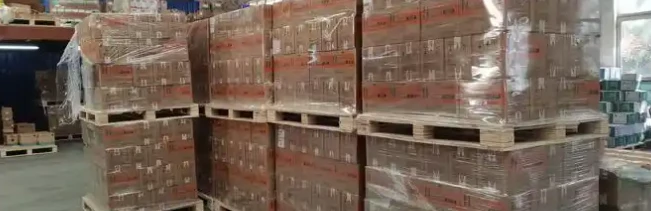
NAVI Titanium strictly follows operational standards of independently packaging each batch, storing each specification separately, and packing each order individually. Every batch of products comes with a unique traceability identifier and complete technical documentation, allowing full traceability of product specifications, production batches, quality inspection data, packaging time, order information, and applicable working conditions. This helps overseas customers manage their inventory precisely, archive batches, trace quality, and handle project acceptance with ease.
Application
The sintered metal filter from NAVI Titanium is a critical functional component in industrial-grade PEM (proton exchange membrane) water electrolysis hydrogen production systems. Its primary functions extend beyond traditional solid-liquid separation and gas filtration; rather, the three-dimensional, interconnected porous structure formed by high-temperature sintering of metal powders enables a variety of functions, including uniform fluid distribution, impurity retention, gas-liquid separation, protection of the electrochemical environment, and protection of key components.
In the PEM water electrolysis hydrogen production process, the water entering the electrolyzer must meet extremely high purity requirements. Since the PEM membrane, electrocatalysts, and metal bipolar plates are all highly sensitive to contaminants, the recirculating water system must be equipped with high-performance sintered metal powder filters to continuously remove microscopic particulate contaminants from the water. The primary sources of contamination in PEM hydrogen production systems include mechanical impurities such as metal particles, welding slag, and machining dust left over from the equipment manufacturing process; trace wear particles generated by bipolar plates, piping, and seals during long-term operation; metal oxide particles resulting from material corrosion in high-potential environments; and trace impurities introduced by the external makeup water system.


Although the concentrations of these contaminants are very low, under high current density operating conditions, they gradually deposit on the surface of the membrane electrode assembly, clogging the pores of the catalytic layer and reducing proton transport efficiency.
Sintered metal filter perform deep filtration of solid particles in circulating water through a uniformly distributed microporous structure. Unlike conventional surface filtration methods, sintered metal filters contain a large number of tortuous, interconnected channels. Once contaminant particles enter the filter bed, they are adsorbed and trapped within these channels, thereby achieving high-efficiency filtration. This structure not only improves filtration precision but also increases filtration capacity, enabling the equipment to operate continuously over the long term.
Frequently Asked Questions
Does the product meet GOST industrial standards? Can you provide compliant customs clearance documents?
+
-
NAVI Titanium's products comply with Russia's GOST industrial filter product standards and can provide certification, technical specification files, and test reports suitable for CIS customs review, ensuring smooth customs clearance.
What is the proper way to clean NAVI Titanium filter cartridges after they get clogged?
+
-
First, use high-pressure air backflushing or liquid backwashing; for heavy clogs, ultrasonic cleaning or weak acid soaking can be used. After cleaning, rinse with clean water and air dry. The filtration flow can be fully restored, and the cartridge can be reused multiple times.
If the system is shut down in winter with water inside, will the filter cartridge freeze?
+
-
The filter itself won't crack from freezing, but accumulated water inside may expand and block the pores. It's recommended to drain the fluid and store it dry during winter shutdown. A simple backflush cleaning in spring will restore full flow.
How do you know when the filter cartridge needs replacing?
+
-
If the inlet/outlet pressure difference keeps increasing, flow can't be restored after repeated cleanings, there are corrosion pits, structural deformation or damage, or if the precision leakage exceeds limits, the cartridge should be replaced.
How should long-distance sea shipments be packaged to prevent deformation or damage?
+
-
Use individual shockproof foam wrapping, a rigid cardboard box, reinforced with solid wood, with protective end caps. This prevents squeezing, bumps, deformation, and end-face damage, making it suitable for long overseas shipping.
Hot Tags: sintered metal powder filter, China sintered metal powder filter manufacturers, suppliers, factory, Porous Media Filter, Porous Metal Filter, Sintered Bronze Filter Element, Sintered Metal Tube, Sintered Nickel Filter, Sintered Stainless Steel Tube