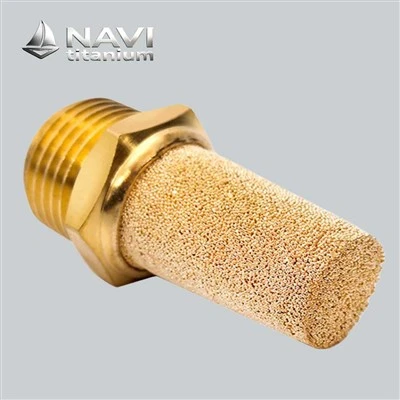


NAVI Titanium bronze filter element provides controlled particle removal for pneumatic, lubrication, and process-line applications where consistent flow matters. Its calibrated openings and uniform material distribution help maintain predictable pressure drop across repeated operating cycles. Batch records and dimensional checks support purchasing confidence. NAVI Titanium has over 20 technologies have been granted utility model and design patents by the China National Intellectual Property Administration (CNIPA).
Solution of NAVI Titanium
This flow control panel is developed for scenarios involving substance retention, heat dissipation and self-lubricating operation. With NAVI Titanium, its carefully controlled dimensional features and internal opening parameters allow flexible customization according to different machinery requirements. The selected configuration supports various operating environments by providing balanced transmission behavior, effective heat management, and adaptable installation options. Detailed technical specifications are provided below.
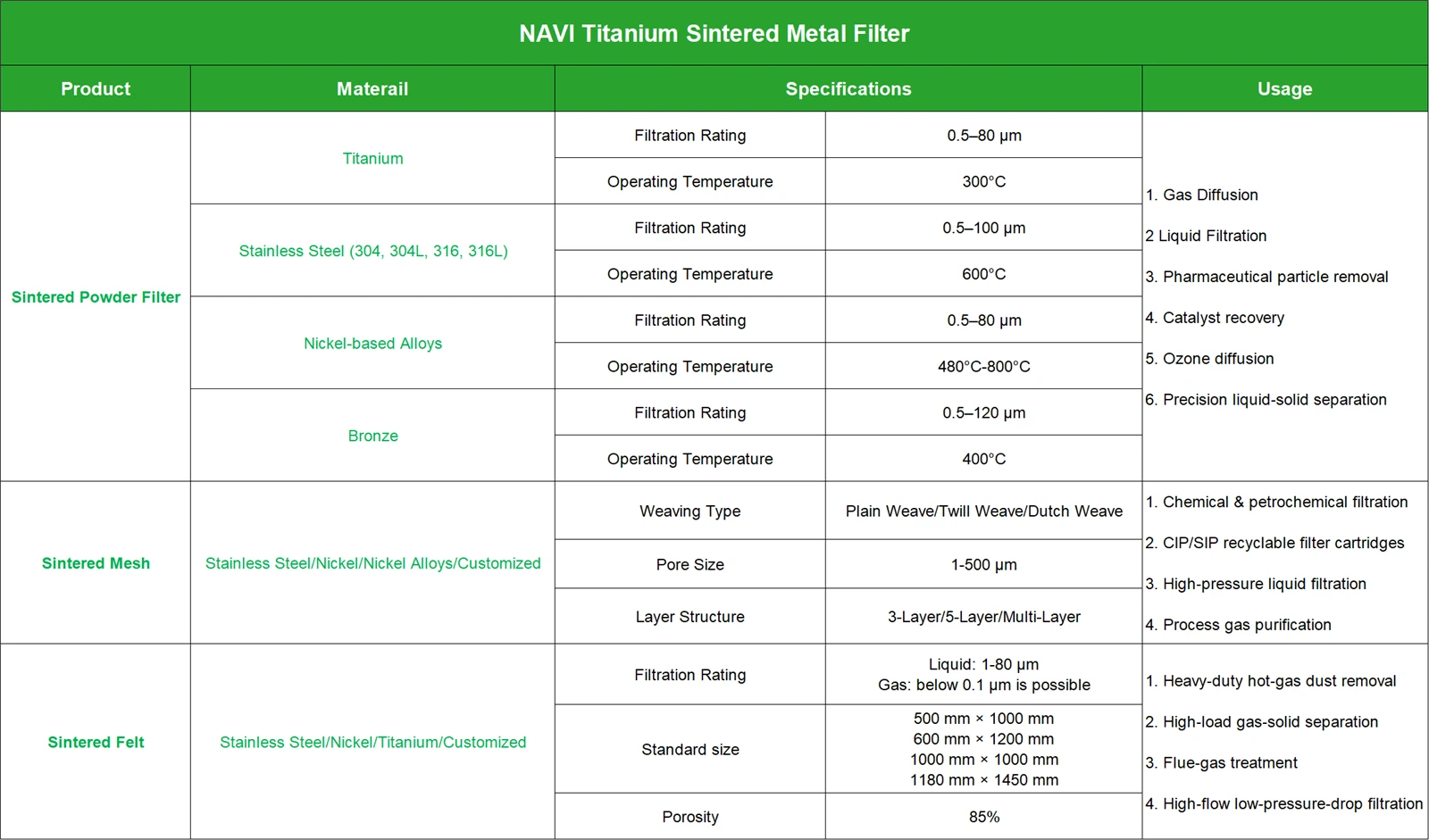

NAVI Titanium supplies precision-engineered porous components for pneumatic circuits, lubrication lines, and process applications requiring controlled particle retention and steady flow characteristics. Carefully selected raw materials, uniform openings, and consistent dimensional control support repeatable performance across different operating cycles.


Application
Bronze filter element supports controlled substance movement in situations involving pressure changes, unwanted residue migration, and continuous operating demands. Within bulk transfer routes, NAVI Titanium helps maintain balanced air release behavior while reducing unnecessary loss of transported materials during repeated conveying cycles. In fuel circulation environments, it assists in protecting sensitive mechanical areas by restricting the movement of external particles carried through liquid pathways.
Bulk transfer operations frequently encounter repeated variations caused by filling activities, discharge movements, and continuous ventilation requirements. These changes may affect pressure balance and conveying consistency during extended operation periods. A specially formed passage body assists in managing air exchange by enabling gradual release while reducing unnecessary loss of transported substances. Its internal pathway arrangement, supported by NAVI Titanium, promotes smoother movement, minimizes irregular pressure changes, and supports more consistent transfer behavior throughout ongoing operation. By enhancing ventilation management and reducing maintenance frequency, this approach helps operators improve resource utilization and maintain more continuous material handling capability.

Fuel Delivery Systems

Fuel circulation systems experience continuous variations caused by injection timing, pumping actions, pressure adjustments, and return movement. During storage and transfer stages, external residues may enter the circulation route, creating higher requirements for cleaner fuel movement and balanced supply behavior. A specially prepared passage body forms a transitional area that helps restrict unwanted substance migration before reaching sensitive mechanical positions. Its selected physical properties and internal opening arrangement support smoother fuel delivery under changing pressure conditions. By maintaining consistent circulation behavior and reducing inspection frequency, this approach helps improve combustion quality, decrease operating expenses, and enhance the long-term value of engines and related machinery.
Purchasing guide

Quality control (QC)
Engineered for demanding filtration environments, this component pairs a robust titanium body with a precision-formed porous bronze filtration core. The bronze matrix delivers consistent particle retention, corrosion resistance, and reliable performance under high pressure and temperature. Every batch is documented for material composition, porosity, and flow characteristics, ensuring full traceability and dependable quality for critical applications.

Manufacturing Process
Bronze Powder Preparation
Select spherical or irregular bronze powder according to the target permeability and mechanical strength.
01
Mold Filling & Compaction
Distribute the powder into a dedicated mold, then apply controlled pressure to establish the required geometry and density.
02
Controlled Sintering
Heat the compacted body in a protected atmosphere, allowing bronze particles to bond while retaining interconnected internal passages.
03
Sizing & Finishing
Calibrate the formed body, remove excess material, and verify dimensions, surface condition, and flow characteristics before shipment.
04
Procurement Cost Optimization
Procurement expenditure can often be reviewed through buying frequency rather than altering the confirmed requirements. When demand is predictable, buyers can compare one larger acquisition against several smaller acquisitions by considering setup allocation, inspection arrangements, documentation, freight, receiving, and internal administrative workload. If several acquisitions are expected within a similar period, consolidation may also be considered, allowing multiple requirements to be planned under one buying cycle while keeping each requirement clearly identified. For project-based demand, a planned dispatch schedule can be arranged in advance, with quantities released according to actual site requirements where appropriate.
Dispatch timing is another area worth reviewing. Advance planning gives procurement staff more time to confirm technical details, arrange fabrication, prepare documents, and select an appropriate freight method.

Documentation Standardization, Repeat Orders & Total Procurement Effort

Cost optimization should also include the administrative side of purchasing. Once drawings, specifications, inspection requirements, document formats, and approval references have been confirmed, they can be retained for future orders. Standardized documentation reduces repeated requests for the same information and makes it easier for Purchasing, QA, Finance, and receiving teams to review subsequent orders. For recurring demand, previous specifications and batch records can provide a reference for the next purchase, reducing the time required to prepare a new order from the beginning.
For customers with regular annual or project-based demand, a longer purchasing arrangement can also reduce repeated sourcing activities. Forecast quantities, planned order frequency, delivery windows, and documentation requirements can be discussed in advance, while any specification change remains subject to separate confirmation.
Advantages
Controlled Air Release
Bulk conveying systems frequently experience pressure shifts during filling, unloading, and air exchange. These variations may interrupt material transport and increase unnecessary product loss. Bronze filter element, supported by NAVI Titanium, creates a gradual escape path for trapped gas, allowing cargo transfer to remain more uniform throughout transportation. Its compact body withstands vibration, repeated loading, and routine cleaning without requiring frequent replacement. Efficient heat dissipation further limits thermal accumulation inside the conveying line, lowering mechanical strain while encouraging smoother bulk movement over extended operating periods.

Conveying Efficiency

Material handling lines frequently encounter changing airflow demand as filling, discharge, and transfer stages alternate throughout daily production. Irregular gas release can interrupt material transport, raise energy consumption, and decrease conveying efficiency over extended operating periods. A carefully arranged passage layout moderates air circulation, easing sudden pressure transitions while encouraging more uniform movement inside the conveying route. This balanced flow pattern, supported by NAVI Titanium, limits unnecessary turbulence, allowing bulk materials to travel with greater continuity and reducing unwanted material loss during repeated transfer cycles.
The compact configuration simplifies installation within different conveying assemblies while tolerating recurring mechanical loading encountered during routine operation. Even under demanding operating schedules, the passage arrangement continues to promote stable gas distribution without creating excessive flow resistance.
Fuel transport circuits operate under changing injection rhythms, pumping activity, and varying load levels throughout normal operation. During storage, circulation, and distribution, unwanted particles may enter the flow path, interrupting smooth liquid movement and creating additional resistance inside the supply route. A carefully arranged passage chamber slows contaminant migration before sensitive mechanical sections encounter foreign matter, reducing unnecessary wear during prolonged operation. Optimized passage geometry encourages steady liquid distribution under different pressure levels while limiting sudden flow variation and improving overall circulation continuity.
Frequent vibration, temperature fluctuation, and chemical exposure place additional demands on internal passages during extended service periods. Strong tolerance to recurring operating cycles allows the unit to remain effective in demanding environments without frequent replacement.

System Performance

Bulk conveying and fuel circulation applications require materials capable of handling changing pressure, elevated temperatures, and recurring mechanical loading throughout extended operating periods. A carefully arranged internal passage layout encourages smoother transfer while limiting unnecessary flow resistance inside the transport route. More balanced circulation also reduces unnecessary pressure loss, allowing material movement to remain more uniform during repeated production cycles.
Repeated cleaning restores functional capability, extending replacement intervals and improving resource utilization over long service durations. Flexible mounting options simplify installation across different application layouts, allowing convenient adaptation without extensive modification. Consistent dimensional characteristics encourage predictable operating results under varying operating environments while reducing unnecessary interruption during routine usage.
Innovation Value
NAVI Titanium continuously improves purification assemblies by refining production methods and adjusting specifications to match different application requirements. Careful examination of pressure variation, passage geometry, and expected operating duration guides every stage of optimization. This ongoing refinement reduces replacement demand, shortens downtime, and improves asset utilization across a wide range of applications. Tailored dimensions and functional options allow each unit to match specific installation requirements while lowering overall ownership expenses throughout its usable lifespan.

Cost Reduction Approach

Extended operating periods place greater emphasis on service lifespan and restoration capability when evaluating ownership expenses. The reusable body tolerates repeated cleaning while retaining its original operating characteristics, allowing replacement intervals to become significantly longer. Carefully arranged internal passages remain effective after multiple cleaning cycles, reducing unnecessary downtime associated with routine maintenance.
Organizations operating numerous installations benefit from fewer replacement schedules, simplified upkeep, and lower inventory demand. Longer service intervals improve maintenance planning and reduce daily management effort while decreasing discarded parts over time. NAVI Titanium supports efficient resource allocation, reusable construction, and lower consumption, together delivering measurable financial advantages for applications requiring uninterrupted production over many years.
Bronze filter element is intended for applications where extended service duration and lower replacement demand remain primary objectives. Repeated cleaning restores functional capability, allowing continued operation without frequent renewal. Carefully arranged internal channels encourage smooth passage movement while preserving efficient resource utilization throughout ongoing service.
Adaptability across different installation environments allows the unit to satisfy a wide variety of operational requirements. NAVI Titanium supports reduced consumption, fewer shutdowns, and simplified lifecycle planning, lowering ownership expenses while improving overall economic return. Extended usability and efficient resource management make this option well suited for organizations seeking sustainable long-term operating value.

FAQ
1. Is this suitable for special operating conditions?
+
-
Yes. It can be tailored for demanding applications involving elevated temperatures, pressure fluctuations, corrosive surroundings, frequent cycling, or strict cleanliness requirements. Before quotation, customers can provide the operating temperature, pressure range, chemical exposure, flow requirements, and expected service period so the appropriate material grade and configuration can be selected.
2. Can you make sizes or specifications outside your standard range?
+
-
Yes. Non-standard dimensions and configurations can be considered according to the customer's installation requirements.
3. Can you provide packaging with our own brand?
+
-
Yes. OEM packaging and private-label requirements can be supported for qualified orders.
4. Why is repeated cleaning important for long-term operation?
+
-
Repeated cleaning allows the unit to continue operating efficiently without frequent replacement. A well-arranged passage layout remains functional after multiple restoration cycles, allowing daily production to continue with fewer shutdowns. Longer service intervals also lower spare-part consumption and simplify routine maintenance planning.
5. Which factors should be considered before selecting a suitable model?
+
-
Selection depends on operating pressure, temperature range, installation dimensions, flow direction, available space, and the characteristics of the transported gas or liquid. Matching these factors with the intended application improves operating efficiency while avoiding unnecessary replacement and excessive operating expenses.
Hot Tags: bronze filter element, China bronze filter element manufacturers, suppliers, factory, Bronze Filter Element, Sintered Metal Powder, Sintered Metal Powder Filter, Sintered Metal Sheet, Sintered Nickel Filter, Sintered Stainless Filter