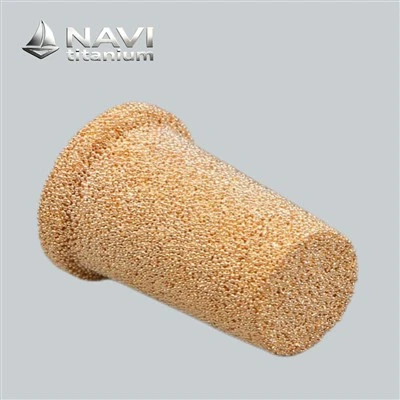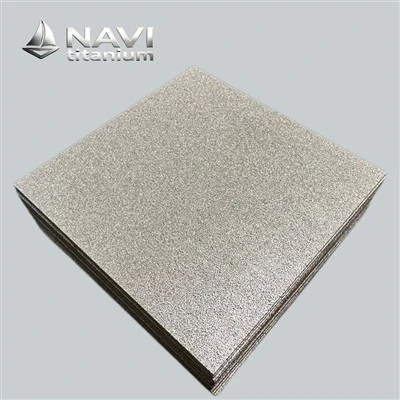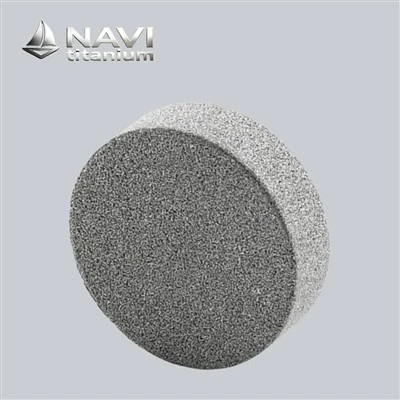


Sintered copper filter of NAVI Titanium is a porous metallic component produced by consolidating copper-based powders into a rigid structure with engineered passages for gas and liquid transmission. Available in pure copper, copper-zinc, and copper-tin compositions, we offer different combinations of conductivity, hardness, and chemical resistance. NAVI Titanium provides tailored structural specs and accurate porous grading, delivering stable, reusable filtering solutions that effectively cut operational costs and improve medium purification efficiency for diverse industrial scenarios.
Solution of NAVI Titanium
NAVI Titanium copper filter is manufactured from selected copper powder through controlled metal powder sintering, forming a rigid porous filter medium for precision filtration, gas-liquid separation, air permeability, and flow control. Its interconnected openings provide consistent filtration and permeability, while copper offers good thermal conductivity and suitability for industrial fluid handling. Customized dimensions, shapes, and filtration grades are available for different equipment requirements. The following table presents key specifications and reference data for NAVI Titanium Sintered Metal Filter products.


NAVI Titanium has developed copper filters engineered for controlled gas and liquid filtration, flow regulation, and particle retention in demanding industrial environments. We offer customized processing for a wide range of copper filter forms, including discs, tubes, cartridges, sheets, and other specially shaped components.


Application
NAVI Titanium sintered copper filter act an important role in industrial gas management by combining particle interception with controlled media dispersion. Their internal micro-channel arrangement allows gases to spread, regulate, or discharge evenly while reducing localized variations during operation. Beyond basic separation functions, these components assist with gas homogenization, acoustic attenuation, and protection of sensitive assemblies.
Many systems require gas delivery to be evenly dispersed rather than concentrated through limited openings. The copper porous component functions as a diffusion medium by converting localized inlet forces into numerous microscopic pathways. These distributed channels divide incoming gas streams into smaller passages, producing a more uniform velocity profile across the outlet surface.
This approach is widely used in combustion devices, laboratory gas supply units, catalyst systems, and protective purge assemblies where repeatable gas delivery affects process consistency. Compared with drilled plates that rely on fixed openings, copper-based media naturally distribute incoming gas through multiple internal routes, reducing uneven discharge patterns and improving dispersion performance over extended service periods. Engineers can adjust permeability characteristics through alloy selection, particle grading, forming parameters, and thermal treatment methods, allowing the component to match requirements from analytical instruments to automated production equipment.

2. Instrument Protection and Fluid Conditioning

Sensitive measurement devices require protection from suspended particles while maintaining accurate signal transmission. NAVI Titanium copper porous components can separate unwanted particles from gases or low-viscosity media before reaching sensors, regulators, flow controllers, and analytical devices.
Rather than acting only as a physical barrier, these components help smooth media movement by reducing turbulence generated by upstream valves, pumps, or pressure fluctuations.
The internal passage arrangement can minimize pulsation effects that may influence measurement accuracy. As a result, laboratories, calibration equipment manufacturers, and instrumentation suppliers often integrate copper porous parts into sampling assemblies where consistent transmission behavior is required.
Because the copper medium itself contributes to flow damping, additional buffering components may be reduced in some designs, simplifying equipment structure. Selecting appropriate opening size and geometry enables engineers to balance retention capability with acceptable resistance for measurement environments.
Purchasing guide

Quality control (QC)
NAVI Titanium manufactures copper filter products under an ISO 9001-certified quality management system. To help you verify copper composition, dimensional accuracy, filtration characteristics, and inspection results, we provide selected Certificates of Analysis (COA) for reference. Click the button below to view available COA documents and review product quality information before placing your order with confidence.

Manufacturing Process
NAVI Titanium manufactures sintered copper filter through a controlled powder metallurgy process. Each stage is managed according to the required filtration grade, dimensions, permeability, and application conditions, from copper powder preparation to final inspection and packaging.
01. Copper Powder Selection & Screening
Selected copper powder is screened and classified according to particle size and material requirements. The powder grade directly influences the final opening characteristics, permeability, and filtration accuracy of the finished filter.
02. Powder Mixing & Preparation
Copper powder is uniformly prepared according to the specified formulation and production requirements. Controlled preparation helps maintain consistent powder distribution before forming and supports repeatable filter characteristics across production batches.

03. Molding & Compaction
The prepared powder is loaded into dedicated molds and compacted under controlled pressure to form the required filter geometry. Depending on the product design, NAVI Titanium can manufacture discs, tubes, cartridges, plates, and other customized shapes.
04. Vacuum / Controlled-Atmosphere Sintering
The compacted copper body is sintered under a controlled thermal atmosphere. During heating, copper particles bond together while retaining the designed open volume within the body, forming the rigid porous structure required for filtration and gas or fluid flow.

05. Machining & Forming
After sintering, filter elements are machined or formed according to the required dimensions and connection design. End faces, mounting interfaces, threads, edges, and other features can be processed to match the customer's equipment.
06. Cleaning & Surface Treatment
Finished elements are cleaned to remove loose particles and processing residues. Additional treatment can be applied according to the intended operating environment and customer's technical requirements before final inspection.

07. Filtration & Dimensional Inspection
Finished filters are inspected for dimensional accuracy, filtration characteristics, permeability, and structural consistency. Inspection results are recorded according to the applicable product requirements and can be provided through relevant quality documentation.
08. Packaging & Shipment
After final verification, each filter is individually protected and packed according to its geometry and shipment requirements. Customized packaging and identification are available to support safe international transportation and straightforward product identification upon arrival.

Understanding Copper-Based Porous Materials
Although these materials are often grouped under the broad term "copper-based permeable components," they represent three distinct alloy categories with different chemical compositions and physical characteristics. Selecting an unsuitable material may affect strength, corrosion behavior, conductivity, and production economics. Professional buyers usually evaluate these alloys according to composition and service requirements rather than visual appearance.
NAVI Titanium copper filter is produced from high-purity copper with limited alloy additions. Due to copper's inherent electrical and thermal conductivity, this material is particularly suitable for designs where heat transfer or electrical performance contributes to the overall function. Compared with copper alloys, pure copper generally provides superior conductivity but lower hardness, making it more appropriate for specialized components where thermal characteristics are prioritized.


Sintered brass filter is manufactured from copper-zinc (Cu-Zn) alloy. The addition of zinc improves hardness, rigidity, and machining performance compared with pure copper while maintaining relatively economical manufacturing characteristics. Brass components are commonly used in pneumatic exhaust devices, ventilation plugs, sensor protection parts, gas diffusion units, and general-purpose separation assemblies where moderate environmental resistance is sufficient. Their balanced material properties make them widely adopted in compact air-handling devices and auxiliary components.
Sintered bronze filter, in comparison, is based on copper-tin (Cu-Sn) alloy composition. The presence of tin modifies the alloy behavior during heating and contributes to improved wear resistance and corrosion tolerance compared with brass. Bronze are often selected for demanding environments involving oil-based media, fuel systems, and mechanical assemblies where stronger resistance to abrasion and chemical exposure is required.
Although these three copper alloys share similar forming principles, their responses during production vary because of differences in composition and thermal characteristics. NAVI Titanium copper materials are processed through controlled forming and heating stages, during which individual metal particles gradually join together while maintaining designed internal passages.
Pure copper provides excellent heat transfer capability but has comparatively lower hardness. Brass achieves greater rigidity because of zinc alloying, allowing better resistance against deformation during assembly and handling.


Bronze behaves differently due to the influence of tin, resulting in enhanced wear resistance and improved compatibility with demanding service environments. These alloy-specific differences explain why production parameters developed for one copper cannot always be directly applied to another.
Material selection therefore requires consideration beyond corrosion resistance. Engineers usually compare conductivity requirements, strength demands, machining needs, environmental exposure, production cost, and expected service conditions before choosing the appropriate copper-based material.
Because each alloy provides a different combination of physical and chemical characteristics, material selection is normally determined by the working environment and functional requirements rather than separation accuracy alone.
Brass porous components are commonly installed in pneumatic discharge devices, compact ventilation parts, protective vents, sensor housings, gas diffusion assemblies, and flame-control components. Their good machinability, moderate atmospheric resistance, and cost advantages make them suitable for large-volume manufacturing. However, brass may not be the preferred choice for aggressive chemical environments or elevated temperatures where zinc-related material changes could occur.


Pure copper components are typically chosen when thermal transfer or electrical conductivity plays an important role. They are frequently integrated into specialized assemblies where heat dissipation performance is more important than maximum hardness. Their lower mechanical strength compared with copper alloys should be considered when exposed to repeated impact or heavy mechanical loading.
Bronze components are generally selected for applications involving oil circulation, fuel handling, mechanical assemblies, and demanding industrial media. NAVI Titanium copper-tin composition provides improved resistance against wear and environmental stress, making bronze suitable for applications requiring extended service intervals and durable material performance.
NAVI Titanium Proven Experience, Global Reach, Trusted Quality
NAVI Titanium brings over fifteen years of specialized expertise to the manufacturing of sintered copper filters, establishing ourselves as one of the most dependable suppliers in the porous metals industry.
Since our establishment, we have continuously invested in advanced sintering technology, precision tooling, and laboratory testing equipment, accumulating invaluable production know-how that translates directly into superior product quality. Our engineering team has completed thousands of successful projects, from standard filtration discs to highly customized porous components for demanding applications. This extensive experience means we understand failure modes, application nuances, and performance optimization in ways that newer manufacturers simply cannot match. Our fifteen-year track record of stable operations, consistent financial health, and uninterrupted supply capability gives customers confidence that we will remain a reliable partner for decades to come. Experience is not just our history - it is your competitive advantage.
The global trust in NAVI Titanium copper filters is reflected in our impressive export scale. Our products currently serve customers in more than 50 countries, spanning North America, Western Europe, Japan, South Korea, Southeast Asia, the Middle East, and Australia, with annual export volume exceeding 600 tons of porous copper products.


We have supplied over 2,000 international clients, including leading OEMs in hydrogen energy, medical equipment, automotive, and chemical processing industries. Our filters are trusted in critical applications across diverse climates and regulatory environments, passing stringent certifications including ISO 9001 and meeting RoHS and REACH compliance requirements for European markets. Major markets like Germany, the United States, and Japan - known for the world's strictest quality standards - consistently return with repeat orders, with our customer retention rate reaching 95 percent. Such widespread international acceptance demonstrates that NAVI Titanium quality meets the highest global benchmarks.
Behind every export shipment lies a comprehensive service system refined through years of international trade experience. Engineer maintains dedicated export departments staffed with multilingual professionals who manage documentation, customs clearance, and logistics coordination, delivering to over 40 countries with a 99 percent on-time shipping rate. We operate safety stock programs for key customers and maintain strategic warehousing partnerships in major markets,
ensuring rapid replenishment even during global supply disruptions - a resilience proven during recent logistics challenges when we maintained uninterrupted delivery for all contracted clients. Our export credentials include long-term cooperation with renowned freight forwarders, full Container Load (FCL) and Less than Container Load (LCL) flexibility, and professional vacuum packaging that protects filter integrity during ocean transit. For customers seeking a sintered copper filter supplier with proven international capability, documented export success, and the infrastructure to support global partnerships.
FAQ
How can I work with you if my filter requirements change after the first order?
+
-
For repeat projects, customers can provide feedback from the first batch, including installation results, cleaning frequency, pressure-drop observations, service interval, or dimensional changes requested by the equipment team. We can use this information when reviewing subsequent orders, helping the customer move from an initial specification toward a more suitable long-term purchasing standard.
How is the quality of a copper filter verified before shipment?
+
-
Each copper filter can be checked against the agreed technical requirements before shipment. Depending on the order specifications, quality checks may include dimensions, pore characteristics, air or liquid permeability, material composition, appearance, and mechanical condition. Inspection records can be maintained for each production batch, and a Certificate of Analysis (COA) can be supplied when required.
Can I use the same filter specification after changing the operating conditions?
+
-
Customers should recheck the specification whenever temperature, pressure, flow rate, contaminant concentration, or working medium changes significantly. A filter that performs well under one set of conditions may not provide the same result after the process is modified. We can review the updated conditions before a repeat order is placed.
How long can a copper filter normally be used?
+
-
There is no single service-life figure that applies to every customer. Actual service time depends on the operating environment, contaminant loading, cleaning frequency, temperature, pressure, and handling practices. Instead of quoting an arbitrary number of months or years, we recommends evaluating service history under the customer's actual conditions.
What should I avoid when cleaning the filter?
+
-
Customers should avoid methods that may deform the filter, block its pores, introduce foreign material, or alter the copper material. Abrasive treatment and uncontrolled mechanical force should be avoided unless specifically approved for the particular part. After cleaning, the filter should be fully dried and inspected before being returned to service.
Hot Tags: sintered copper filter, China sintered copper filter manufacturers, suppliers, factory, Porous Metal Filter, Porous Stainless Steel Plate, Sintered Bronze Air Muffler, Sintered Metal Powder Filter, Sintered Metal Tube, Titanium Filter