NAVI Titanium porous stainless steel tubes are integrated porous metal tubular components manufactured through powder metallurgy high-temperature vacuum sintering technology. Unlike conventional mechanically perforated steel pipes, they are precision filtration and fluid distribution core components specifically designed for industrial applications. NAVI Titanium products are mainly manufactured using high-quality 304 and 316L stainless steel powders as raw materials, through multiple processes including material formulation, isostatic compaction, oxygen-free sintering, and precision post-processing.
Solution of Titanium Anode
In terms of key performance parameters and customization capabilities, filtration precision and fluid flow capacity can be accurately matched according to operating conditions. The products feature excellent adaptability under complex operating conditions, with temperature resistance up to 600°C, maximum pressure resistance of 3.0 MPa, outstanding acid and alkali resistance, oxidation resistance, and thermal shock resistance. They can meet the requirements of most industrial applications involving corrosive media, high and low temperatures, and high-pressure environments.
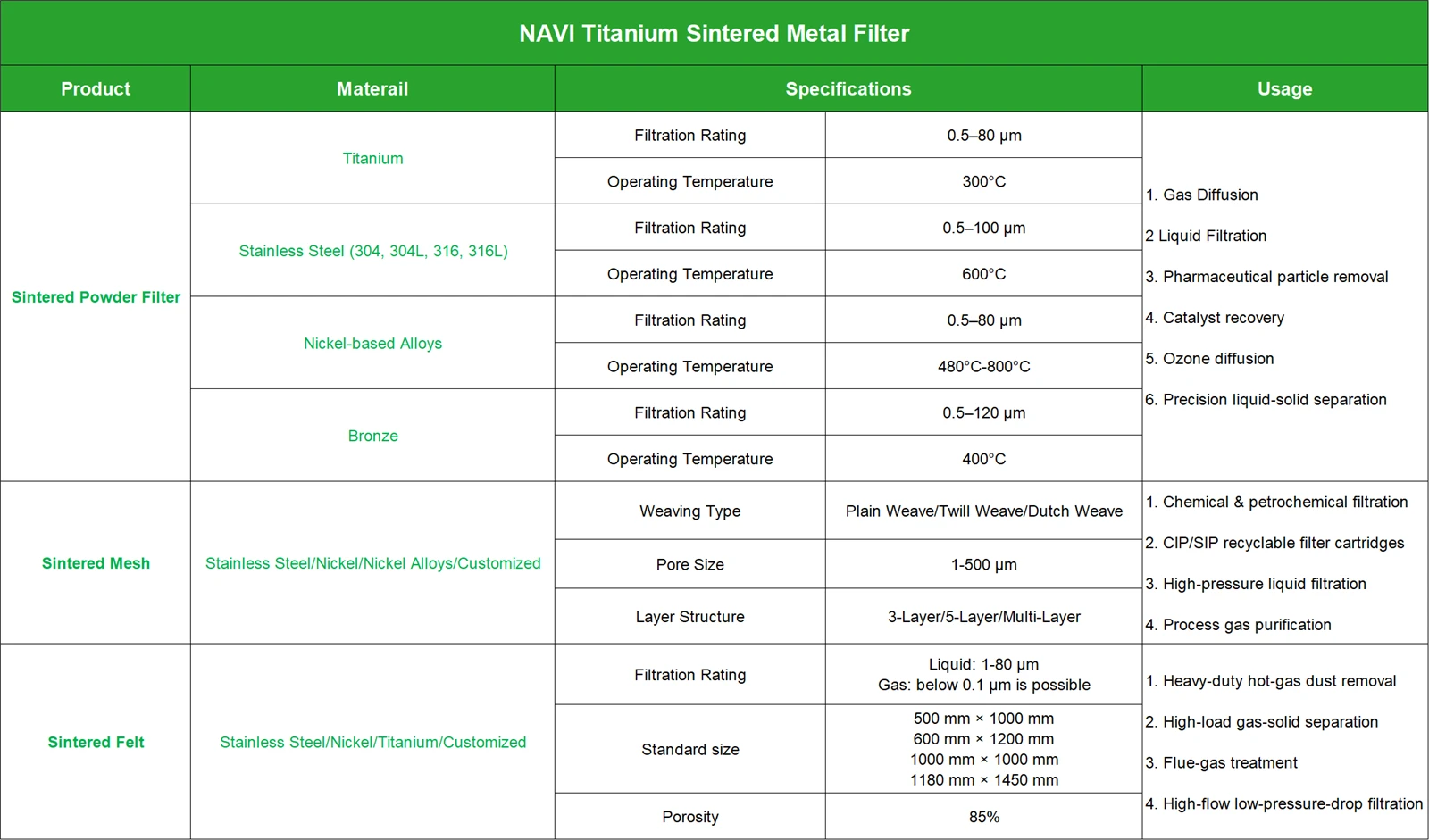

Tube diameter, tube length, and wall thickness can all be customized according to customer requirements. NAVI Titanium tube ends can be designed with various connection options, including clamps, threads, flanges, and welding structures, making them suitable for installation in various pipelines, reactors, and filtration systems.


Application
Due to their precisely controllable microporous structure, excellent corrosion and high-temperature resistance, as well as their cleanable, regenerable, and long-term stable operating characteristics, NAVI Titanium porous stainless steel tubes are highly suitable for demanding industrial fluid treatment environments. They have already been widely adopted in biopharmaceuticals, fine chemical and petrochemical industries, environmental water treatment, advanced new energy equipment, oil and gas extraction, and high-temperature industrial applications. The following section describes their application details in industrial circulating water and cooling water filtration.
This working condition is widely used in equipment cooling and process temperature control systems across various industries. In open-loop circulating water systems, water directly contacts air, allowing various contaminants to enter during circulation, including dust, flocs, sediment, aged filler fragments, and pipeline corrosion particles. Traditional filtration consumables generally suffer from limited filtration accuracy, clogging, damage, and inability to regenerate, which can lead to pipeline sediment accumulation, spray nozzle blockage, and reduced heat exchange efficiency. As a front-end core filtration component in pipelines, the products utilize their uniform microporous structure, high pressure resistance, and excellent erosion resistance to continuously intercept solid and liquid contaminants while maintaining stable system flow and circulation pressure. The products support 24/7 continuous operation and can quickly restore filtration capacity through online backwashing without shutting down equipment for filter replacement. They are suitable for continuous large-flow filtration requirements in various industrial open circulating water systems.

Precision Filtration Application in Closed Pure Water/Softened Water Circulation Systems

NAVI Titanium application is designed for closed-loop cooling water circulation systems supporting precision equipment and advanced manufacturing processes. Such systems require extremely high water cleanliness. Although closed systems are isolated from external contamination, long-term operation may generate micron-level contaminants such as welding residues, metal oxide particles, sealing gasket fragments, and chemical treatment residues. These particles can easily block precision pipelines, cooling chambers, and analytical instruments. Porous sintered stainless steel tubes feature high-precision microporous structures that accurately capture fine contaminants. The 304/316L stainless steel material provides excellent chemical stability and does not react with pure water, softened water, or water treatment chemicals, preventing metal ion release and secondary contamination. The products offer strong installation flexibility and can be installed in bypass filtration units or equipment inlet points to continuously purify water quality, preventing micro-blockage, heat exchange degradation, and pipeline wear in precision equipment. They are particularly suitable for closed-loop water circulation systems in electronics, new energy, precision machinery, and other advanced manufacturing industries.
Industrial circulating water systems commonly require chemical dosing, including scale inhibitors, biocides, and flocculants. After chemical reactions with impurities in water, sticky flocs, suspended colloids, and chemical residues may form. These soft contaminants easily attach to pipelines and heat exchanger surfaces, causing sludge accumulation, scaling, reduced heat transfer efficiency, pipeline corrosion, and deterioration of water quality. The ubes provide excellent anti-adhesion performance, high flow capacity, chemical corrosion resistance, and regeneration capability. They are specifically designed for purification filtration after chemical dosing. Compared with traditional paper or cotton filter cartridges, stainless steel tubes are less prone to clogging and failure. They maintain stable water quality, reduce scaling and biological growth, decrease wastewater discharge frequency, and lower water treatment costs. They serve as key supporting components for refined operation and maintenance of industrial circulating water systems.

Pre-Filtration Protection for Circulating Water Pump Rooms and Equipment

During commissioning, maintenance, and long-term operation of circulating water systems, residual construction debris, corrosion deposits, coating particles, and other hard contaminants may remain inside pipelines. These contaminants can severely damage pump impellers, sealing components, heat exchangers, and valves, significantly increasing equipment failure rates and maintenance costs. Installed at pump suction inlets or as pre-filters for critical equipment, stainless steel tubes provide high strength, excellent erosion resistance, and pressure resistance to effectively intercept hard particulate contaminants and protect downstream equipment. The products have low flow resistance and do not affect pump head or system circulation efficiency. They effectively reduce equipment wear, minimize downtime risks, and ensure long-term stable and low-loss operation of circulating water systems.
Purchasing guide

Quality control (QC)
NAVI Titanium strictly controls quality throughout the entire process, and every batch of products comes with a complete quality inspection report. From raw material composition analysis and mechanical performance testing to corrosion resistance verification, all test data is real and traceable, providing reliable quality proof for your project selection.
|
|

Manufacturing Process
The manufacturing of sintered stainless steel involves a series of precisely controlled steps, from stainless steel powder preparation and forming to sintering, sizing, machining, and finishing. The selection of powder characteristics and forming conditions directly influences the final pore structure and product geometry, while controlled sintering creates the required strength and interconnected porosity. After sintering, sizing and precision machining are applied where necessary to achieve the required dimensions, tolerances, and surface finish. Process parameters can also be adjusted according to different product designs, pore sizes, permeability requirements, and application conditions.
|
|
|
|


Advantages of Sintered Stainless Steel
Sintered stainless steel combines controlled porous structures with the inherent strength and corrosion resistance of stainless steel. Its adjustable pore size, porosity, permeability, and geometry make it suitable for a wide range of liquid and gas filtration applications. With proper material selection and process control, it can provide stable filtration performance, good mechanical durability, and convenient cleaning and reuse, making it a practical choice for demanding industrial environments. More details are below for your reference.
| Advantage | Description |
| Precise Filtration | Controlled pore size and uniform pore distribution provide stable and reliable filtration performance. |
| High Mechanical Strength | The sintered structure offers good strength and dimensional stability, even under demanding operating conditions. |
| Corrosion Resistance | Stainless steel grades such as 304, 316, and 316L provide good resistance to moisture, chemicals, and corrosive media. |
| Temperature Resistance | Suitable for high-temperature applications, with performance depending on the stainless steel grade and operating conditions. |
Porous Metal Solutions for Equipment Manufacturers and OEM Buyers
NAVI Titanium provides customized porous metal components for equipment manufacturers, system integrators, engineering companies and OEM buyers requiring reliable filtration, gas or liquid distribution and controlled flow performance. Standard filter media or off-the-shelf components may not always match the required dimensions, operating conditions, installation structure or performance requirements of specialized equipment. Porous metal components provide an integrated metallic structure with interconnected pores, combining controlled permeability with mechanical strength and dimensional stability. Depending on the application, they can be developed for filtration, gas diffusion, ventilation, pressure equalization, fluid distribution and other controlled-flow functions. Material selection can include stainless steel, titanium, bronze and nickel-based alloys according to the working environment, while pore characteristics, thickness, dimensions, shape and connection structure can be adjusted according to customer requirements. Product configurations can include discs, plates, tubes, cylinders, cartridges, rings and other customized geometries, providing a practical component solution for new equipment development, existing equipment modification and replacement projects.


For B2B customers, selecting a porous metal component is usually part of a larger equipment or sourcing project rather than a simple one-time purchase. NAVI Titanium works with customers from initial requirement review through prototype development, specification confirmation and subsequent production, with technical information such as drawings, samples, working conditions, flow requirements, pressure, temperature, material and pore characteristics reviewed before manufacturing. Prototype and small-quantity orders can be used for customer evaluation and system integration, while confirmed specifications can then be maintained for repeat orders and larger production requirements. Existing components or samples can also be used as references when developing replacement parts or compatible alternatives. Depending on the project, inspection requirements, documentation, packaging and delivery arrangements can be coordinated as part of the supply process. This provides equipment manufacturers, engineering companies and OEM buyers with a more structured sourcing route from initial component development to stable and repeat procurement.
FAQ
01.How should porous stainless steel tubes be cleaned during routine maintenance?
02.How can I tell when porous stainless steel tubes need cleaning?
03.Can porous stainless steel tubes withstand frequent cleaning?
04.How often should porous stainless steel tubes be inspected?
05.What maintenance practices can help extend the service life of porous stainless steel tubes?
Hot Tags: porous stainless steel tube, China porous stainless steel tube manufacturers, suppliers, factory, Sintered Bronze Fuel Filter, Sintered Bronze Muffler, Sintered Metal Disc, Sintered Metal Powder, Sintered Porous Filter, Sintered Stainless Steel Sheet