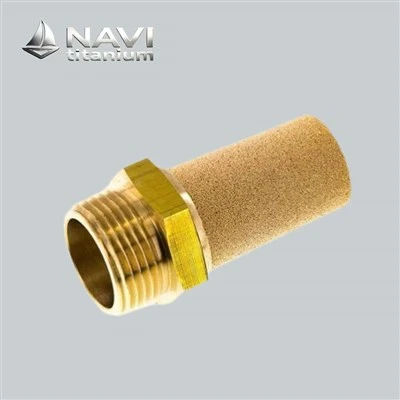
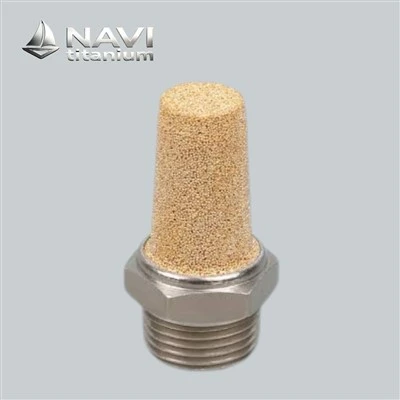
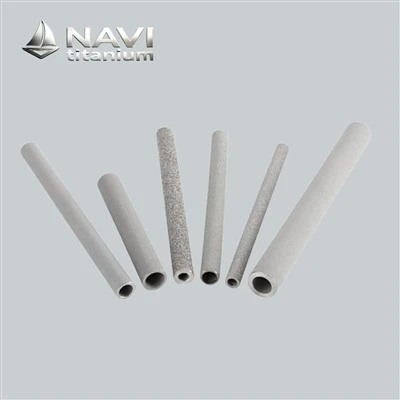
NAVI Titanium porous metal filter is a permeable alloy element with an interconnected three-dimensional pore structure that guides gases and liquids while restricting unwanted solids. Its rigid construction and adjustable porosity support controlled flow, dispersion, and impurity retention. Designed for demanding applications, we provides customized materials, dimensions, pore grades, and technical support for diverse filtration requirements.
Solution of NAVI Titanium
NAVI Titanium porous filter is fabricated via mature metal powder sintering technology. As high-performance porous substrates, it delivers uniform, controllable pore structure, outstanding acid & alkali corrosion resistance and biocompatibility, supporting in-situ regeneration for stable service under harsh high-temp, high-pressure environments. We provide custom solutions for filtration, permeability and flow demands across precision filtration, electrochemistry and biomedicine. Below table lists its specifications and performance data for your reference only.


NAVI Titanium has developed specialized porous filters engineered for controlled gas and liquid flow, solid retention, and demanding industrial filtration conditions. We offer customized processing for various alloys, pore sizes, thicknesses, dimensions, and shapes, including plates, discs, tubes, and other porous components.


Application
Porous metal filter products are commonly selected for gas handling duties where contaminant control and steady gas transmission are required. During gas transportation, purification, and treatment operations, unwanted substances may enter the gas stream from upstream sources, equipment operation, or external exposure. These contaminants may influence valves, monitoring devices, compressors, and other sensitive assemblies.
Metallic separation units help manage these impurities by providing controlled passage routes that permit gas movement while restricting unwanted materials. In vacuum equipment, compressed gas treatment, and purification assemblies, NAVI Titanium is often considered when maintaining cleaner gas quality and predictable separation capability is important for long-term operation.

Reactive Compound Production

Facilities manufacturing acids, alkalis, specialty reagents, catalysts, and other reactive compounds often expose alloy products to demanding service situations involving corrosive substances, thermal cycling, and mixed-phase streams. These circumstances place strict expectations on alloy selection and product reliability.
A porous cell is frequently incorporated into transfer lines, reaction vessels, dosing systems, and purification stages where foreign solids must be removed without interrupting production. NAVI Titanium grades can be selected for compatibility with aggressive compounds, allowing the product to remain effective throughout long production campaigns involving challenging processing substances. Its adaptable design also enables integration into both newly built facilities and existing production lines with minimal modification to surrounding installations.
Modern manufacturing equipment used for semiconductor fabrication, analytical laboratories, pharmaceutical production, and optical processing depends on exceptionally clean incoming streams. Even trace amounts of dust or suspended debris may affect measuring accuracy, product quality, or equipment reliability.
Our unit is often positioned upstream of critical instruments to intercept unwanted solids before they reach precision devices. Typical installations include sample preparation systems, laboratory instruments, automation equipment, and clean manufacturing lines. Introducing an alloy filtration stage near sensitive hardware helps reduce the possibility of unwanted deposits while preserving cleaner working conditions throughout the production sequence.

Purchasing guide

Quality control (QC)
NAVI Titanium's production facility holds ISO 9001 certification for porous cell production. To showcase our rigorous quality control system for sintered porous metal elements, click the button below to access our official Certificate of Analysis (COA) and inspect full quality test records for your evaluation.

Manufacturing Process
Our filter adopts binder-free powder metallurgy and vacuum sintering, following a standardized multi-stage workflow:
Powder Selection & Grading
Raw metal powders are screened and classified to control particle size distribution. We test powder flow rate and apparent density, and verify chemical composition to match target pore size requirements.
Compaction & Forming
Weigh-classified powder is loaded into custom moulds, then compacted under controlled pressure to form preformed cell blanks with precise geometry and consistent porosity.
Vacuum Sintering
Compacted green bodies undergo high-temperature vacuum sintering. Metal particles diffuse and bond together to form an integrated, rigid porous structure without organic residues.
Post Machining & Surface Treatment
Secondary machining such as cutting, drilling and finishing is performed to achieve final dimensions. Surface treatment removes impurities and optimizes corrosion performance.
Full Performance Testing
Each finished cell is inspected for pore size, permeability, mechanical strength and corrosion resistance. Only qualified pieces move to packaging.
Protective Packaging & Shipment
Products are packed with anti-scratch, moisture-proof packaging to safeguard porous surfaces before export delivery.
Performance Characteristics
Balanced Permeability

A porous metal filter should achieve an appropriate balance between stream permeability and impurity interception. Excessively open voids may allow unwanted solids to pass through, whereas an overly dense alloy can restrict circulation and increase energy demand. Achieving the desired balance depends on the relationship among alloy grade, void ratio, wall thickness, and the physical properties of the incoming stream across a wide range of production duties and service demands.
Instead of evaluating a single specification, NAVI Titanium usually examine these factors as a combined system to determine the most appropriate product for each application. A well-matched design promotes steady stream circulation while limiting unnecessary loading on pumps, compressors, and associated production facilities.
Contamination holding capability refers to the ability of a porous cell to manage accumulated foreign materials during extended service periods. Unlike traditional screening methods that rely mainly on a single blocking area, the internal metallic body enables impurities to interact with multiple internal regions, creating a progressive retention effect. This characteristic allows the separation element to handle changes in contaminant concentration and variations in incoming material conditions during practical operation. Retention behavior depends on factors such as contaminant size, shape, substance characteristics, and separation requirements. In production environments where incoming streams may contain different levels of unwanted substances, the ability to accommodate retained materials becomes an important factor when selecting suitable metallic separation units.

Alloy Compatibility

Every manufacturing application exposes NAVI Titanium to its own combination of substances, thermal conditions, and service demands. Selecting an appropriate alloy is therefore just as significant as choosing the correct void rating.
Titanium, stainless steel, nickel, and specialty alloys each exhibit distinct advantages under particular exposure conditions. Factors including corrosion potential, thermal cycling, product purity, and contact substances should all be reviewed before finalizing an alloy grade. Careful matching between alloy composition and production duty helps extend product life while reducing the possibility of premature degradation. For this reason, alloy compatibility remains a primary consideration in pharmaceutical manufacturing, semiconductor fabrication, food production, energy systems, and many other specialized industries.
Technical Challenges
One important challenge of porous metal filter technology is maintaining a suitable balance between contaminant removal capability and substance transmission behavior. In practical operating environments, improving separation precision may reduce the movement speed through internal passages, while excessive resistance can influence throughput and energy consumption. Engineers need to evaluate factors such as substance characteristics, transmission velocity, and production requirements when selecting our elements. A well-developed metallic separation unit should provide effective impurity control while maintaining sufficient passage capability during operation. This balance depends on the relationship between internal opening characteristics, contaminant behavior, and movement dynamics rather than relying only on a single specification value.

Maintaining Consistent Performance Under Variable Conditions

NAVI Titanium products may experience various changes during practical service, including differences in contaminant concentration, transmission speed, temperature range, and transported substance composition. A separation element that performs well under controlled testing conditions may respond differently when introduced into actual production environments. Changes in incoming streams, uneven contaminant distribution, and fluctuating operating factors can influence separation results over extended periods. Therefore, evaluation should include realistic service scenarios rather than depending only on laboratory measurements. Understanding how metallic porous units respond to changing circumstances helps engineers select suitable specifications and achieve more predictable operating results in complex technical environments.
Another challenge in porous cell development is matching the element configuration with different installation arrangements and functional requirements. Various machines and treatment assemblies may differ in connection methods, transmission direction, available space, and integration approaches. A standard separation unit may not always meet every project requirement. Customized solutions require careful consideration of dimensions, internal passage characteristics, joining methods, and compatibility with surrounding equipment. Engineers must balance flexibility with production consistency to achieve suitable functional results. Close communication between suppliers and users is often required to ensure that the final metallic element corresponds with the intended service environment.

Internal Passage Behavior
How Internal Passage Arrangement Influences Residence Time Distribution

In many separation technologies, the duration that a transported substance remains inside a permeable element is an overlooked factor affecting overall behavior. Unlike conventional channels where movement usually follows a relatively fixed route, porous metallic bodies contain numerous internal paths with different lengths, shapes, and directions. When substances enter these routes, some portions may travel through shorter passages quickly, while others may remain longer due to more complex internal areas. This difference creates residence time variation that influences the interaction between processed substances and the metallic body. Longer contact duration may affect contaminant capture, gas diffusion, or heat exchange depending on the intended operating purpose. Researchers studying advanced porous elements now examine more than simple opening dimensions. The arrangement of internal routes and their influence on residence duration provide valuable information for predicting actual working behavior. This explains why two products with similar opening ratings may produce different results after being installed into complete assemblies.
At microscopic scales, substance movement inside porous metallic bodies is influenced by physical forces that are difficult to observe in conventional transmission routes. Capillary effects can affect how liquids enter, spread through, and leave the small spaces within the permeable region. These effects become particularly important in precision equipment, low-volume transfer situations, and setups involving liquids with different viscosity characteristics. The interaction between liquid properties and internal metallic surfaces may influence initial filling behavior, distribution patterns, and retained liquid quantity. Understanding capillary behavior allows engineers to evaluate NAVI Titanium elements beyond basic dimensional parameters. Factors such as passage geometry, material interaction, and liquid characteristics work together to determine how effectively the metallic body manages small-scale substance movement.

Why Internal Opening Distribution Can Matter More Than Average Opening Size

Average opening size is commonly used as a reference when evaluating porous materials, but this value does not always represent the complete internal condition.
Two permeable elements may share the same average opening rating while showing different working results because their internal distribution patterns are not identical. A balanced arrangement creates varied connected routes, while uneven distribution may cause certain regions to carry more substance movement than others. This difference can influence transmission balance, contaminant accumulation, and long-term operational behavior. For advanced porous metal filter selection, engineers increasingly evaluate distribution characteristics together with opening size values. This approach provides a more complete understanding of how the element behaves after integration into a finished assembly.
NAVI Titanium Quality & International Supply
NAVI Titanium supports international customers with documentation and quality practices designed for global purchasing requirements of porous products. Relevant quality management credentials may include ISO 9001 and ISO 14001, while CE documentation can be provided when applicable to the supplied product and market requirements. Material inspection reports can document the selected raw material and corresponding test results, helping buyers verify technical information before shipment. Third party inspection through organizations such as SGS can also be coordinated when requested or required by a project. Batch traceability records provide another important reference by connecting production information with specific orders and inspection documentation. This documentation approach helps purchasing teams prepare internal approvals, import files, and project records while supporting customers seeking internationally recognized quality practices and clearer compliance information for overseas procurement and project delivery.

Zero-Defect Batch Quality Control

We applies a batch-oriented quality control process for porous filter production, beginning with incoming material inspection and continuing through processing, sampling, and finished-product verification. Raw materials can be checked against specified grades and purchasing requirements before production begins. During the sintering process, scheduled inspections can monitor key production parameters and identify deviations requiring attention. Finished products may undergo pressure resistance, porosity, dimensional, and corrosion resistance testing according to agreed technical requirements. Inspection results can be recorded with corresponding batch information to support traceability and customer documentation. Selected production samples may also be retained for future reference, allowing the team to compare later inquiries with previous batches when necessary. This process supports consistent purchasing expectations and helps reduce differences between production batches for customers managing repeat orders or critical filtration requirements.
NAVI Titanium has experience supporting overseas customers with porous metal filter requirements across different purchasing programs, project schedules, and technical specifications. International projects may involve customized dimensions, material selections, pore ratings, filtration conditions, packaging requirements, inspection documents, and delivery arrangements, requiring close coordination between technical and commercial teams. Before production, customer drawings, specifications, samples, or photographs can be reviewed to clarify essential details and reduce communication gaps. For larger projects, order quantities and delivery schedules can be coordinated with production planning to support phased shipments or recurring supply. Export documentation and packaging details can also be prepared according to agreed purchasing requirements. This experience helps us communicate with international buyers more efficiently and organize technical confirmation, production, inspection, shipment, and follow-up support throughout different stages of overseas project fulfillment and repeat procurement.

fAQ
How long can a porous metal filter normally be used?
+
-
The usable period varies according to the medium, contamination level, pressure difference, temperature, cleaning frequency, and operating conditions. A filter exposed to a large amount of particulate matter may require attention much sooner than one used with a relatively clean medium.
What is the best way to estimate the replacement interval for a porous filter?
+
-
Instead of using a general replacement schedule, record the pressure difference, flow rate, cleaning frequency, contamination level, and actual service period of the filter. After several operating cycles, these records can provide a more useful replacement reference for the specific process.
Can a porous filter be used in a horizontal or vertical position?
+
-
The installation direction may not be critical for every process, but it can matter when the medium contains liquid, heavy particles, or material that tends to settle. The actual orientation and drainage conditions should be considered when the filter is used in a process where retained material can accumulate.
Can a porous filter be tested before shipment?
+
-
Yes. Depending on the agreed specification, inspection may include dimensions, material verification, pore-related measurements, flow or permeability testing, and visual inspection. The specific test items should be agreed before production so that the supplier and buyer use the same acceptance criteria.
Can you help investigate an abnormal result from an existing porous filter?
+
-
Yes. We can review available information such as the filter drawing, material, pore specification, operating pressure, temperature, medium, flow data, contamination condition, and service history.
Hot Tags: porous metal filter, China porous metal filter manufacturers, suppliers, factory, Bronze Filter Element, Sintered Bronze Filter, Sintered Bronze Filter Element, Sintered Bronze Muffler, sintered metal filter, Sintered Powder Filter Cartridge