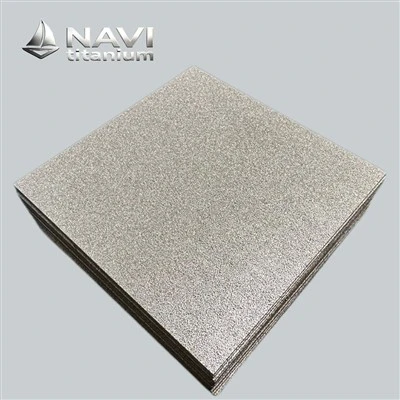
NAVI Titanium sintered filter elements provide a compact separation medium for demanding flow-control duties where clean passage and consistent retention are important. A carefully graded particle bond creates interconnected openings that help intercept unwanted solids without relying on disposable cartridges. Optional surface finishing improves cleanability and handling during repeated service.
Solution of NAVI Titanium
Customer feedback has become an important reference for NAVI Titanium when refining product selection and application support. Comments from industrial users frequently focus on dimensional consistency, structural stability, corrosion resistance, permeability control, and compatibility with existing equipment. Such feedback is reviewed alongside production records and application conditions, helping the team identify practical adjustments for different operating environments.
For customers evaluating titanium-based products, the following table brings together the core information of NAVI Titanium's current main titanium product range.


NAVI Titanium presents a research-oriented view of compact particulate-retention bodies, emphasizing how particle size, passage diameter, thickness, and flow velocity govern pressure loss and capture behavior. Microscopic pathways distribute incoming streams across the full cross-section rather than relying solely on the outer surface.


Application
Sintered filter elements address the growing need in drug manufacturing for separation media that keep purity intact through intricate production steps. NAVI Titanium offers these units, while ongoing refinements in fabrication techniques have boosted dimensional stability, material behavior, and channel size control for vital processing duties. In drug production, hot-gas operations, and pollution-control fields, these units aid in managing gas and liquid flow via tuned permeability and extended service life.
Drug‑making puts tough demands on separating materials because sterile blends, biological agents, and reactive mixtures are easily compromised. The work environment often sees sterilization, heat, and wash cycles, which test the ability to keep stable, move fluids evenly, and last through repeated runs. Today's fabrication routes emphasize tight control over formation and internal arrangement, so that behavior stays predictable through tricky steps. Such materials support culturing, vaccine prep, and active‑ingredient synthesis by trapping impurities and maintaining uniformity across validated batches.

high-temperature & environmental applications

Operations in heat-intensive industries, energy recovery, and emissions control call for particulate separation bodies that can endure extreme heat, pressure shifts, and reactive atmospheres. Typical duties-such as exhaust scrubbing, gas cleanup, and heat-exchange systems-subject the internals to oxidation, thermal strain, and steady particle bombardment. NAVI Titanium supplies solutions for these demanding applications, while ongoing process upgrades have introduced new fabrication routes that boost heat tolerance, structural strength, and extended service life. Better control over passage geometries and material recipes helps keep flow uniform and cuts downtime for upkeep. These gains lead to lower emissions, better resource reuse, and greener operation in the most punishing hot-gas environments.
Purchasing guide

Quality control (QC)
Engineered for precision and longevity, these porous metal components are produced through advanced powder metallurgy, creating a uniform pore network that ensures reliable filtration and stable flow. Each production lot is rigorously tested and documented, with full material traceability from raw powder to finished part. This commitment to verified quality guarantees consistent performance, extended service life, and confidence in critical applications where failure is not an option.

Manufacturing Process
Element Configuration
The production begins by defining the element's outer profile, effective length, wall geometry, and end connections according to the intended equipment interface. These parameters establish the usable filtration area and determine how the finished component integrates into a housing.
Powder Loading & Shape Formation
Precisely classified metallic particles are distributed into a forming cavity around a central support or mandrel when required. Controlled compaction creates a self-supporting tubular, cylindrical, or customized body while preserving the designed internal passage.
Thermal Bonding & Structural Stabilization
The formed body undergoes controlled heating in a protected atmosphere. Carefully managed temperature and holding time promote bonding between adjacent particles without eliminating the interconnected openings needed for fluid passage.
End-Fitting & Dimensional Finishing
After consolidation, the component is sized and finished at critical sealing and connection areas. End caps, threaded sections, or mounting interfaces can be integrated according to the equipment design.
Milestone-Based Communication
After an order is confirmed, key information can be checked against the customer's PO and agreed purchasing details. The first communication can confirm PO reference, quantity, specifications, delivery requirements, and requested schedule, giving the purchasing team a clear record of what has been accepted. The next update can focus on planned production period and batch arrangement, especially when an order contains multiple quantities or requires separate batches. For project-based purchasing, these updates help the customer understand whether the order has moved from commercial confirmation into scheduled preparation, rather than receiving only a general message such as "your order is being processed." If any specification, quantity, or requested date requires clarification, the relevant point can be identified before the next stage begins.

Inspection Status → Documentation → Delivery Preparation

As the order moves forward, communication can shift from scheduling information to quality review and dispatch readiness. The inspection update can indicate whether the requested checks have been completed and whether the related documentation is ready for review. Before dispatch, the buyer can receive confirmation of final quantity, package information, and transport documents, allowing Purchasing and QA teams to complete their respective checks before the cargo leaves. For larger contracts, milestone updates can also be aligned with approval dates, installation plans, or partial dispatch requirements. The communication path can therefore follow Order Confirmation → Scheduling → Quality Review → Dispatch Preparation, with each update answering a practical question: What has been confirmed? What stage is underway? What has been completed? What is required before the next stage? This gives project teams a clearer view of order progress and makes internal coordination easier.
Advantages
Sintered filter elements offer unique separation roles for drug-making lines that run under high pressure and demand tight purity oversight. NAVI Titanium supplies these units for demanding applications. The unified piece keeps its dimensions steady under fluid strikes, while its even internal passages lower seepage risks and limit stray particulate drift. Ongoing improvements in making methods enhance void uniformity, attachment strength, and dimensional precision for tough service duties.
In today's pharmaceutical production, concentrated feeds and delicate recipes are handled under ongoing high pressures, pushing the working hardware to new limits. High-pressure runs demand good mechanical toughness, shape retention, and freedom from impurities. NAVI Titanium provides a dense, evenly voided block that can take liquid impact without warping, keeping flow paths stable across numerous batches. The regular arrangement of tiny channels lowers the chance of stray particle drift, thereby cutting cross-contact risks during critical compounding steps. These traits are vital for settings where strict cleanliness and uninterrupted output are non-negotiable.

2. Operating Conditions

In drug manufacturing sites, routine cleaning, heat sterilization, pressure shifts, and extended runs are common. A consolidated stainless retention unit, under such stresses, needs its internal framework to keep shape and allow even flow. Its tight, uniform passage network stops unwanted routes that might permit leakage or impurity ingress at high pressures. The compact build withstands mechanical strain and chemical reactions well, so results remain steady after repeated cycles. These features are especially helpful on lines where cleanliness and continuous operation are critical.
Controlled heating and compaction procedures have recently been refined to achieve better internal consistency, stronger interparticle attachment, and tighter dimensional tolerances. By varying particle packing, temperature profiles, and shaping pressures, producers can obtain more even flow paths and fine‑tuned gas/liquid passage rates. These improvements help drug‑production hardware cope with severe pressure loads without losing their capture accuracy. Ongoing refinement of making methods also cuts internal flaws, tightens size control, and broadens adaptability to automatic production lines. Such gains lead to more uniform outcomes in today's pharma production.


To minimize downtime, modern drug-making plants operating under sustained high pressure rely on processing hardware that can run continuously without frequent stops. A single-piece forming route produces a compact, joint-free body, which enhances overall uniformity and makes daily handling easier. NAVI Titanium supplies this approach in round, tubular, or bespoke shapes, so they fit various floor plans and operating parameters. By fine-tuning interior passage geometries and outside diameters, flow remains well balanced even in tough duties. Such features are valuable for drug production, where hygiene, service longevity, and consistent output are paramount.
Industry Challenge
For hot-gas cleanup, the real challenge is not merely the temperature itself. It is the simultaneous assault of thermal spikes, pressure oscillations, and aggressive vapor chemistry. These forces can warp, crack, or erode ordinary hardware. Even minute changes in shape or open-area ratio may upset flow uniformity. Many common choices soften or oxidize under repeated heat cycles. NAVI Titanium supplies installed parts intended to resist creep, corrosion, and fatigue-so that throughput stays steady and unscheduled overhauls become rare.

2. Operational Stability Requirements

Under prolonged high‑temperature gas‑treating duties, sustained hardware effectiveness hinges on resistance to dimensional drift. Cyclic heating and cooling, together with abrasive particle impingement, can alter the physical response of the working medium. A properly arranged internal skeleton helps diffuse localized stresses and restricts permanent set across repeated thermal swings. Endurance against sudden thermal surges and aggressive chemical atmospheres becomes non‑negotiable in fields such as exhaust cleanup and heat‑to‑power conversion. Such harsh circumstances demand that materials exhibit foreseeable behavior, thereby cutting downtime from premature wear or unnecessary overhauls.
NAVI Titanium's sintered filter elements embodies a philosophy of exacting process stewardship, where each production variable is finely tuned to yield consistent bulk properties and enduring operational trustworthiness. Even slight fluctuations in the production chain can affect how fluids pass through, how dimensions hold, and how heat stresses are withstood. Today's fabrication practices emphasize even raw-material distribution and carefully chosen thermal profiles to satisfy the most exacting use cases. After prolonged interaction with corrosive streams, repeated thermal shocks, and sustained mechanical forces, the finished devices still perform to their original specifications. Progress in this arena depends on ongoing upgrades to production techniques, inspection systems, and performance‑validation protocols for aggressive‑service gas handling.

FAQ
1. Can urgent orders be arranged?
+
-
Yes. Rush orders can be discussed according to stock status, specifications, quantity, and the requested delivery schedule. Our sales team will review the actual situation and provide a feasible arrangement.
2. Are discounts available for bulk purchases?
+
-
Yes. Larger purchasing quantities generally qualify for tiered pricing. Buyers can contact our sales team with the expected quantity and purchasing frequency for a tailored quotation.
3. Do you provide after-sales support?
+
-
Yes. We have a dedicated after-sales team handling order follow-up, usage feedback, specification questions, and other customer concerns throughout the purchasing process.
4. How are customer complaints handled?
+
-
Customer complaint handling is a key part of our ISO management system. Each case is reviewed according to the relevant records, with follow-up communication and corrective action arranged when necessary.
5. What makes this medium a good fit for around‑the‑clock production lines?
+
-
This medium stays stable over long service runs, which is why it works well in non‑stop operations. Its one‑piece fabrication cuts out weak spots that come from joining separate parts, while also tightening size control and service uniformity. Because it can handle wash cycles, pressure swings, and tough working conditions, it lets makers keep their lines moving without frequent holds. That is why it is a good pick where dependability, tight quality checks, and non‑stop output are a must.
Hot Tags: sintered filter elements, China sintered filter elements manufacturers, suppliers, factory, Microporous Filter, Porous Media Filter, Sintered Bronze Bar, Sintered Bronze Plate, Sintered Powder Filter, Titanium Filter