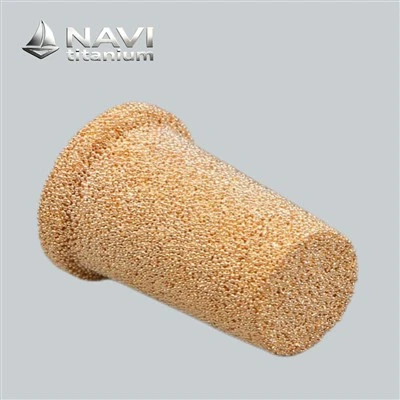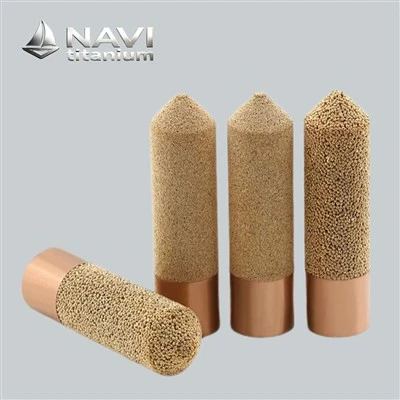


NAVI TItanium sintered bronze plate is a high-performance void-network metal component manufactured with high-purity bronze alloy raw powder via proprietary powder-based thermal forming procedures. Production workflows cover precise powder proportioning, isostatic compaction, thermal fusion under inert gaseous shielding, precision machining, surface polishing, and anti-corrosion passivation treatment. Dense sintered bronze plates cannot deliver sufficient gas circulation, while conventional porous metal blanks suffer from fragile structural rigidity. Finished panels feature interpenetrating void networks without enclosed dead spaces, and no loose powder detachment occurs during operation. After delivery, NAVI Titanium provides remote technical support to assist customers with installation, operating conditions, maintenance guidance, and performance-related questions, helping ensure stable use of the products throughout its service life.
Solution of NAVI Titanium
Supported by elaborately engineered void networks, stable physicochemical traits and outstanding mechanical strength, this bronze alloy panel maintains dependable performance under harsh working conditions. Applicable scenarios include high temperature, high humidity environments, environments with heavy particle accumulation, nonstop mass production, plus periodic flushing and sanitization routines. This hardware resolves multiple frequent production obstacles: uneven gaseous stream spread, shifting gas pressure values, particle leakage, accelerated abrasion of consumable spare parts and unstable process conditions. Typical application ranges include material dehydration facilities, particle purification assemblies, industrial gas circulation loops, sterile medium circulation pipelines, pressure balancing assemblies and fluid homogenization systems. All specifications can be adjusted to match distinct equipment and field working environments.
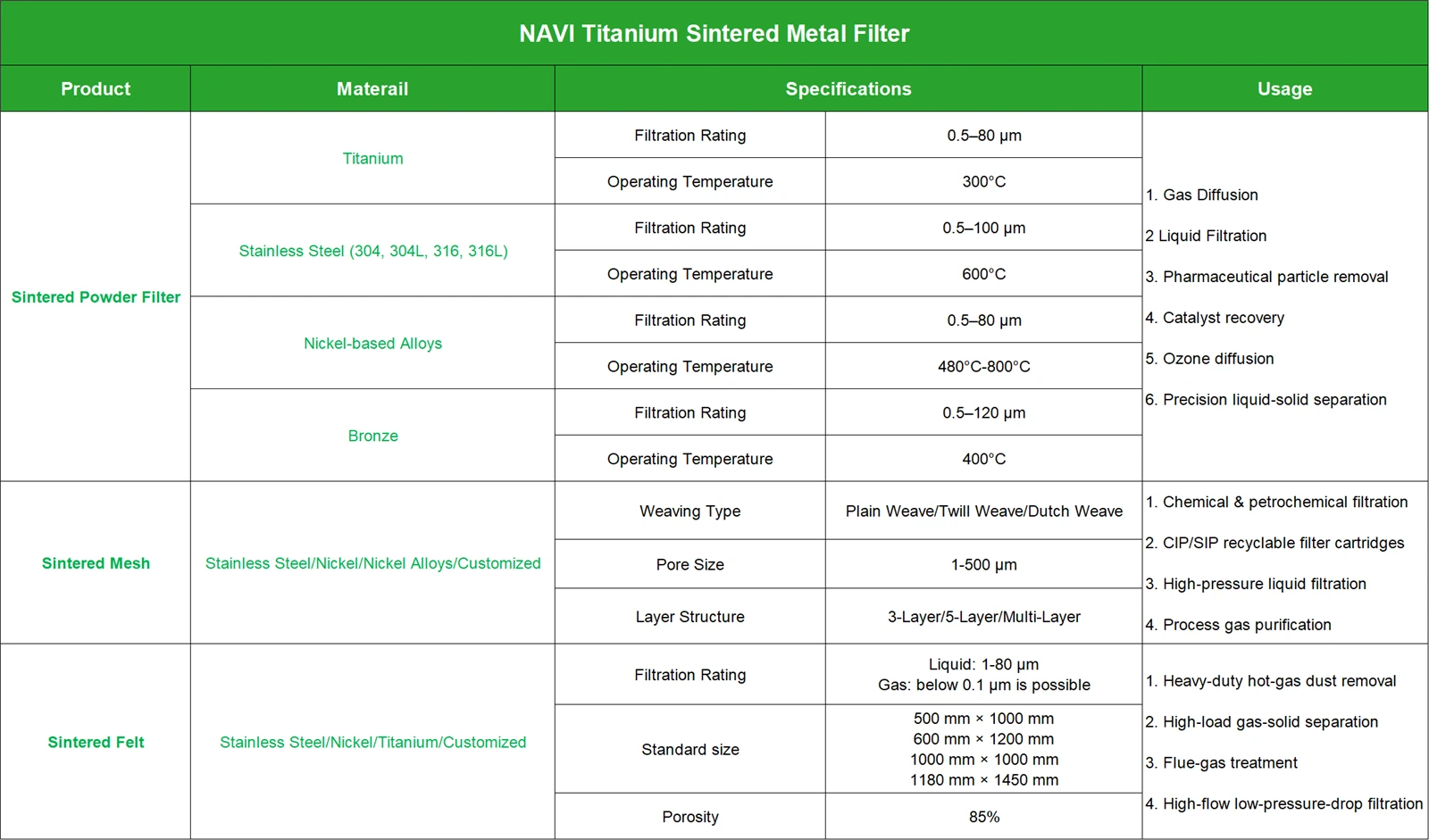

NAVI Titanium bronze alloy flow homogenization panel is developed to match industrial gas circulation, particle interception, medium separation, heat dissipation, gaseous pressure balancing, fluid homogenization, abrasion resistance and self-lubricating working scenarios. The hardware achieves balanced performance across gas through-flow capability, fine particle entrapment efficiency, mechanical toughness and sustained operational reliability. All geometrical parameters and void indicators support personalized customization to fit different types of industrial machinery.


Application
NAVI TItanium sintered bronze plate naturally possess reliable anti-corrosion traits, oxidation resistance, thermal endurance and solid mechanical rigidity. Combined with custom-tailored internal void layouts, the thermally consolidated panel bears dual functions: structural load-bearing and controllable medium penetration. A single component can homogenize gaseous streams, intercept fine particles, balance gas pressure and suppress operational noise simultaneously. With integrated functions including medium regulation, heat dissipation, abrasion resistance and vibration suppression, the bronze alloy flow homogenization panel serves as indispensable structural hardware for contemporary industrial machinery. It fits high-precision, heavy-load equipment requiring extended service lifespans within demanding operating environments.
Bronze alloy flow homogenization panels act as core hardware inside food dehydration assemblies. They see extensive adoption on production lines for fruit and vegetable processing, herbal raw material dehydration, snack baking, grain air-drying, frozen food pretreatment and meat curing workflows. The hardware works alongside continuous hot-air dehydration machines, constant-temperature drying assemblies, low-temperature dehydration equipment and material dehumidification systems. It serves as gaseous stream homogenizing substrates, breathable carrier bases or pipeline-end particle intercepting hardware. Traditional dehydration equipment often encounters practical hurdles. Direct hot air impact leads to inconsistent gaseous stream distribution, uneven dehydration effects, incomplete drying on product edges. Particles accumulating inside pipelines will further boost bacterial reproduction risks. Thanks to evenly distributed interpenetrating void networks, the bronze alloy panel converts turbulent gas flow into stable laminar streams. It balances temperature and gaseous distribution inside dehydration chambers, lifting dehydration uniformity and finished product yield significantly. The hardware traps food fragments and lightweight fine particles generated during dehydration. It stops contaminants from entering pipelines and heating assemblies, lowering pipeline blockage and cross-contamination risks.

Food Powder Dust Collection & Purification

Bronze alloy flow homogenization panels adapt to full-range food powder processing workflows, including blending, screening, conveying and grinding procedures. Applicable materials cover wheat flour, starch, powdered sugar, seasoning mixtures, meal replacement powders, milk powder and food additives. These panels are installed inside negative-pressure particle removal assemblies, screening air outlets, powder pressure balancing hardware, silo ventilation assemblies and terminal particle purification equipment, acting as rigid pressure regulation and particle interception components. Food-grade fine powders feature low density and tend to suspend and adhere onto equipment surfaces. Traditional filter cloth and metal mesh materials easily become blocked, shed fiber fragments and breed microorganisms. Frequent replacement of filter media pushes up maintenance expenditure, triggering material loss, excess suspended particles and finished product contamination. Adopting surface particle entrapment logic, the bronze alloy panel intercepts food dust particles larger than 10 μm while keeping system negative pressure steady. Contaminants remain on component surfaces instead of penetrating deep into void channels. Operators can restore gas through-flow capacity simply via compressed air purging or water washing. Besides, bronze alloy substrates deliver inherent microbial inhibition performance and strong corrosion resistance.
Purchasing guide

Quality control (QC)
NAVI Titanium verifies key parameters throughout the production of sintered bronze, including material composition, porosity, permeability, dimensions, and mechanical properties. Each batch is inspected and documented to ensure consistent quality and reliable performance.
|
|

Manufacturing Process
The manufacturing process is the foundation of quality and performance. NAVI Titanium carefully controls every stage of production, from bronze powder selection and preparation to compacting, sintering, sizing, machining, and final inspection. Each process is designed to precisely control the material's pore structure, porosity, permeability, strength, and dimensional accuracy. The process begins with selecting bronze powder with suitable particle size and composition according to the intended application. The prepared powder is then uniformly filled and compacted into the required shape before undergoing controlled high-temperature sintering. During sintering, the powder particles bond together while maintaining interconnected pores, forming the characteristic porous structure of sintered bronze. Subsequent sizing and precision machining can further improve dimensional accuracy and meet specific design requirements.
|
|
 |
 |

Application
Suited for sealed automatic food production workshops, bronze alloy flow homogenization panels are fitted onto high-speed packaging machines, vacuum sealing assemblies, food sorting hardware, automatic filling devices, enclosed mixing tanks and cold-chain pretreatment facilities. They undertake chamber ventilation, pressure balancing and particle isolation functions. During sealed automated manufacturing, unbalanced air pressure, condensate buildup and heat accumulation often lead to ineffective pressure relief, sealing failure, raw material moisture absorption, material caking, unexpected machine shutdown and higher reject ratios. Customized internal void layouts deliver adjustable gas flow resistance, enabling slow and even gas exchange while dynamically balancing internal and external pressure. The hardware eliminates surplus heat and moisture and prevents condensate formation inside processing chambers. Meanwhile, it intercepts suspended particles and microorganisms, sustaining hygienic continuous high-speed production without aging and performance attenuation commonly found in conventional filter materials.

Food Sterilization & Clean Air Systems

Bronze alloy flow homogenization panels match sterile production workflows, high-temperature disinfection and clean gas circulation assemblies. They are widely installed inside hot-air disinfection devices, aseptic dehydration equipment, cleanroom circulation units, food disinfection pretreatment assemblies and low-temperature preservation machinery, acting as core gaseous stream regulation hardware for hygienic food manufacturing. Food production sets strict standards for equipment raw materials. Hardware must withstand repeated disinfection operations without releasing pollutants, and avoid spaces where microorganisms can multiply. Conventional plastic and textile filter media cannot sustain cyclic high-temperature sterilization, disinfectant spraying or ozone exposure. Such materials easily deform, age, leach impurities and gather bacteria inside internal gaps. Manufactured as an integrated thermally consolidated entity, bronze alloy panels contain no loose gaps prone to contamination. The hardware adapts to wide temperature variation ranges and repeated disinfection workflows. No residual substances or peculiar odors will be generated, and functional indicators will not decline. The panel continuously purifies sterile hot gas and clean circulating airflow by intercepting suspended particles. It works reliably for bakeries, dairy workshops, prefabricated food production lines and aseptic packaging stations.
Why Choose NAVI Titanium for Porous Metal Solutions
Porous metal components often need to balance permeability, filtration efficiency, mechanical strength and resistance to the operating environment. The appropriate configuration depends on the working medium, flow requirements, pressure, temperature, chemical exposure and installation conditions. NAVI Titanium works with customers to evaluate these factors and select a suitable metal material and porous structure for the intended application. Stainless steel, titanium, bronze and nickel-based alloys can be considered for different industrial conditions, while pore characteristics, thickness, dimensions and product geometry can be adjusted according to functional requirements. This engineering-focused approach helps transform application requirements into practical component specifications for filtration, gas diffusion, fluid distribution, ventilation and other industrial processes.


Porous metal performance is closely related to the manufacturing process. Powder characteristics, forming conditions and sintering parameters all influence the final porous structure, dimensional stability and mechanical properties of the component. The production process covers powder preparation, forming, controlled sintering, finishing and inspection, with key characteristics reviewed throughout manufacturing. Dimensional accuracy, surface condition, structural integrity and pore-related requirements can be controlled according to the product specification. This manufacturing capability supports different product forms, including discs, plates, tubes, cylinders, filter elements and other specialized shapes. It also provides a production foundation for maintaining consistent specifications when projects move from initial samples to repeat orders and larger production quantities.
Industrial procurement often involves more than simply purchasing a finished component. Customers may need support with technical drawings, sample evaluation, specification confirmation, packaging, documentation and production scheduling before placing repeat orders. The supply process can therefore be adapted to different purchasing stages, from prototype quantities and trial orders to small-batch manufacturing and regular production. For OEM and equipment manufacturers, existing drawings or samples can be used as the basis for production, while new requirements can be reviewed before manufacturing begins. Export-oriented packaging and shipment arrangements can also be coordinated according to the destination and transportation method. This structured B2B approach provides customers with a clearer path from initial sourcing and product evaluation to stable long-term supply.

FAQ
01.What is the difference between cast bronze and sintered bronze?
02.How does NAVI Titanium maintain powder consistency during sintered bronze plate production?
03.How does the sintering process affect the structural stability?
04.How does NAVI Titanium control dimensional consistency during manufacturing?
05.How does NAVI Titanium ensure stable quality across different production batches?
Hot Tags: sintered bronze plate, China sintered bronze plate manufacturers, suppliers, factory, Sintered Bronze Filter Disc, Sintered Bronze Filter Element, Sintered Filter Plate, Sintered Metal Sheet, Sintered Stainless Steel, Sintered Stainless Steel Tube