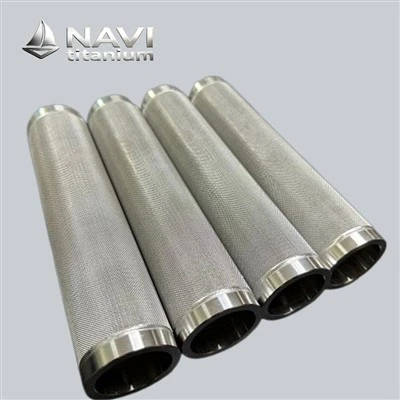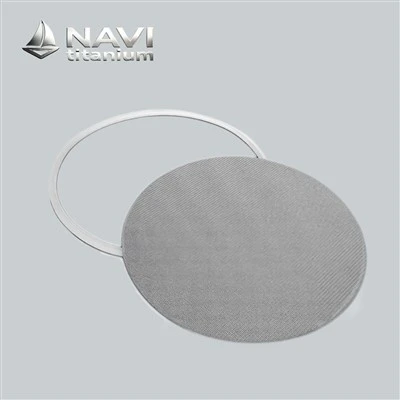


NAVI Titanium's sintered filter plate have uniform pore size, high strength, and are resistant to high temperatures and corrosion. They are widely used for precision separation and purification of industrial fluids (liquids/gases). NAVI Titanium handles the entire process in-house, from powder mixing, mold development, pressing, and vacuum sintering to precision machining and edge finishing. Their sales team provides one-on-one service to fully address customer needs.
Solution of NAVI Titanium
NAVI Titanium's sintered metal filter portfolio covers sintered powder filters, multi-layer sintered mesh and sintered felt. With versatile metal substrate choices and flexible design parameters, these filter elements deliver consistent filtration performance under high-temperature and corrosive working environments. Below is a summary of material options, key specifications and common industrial applications.


Our sintered titanium filter plates can be custom-made as square, rectangular, rounded-corner or perforated sheets with mounting holes. Produced by high-temperature powder sintering, they come with adjustable pore size and porosity. These plates ensure consistent airflow, high structural strength, and acid-alkali corrosion resistance. They are easy to clean for repeated use and commonly applied in electrochemistry, fluid filtration, gas diffusion, and breathable electrode plates for electrolyzers.


Application
Sintered Filter Plate is a rigid integrated porous functional component made of bronze, 304/316L stainless steel, titanium alloy metal powder, or multi-layer metal wire mesh as the substrate, through compression molding and high-temperature vacuum solid-phase sintering. Internally, a three-dimensional connected and controllable microporous network is formed, which is different from tubular sintered filters, ordinary woven filters, and punched plates. It has unique advantages such as planar rigid structure, compressive difference, pore deformation resistance, and can be integrated and installed inside valve blocks, oil tanks, pump bodies, and gas source processing units. In hydraulic transmission, circulating lubrication, fuel supply, and pneumatic control systems, sintered plate simultaneously undertake five major functions: precision particle interception, fluid homogenization and pressure stabilization, airflow noise reduction, component built-in protection, and fire and explosion prevention. Traditional paper filter materials and woven metal mesh commonly suffer from shortcomings such as pore expansion under high pressure, fiber shedding, non renewability, and limited installation forms; The sintered plate relies on a metallurgical integrated framework to adapt to harsh working conditions such as high and low temperatures, pressure fluctuations, continuous oil and liquid impacts, and combustible media.
The sintered plate produced by NAVI Titanium is installed inside the fuel tank and on the end face of the oil pump suction flange, serving as the core filter material for the suction filter. The main purpose is to intercept larger impurities (welding slag, rubber fragments, mud and sand) in the fuel tank, prevent hard large particles from directly entering the hydraulic pump chamber, and avoid large-scale scratches on gears, blades, and distribution plates. Generally, bronze sintered plate and large-diameter stainless steel sintered plate are the most commonly used, with an accuracy of generally 20-60 μ m.


The oil pump starts to generate negative pressure to extract oil, and the sintered plate has a uniform porous structure to ensure sufficient flow capacity and avoid cavitation caused by high oil absorption resistance; Compared to metal filters, sintered plate have stronger rigidity, will not collapse under negative pressure, and will not corrode when immersed in hydraulic oil for a long time. It belongs to the first barrier, protecting the main pump from catastrophic damage, and is commonly used in hydraulic systems of construction machinery, hydraulic stations of machine tools, and small hydraulic power units.
Purchasing guide

Quality control (QC)
NAVI Titanium boasts long-standing expertise in the research and manufacture of titanium products. Quality control forms the cornerstone of our operations. Our standardized, thorough full-process quality management system has achieved ISO9001 international certification. Aligned with leading global standards, we supply worldwide customers with titanium products featuring outstanding reliability and stable quality. A collection of our product test reports is attached below for reference.
|
|

Material Selection Guide
Choosing the right material is critical to the filtration performance, service life, and chemical compatibility of a sintered filter plate. NAVI Titanium offers sintered filter plates in titanium, stainless steel, bronze, and nickel-based materials, allowing the filter structure to be matched to the operating medium, temperature, pressure, corrosion conditions, and filtration requirements. The following guide helps engineers and procurement teams select a suitable material based on application conditions rather than material cost alone.
| Material | Best Suited For | Key Advantages | Typical Media | Typical Applications | Selection Considerations |
| Titanium | Highly corrosive environments, chloride-containing media, seawater and electrochemical applications | Excellent corrosion resistance, high strength-to-weight ratio, good resistance to chloride-containing environments | Seawater, chloride solutions, chemical liquids, gases | Water treatment, chemical processing, electrochemical systems, hydrogen-related applications | Recommended when corrosion resistance and long-term durability are more important than lowest initial cost |
| 316L Stainless Steel | General industrial filtration and moderately corrosive environments | Good corrosion resistance, mechanical strength, availability and cost balance | Water, oils, gases, chemicals, process fluids | Hydraulic systems, food processing, pharmaceutical, chemical processing | Suitable for general-purpose filtration where 316L chemical compatibility is sufficient |
| Bronze | Hydraulic, lubrication and fuel filtration | Good permeability, machinability, wear resistance and cost efficiency | Hydraulic oil, lubricating oil, fuel, air | Hydraulic systems, lubrication systems, fuel systems, pneumatic components | Suitable for oil-based media and applications where extreme corrosion resistance is not the primary requirement |
| Nickel / Nickel Alloys | High-temperature or highly aggressive chemical environments | Excellent chemical resistance and high-temperature performance | Aggressive chemicals, high-temperature process gases and liquids | Chemical processing, high-temperature filtration, specialized industrial systems | Selected when stainless steel or conventional materials cannot provide sufficient chemical or thermal resistance |
How to Select the Right Material
| Step | What to Check | Example |
| Ⅰ | Filtration Medium | Water / oil / fuel / gas / chemical |
| Ⅱ | Chemical Composition | Chloride / acid / alkali / solvent |
| Ⅲ | Operating Temperature | Normal / high temperature |
| Ⅳ | Operating Pressure | Differential pressure / system pressure |
| Ⅴ | Required Filtration Rating | 1 / 5 / 10 / 20 / 50 μm etc. |
| Ⅵ | Required Service Life | Disposable / reusable / long service |
| Ⅶ | Cleaning Method | Backwashing / ultrasonic / chemical / thermal |
| Ⅷ | Material Selection | Titanium / 316L / Bronze / Nickel Alloy |
| Ⅸ | Structural Design | Thickness / diameter / mounting holes / shape |
| Ⅹ | Validation | Filtration / permeability / dimensional / pressure testing |
Application
Hydraulic valve block with built in sintered filter plate
Overflow valve, pressure reducing valve, electro-hydraulic directional valve, proportional valve, servo valve pilot control oil circuit. The clearance between the valve core and valve sleeve of servo valves and proportional valves is usually only 1-5 μ m, and extremely small particles can cause valve core jamming, zero drift, and control failure. Before the pilot oil enters the valve core, a 5-10 μ m sintered stainless steel filter plate is used for terminal security filtration.
The filter plate is directly press installed inside the valve block flow channel, without occupying external space, achieving "built-in filtering of components", which is a standardized design scheme for high-end hydraulic components. In this way, the flow rate is small and the pressure pulsation is frequent, requiring stable pores of the filter material and no medium precipitation; It is not allowed for the filter material to shed tiny particles and cause permanent damage to the servo valve.


Multilayer wire mesh sintered plate are widely used in the field of servo valves due to their uniform aperture and stable dirt absorption.
High pressure oil discharge circuit, flushing circuit filter plate
The oil discharged from the main valve, plunger motor, and variable displacement pump discharge port carries a large amount of metal particles generated by friction, which are intercepted by the sintered plate to prevent pollutants from flowing back to the oil tank and continuously circulating in the pollution system. The flushing valve of the partially closed hydraulic system is integrated with a sintered plate , which continuously purifies the closed circuit oil and controls the pollution level of the system.
The hydraulic oil circuit for accumulator inflation and the control flow channel of the one-way valve are equipped with small circular sintered filters to prevent rust particles from entering the sealing surface of the one-way valve and prevent the one-way valve from not closing tightly and continuously leaking.
The oil level of the hydraulic oil tank rises and falls with the expansion and contraction of the oil cylinder, and air enters and exits the oil tank through the respirator. The sintered plate inside the respirator filters dust from the outside air to prevent atmospheric pollutants from entering the oil; Simultaneously blocking the oil mist from overflowing outward. Bronze sintered plate are widely used in hydraulic air filters, with characteristics of breathability, dust resistance, and oil resistance.

Application in lubricating oil circulation system
The lubricating oil system includes equipment gearbox circulation lubrication, bearing thin oil lubrication, generator set crankshaft lubrication, and large fan main shaft lubrication. The core function of lubricating oil is to lubricate, cool, and remove friction and wear debris. NAVI Titanium's sintered filter plate mainly undertakes four functions in the lubrication system: isolation and filtration inside the oil tank, protection of the oil pump inlet, local filtration of the oil circuit branch, and separation of oil mist.

A sintered plate is installed on the front flange of the oil pump for large gearboxes and thin oil lubrication stations to intercept metal debris from gear peeling and rust impurities from the casing, protecting the impeller and gears of the lubricating oil pump. The viscosity of lubricating oil is generally higher than that of hydraulic oil. The porosity of the filter plate has been optimized to reduce the resistance of high viscosity fluids passing through and avoid bearing burnout caused by insufficient oil supply.
Branch lubricating oil circuit end security filter plate
Multiple independent bearing lubrication branches are embedded with sintered plate at the end of the pipeline leading to high-speed bearings. Even if the main filter is damaged, the sintered filter sheet still serves as the final barrier to prevent hard particles from entering the high-speed friction pair. Once high-speed bearings enter micron sized particles, they are prone to pitting corrosion and fatigue peeling.
Internal oil separation and settling auxiliary filter plate of gearbox
A sintered filter sheet partition is installed inside the large reducer box, which blocks the settling impurities at the bottom of the box and reduces the continuous suction of impurities by the oil pump; At the same time, it does not hinder the overall circulation and flow of the oil.


Lubricating oil gas separation and oil mist recovery unit filter plate
The operation of the gearbox and bearing housing heats up and generates oil mist. The sintered filter sheet at the ventilation port of the housing achieves air permeability and oil resistance: the gas is discharged to balance the pressure inside the housing, and the lubricating oil mist is trapped by micro holes and flows back to the housing, reducing lubricating oil loss while blocking external dust from entering the housing.
Generator set, internal combustion engine crankcase respirator filter plate
Internal combustion engine crankcase generates blow by gas, and the respirator is equipped with a sintered filter sheet to separate oil mist and filter the externally inhaled air;
Compared to non-woven respirators, metal sintered filter sheet are heat-resistant and can withstand continuous high temperatures in the engine compartment. They are less prone to aging and blockage, and can be cleaned and reused.
Summary of application characteristics of lubrication system
The pollutants in the lubrication system are mainly metal debris, which has high hardness; Part of the operating conditions have a long-term oil temperature of 80-110 ℃. Bronze sintered filter sheet are suitable for conventional cyclic lubrication; Stainless steel sintered filter sheet are preferred for lubricating oil with continuous high temperature and extreme pressure additives to avoid medium corrosion of filter materials.

Application in fuel supply system
The fuel system medium includes gasoline, diesel, aviation kerosene, and heavy oil; The system components include fuel tank, fuel transfer pump, high-pressure common rail fuel pump, fuel injector, and fuel pressure regulating valve. The precision parts of the high-pressure fuel injection system have extremely small clearances and are highly sensitive to solid impurities in the fuel. Sintered filter plate are mainly used for four scenarios: coarse filtration inside the fuel tank, inlet protection of the oil pump, filtration inside the pressure regulating valve, and explosion-proof, fire-resistant, and breathable.

The fuel tank is equipped with a built-in suction filter plate
The circular sintered filter sheet is installed at the oil suction port of the diesel fuel tank and generator set fuel tank of construction machinery, which belongs to the first filtration of fuel. Intercept large particles of rust, sediment, and gum to protect the impeller of the oil pump. Different from external fuel filters, the sintered filter sheet inside the fuel tank is immersed in fuel for a long time, with a sturdy structure and resistance to fuel impact. Bronze sintered plates are resistant to swelling in diesel and gasoline media and are widely used.
High pressure fuel pump, common rail pressure regulating valve with built-in precision filter plate
The pressure of modern diesel common rail systems can reach over 1600 bar, and micro sintered filters (3-10 μ m) are pressure installed inside the high-pressure fuel pump and fuel pressure regulating valve as terminal precision protection. Once the main fuel filter is damaged, tiny hard particles will directly cause wear and jamming of the high-pressure plunger and fuel injector; The built in sintered filter sheet forms a secondary protection, which is an important guarantee for the reliability of the common rail fuel system. Stainless steel sintered filter sheet are commonly used for fuel control valves in aircraft engines.


Internal protective filter plates for one-way valves and overflow valves in fuel pipelines
The fuel overflow valve and one-way valve are equipped with sintered filter sheet to prevent impurities from getting stuck on the sealing cone surface, causing unstable fuel pressure, leakage, and difficulty in starting.
Breathable flame retardant filter plate for fuel storage tank
The sintered metal filter plate produced by NAVI Titanium in the fuel tank vent has the ability to filter dust in the air; The metal porous structure serves as a flame arrester, blocking external open flames from igniting fuel vapor inside the box, achieving the integration of breathability and explosion prevention. This function is based on the destruction of flame propagation conditions by a large number of small channels in porous metals, and is a standard safety structure for internal combustion engines and mobile fuel equipment.

Frequently Asked Questions
What are the advantages of NAVI Titanium sintered filter plates compared to woven mesh plates and ordinary powder sintered plates?
+
-
Woven mesh plates have uneven pore sizes, can deform under high pressure, and risk wire shedding; ordinary sintered plates vary in thickness and batch quality, and high pressure can cause powder to fall off. NAVI Titanium filter plates use uniform material distribution and constant-temperature sintering along with a full-plate leveling process. The whole plate has uniform flux, no flow deviation, is not easily warped under high pressure, maintains long-term stable filtration accuracy, can be regenerated repeatedly, and is suitable for high-demand scenarios like sterile and high-purity fluids, preventing secondary fluid contamination.
For food and pharmaceutical applications, do the filter plates meet FDA and NSF requirements, and is there any risk of metal leaching?
+
-
Made from high-purity GR1 titanium and food-grade 316L stainless steel, with no adhesives or organic coatings, formed by physical sintering. The products comply with FDA food contact and NSF drinking water standards, with no risk of powder shedding or metal ion leaching. They can withstand CIP cleaning and repeated steam sterilization, are suitable for sterile production processes, and come with a full set of test reports.
How can you tell if a filter plate needs cleaning or replacement?
+
-
If the pressure drop rises, flow decreases, plate area gets fouled, or aeration becomes uneven, this indicates shallow blockage, which can be regenerated using backwashing or ultrasonic cleaning. If after multiple cleanings the pressure drop does not recover, or the plate surface is warped, pitted from corrosion, micropores are damaged, or sealing surfaces are worn, the filter plate must be replaced with a new one.
What is the typical service life of a filter plate and the criteria for disposal?
+
-
Under clean conditions, titanium sintered filter plates normally last 5–8 years and can be regenerated 35–40 times; 316L plates last 3–5 years; under general corrosive conditions, 2–4 years. Permanent plate deformation, structural blockage that cannot be regenerated, perforation corrosion, or loss of precision requires disposal.
How should disposed filter plates be handled, and do they meet EU hazardous waste regulations?
+
-
The plates are made of pure metal components and are not classified as hazardous waste. They can be recycled and melted for reuse, in line with EU circular economy regulations. We can provide filter plate recycling instructions to help customers establish eco-friendly operation and maintenance records.
Hot Tags: sintered filter plate, China sintered filter plate manufacturers, suppliers, factory, Microporous Water Filter, Porous Stainless Steel Plate, Sintered Bronze Plate, Sintered Bronze Sheet, Sintered Filter Plate, Sintered Steel Filter