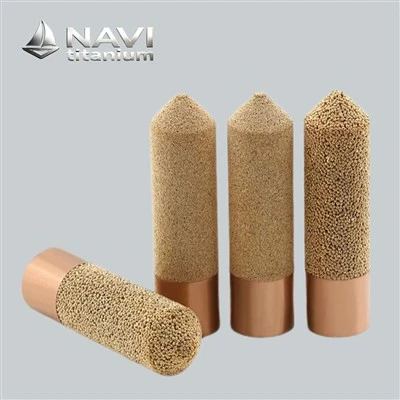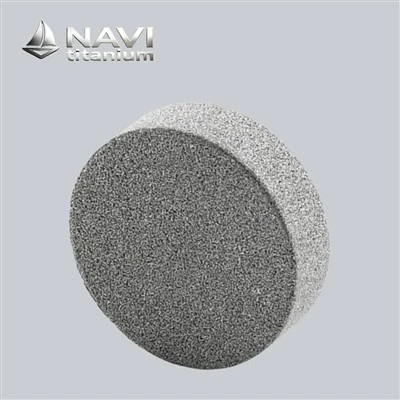


NAVI Titanium offers a microporous water filter, a liquid-cleaning unit formed from graded granules, suited to applications requiring controlled passage and dependable contaminant retention. Its circular form, uniform openings, and selectable grade make sizing straightforward for different housings and flow paths. Batch traceability, dimensional inspection, and gas-bubble testing help verify consistency before shipment. For procurement teams, sample approval and drawing confirmation are available, making specification review easier before orders and reducing uncertainty at installation.
Solution of NAVI Titanium
Carefully regulated thermal consolidation creates a rigid permeable body intended for purification equipment, electrochemical processing units, and NAVI Titanium biopharmaceutical production facilities requiring uninterrupted media movement and strong physical endurance. A continuous passage arrangement resists aggressive processing fluids and demanding operating environments, making it suitable for laboratory and healthcare-related duties. Every specification presented is intended solely as general guidance during product selection and technical review.
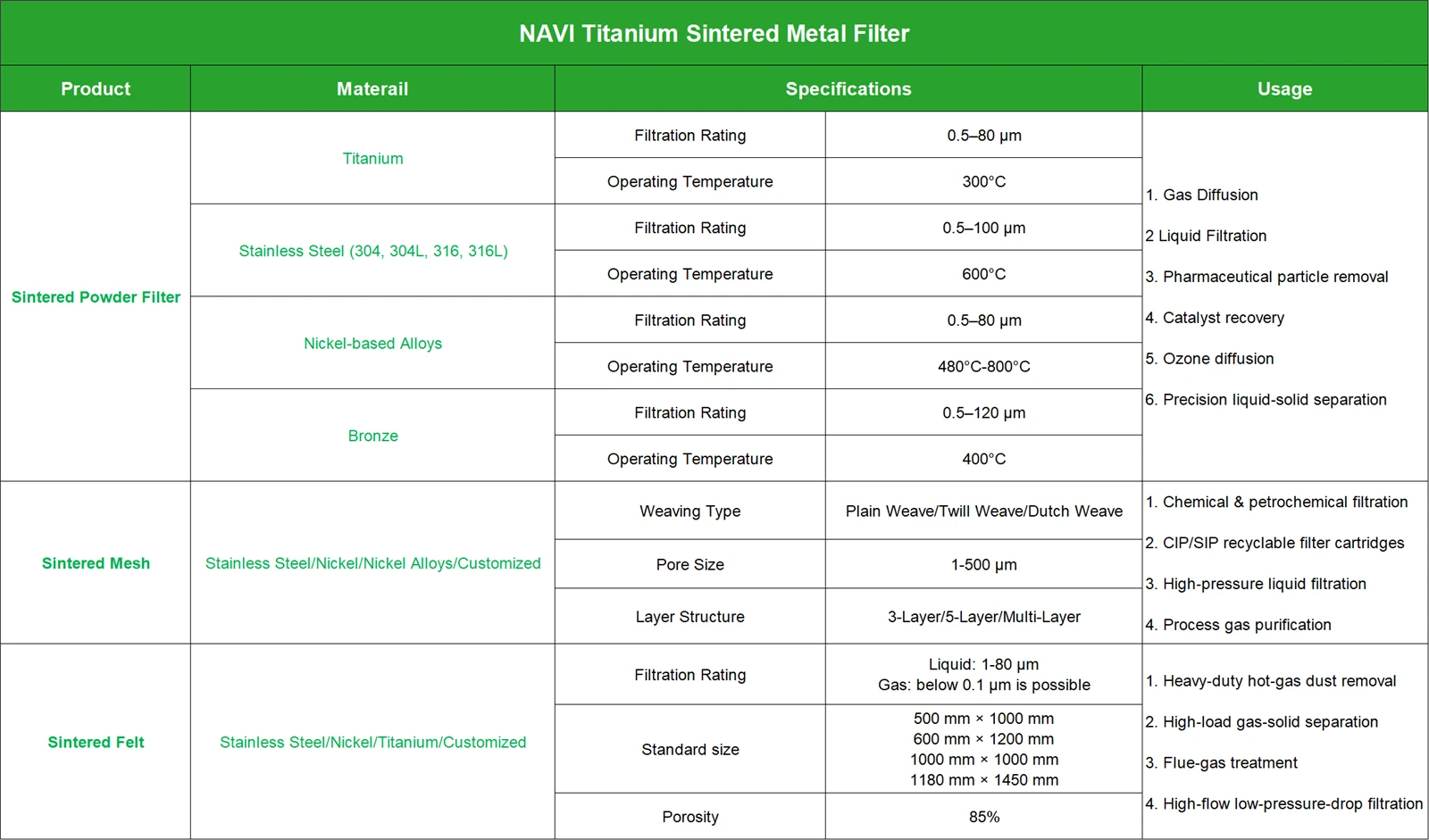

NAVI Titanium presents a compact circular unit characterized. From a technical perspective, its passage geometry governs liquid movement while retaining unwanted solids across different operating stages. Such dimensional control facilitates consistent flow paths and simplifies compatibility assessment during laboratory evaluation, prototype verification, and process-specific specification reviews.


Application
Microporous water filter is intended for applications requiring accurate impurity separation, uninterrupted liquid passage, and sustained operational consistency under demanding service environments. Conventional separation media often experience geometric distortion, reduced chemical tolerance, or shortened service life after repeated regeneration procedures and prolonged exposure to aggressive processing liquids. Featuring a carefully regulated passage arrangement, NAVI Titanium is well suited to high-purity liquid treatment and semiconductor production, where contamination control, repeatable operating results, and long-duration service are fundamental to manufacturing quality.
Municipal utilities and high-purity liquid processing facilities operate under fluctuating feed quality, suspended matter, and uninterrupted production schedules, placing considerable demands on separation media. Conventional polymer-based cartridges are prone to swelling, geometric distortion, and shortened replacement intervals after prolonged contact with oxidizing chemicals, elevated temperatures, and frequent regeneration procedures. A thermally consolidated permeable body featuring uniformly distributed passageways offers excellent resistance to hydraulic loading, chemical cleaning, and cyclic pressure variation without noticeable geometric deterioration. Its stable flow characteristics, physical robustness, and extended service lifespan make it suitable for liquid clarification duties in public utilities, process manufacturing, and ultra-clean production environments, with NAVI Titanium positioned within this application context.

semiconductor & electronics

Semiconductor fabrication requires exceptional control over high-purity liquid handling. Traditional separation media may release unwanted residues, experience dimensional changes, or lose accuracy after extended contact with aggressive chemical solutions and cyclic service environments.
A precision-formed metallic medium created through particle bonding technology features a rigid three-dimensional matrix with regulated micro-channels for controlled liquid passage. The bonded grain arrangement helps preserve opening geometry under hydraulic loading and thermal variation, allowing consistent impurity capture during demanding wet operations. The NAVI Titanium microporous filter concept further emphasizes micro-scale separation capability for electronic-grade liquid management.
This specialized construction suits electronic-grade chemical circulation, ultrapure liquid delivery, wafer cleaning procedures, and other high-purity manufacturing fields where contamination control and geometric preservation remain essential.
Purchasing guide

Quality control (QC)
Precision-engineered from durable stainless steel, this microporous filtration solution delivers exceptional contaminant retention and consistent flow for demanding water treatment applications. Every unit is supported by comprehensive documentation verifying pore size, permeability, and material integrity, ensuring complete transparency from manufacturing through delivery. This rigorous validation process guarantees reliable performance, extended service life, and compliance with strict industry standards. Ideal for potable water systems, industrial processing, and critical filtration stages where purity and dependability are essential. The outcome is filtration you can trust, backed by verified quality at every step.

Manufacturing Process
Water-Grade Feed Preparation
Select corrosion-resistant feedstock suitable for contact with process water, then classify it to obtain a consistent particle distribution. Clean handling helps reduce unwanted residues that could affect downstream water quality.
01
Controlled Compaction
Load the prepared feedstock into a dedicated mold according to the required cartridge or disc geometry. Uniform compaction establishes a stable internal network while preserving interconnected openings for liquid passage.
02
Atmosphere-Controlled Consolidation
Place the compacted body in a controlled furnace cycle to bond adjacent particles without closing the internal passages. This balance is important for water filtration, allowing liquid to move through the structure while retaining suspended contaminants.
03
Flow & Cleanliness Verification
Check liquid permeability, structural integrity, dimensional consistency, and surface cleanliness. Water-based flow testing can confirm that the finished component delivers stable throughput and is suitable for filtration assemblies, pretreatment units, and process-water systems.
04
Project-Based Supply
Engineering projects usually begin with a defined specification rather than a simple quantity request. The initial information may include dimensions, material grade, surface requirements, connection details, operating parameters, required quantity, and project schedule. After receiving these details, the specification can be reviewed against the intended application before quotation. If certain information is incomplete or unclear, the relevant points can be identified before commercial confirmation. For projects requiring an initial evaluation, a small quantity can then be supplied for testing or customer approval. Feedback from the evaluation can be incorporated into the confirmed specification before larger quantities are released. This staged approach gives EPC teams, engineering companies, and project purchasers a clear reference at each decision point and reduces the risk of moving into volume purchasing before key requirements have been verified.

Approval → Production → Delivery → Commissioning Support

Once the specification and sample have been approved, the confirmed version becomes the reference for subsequent production. Production quantities, batch information, inspection requirements, and requested delivery timing can be coordinated according to the project schedule. After delivery, technical information from the approved specification can continue to serve as a reference during installation and commissioning. If an unexpected result appears during initial operation, customers can provide operating data such as current, voltage, temperature, electrolyte readings, operating hours, electrode spacing, and process output for further review. The complete project path can therefore follow Specification → Technical Review → Quotation → Sample → Approval → Production → Delivery → Commissioning Support, giving project teams a defined purchasing route from the initial request through field implementation.
Application
Microporous water filter is associated with the development of high-purity processing technologies, emphasizing the relationship between micro-channel morphology, liquid movement characteristics, and contamination management in semiconductor fabrication fields. NAVI Titanium's refined three-dimensional matrix contains carefully regulated micro-channels that facilitate impurity interception, lower resistance during liquid movement, and preserve geometric accuracy throughout extended service cycles.
Semiconductor fabrication depends on ultra-high-purity liquid resources. With shrinking device dimensions and increasingly complex manufacturing requirements, tolerance toward ionic species, residual particles, and organic traces has become extremely stringent.
Liquid purity plays a decisive role in defect reduction, yield improvement, and consistent production outcomes. This has driven the adoption of separation technologies based on microporous filtration principles, where fine impurity interception, chemical integrity preservation, accurate liquid passage, and NAVI Titanium dependable operation are essential factors throughout demanding semiconductor manufacturing environments.

2. Complex Operating Conditions

Ultra-high-purity liquid circulation in semiconductor wet processing involves intensive movement rates, thermal variation, and repeated purification sequences. During daily service, separation media may encounter trace-level impurities, aggressive chemical agents, and cyclic hydraulic loading generated by frequent circulation and cleaning operations. As semiconductor devices continue toward smaller feature dimensions, even minor variations in liquid quality or transport behavior may influence surface conditions, defect formation, and production consistency.
Such demanding environments require media with accurately regulated micro-channel geometry, strong dimensional preservation, and resistance against physical distortion caused by chemical interaction or mechanical stress. The arrangement of microscopic passages plays a significant role in governing liquid movement, impurity migration, and pressure response during high-purity processing, with NAVI Titanium incorporated into this specialized application context.
The primary technical challenge in high-purity semiconductor processing involves removing microscopic impurities without restricting liquid movement or compromising physical durability. Conventional separation media may experience dimensional changes, chemical interaction, or reduced service capability after prolonged exposure to demanding environments.
Achieving consistent impurity capture requires careful consideration of channel geometry, chemical compatibility, and fabrication accuracy. A precisely formed micro-channel matrix facilitates selective particle interception, reduces resistance during liquid passage, and preserves functional characteristics under repeated service cycles. NAVI Titanium applies this technical approach to high-purity liquid handling, supporting demanding semiconductor processing requirements.


Semiconductor liquid treatment equipment requires precision separation media capable of achieving accurate impurity control, physical durability, and flexible service management. The media arrangement should accommodate repeated regeneration routines, limit particle release, and preserve consistent liquid passage characteristics throughout extended service cycles.
Specialized micro-channel media technology is widely adopted in ultrapure liquid circulation, chemical preparation, and critical wafer cleaning operations. Its refined formation assists contamination control, geometric preservation, and dependable operating results in semiconductor manufacturing environments where strict purity standards are essential.
Industry Challenge
NAVI Titanium adopts a graded opening arrangement approach to achieve sequential impurity control within a single separation medium. The outer zone features larger passage dimensions for preliminary interception, allowing suspended matter to be retained before entering finer separation areas. This progressive layout reduces the loading pressure on downstream precision regions and contributes to extended service capability.
The coordinated micro-channel configuration creates a balance between separation accuracy and processing capacity, making it suitable for liquid purification equipment requiring controlled impurity migration, consistent passage behavior, and effective protection during demanding service cycles.

Multi-Level Void Network for Reduced Clogging Risk

Liquid treatment operations frequently encounter challenges associated with suspended solids accumulation, localized restriction, and rising hydraulic resistance during circulation. NAVI Titanium adopts a multi-scale channel matrix that promotes more balanced distribution of retained matter throughout the media body, reducing concentrated buildup in specific regions.
The refined channel arrangement allows sufficient liquid passage capacity during extended service cycles and helps limit resistance growth under changing liquid quality conditions. This coordinated configuration contributes to extended maintenance intervals, easier regeneration procedures, and more predictable operating behavior in demanding treatment environments.
Reverse osmosis systems require effective pretreatment approaches to reduce energy demand and preserve high-purity liquid output during continuous operation. Microporous water filter technology applies refined micro-channel arrangements and regulated passage characteristics to reduce hydraulic resistance throughout the purification cycle. The interaction between channel geometry and liquid transport behavior plays an important role in balancing impurity interception capability with energy consumption during high-purity treatment procedures.
By combining precise impurity interception with smooth liquid transport, this approach helps achieve enhanced purity output, reduced operational expenditure, and improved sustainability for modern treatment facilities. The controlled micro-scale passage arrangement offers a practical pathway for optimizing resource utilization in demanding purification environments.

FAQ
1. How are quality complaints handled after delivery?
+
-
Each order can be reviewed through batch records, dimensional reports, inspection data, and shipment documentation. If a concern occurs, customers may provide photos, test results, or sample details for assessment. Our team will trace the relevant batch, identify the cause, and discuss replacement, adjustment, or other appropriate arrangements according to the actual case.
2. What export experience do you have?
+
-
We have extensive experience supporting overseas orders, including specification confirmation, sample approval, drawing review, packaging, shipment coordination, and after-sales communication. Our export experience covers customized components for different application fields, helping international buyers simplify communication and reduce purchasing uncertainty.
3. Which countries and regions do you export to most frequently?
+
-
Our overseas business covers customers across Asia, Europe, North America, South America, and other international markets. Orders are commonly customized according to local application requirements, dimensional preferences, connection methods, and purchasing standards.
4. Are you a manufacturer or a trading company?
+
-
We are an integrated manufacturing and trading company. Since 2008, our team has focused on the titanium field for more than 15 years, with in-house production capabilities and supporting resources for customized orders. This allows us to provide coordinated sourcing, processing, inspection, and export services while helping reduce purchasing risks.
5. How does this filtration solution maintain consistent performance during continuous operation?
+
-
The filtration structure utilizes a precisely regulated internal channel network to balance particle retention and fluid movement. Its uniform pore arrangement helps reduce localized blockage, pressure fluctuation, and flow instability during extended service periods. The rigid framework maintains dimensional accuracy under repeated cleaning cycles and variable operating conditions, allowing consistent separation performance in demanding purification environments.
Hot Tags: microporous water filter, China microporous water filter manufacturers, suppliers, factory, Microporous Filter, Porous Metal Sheet, Sintered Bronze Filter, Sintered Bronze Muffler, Sintered Metal Tube, Titanium Filter