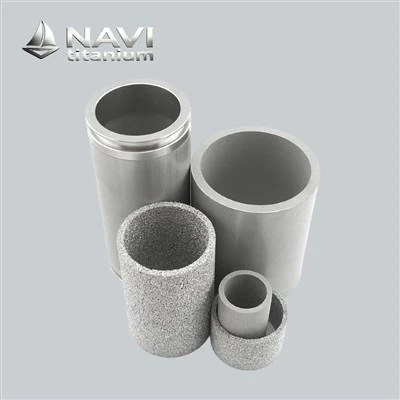
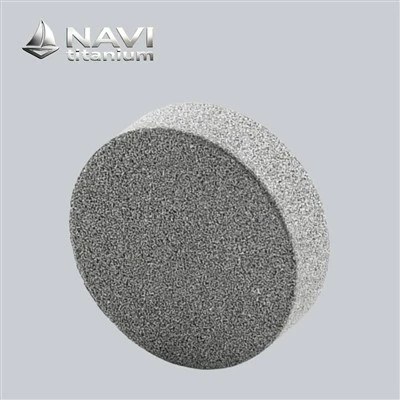
NAVI Titanium defines sintered ss filter cartridges as a self-supporting 316L tube whose wall does the separating, depth-filtering through channels running through its thickness rather than catching dirt on a skin. Buyers gain operationally: one metallurgy covers liquid, gas and hot vapour, so spare holdings shrink to fewer stocked part numbers; existing housings accept it without modification, because NAVI Titanium work to your sample; and each element can be integrity-tested after cleaning, so retirement follows readings rather than a calendar.
Solution of NAVI Titanium
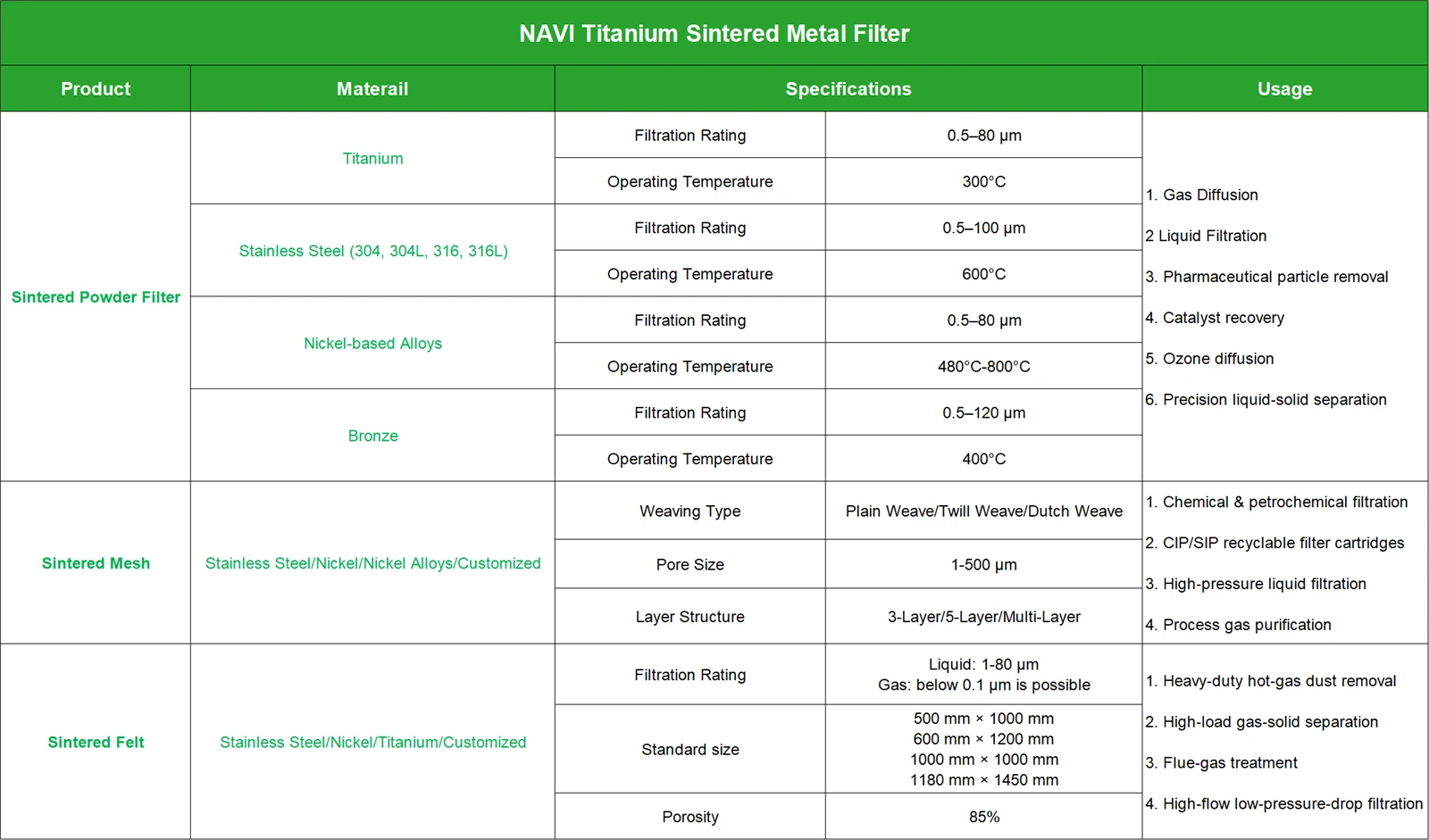
NAVI Titanium runs gas-atomised 316L through classification, compaction and logged vacuum cycle, fusing grain to grain with no binder, no fibre and no seam to open under pressure. Every lot is classified to a locked particle cut, isostatically pressed, and sintered under a recorded temperature and vacuum profile. It serves precision filtration, electrochemistry, biomedical rigs and high-temperature fluid separation, resists acid and alkali, and presents a biocompatible surface that is easy to clean and safe in contact with media. Voids stay uniform, so backwashing restores throughput instead of ending the campaign, and a fouled cartridge returns to rated flow. Retention, permeability and flow follow your duty, tuned to your figures and confirmed before release. Figures sit in the table below.


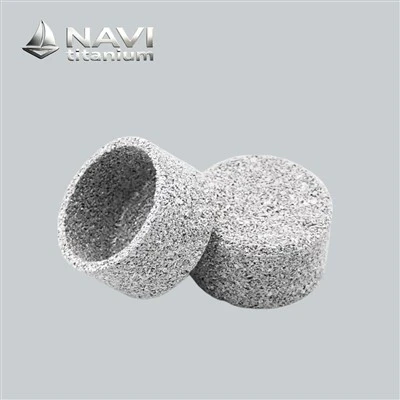
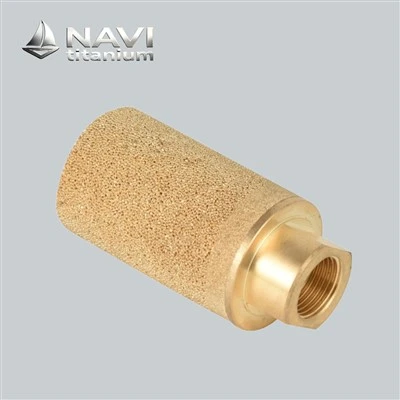
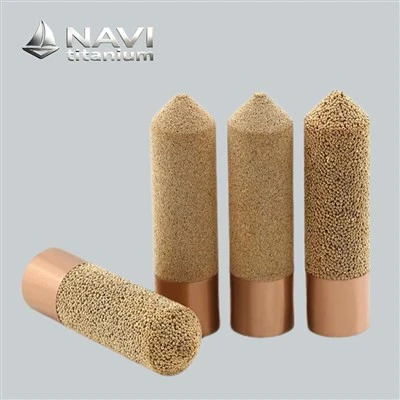
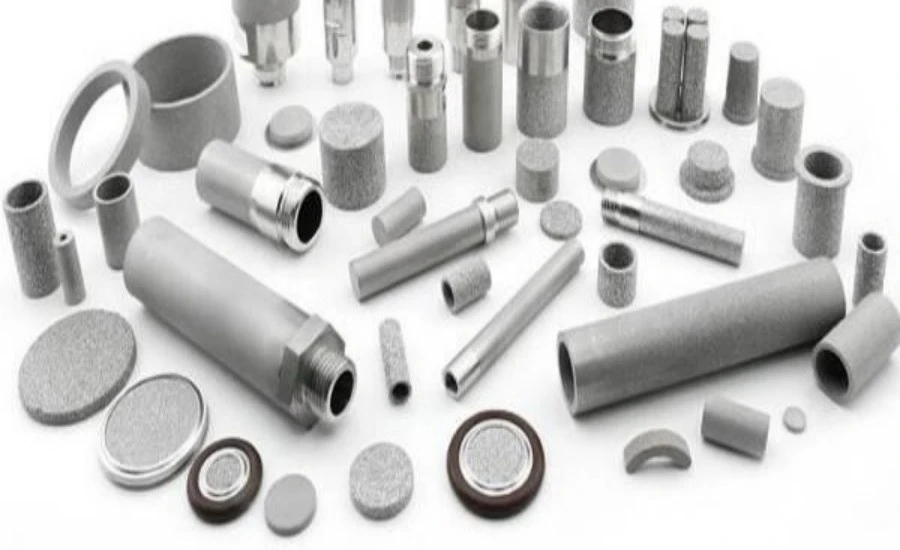
Bodies are supplied as straight tubes, closed-dome candles, cones, stepped and multi-diameter profiles, discs, rings, plates and flat panels, plus flanged, threaded or weld-in bosses. Ends follow your housing: 222 and 226 bayonet, DOE flat gasket, sanitary clamp or machined face. Send a drawing, or one used sample to NAVI Titanium, and the geometry is reproduced exactly rather than approximated from a description.


Application
Both duties below run hot, and heat is where media stop being predictable: seals soften, screens distort, and any chloride present concentrates at the metal surface. What decides whether a NAVI Titanium stainless element survives is rarely the wall itself. It is the seal, the weld and the water chemistry around it, and all three are settled before the metal is chosen.
Catalyst Recovery in Chemical and Petrochemical Processing
Recovery duties combine three problems that rarely appear together: the stream is hot, the solids are abrasive, and the material being caught is worth more than the filter. A plant losing catalyst fines loses product on every cycle, while a plant stopping to change elements loses throughput that no recovery step can repay.
NAVI Titanium's sintered ss filter cartridge handles this because the wall is depth media rather than a screen - fines are held inside the thickness, so a surface scratch or a pressure spike does not immediately open a path. It also tolerates the reverse blowback that recovery loops depend on: the cake is detached and sent back to the reactor while the element stays in place. Where temperatures rise above what a polymer or bonded medium survives, metal keeps its strength. Give us particle size, solids loading and blowback pressure, and we will return a grade and wall gauge sized to both.


Steam, Condensate and High-Temperature Gas Lines
Steam looks benign on a datasheet and is not in service. Chloride carried over in boiler feedwater concentrates at wet-dry interfaces and attacks stainless by pitting, so the same 316L that survives dry superheated steam can fail in a condensate return that nobody watches. NAVI Titanium therefore ask buyers three questions before quoting: what is the chloride content, where does the line spend time partly wet, and how does it drain when stopped.
Where the answer is unfavourable, we say so and point to a higher alloy or titanium instead of selling metal that will pit. Where it is acceptable, a sintered element gives particle-free steam for turbine protection, clean condensate for return, and a body that survives thermal cycling without cracking. Seals, not the wall, usually set the temperature ceiling here, so we specify that limit in writing with every quotation, alongside the section of the line it applies to.
Purchasing guide

Quality control (QC)
Every sintered SS filter cartridge from NAVI Titanium clears ISO 9001 release only after alloy identity, intergranular corrosion, retention threshold, flow at stated differential, weld penetration and surface condition are filed against its batch. Nothing is released on appearance. Press the button below to open the COA and read the values actually recorded for the batch held against your order.

Manufacturing Process
Every sintered ss filter cartridge from NAVI Titanium clears ISO 9001 release only after alloy identity, intergranular corrosion, retention threshold, flow at stated differential, weld penetration and surface condition are filed against its batch. Nothing is released on appearance. Press the button below to open the COA and read the values actually recorded for the batch held against your order.
| Step | Process | Key Control / Verification | What It Secures |
|---|---|---|---|
| 1 | Carbon Level & Melt Choice | Buy to mill certificate; verify chromium, nickel, molybdenum and carbon in-house before a gram is loaded | Prevents intergranular corrosion from carbon migrating to grain boundaries |
| 2 | Particle Cut & Compaction Route | Lock particle distribution before forming; isostatic (CIP) compaction for long thin-walled tubes; check green-body concentricity | Sets retention; avoids density gradient that bends or thins the wall |
| 3 | Vacuum Cycle & Pore Stability | Record peak temperature, dwell and vacuum level per load; hold the grade window; exclude carbon-bearing atmospheres | Balances strength (hotter) against permeability (cooler); keeps pores stable |
| 4 | Welding & Post-Weld Treatment | Argon-shielded welding of end caps and bosses; restore and treat the heat-affected zone; examine penetration on sectioned samples | Stops corrosion from starting in the untreated weld area |
| 5 | Surface Condition & Free Iron | Pickle and passivate to remove free iron; electropolish for hygienic or low-shedding duty; measure roughness | Clean, low-shedding, hygienic surface that stays finished |
| 6 | Readings That Release the Batch | Verify alloy identity, pass intergranular corrosion testing, record retention and flow at a stated differential, examine the weld, accept the surface; pack under a batch code | A batch ships only when every reading is present - never with a promise to follow |
NAVI Titanium Technical Data
Buyers usually size a cartridge by micron and length, then discover that something else in the assembly gave out first. The tables below map where the limit actually sits in a stainless installation, first by component, then by the seal material blamed afterwards. Treat every figure as indicative only; the numbers we stand behind are those written against your drawing.
Where the Limit Sits First (Reference Only)
|
Consideration |
Porous 316L body |
Elastomer seal |
Weld and heat-affected zone |
Housing seat |
|
Practical temperature ceiling |
400 – 600 °C |
120 – 230 °C by material |
Same as body if treated |
Set by vessel design |
|
What fails first |
Rarely |
Almost always |
Only if left untreated |
When tolerances stack |
|
Failure signature |
Blinding, gradual |
Hardening, weeping |
Dark lines, intergranular attack |
Bypass around the end |
|
Detectable before failure |
By differential trend |
Only by inspection |
Rarely, without sectioning |
By integrity test |
|
Our recommendation |
Match grade to solids load |
Specify seal separately |
Require treatment in writing |
Give us the drawing |
NAVI Titanium – Pure Performance, Proven Reliability
Field Record - A Recovery Loop in Rayong
A petrochemical site in Rayong was losing catalyst fines in a hot recycle stream and had been changing elements on a fixed interval that nobody had ever challenged. Their process team sent us particle size, solids loading and blowback pressure, and asked whether a deeper wall would extend the interval. We recommended a coarser cut with a thicker wall instead - more holding volume rather than finer capture - because their loss was product carryover, not penetration. NAVI Titanium sample elements were made to the existing end style so the housing stayed untouched, and the plant ran them through three blowback cycles before committing. Reported carryover fell, and the change interval was set by differential trend rather than by the calendar they had inherited. Their engineers also asked for the retention readings to be repeated after cleaning, which is the only way to know whether a porous body is the body that was specified.

What One Complaint Changed
A NAVI Titanium batch once came back from a steam condensate line with pitting that no datasheet predicted. The wall itself was within specification, the grade was correct, and the stainless was genuine - the failure sat in water chemistry, not in manufacture. Feedwater chloride had concentrated at a section that spent its cycle partly wet, and 316L does not survive that indefinitely. Two things came from that single complaint. First, we now ask about chloride content and wet-dry exposure before quoting rather than after delivery, and we decline orders where the answer is unfavourable, pointing buyers instead toward titanium or a higher alloy. Second, we rewrote our specification sheet to state the excluded streams in the same type size as our capabilities, That complaint cost us more than the order was worth and saved more than it cost. Buyers who hear that story usually ask us what else we refuse to make.
Two Voices, One Year On
A maintenance supervisor at a chemical site in Antwerp had kept a written log since commissioning: differential after each blowback cycle, retention reading after each clean, and the date of every intervention. Twelve months in, his comment was unemotional and useful - the readings had stopped being interesting because they had stopped moving, and an element that gives no news is an element nobody has to think about. The project engineer on the same line cared about something else: whether the second shipment of NAVI Titanium would seat like the first. It did, and not by accident, because the end style was made to their drawing rather than matched by eye. Their buyer summed up the commercial side in one sentence: fewer part numbers, fewer urgent orders, and no argument about whether the certificate describes what arrived. We quote that last part deliberately, because it is the only claim we can prove from paperwork.

FAQ
What proves weld quality, since corrosion usually starts there?
+
-
We treat the heat-affected zone after welding rather than leaving it as-welded, then verify by intergranular corrosion testing on samples from that lot. Alloy identity is confirmed by positive material identification per lot, and weld procedure records ship with the order. Ask any supplier for those three items and see how fast the conversation moves.
Can 316L handle seawater, brine or hypochlorite duty?
+
-
No, and we would rather lose the order than ship it. Chloride media pit stainless, particularly where flow runs slow or the surface cycles wet and dry, and pitting is permanent: nothing restores metal already lost. For those duties specify titanium, duplex or a nickel alloy from us instead. Tell us chloride content, temperature and whether the line ever drains partially; those three answers decide the material faster than any datasheet comparison, and they take ten minutes to give us.
Can you copy a cartridge we already buy, without changing the housing?
+
-
Yes, and this is the most common first order. Send one used element or a dimensional drawing; we measure end style, length, diameter and seat geometry, then reproduce it in the grade you need now. Where the original failed early, we say why rather than copying the weakness along with the dimensions, and where the housing tolerance is at fault we flag that too.
The body is rated for 600 °C - can the assembly actually run there?
+
-
Not with standard elastomers fitted. NBR, EPDM and Viton each impose their own ceiling, far below what the metal tolerates, which is why seal material is quoted separately and stated in writing rather than assumed. Above elastomer range we supply spiral-wound metal gaskets or welded-in ends, and we say which one applies before you order.
How long does one cartridge last, and how do we know it is finished?
+
-
Judge by two readings, not by years. Rising differential that cleaning no longer reverses means blinding; a retention value drifting below its start-up figure means the pore structure has coarsened or a defect has opened, and no cleaning recovers either. Log the retention reading at commissioning and compare after every campaign.
Hot Tags: sintered ss filter cartridges, China sintered ss filter cartridges manufacturers, suppliers, factory, porous sintered metal filter plate, Sintered Bronze Filter Element, Sintered Bronze Sheet, Sintered Filter Plate, sintered metal filter disc, uniform pore porous metal filter