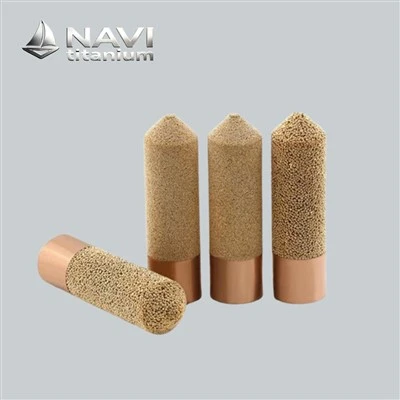
NAVI Titanium offers sintered porous metal for applications requiring controlled permeability, and repeatable batch characteristics. For overseas buyers, the export team coordinates order details, commercial paperwork, packing records, carrier handover, and destination requirements with clear document matching. Retained specifications also simplify repeat purchasing, allowing drawings, inspection criteria, and previous order records to be referenced rather than recreated. This traceable approach gives procurement teams a clearer basis for supplier evaluation.
Solution of NAVI Titanium
NAVI Titanium focuses on advanced industrial materials and precision-manufactured components. Since 2008, the company has developed capabilities covering material selection, structural design, surface treatment, powder metallurgy, precision machining, quality inspection, and customized production. Its product portfolio extends across electrochemical components, and porous metal products, allowing buyers to evaluate material composition, geometry, dimensional tolerance, operating conditions, and application requirements as an integrated specification rather than as isolated purchasing parameters.
The following table summarizes the core information major titanium-related products. This overview can help buyers compare different product structures and identify the appropriate solution according to equipment design and process requirements.
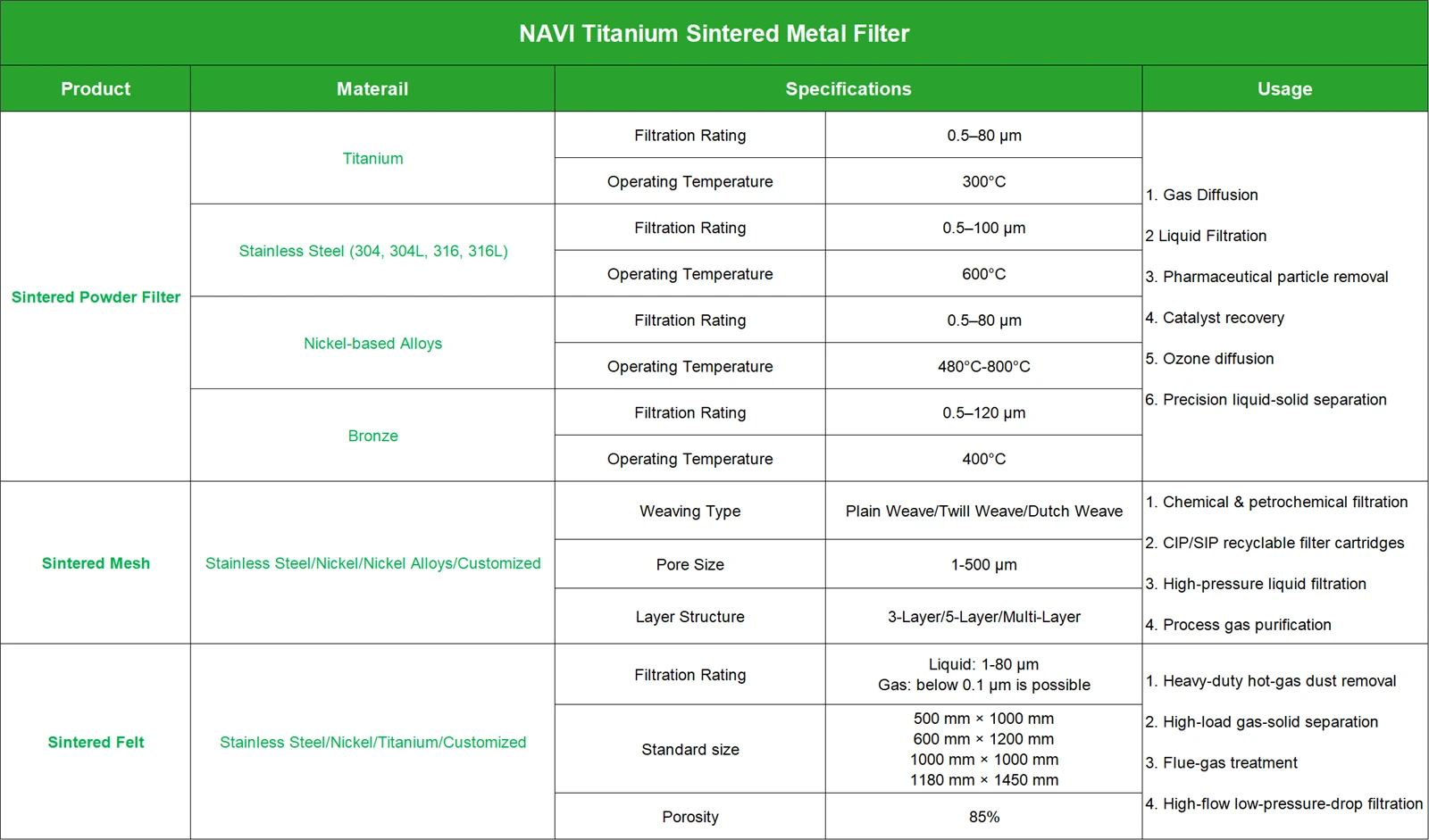


NAVI Titanium examines this class of porous media through its interconnected passage geometry, particle retention capacity, permeability, and thermal response. The open-volume ratio and passage dimensions jointly determine fluid transfer, while substrate grade and thickness affect mechanical behavior under operating loads.


Application
NAVI Titanium supplies sintered porous metal for medical and life-science gas management as well as flame-arrestor assemblies requiring controlled passage, heat dissipation, and application-specific flow characteristics.
In medical and life-science devices, controlled gas passage is often more important than simple particle retention. A porous metallic body can provide a defined path for gas diffusion, venting, pressure equalization, and sterile-barrier functions while remaining compact enough for small instrument housings. Its interconnected void volume creates distributed flow resistance rather than relying on a single opening, which helps moderate local velocity and reduce abrupt pressure changes. For diagnostic cartridges, respiratory interfaces, specimen-handling hardware, and laboratory gas lines, cleanliness and extractables are critical purchasing criteria. Buyers may also specify ultrasonic cleaning, passivation, dimensional inspection, lot traceability, and particulate limits according to the final application. Thermal history matters because it affects grain bonding and internal passage geometry. NAVI Titanium can tailor diameter, thickness, nominal micron grade, and connection form according to drawings, while inspection records help medical-device teams maintain consistent incoming acceptance across recurring orders. For recurring qualification and purchasing.

2. Flame Arrestor Assemblies

Flame arrestor assemblies depend on controlled interruption of flame propagation while preserving an acceptable gas-flow path. A porous metallic body functions through a closely spaced three-dimensional passage field that removes heat from an advancing flame front. When the passages are sufficiently narrow, the flame loses thermal energy faster than combustion can continue through the material, reducing the likelihood of flame transmission toward the protected side. Selection therefore requires more than a nominal micron value. Passage geometry, thickness, thermal conductivity, gas composition, operating pressure, temperature, and expected flow rate all affect arresting performance. For refineries, chemical processing lines, vapor recovery systems, storage vessels, and vent assemblies, buyers commonly evaluate pressure loss, quenching capability, mechanical attachment, corrosion resistance, cleanability, and inspection records as one procurement package. NAVI Titanium can supply cylinders, cartridges, and other geometries. Batch identification and dimensional records are useful for replacement planning, especially when an installed arrestor must match an established assembly without altering adjacent piping. During recurring replacement qualification cycles.
Purchasing guide

Quality control (QC)
NAVI Titanium records batch-specific material data for its porous sintered series. The accompanying quality record gives buyers a clear reference for specification verification before acceptance. Such documentation also helps purchasing and technical teams compare successive lots against approved drawings and agreed technical requirements.

Manufacturing Process
| Stage | Process Focus | Description |
| 1. Raw Material Preparation | Feedstock Selection | NAVI Titanium selects metallic granules according to grade, particle range, purity, and intended service requirements. |
| 2. Particle Classification | Size Distribution | Granules are separated into defined size fractions. Their distribution affects the future opening scale and internal void volume. |
| 3. Mold Filling | Cavity Loading | Classified granules are introduced into a prepared cavity. Filling uniformity is considered carefully to reduce local density variation. |
| 4. Cold Compaction | Shape Formation | Controlled mechanical force consolidates the loose feedstock into the required geometry while retaining interconnected openings within the compact. |
| 5. Thermal Consolidation | Heat Treatment |
A controlled heating cycle promotes bonding between adjacent particles without eliminating the intended internal passages. |
| 6. Finishing & Inspection | Final Verification | The formed item undergoes sizing, surface treatment, dimensional checks, pore-rating verification, and visual inspection before final technical approval. |
Semiconductor Fab Applications: U.S. and South Korea
For United States semiconductor fabs, porous sintered media are commonly evaluated as upstream consumable parts where cleanliness, pore rating, particle retention, chemical compatibility, and service interval matter to purchasing teams. A market study places North America at about 27% of the global semiconductor filter market, reflecting demand associated with wafer fabs, specialty fabs, and cleanroom expansion. Buyers in the U.S. commonly examine micron grading, open-area ratio, thickness, diameter, connection format, surface finish, and batch-to-batch consistency before approval. NAVI Titanium can present these specifications in a procurement-oriented format, helping technical and purchasing teams match the selected grade with gas handling, liquid handling, chemical delivery, and process monitoring duties. For recurring orders, retained drawings, agreed inspection points, lot identification, and replacement compatibility can also reduce qualification effort. The key purchasing question is therefore not simply the nominal micron value, but whether pore size, geometry, cleanliness, and documented inspection data remain aligned with the fab's operating requirements. This is especially relevant during qualification and routine replacement cycles across multiple fab lines daily.

South Korea

South Korea is another important destination for porous sintered media used around semiconductor production. Korea has the world's third-largest semiconductor manufacturing capacity, accounting for 14.6% of global production capacity, according to InvestKOREA, while Samsung Electronics and SK hynix remain central to the country's memory-chip ecosystem. For Korean buyers, selection commonly centers on controlled pore grading, dimensional repeatability, surface cleanliness, chemical resistance, pressure-drop characteristics, and compatibility with existing process hardware. NAVI Titanium can frame these requirements around practical procurement data rather than generic material descriptions. Replacement planning is also important when fabs operate continuously, since a repeat order should match previously qualified dimensions and specifications. Korean purchasing teams may therefore compare samples, drawings, inspection records, and production history before approving a recurring source. This application focus gives the page useful relevance for semiconductor gas handling, chemical delivery, process sampling, and specialty fluid-control duties across Korea's expanding fabrication ecosystem at qualified fabrication sites.
Form & Installation Considerations
For procurement, sintered porous metal should be assessed together with the receiving housing rather than by nominal dimensions alone. The buyer normally needs to verify housing inner diameter, insert outer diameter, insertion depth, sealing surface width, mounting thread, retaining method, and available clearance around the installed part. A small dimensional mismatch can affect insertion, sealing, removal, or downstream flow characteristics. NAVI Titanium can review drawing dimensions together with the intended housing interface before production, especially where the insert must replace an existing part without modifying the surrounding assembly. Thread form, shoulder location, end-face geometry, and sealing allowance can be specified according to the buyer's existing hardware. For maintenance-oriented applications, removal space also deserves attention: an insert that fits the bore but cannot be extracted conveniently may increase downtime during servicing. Buyers can therefore provide housing drawings, mating dimensions, thread specifications, or previous-part samples for dimensional matching. This approach shifts purchasing from a standalone size selection toward interface compatibility, helping OEMs reduce installation changes and avoid unnecessary revisions to the receiving hardware.

Dirt Loading

For sintered stainless steel filter, service-life assessment can begin with the progression from a clean insert to progressive particle accumulation. As retained contamination increases, the available passage area gradually decreases and the differential pressure across the part may rise. Buyers therefore need more than an initial micron rating when estimating maintenance intervals. Useful purchasing criteria include contamination loading, dirt-holding capacity, pressure-rise curve, cleaning frequency, and the replacement threshold defined by the host system. A controlled test can compare initial differential pressure with readings after predetermined contaminant loading, allowing procurement teams to establish a practical replacement point. Cleaning method is equally important: back-pulse, reverse-flow, solvent rinsing, ultrasonic treatment, or another approved method can produce different recovery levels depending on the retained material and part geometry. NAVI Titanium can evaluate these factors against the buyer's operating flow, contaminant type, target service interval, and cleaning practice. For OEM programs, historical loading data can also help maintain consistent specifications across repeat orders, reducing the need to select a replacement based only on nominal micron grade.
Connection & Mounting
For sintered porous metal, mounting selection determines how the part is positioned, retained, sealed, and connected within a larger assembly. NAVI Titanium evaluates the interface according to thread geometry, weld location, brazed area, flange dimensions, press-fit allowance, retaining-ring position, and end-cap configuration. Each joining method creates a different load path and may alter the effective passage area near the connection. Threaded interfaces are suited to removable assemblies, while welded or brazed joints favor permanent installation. Press-fit mounting requires careful control of mating dimensions to avoid excessive insertion force or unwanted movement. Adapters can accommodate transitions between dissimilar connection standards, whereas retaining rings permit easier servicing. End caps and support tubes can also define the inlet or outlet route. For OEM purchasing, drawings should identify connection location, insertion depth, sealing face, fastening method, and clearance requirements.
| Mounting Method |
|
|---|---|
| Threaded |
|
| Welded |
|
| Brazed | Interface clearance, filler compatibility |
| Flanged | Bolt pattern, sealing face |
| Press-fit | Mating diameter, insertion allowance |
| Retaining ring | Groove position, removal access |
| Adapter | Interface transition, dimensional matching |
A properly specified connection interface helps maintain consistent positioning, sealing, retention, and passage continuity, while reducing installation adjustments and simplifying future replacement within assemblies.
FAQ
1. How do you select the base material for a porous metallic part?
+
-
Selection begins with the chemical environment, operating temperature, mechanical loading, required permeability, joining method, and expected contaminant exposure.
2. Can electrochemical exposure affect material selection and service performance?
+
-
Yes. Electrolyte composition, electrode potential, current density, pH, temperature, and exposure duration can alter surface reactions and localized corrosion behavior.
3. Which parameters should buyers prioritize when specifying a porous metallic insert?
+
-
Increasing thickness may improve mechanical resistance while raising flow resistance; a smaller opening grade may increase particle retention while requiring greater driving force.
4. How is material compatibility evaluated for different operating environments?
+
-
Compatibility research normally considers chemical composition, temperature, exposure duration, cleaning agents, surrounding materials, and joining conditions. Particular attention is given to galvanic interaction when dissimilar conductive materials are connected.
5. Which production stages require the closest control for consistent porous-part performance?
+
-
Key checkpoints include raw-material classification, particle-size distribution, formulation uniformity, mold filling, compaction, thermal consolidation, sizing, surface treatment, and final dimensional inspection. Each stage can alter density distribution, interconnected openings, permeability, and final geometry.
Hot Tags: sintered porous metal, China sintered porous metal manufacturers, suppliers, factory, Microporous Filter, porous metal filter core, Sintered Bronze Filter, Sintered Filter Plate, sintered metal filter disc, Sintered Stainless Filter