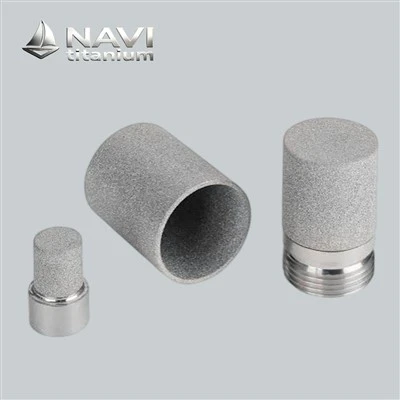
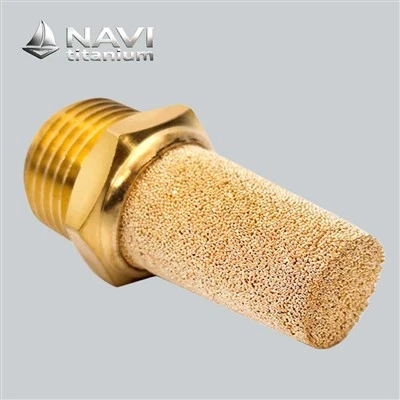
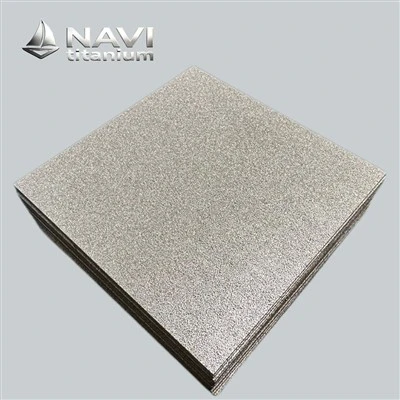
NAVI Titanium supplies sintered powder filter element solutions. Its R&D group includes specialists with doctoral and master's backgrounds, bringing feedstock assessment, pore-size evaluation, and application-specific analysis into project preparation. The production team follows documented specifications from initial drawing review through forming, sizing, finishing, and inspection, with batch information retained for repeat orders. Cross-functional communication allows technical questions to move directly between laboratory personnel and shop-floor specialists, helping sourcing party clarify opening grades, operating parameters, and sampling requirements before volume purchasing.
Solution of NAVI Titanium
NAVI Titanium maintains a broad portfolio of titanium-based industrial feedstock, with technical coverage extending from conductive substrates and coated anodes to formed cathodic accessories and application-specific assemblies. Its technical records place emphasis on grade selection, geometry, coating chemistry, working current, dimensional ranges, and service environment rather than relying on generic feedstock descriptions. For overseas sourcing party, the following reference table brings the principal titanium offerings into one view, outlining available grades, typical dimensions, electrical characteristics, coating options, physical attributes, and corresponding application fields. These data points provide a practical starting point for specification review, drawing confirmation, sample selection, and project-based purchasing.
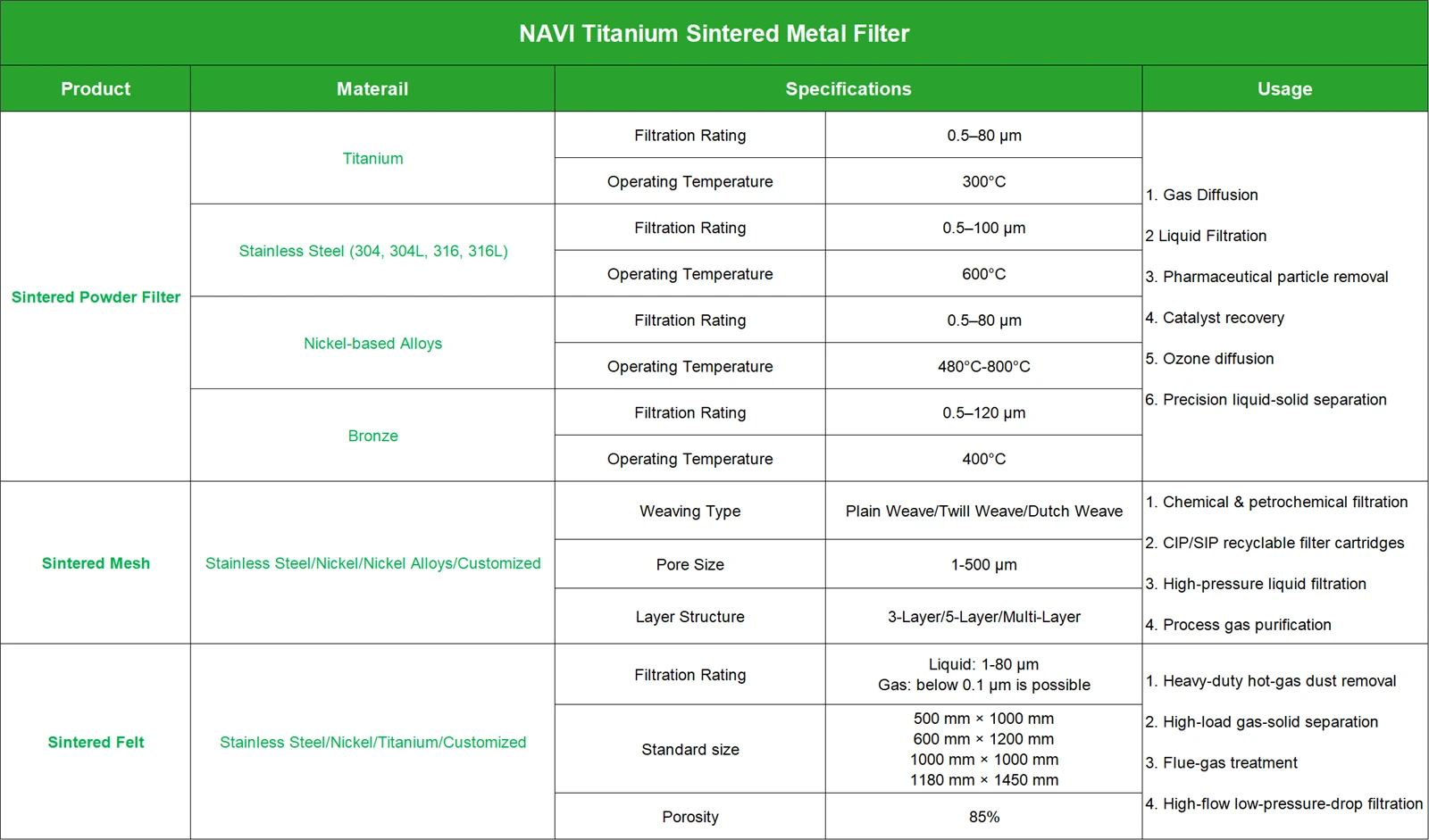


NAVI Titanium examines particulate-based porous bodies through their interconnected voids, where opening size, void fraction, thickness, and surface morphology jointly determine fluid conduit and particle retention. From a materials-science perspective, these variables govern pressure loss, permeability, and contaminant capture under different flow regimes.


Application
NAVI Titanium supplies sintered powder filter element solutions for controlled gas diffusion, sparging, pressure measurement, and flow-sensing applications where conduit size, flow resistance, and gas distribution must be carefully matched.
Gas diffusion and sparging depend on how effectively a compressed gas is divided into numerous small streams before entering a liquid phase. A consolidated particulate body contains interconnected openings whose size distribution governs local velocity, flow resistance, and bubble formation. When gas reaches the lower surface, the driving force must overcome liquid surface tension at each opening before discrete bubbles detach. Smaller openings generally promote finer bubbles, increasing interfacial area per unit gas volume, while excessive flow resistance can raise the required inlet force and restrict throughput. Bubble diameter is also affected by liquid viscosity, surface tension, immersion depth, gas rate, and outlet geometry; therefore, nominal opening size alone cannot predict dispersion performance. In reactor and aeration vessels, uniform bubble release helps reduce preferential flow paths and improves gas–liquid contact. Feedstock selection should additionally reflect liquid chemistry, operating temperature, cleaning practice, and repeated load cycling. These parameters allow the same basic form to be specified for laboratory vessels, chemical reactors, fermentation tanks, and continuous gas–liquid mixing duties.

2. Gas Measurement

Gas measurement assemblies require a controlled interface between the process stream and sensing hardware. A finely distributed opening pattern can restrict suspended contaminants while allowing the force signal to pass toward a gauge, transmitter, or flow-sensing device. The key physical relationship is flow resistance versus volumetric throughput: as velocity rises, viscous losses through narrow conduits increase, while inertial effects become increasingly relevant at higher flow rates. An appropriately selected grade therefore acts as a hydraulic conditioning stage rather than merely a barrier against foreign matter. This distinction matters in force gauges, differential-force instruments, mass-flow systems, and laboratory gas-analysis lines, where abrupt particle ingress or local turbulence may distort readings or shorten service intervals. Conduit size, thickness, effective area, upstream force, downstream force, and gas viscosity should be considered as a coupled set. For 316L stainless grades, chemical compatibility is also assessed against humidity, process vapors, cleaning agents, and temperature. Sourcing party specifying these assemblies should define the target micron rating together with allowable force loss and nominal flow rate. Such information gives manufacturers a meaningful basis for selecting geometry and producing repeatable instrument interfaces.
Purchasing guide

Quality control (QC)
NAVI Titanium accompanies applicable orders with a COA, giving sourcing party a documented record of key inspection results for the supplied grade and batch. Batch identification links the certificate with the corresponding production records, making technical review easier during incoming inspection and repeat purchasing. For procurement teams, the COA offers a concise reference for comparing delivered goods against the approved specification before final acceptance.

Manufacturing Process
NAVI Titanium follows a controlled powder-forming route in which particle characteristics, compaction pressure, thermal treatment, and final sizing are treated as interrelated variables. The objective is not simply to obtain a defined shape, but to establish a repeatable internal conduit pattern with the required permeability and mechanical integrity.
1. Feedstock Preparation
Selected particles are screened according to particle-size distribution, chemical composition, cleanliness, and batch identification. Consistent feedstock establishes the basis for subsequent dimensional and permeability control.


2. Proportioning & Blending
The selected fraction is prepared to obtain the required particle distribution. Mixing uniformity is checked before forming so that local density differences are minimized.
3. Mold Filling & Compaction
The prepared feedstock is introduced into a dedicated mold and compressed under a specified load. Filling height, pressing force, dwell time, and density distribution are monitored according to the required specification.


4. Thermal Consolidation
The compact undergoes controlled heating under a selected atmosphere. Thermal exposure promotes bonding between adjacent particles while retaining interconnected openings required for fluid conduit.
5. Sizing & Finishing
After cooling, dimensional correction and surface finishing bring the item toward its specified diameter, thickness, length, or interface geometry.


6. Final Inspection
NAVI Titanium checks dimensions, visual quality, permeability-related characteristics, and batch identification before release. Inspection records can then be matched with the applicable technical specification and COA.
International Logistics
For NAVI Titanium, transit protection begins before the goods leave the factory and continues until receiving inspection at the sourcing party's site.
Factory: dimensional and visual checks are completed before dispatch.
Inner Protection: individual pieces are separated to reduce abrasion, impact, and surface contact.
Outer Carton: grouped units are secured against movement during repeated handling.
Pallet / Wooden Case: larger orders receive a stable external base for lifting and stacking.
Container: cargo is positioned to limit shifting, compression, and exposure to moisture.
Vessel: prolonged transit makes internal fixation and moisture protection especially important.
Destination Port & Customs: documents and cargo identification remain matched throughout clearance.
Local Warehouse: unloading and temporary storage should avoid excessive stacking or rough handling.

LCL and FCL

NAVI Titanium can arrange logistics according to order volume, purchasing frequency, and dimensional variety. LCL is generally suited to small batches, mixed items, and orders containing multiple sizes. Because cargo may pass through several consolidation points, sourcing party should consider additional handling, warehouse transfers, cargo movement, and potentially longer transit periods. Individual identification and firm internal fixation become particularly important when different items share one outer package.
FCL becomes more practical for larger quantities, recurring supply, or annual procurement programs. With a dedicated container, loading can be planned around pallet dimensions, wooden-case placement, available cubic capacity, and unloading access. Sourcing party should review:
LCL: consolidation, multiple handling points, warehouse transfer, transit duration, cargo separation.
FCL: palletization, crate loading, container utilization, moisture protection, lifting access, unloading sequence.
For repeat purchasing, retaining approved packing specifications and loading records can simplify future dispatch planning while reducing variation between successive consignments.
Form & Installation Considerations
For procurement, the physical form should be specified together with the interface rather than treated as an isolated item. A single-open-end version can connect directly to a tube seat or retaining socket, while a double-open-end version may suit through-flow arrangements requiring conduit from one side to the other. A blind-end version closes one side and directs the process stream through the active surface. End treatment also affects installation: a flat termination may rely on compression sealing, whereas a threaded end can mate directly with a corresponding port. Flanged versions are useful where bolted joints are preferred for frequent inspection or replacement. Sourcing party should confirm outside diameter, inside diameter, overall length, end thickness, thread specification, flange dimensions, and allowable seating depth. Where required, end caps, O-rings, gaskets, retaining cores, or fastening collars can be incorporated into the specification. These details reduce uncertainty during assembly and help purchasing teams order a version compatible with the intended housing.

Housing Fit and Flow Orientation

The relationship between the insert and its housing determines how fluid enters, passes through, and exits the assembly. For radial flow, fluid moves from the outer circumference toward the inner conduit, or in the reverse direction, depending on the system arrangement. Axial flow directs the stream along the longitudinal axis, making end geometry and internal clearance especially important. An inside-to-outside route requires sufficient internal volume upstream of the active surface, while an outside-to-inside route requires adequate clearance around the circumference. Sourcing party should therefore provide housing drawings, port locations, sealing positions, available installation depth, and intended flow direction when requesting quotations. Clearance must account for thermal expansion, sealing compression, retaining hardware, and removal space. A nominally correct diameter may still be unsuitable if the seating length, shoulder position, thread engagement, or gasket location differs from the mating housing. Early dimensional confirmation between NAVI Titanium and the purchasing team can reduce modification requests, installation delays, and costly on-site fitting issues.
316L Grade for Gas Pressure & Flow Measurement
NAVI Titanium approaches the sintered powder filter element from the perspective of gas-force instrumentation, where nominal micron grade alone cannot determine practical performance. In a 5–60 μm specification range, particle size distribution, void fraction, thickness, effective area, and conduit tortuosity jointly affect force loss and gas throughput. A 316L stainless grade is particularly relevant where the assembly encounters humid gas, process vapors, or repeated force variation. For flow meters and force-sensing lines, the selected opening grade must balance contaminant retention against signal transmission: excessively fine openings may raise differential force, while overly large openings may permit unwanted particulates toward sensitive sensing surfaces. NAVI Titanium can evaluate the following parameters according to the housing and instrument interface.
| Parameter |
|
|---|---|
| Micron grade |
|
| Base grade |
|
| Flow direction | Inside-to-outside / outside-to-inside |
| Application | Gas pressure & flow measurement |
| Key variables | Pressure drop, flow rate, conduit size, thickness |
| Interface | Threaded, flat-end, flanged, custom |
NAVI Titanium positions the sintered metal filter as a controllable gas-interface insert for force and flow instruments, with micron grade, 316L composition, geometry, and flow-loss requirements assessed together.
FAQ
1. How is feedstock selection evaluated for different gas-handling duties?
+
-
Feedstock selection begins with gas composition, humidity, operating temperature, pressure differential, and expected exposure time. Previous application records help identify suitable grades and particle specifications for similar duties.
2. How does the R&D team determine a suitable micron grade?
+
-
Micron selection is evaluated against particle-retention requirements, gas throughput, allowable pressure loss, thickness, and effective conduit area.
3. What technical data can sourcing party request before placing an order?
+
-
Available technical records may cover particle-size distribution, dimensional ranges, pressure-drop data, permeability-related measurements, feedstock composition, and previous sampling results.
4. What processing capabilities are available for customized dimensions?
+
-
Different forming presses, thermal-treatment units, sizing tools, machining resources, and inspection instruments can be assigned according to geometry and quantity.
5. How is production scheduling handled for repeat or customized orders?
+
-
Scheduling normally considers feedstock availability, tooling requirements, forming capacity, thermal-treatment queues, machining demand, inspection timing, and order quantity.
Hot Tags: sintered powder filter element, China sintered powder filter element manufacturers, suppliers, factory, micron rated sintered metal filter, open pore porous metal filter, Porous Stainless Steel Plate, Sintered Air Filter, Sintered Bronze Filter, Sintered Bronze Sheet