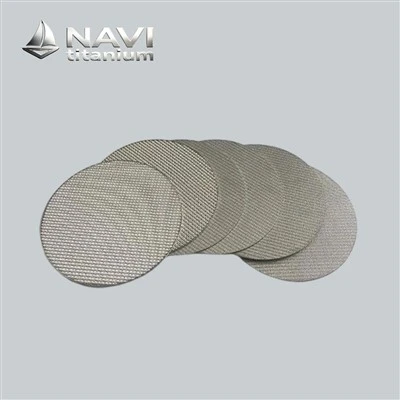
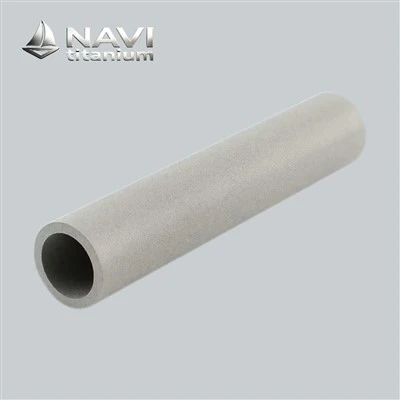
NAVI Titanium supplies sintered metal filter disc products shaped by years of application-oriented research and overseas market experience. During the early R&D stage, attention was placed on particle retention, permeability, dimensional consistency, and material selection under varied service requirements, with testing records accumulated across different configurations. As international business expanded, specifications became increasingly aligned with purchasing practices in Europe, North America, Southeast Asia, and the Middle East. Repeat-order records, inspection documentation, and customized sampling now form part of the buyer-facing service framework.
Solution of NAVI Titanium
With a heritage rooted in Baoji, China's renowned titanium-producing region, NAVI Titanium has cultivated a distinctive reputation around application knowledge, material discipline, and long-term technical accumulation. Since 2008, its portfolio has expanded from conventional electrode forms toward highly customized configurations. Rather than judging an electrode solely by its appearance, professional buyers can evaluate substrate grade, coating chemistry, active area, dimensional range, current loading, reaction type, and installation geometry together. The following table summarizes representative specifications and application references across NAVI Titanium's principal electrode families, providing a practical starting point for technical comparison, project selection, and customized procurement.
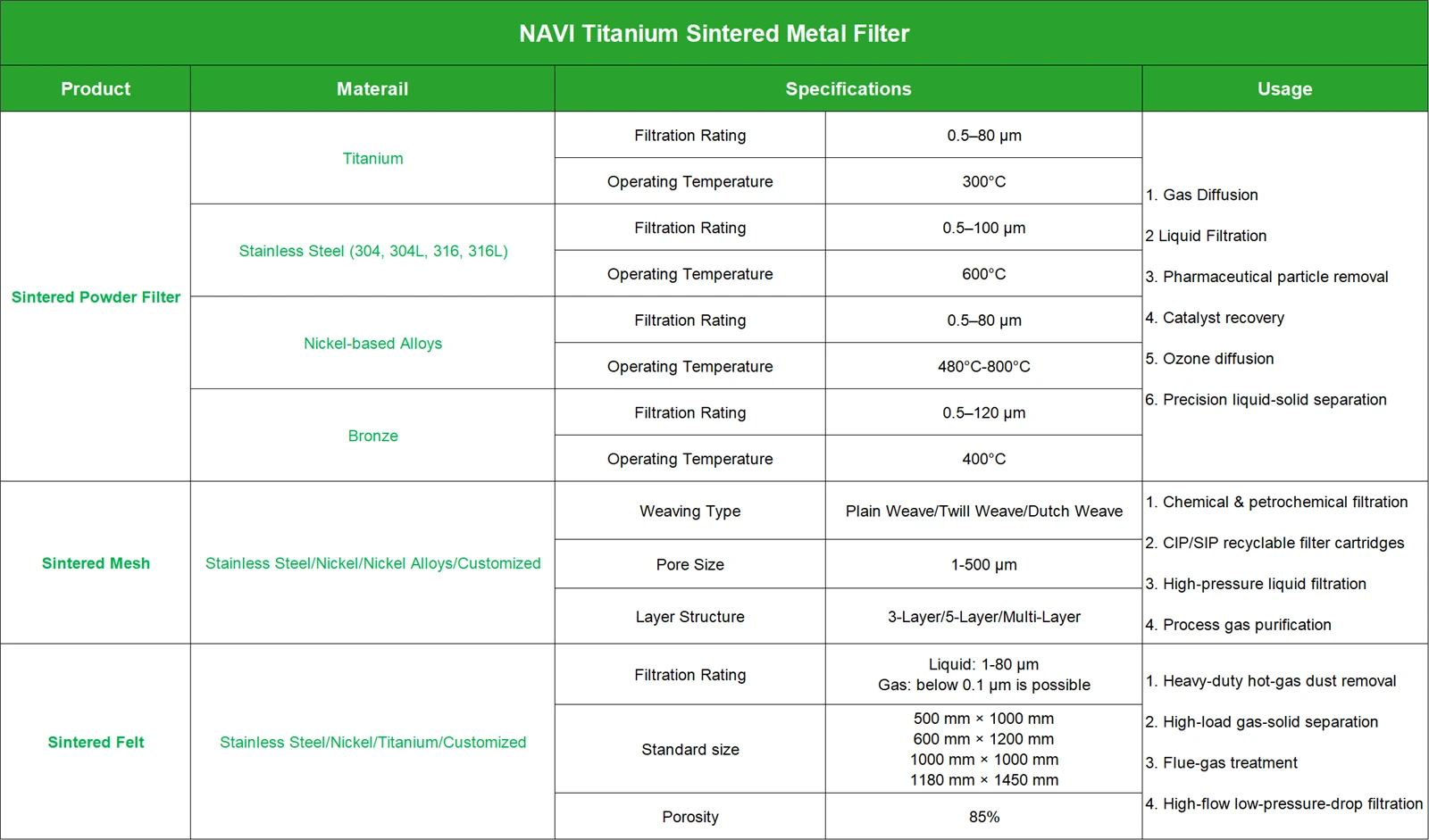


NAVI Titanium approaches disc fabrication from a materials-science perspective. The circular form permits systematic evaluation of diameter, thickness, flatness, concentricity, and pressure response. Such parameters are particularly relevant when the disc is installed within a defined housing or sealing arrangement requiring controlled hydraulic characteristics.


Application
Sintered metal filter disc from NAVI Titanium is suited to gas purification and analysis as well as wastewater treatment, where controlled particulate retention, pressure management, chemical compatibility, and consistent flow performance are critical.
Gas purification and analytical sampling require controlled removal of suspended solids without disturbing the pressure balance or chemical composition of the stream. At NAVI Titanium, a sintered particulate-retention disc functions through a tortuous three-dimensional passage network, where capture depends on particle diameter, passage distribution, thickness, superficial velocity, and differential pressure. For analytical systems, this relationship is particularly important because excessive pressure loss may alter sampling rates, while insufficient retention can introduce contaminants into downstream sensors, chromatographic columns, or spectroscopic cells. For procurement teams, nominal micron rating alone therefore offers limited information; bubble-point data, pressure-drop curves, effective open volume, dimensional tolerance, and material compatibility provide a more meaningful basis for specification. Applications include gas sampling lines, analytical instruments, carrier-gas preparation, laboratory reactors, and process-gas purification. Selecting thickness and pore-size distribution according to flow demand helps maintain consistent sampling conditions while reducing particulate transfer to sensitive analytical stages.

2. Wastewater Treatment

Electrochemical and physicochemical wastewater systems frequently encounter suspended solids, catalyst residues, precipitates, and reaction by-products that must be removed before recirculation or downstream treatment. A sintered particulate-retention disc can regulate solids migration through interconnected internal passages, with separation performance governed by passage size distribution, thickness, viscosity, flow velocity, and pressure differential. Unlike a simple surface barrier, depth-based retention distributes captured matter through the internal volume, which can affect pressure rise and service intervals as loading increases. For treatment-system buyers, material compatibility should be assessed against pH, chloride concentration, oxidizing species, temperature, and cleaning chemistry rather than selected solely from nominal retention grade. Disc diameter, thickness, sealing geometry, and flow direction also affect hydraulic resistance and installation compatibility. Typical duties include pretreatment of recirculating streams, removal of precipitated solids, protection of pumps and valves, and clarification stages before membrane or electrochemical processing. Performance records covering pressure drop, retention efficiency, and repeated cleaning are valuable when establishing specifications for continuous operation.
Purchasing guide

Quality control (QC)
For NAVI Titanium, a certificate of analysis is more than a routine quality document; it creates a traceable link between the ordered specification and the delivered batch. Each record can identify key material information, dimensional data, coating-related results, and applicable inspection findings, allowing purchasing and technical teams to verify whether the supplied configuration corresponds with the agreed requirements. This documentation is particularly valuable for repeat orders, incoming inspection, technical audits, and long-term sourcing, giving overseas buyers a clearer documentary basis for acceptance and future specification matching.

Manufacturing Process

At NAVI Titanium, fabrication of sintered metal disc begins with carefully graded particulate feedstock selected according to the required permeability, retention level, and service environment. The material is first proportioned and blended to obtain a uniform distribution of particle size. This feedstock is then filled into a dedicated mold and compacted under controlled pressure, establishing the required diameter, thickness, and internal void pattern.
The shaped blank proceeds to thermal consolidation, where a carefully controlled heating cycle promotes bonding between adjacent particles while preserving interconnected passages. Heating rate, holding period, peak temperature, and cooling sequence are adjusted according to material composition and dimensional requirements. After thermal treatment, edges and connection surfaces may receive machining or finishing to meet the specified geometry.

Dimensional Selection
For procurement teams, the outer diameter of a disc is not merely a nominal size; it determines how the part seats inside a housing, cartridge, groove, or retaining ring. NAVI Titanium can assess OD requirements alongside tolerance and circularity so that mating surfaces remain properly aligned during assembly.
- Outer diameter (OD): Specify nominal diameter and the required tolerance range rather than using an approximate size.
- OD tolerance: A tighter range may be necessary where the disc fits into a machined recess or compression holder.
- Roundness: Excessive deviation from a true circle may create uneven contact, local gaps, or difficult insertion.
- Dimensional stability: Diameter should remain within the agreed range after thermal processing, machining, cleaning, and service exposure.
- Installation clearance: Radial clearance must account for housing geometry, thermal expansion, sealing method, and insertion direction.
- Inspection basis: Buyers may request measured OD, roundness results, thickness, and batch identification before acceptance.

Center Hole

A center-hole configuration expands sourcing options beyond a circular disc, particularly where the part must fit around a shaft, bolt, tube, nozzle, or passage. NAVI Titanium can review the relationship between outer diameter, inner diameter, thickness, and mounting arrangement before production.
- Outer diameter: Defines the seating boundary and area.
- Inner diameter: Determines shaft or passage clearance and should match the mating dimension.
- Hole concentricity: The inner opening should remain centered relative to the OD to prevent eccentric seating or uneven loading.
- Thickness: Affects axial clearance, pressure drop, retention capacity, and mounting depth.
- Mounting method: Specify compression, clamping, threaded retention, gasketed seating, or fixing approach.
- Flow direction: Clarify whether flow passes radially, axially, or through the central opening according to the housing layout.
- Form terminology: Washer-shaped disc, ring-shaped element, and center-hole disc can describe configurations but may imply mounting details.
Flatness and Parallelism for Disc Applications
As diameter increases while thickness remains limited, even a small amount of warpage can become more significant during assembly. NAVI Titanium evaluates the planar condition according to diameter, thickness, mounting method, and mating surface requirements.
Flatness tolerance: Define the permitted deviation across the complete face rather than relying only on nominal thickness.
Warpage: Check whether the circular face remains sufficiently even after thermal processing and finishing.
Gasket contact: Excessive deviation may create uneven gasket compression and localized leakage paths.
Retaining-ring contact: A curved face can produce partial contact instead of uniform seating.
Clamping distribution: Uneven geometry may concentrate force around selected areas rather than distributing it across the circumference.
Installation stability: Larger, thinner discs generally require closer attention to planar deviation because small distortions become more noticeable during fitting.

Parallelism: Two-Face Alignment in Sealing Assemblies

Parallelism describes the angular relationship between the two principal faces of a disc and is closely associated with thickness consistency. NAVI Titanium considers face-to-face alignment together with overall thickness, diameter, gasket type, and fastening arrangement when reviewing dimensional requirements.
Two-face parallelism: Establish the allowable angular deviation between the upper and lower faces.
Thickness consistency: Local thickness variation can amplify assembly differences even when average thickness meets the drawing.
Gasket compression: Parallel faces help distribute compression more evenly around the sealing circumference.
Clamping force: Uneven face orientation may concentrate load at selected contact areas.
Stack-up tolerance: Disc thickness, gasket thickness, housing depth, and retaining-ring position should be evaluated together.
Assembly clearance: Excessive angular deviation can reduce available clearance on one side while increasing it on the opposite side.
Concentricity: OD–ID Alignment for Assembly Accuracy
For a sintered metal filter disc, concentricity describes the positional relationship between the outer diameter (OD) and inner diameter (ID), making it especially important for washer-shaped or center-hole configurations. NAVI Titanium considers this geometric relationship when the disc must fit around a shaft, nozzle, retaining feature, or circular sealing seat. If the OD and ID axes deviate, the radial width around the annular area becomes uneven. Such eccentricity can alter local flow area, create unequal gasket contact, increase interference during insertion, and shift clamping loads toward one side. In rotating or coaxial assemblies, excessive deviation may also produce misalignment between the disc and its mating shaft or passage.
| Buyer Focus | Technical Significance |
|---|---|
| OD–ID concentricity | Maintains uniform annular width |
| Hole position | Reduces assembly offset |
| Sealing width | Promotes more even gasket contact |
| Flow area | Limits asymmetric passage distribution |
| Shaft/nozzle alignment | Helps maintain coaxial installation |
| Clamping | Reduces localized loading |
For center-hole configurations, concentricity should be evaluated together with OD, ID, thickness, flatness, and mounting tolerances rather than treated as an isolated dimension.
FAQ
1. How does the R&D team determine the appropriate particle-size formulation?
+
-
The formulation is selected according to the required retention level, permeability, thickness, pressure differential, and intended service environment. Researchers typically assess particle-size distribution together with packing density and thermal bonding characteristics rather than treating one parameter independently.
2. How is a new specification evaluated before mass production?
+
-
R&D personnel review diameter, thickness, hole geometry, flatness, concentricity, flow demand, and fastening method. Small-scale trials can then verify dimensional response and hydraulic characteristics before the specification is released for larger-volume production.
3. How does formulation research address different flow requirements?
+
-
Researchers can adjust the relationship between particle size, void volume, thickness, and thermal cycle to obtain a suitable balance between passage capacity and particulate retention. Comparative testing across several formulations helps identify how changes in internal geometry affect pressure drop and throughput, giving buyers a more scientific basis for grade selection.
4. What information is examined during failure analysis?
+
-
Failure analysis may begin with dimensional inspection, surface observation, permeability testing, pressure-drop comparison, and examination of fractured or deformed areas. R&D personnel then compare the findings with historical batch records, formulation data, thermal-cycle records, and operating parameters.
5. How can R&D records assist with repeat orders and specification optimization?
+
-
Historical records allow researchers to compare previous formulations, dimensions, inspection results, and application feedback. When a repeat buyer requests higher flow capacity, tighter dimensional control, or a revised retention level, these records provide a technical reference for controlled modification rather than starting from an unverified specification.
Hot Tags: sintered metal filter disc, China sintered metal filter disc manufacturers, suppliers, factory, porous metal filter insert, sintered metal filter disc, Sintered Metal Plate, Sintered Porous Metal Filter, Sintered Powder Filter, Titanium Filter