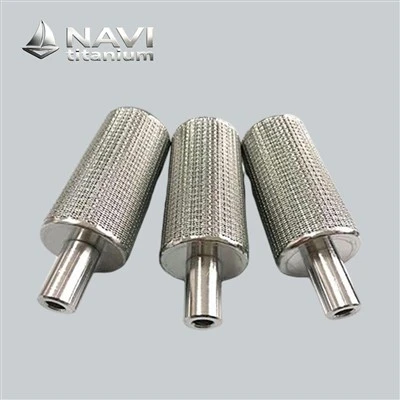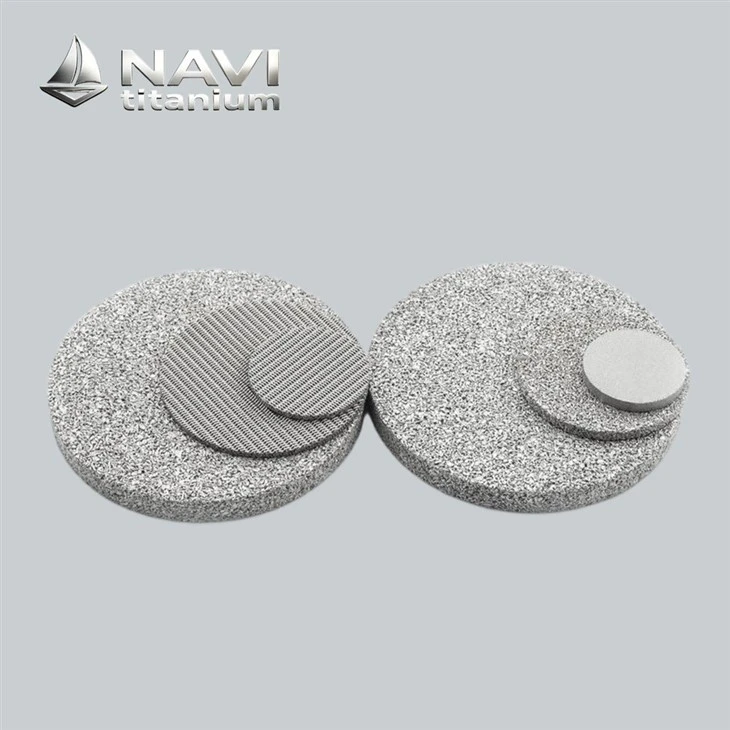
NAVI Titanium produces the sintered disk as a round porous metal plate formed from powder fused grain to grain, ready to drop into a standard housing. Buyers always ask a thing: what stops leaving the budget? Disposable membrane packs, the labour of changing them, and the disposal fee on each spent element. NAVI Titanium disk that is backwashed or regenerated removes those, so cost per treated cubic metre drops, reorder cycles lengthen, and stores carry one repeatable part instead of several.
Solution of NAVI Titanium
Buyers rarely open with micron ratings; they ask whether the plate survives real chemistry at working temperature, and NAVI Titanium answers that first. Powder is graded, pressed and vacuum-sintered grain to grain, so the disk resists acid and alkali attack, stays biocompatible, and holds an evenly distributed, tunable pore network. Since pore volume and thickness are fixed during pressing, filtration, air permeability and flow follow the duty. The table below lists what we hold.


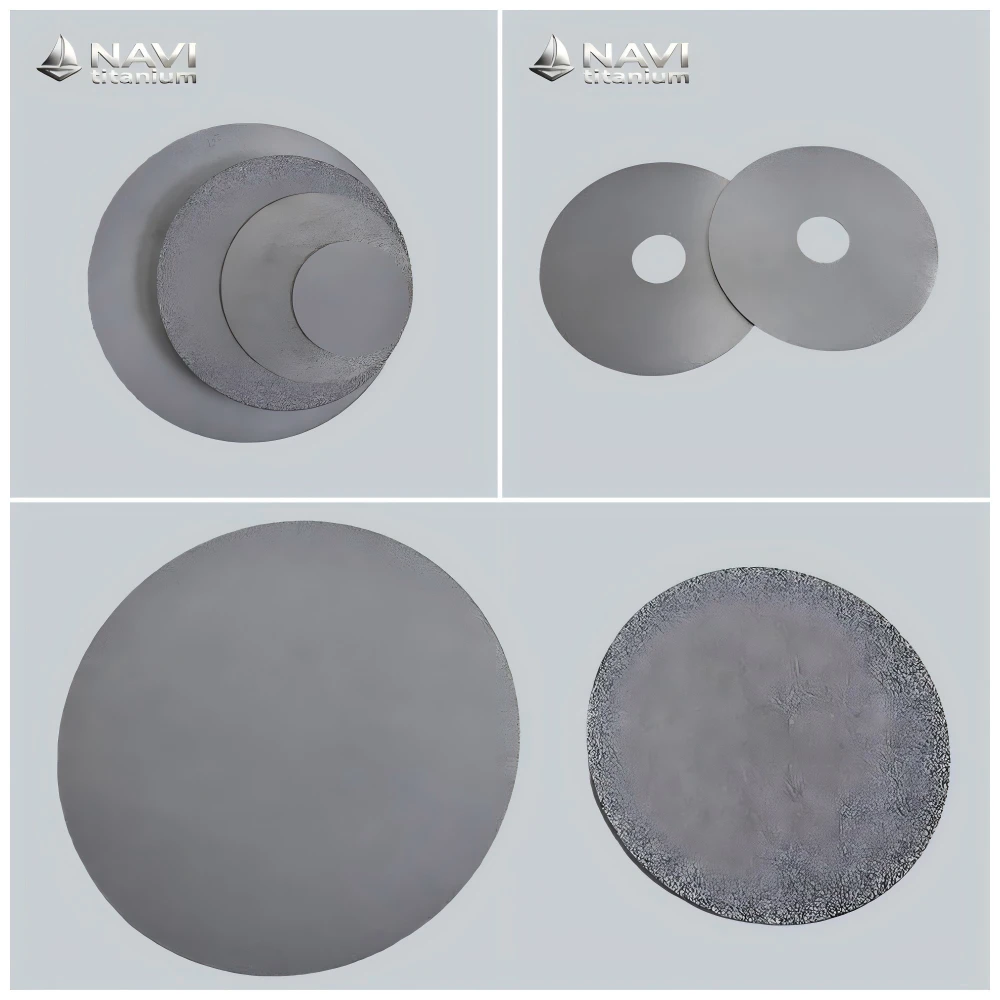
Disks, rings, conical sections, stepped plates carrying two diameters, hemispherical caps and rectangular panels all run on the same tooling. Send a STEP or DWG file and NAVI Titanium will follow it: bolt-hole circles, welded bosses, threaded spigots, locating tabs, gasket grooves.


Application
Two failure modes push buyers back to the market: media that sheds particles downstream, and media that blinds and halts the shift. NAVI Titanium sintered disk answers both, since its pore path is fused metal rather than wound fibre, and fouling is reversed by backwashing. Wear then shows as a trendable pressure rise, not a tear that releases debris into product.
Pharmaceutical and Bioprocessing Lines
Solvent streams, fermentation broths and buffer solutions all reach a polishing step where a failed filter costs a batch rather than a cartridge. NAVI Titanium supplies sintered discs in 316L and titanium for those steps: no fibre migrates into an API stream, and no binder is present to swell in ethanol or acetone. Grade selection follows the stream: 316L for neutral and alkaline service, titanium where chlorides appear.
Powder grains are fused directly, so 1–2% caustic, hot water for injection and steam at 121 °C can be cycled through the same plate during validation without a measurable shift in bubble point. Each disk ships with a heat number tied to its powder lot and furnace cycle, and EN 10204 3.1 certificates, roughness records and extractables data slot straight into IQ and OQ files. Disks arrive as single plates, stacked packs, or welded baskets that lift out for autoclaving.


Food and Beverage Processing
Hot syrup, edible oil, brewery wort and carbonated water share one trouble: organic fouling that blinds a filter in the middle of a production run. NAVI Titanium sintered disc handles that duty on a different clock. Its plate is food-contact grade, tolerates hot caustic and peracetic acid rinses, and takes steam sterilisation without deforming, so a cleaning cycle restores flow rather than ending the element's life. Disk area sets flow, not housing.
Grade choice follows the product: 316L for syrup and wort, titanium for brine and citrus streams. Because the disk is a single fused body, no wound layer unwinds under pressure pulses and no adhesive seam softens at 80 °C. Plants running 24-hour campaigns keep two sets: one in service, one in the caustic bath. Disks are supplied polished to a cleanable finish, with gasketed or welded rims that stop bypass around the edge, where most plate filters fail inspection.
Purchasing guide

Quality control (QC)
Every disk leaves NAVI Titanium's ISO 9001 works carrying a heat number stamped on the rim, traceable to its powder lot, pressing record and furnace cycle. Thickness, bubble point and permeability are logged before packing, and samples are held two years. Skip the marketing claim and check the numbers: press the button below to open our COA and inspection reports.

Manufacturing Process
NAVI Titanium produce high-precision sintered disks via standardized binder-free powder metallurgy and vacuum sintering. Strict raw material screening, precise pressing, controlled sintering and full performance testing ensure consistent pore size, stable structure and reliable filtration quality for industrial applications.

Step 1 - Powder Selection and Classification
Incoming 316L, 316L-LF, titanium Gr1/Gr2, Hastelloy and Monel powders are screened to a controlled particle band and checked for apparent density and flow. Particle band sets the final pore size, so the sieve record is the first quality gate. Chemistry is verified by OES against the mill certificate.

Step 2 - Blending and Charging
Powder is blended in a sealed mixer for a fixed cycle. No organic binder is added, which is why the finished plate carries no residue to outgas or extract during service. Blended lots are split into weighed charges matched to each disk's target mass and thickness.

Step 3 - Pressing
Charges are filled into a hardened die and compacted to a controlled green density; larger or stepped parts are consolidated by cold isostatic pressing so density stays even across the section. Even green density is what keeps shrinkage, and therefore pore size, uniform from centre to rim.

Step 4 - Vacuum Sintering
Green compacts are loaded on ceramic setters and fired under vacuum on a recorded ramp: dewaxing, then a hold at peak temperature where necks grow between grains. Peak temperature and dwell decide open porosity and strength, and both are logged per tray. Shrinkage is measured after firing to confirm the batch stayed inside tolerance.

Step 5 - Machining, Welding and Rim Finishing
Fired disks are turned to final diameter, faced to thickness and, where the design calls for it, argon-welded into a rim, boss or stacked assembly. Welded rims seal the edge against bypass, which is the leak path most often found on plate filters during inspection.

Step 6 - Pore Verification, Cleaning and Packing
Each disk is bubble-point tested, permeability checked, and thickness recorded against its heat number. Parts are ultrasonically cleaned, rinsed in deionised water, dried and sealed in clean-room film. Retained samples from the same tray are archived for two years.
Technical Data of NAVI Titanium Sintered Disk
The two tables below are working figures drawn from recent production batches at our works. Treat them as reference values and a starting frame for sizing conversations, not a performance guarantee: final pore size, pressure limit and corrosion behaviour all depend on your medium, temperature and cleaning cycle. NAVI Titanium supplies sintered disks in multiple alloy grades, we confirm every figure against the actual duty before quoting starts.
NAVI Titanium Sintered Disk
|
Parameter |
316L Sintered Disk |
Titanium Gr1 Sintered Disk |
|
Sintered media |
316L / 316L-LF stainless |
Titanium Grade 1, Grade 2 |
|
Retention rating |
0.5 – 200 µm |
0.5 – 100 µm |
|
Outside diameter range |
10 – 300 mm |
10 – 250 mm |
|
Thickness range |
1 – 10 mm |
1 – 8 mm |
|
Edge configuration |
Plain, welded rim, gasketed, stepped |
Plain, welded rim, bolt-hole circle |
|
End fitting |
Spigot, thread, flange, none |
Spigot, thread, none |
|
Temperature in service |
up to 600 °C |
up to 350 °C |
|
Differential pressure limit |
0.8 MPa |
0.6 MPa |
|
Apparent density |
3.8 – 5.2 g/cm³ |
2.4 – 3.4 g/cm³ |
|
Media compatibility |
Alkali, most organics, steam |
Chlorides, seawater, oxidising acid |
|
Regeneration method |
Backwash, ultrasonic, caustic, thermal |
Backwash, ultrasonic, nitric acid |
|
Industries served |
Food, chemical, water, pharma |
Chlor-alkali, marine, hydrogen, plating |
Wear and Replacement Comparison in Continuous Duty
|
Item |
Sintered Disk (316L) |
Woven Mesh Pack |
Ceramic Disc |
Disposable Membrane |
|
Backwash cycles before renewal |
1,500+ |
300 |
700 |
not regenerable |
|
Abrasion loss, mg per 1,000 cycles |
4 |
22 |
9 |
n/a |
|
Pressure-drop drift after six months |
+6% |
+31% |
+14% |
replaced twice |
|
Renewals per year, single duty |
0.4 |
3 |
1 |
12 |
|
Hazardous waste generated, kg/year |
2 |
27 |
11 |
96 |
|
Cost index over three years |
100 |
178 |
141 |
265 |
NAVI Titanium Manufacturing Lines
Field Note: A Wet Chemicals Line in Penang
A specialty chemicals plant outside Penang was changing disposable membrane packs every eleven days on an etching-grade filtration skid. Twelve change-outs a year meant twelve purchase orders, twelve disposal manifests and roughly forty hours of technician time, most of it spent on gasket seating rather than filtration. NAVI Titanium supplied trial sintered disks in 316L-LF at 5 µm, sized to drop into the existing housings with no adapter. Fouling was removed by a caustic backwash at shift end. The plant logged pressure drop weekly; after nine months the disk still returned to within 8% of its clean differential pressure, and the membrane purchase line disappeared from the budget. The plant's own figures put consumable spend on that skid down 71% in the first year. The follow-up order covered three more skids, and the buyer now holds two disk sets per skid as standard practice rather than a carton of consumables.


What an Audit Actually Sees
Buyers who visit before ordering tend to ask the same three questions, so the factory is arranged to answer them without a slide deck. First, traceability: every green compact carries a tray number that follows it through firing, machining and testing, and the heat number stamped on the finished rim resolves to a powder mill certificate, a furnace chart and a bubble point record. Second, measurement: the works holds ISO 9001 certification, and calibration status is visible on the gauges used for bubble point, permeability and thickness. Visitors may pull any archived tray themselves. Third, repeatability: retained samples from past trays are shelved by date, so a reorder from two years ago can be compared with the batch on the bench. Third-party reports on chemical composition, pore distribution and corrosion rate are available on request. Nothing here is prepared for a visit; it is simply how the batches are run.
Voices From the Line
"We expected the trial disks to match the sample and then drift on the repeat order. They did not. Bubble point on the second batch sat within 4% of the first, which meant we did not have to reopen a validation file." - Process engineer, fine chemicals manufacturer, Kansai. "Our maintenance team was sceptical about cleaning a metal plate instead of throwing one away. After the first backwash they stopped ordering consumables for that skid entirely." - Maintenance supervisor, desalination pretreatment plant, Gulf region. "The welded rim was the detail that mattered to us. Our previous plates leaked around the edge, not through the media." - Project lead, water treatment OEM, Netherlands. "Two years and three repeat orders later, we have not rewritten a validation document." - Procurement manager, specialty gas, Ontario. Feedback of this kind clusters around three themes: batch-to-batch consistency, regeneration that actually restores flow, and edge sealing that survives thermal cycling.

FAQ
How long does a sintered disk last, and when should it be replaced?
+
-
Service life is set by fouling, not by calendar time. Track differential pressure at fixed flow: once a cleaned disk cannot return to within 15–20% of its clean pressure drop, the pore path is blocked and renewal is due. Continuous duties run three to seven years.
What should never be used to clean the disk?
+
-
For 316L, avoid hydrochloric acid and chloride-bearing pickling agents, which pit stainless. For titanium, never use hydrofluoric acid or dry chlorine gas. Steel brushes and needles destroy the surface pore mouths, so use ultrasonic baths, backwash or approved chemistry. Both grades take caustic, nitric acid and steam; check the chart first.
Will it fit my existing housing, metric or inch?
+
-
Disks are made to your drawing, so both systems are covered: metric bores, inch bolt circles, DIN, JIS and ANSI flange patterns, NPT or BSP threads. Send housing dimensions and a photo of the seat; we confirm the gasket groove depth before tooling. Gaskets can be supplied to match your stock.
Which documents come with the shipment?
+
-
Standard paperwork includes EN 10204 3.1 mill certificates, packing list and heat-number traceability. Certificates carry the same heat number as each disk, so paper matches metal. On request we add RoHS and REACH compliance statements, FDA 21 CFR material declarations, ISO 10993 biocompatibility data and fumigation-free wooden case declarations required for customs clearance.
Can I trial before committing, and what is the lead time?
+
-
Trial disks are produced on the same route as production parts, so results carry over; one to three pieces are normally accepted. Standard sizes ship in 10–15 days, drawing-based shapes in 20–30 days including tooling. Tooling is charged once. Repeat orders can be held as consignment stock.
Hot Tags: sintered disk, China sintered disk manufacturers, suppliers, factory, coarse pore metal filter disc, porous metal filter media, porous metal filter plate, Sintered Bronze Fuel Filter, Sintered Copper Filter, Sintered Filter Plate