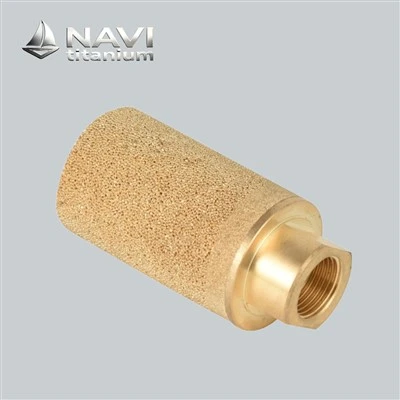
NAVI Titanium defines sintered bronze filter cartridges as one tin-bronze tube whose wall is both barrier and structure, with no wound fibre, no resin, and nothing shed downstream except metal. NAVI Titanium price three things in that construction: ends formed together with the body, so assembly labour leaves your line; a unit cost sitting below stainless in comparable duty; and a part restored rather than discarded, which removes the recurring consumable spend that never appears on a purchase order.
Solution of NAVI Titanium
NAVI Titanium fuses graded tin-bronze feedstock into each cartridge under a controlled sintering cycle, then sets the void network to the duty: precision filtration, gas diffusion, fluid separation, electrochemical and biomedical rigs. Voids stay connected lot after lot, so acid and alkali contact does not blind them and back-flushing restores conductance instead of ending service; a fouled cartridge cleans in place rather than being scrapped. Filtration rating, air permeability and flow are tuned to your figures, never lifted off a sheet, and confirmed by direct measurement before final release. Grades ordered most sit in the Sintered Metal Filter table below.



Straight tubes, domed thimbles, stepped bodies carrying two diameters, cones, threaded breather plugs and flanged assemblies are all standard output at NAVI Titanium. Bronze cuts freely, so NPT, BSP or metric threads and their sealing faces are produced directly on the body rather than added later. Send a three-dimensional file and we will quote the geometry you drew, not the closest stock shape.


Application
Both fields below - fuel gas safety devices and compressed air equipment - share one demand that polymer media repeatedly struggle with: geometry must survive the hour something goes wrong. Pleated paper chars, and a plastic core softens, where a NAVI Titanium bronze body absorbs the event and stays sealed while hot. Pore class, thread form and mounting method are settled only after that.
Flame Arresters and Flashback Protection on Fuel Gas Lines
Bronze conducts heat roughly eight times faster than stainless steel, and that single property is why gas equipment makers build arresters from it. A flame front entering the wall loses heat into the metal faster than the reaction can supply it, so the front dies inside the channels instead of travelling upstream. Gas suppliers, LPG filling stations and burner makers fit these bodies at cylinder outlets, regulator inlets and vent stacks, where a plastic guard simply melts.
Because the wall also filters, one part does two jobs: it stops particles that would otherwise foul a nozzle, and it arrests a returning flame. Specify any of these and tell us the gas group and maximum experimental safe gap you must satisfy - those two numbers fix channel size and wall thickness in one calculation. NAVI Titanium's arrester bodies come from one declared powder lot, since mixed reclaimed feedstock gives a wall nobody can certify.


Pneumatic Silencers, Breather Vents and Flow Control Elements
Walk through any assembly plant and the noisiest point is usually an exhaust port venting compressed air to atmosphere. NAVI Titanium sintered bronze filter cartridges threaded straight into that port spreads the discharge across its whole surface, cutting perceived noise while still passing the flow the valve needs, and catching oil mist before it reaches the shop floor.
The same parts serve as reservoir breathers, keeping dust out of gearboxes and hydraulic tanks while equalising pressure, and as deliberate restrictions that set cylinder speed without a separate valve. Their advantage here is machinability: hex heads, spanner flats and fine threads are turned in one operation, so the part installs with a spanner rather than a clamp and bracket. Give us working pressure, permitted sound level and allowed pressure loss, and we will return the pore grade and thread that meet all three. Threaded bodies also survive the wrench torque that cracks plastic silencers.
Purchasing guide

Quality control (QC)
Every sintered bronze filter from NAVI Titanium clears ISO 9001 release only after tin content, conductance at stated differential, thread gauge acceptance, external collapse and surface condition are filed against its batch. Nothing is ever averaged across lots. Press the button below to open the COA and read the values actually recorded for the batch held against your order.

Manufacturing Process
NAVI Titanium's sintered bronze filter cartridges is manufactured through a controlled metal powder sintering process. Bronze powder is precisely graded, uniformly mixed, and pressed into molds, then sintered at high temperature in a vacuum or protective atmosphere. During sintering, powder particles bond into a rigid, porous structure with distributed, controllable pores. The cartridges are then cooled, machined, cleaned, and inspected for pore size, permeability, and mechanical strength. This process delivers strong, corrosion-resistant, biocompatible porous bronze filters suitable for precision filtration, electrochemistry, biomedicine, and high-temperature fluid separation. Customized pore sizes, dimensions, and flow rates are available.


Invisible Interface Between Media and Mechanical Systems
What follows is NAVI Titanium answers the question buyers ask once quotations land: is bronze actually the right metal for this stream, or should it be stainless, titanium or polymer? Rows weigh service behaviour, not headline price, covering the media that end bronze early. Figures come from production records, indicative only; numbers governing your order sit on the drawing you approve before release.
NAVI Titanium Sintered Bronze Filter Cartridges - Media Comparison for Gas and Vapour Duty (Reference Only)
|
Consideration |
Sintered Bronze |
Sintered 316L |
Sintered Titanium |
Polymer (PE) |
|
Thermal conductivity |
Very high |
Low |
Low |
Very low |
|
Flame quench behaviour |
Effective arrester |
Poor |
Poor |
Melts |
|
Machinability of threads |
Excellent, cheap |
Moderate |
Slow, costly |
Poor |
|
Ammonia and amines |
Avoid |
Suitable |
Suitable |
Suitable |
|
Oxidising acids |
Avoid |
Suitable |
Suitable |
Limited |
|
Hydrogen sulphide service |
Avoid |
Limited |
Suitable |
Suitable |
|
Continuous temperature ceiling |
200 °C |
500 °C |
400 °C |
80 °C |
|
Relative unit cost index |
1.0 |
1.8 |
4.5 |
0.4 |
|
Typical end of life |
Deep blinding |
Weld damage |
Embrittlement |
Deformation |
NAVI Titanium - Engineered for Longevity, Maintained for Life
Field Record - A Gas Appliance Plant in Surabaya
An Indonesian manufacturer of LPG regulators had been stacking stainless mesh discs inside a machined holder to meet its flashback requirement. The assembly held certification, but it used seven parts, three seals, and a torque step that the line occasionally missed, and the mesh deformed during ultrasonic cleaning often enough to trigger replacement. Their engineering team sent us the gas group, required safe gap and port thread; NAVI Titanium returned sintered bronze filter cartridges meeting all three, built to the existing thread so no housing change was needed. Sample quantities were machined and shipped within the month for verification testing on their own rig. The conversion removed seals and the torque step together, and cleaning moved to a solvent rinse that any operator can perform. Their buyers also noted that unit cost fell across the assembly, even though bronze is not the cheapest metal per kilogram, because one part replaced seven.


The Dossier Behind Each Shipment
Distributors and OEM buyers rarely argue about the part; they argue about whether the next shipment matches the last one. NAVI Titanium's answer is documentation, not adjectives. Every batch carries an alloy report with tin content read rather than assumed, a conductance figure taken at a stated differential instead of an unspecified laboratory condition, and a thread result recorded as gauge acceptance rather than a visual impression. Consolidation profiles are stored against the batch code, so a repeat order placed two years later runs against the original record. Third-party inspection is welcome before shipment, and buyers appointing their own inspector receive the same file we use internally. Where a hazardous-area certificate is required for arrester duty, we state plainly which standards our geometry can be tested against and which evidence must come from end product certification rather than from us - a boundary we draw before an order, not after a claim.
Voices From Buyers
Feedback reaches NAVI Titanium from three buyer groups, and each one worries about something different. Maintenance engineers ask whether cleaning actually restores flow, and the answer they care about is measurable: conductance checked before and after a solvent cycle tells them whether the sintered bronze filter cartridges return or go into scrap. Purchasing teams ask whether the second shipment behaves like the first, which is why batch-level recording matters more to them than any single test result. OEM designers ask whether the geometry they drew can be made at volume, and the honest answer depends on thread complexity far more than on porosity. Across those groups the recurring comments concern installation time saved when the thread arrives already formed, and the absence of loose components at the point of use. Several of these customers now order to drawing rather than to part number, because the drawing captures suction conditions no catalogue line could capture.

FAQ
1. How long does a bronze cartridge last, and when should we change it?
+
-
Service life depends less on hours than on what collects in the wall. Measure differential at a fixed flow: once cleaning restores under roughly seventy per cent of original conductance, replacement becomes cheaper, because more cycles spend labour without recovering throughput. On clean compressed air these bodies often run for years.
What may we clean it with, and what will destroy it?
+
-
Solvent soak, ultrasonic baths, warm detergent and reverse flow are safe, and most routine fouling yields to one of them. Never use nitric acid or ammoniated cleaners: both attack the alloy rather than the deposit, leaving damage no inspection can quantify. Always dry the body afterwards; put away damp, it oxidises inside its own channels and returns with conductance permanently lower. Steel brushes are banned.
Which thread do you supply, and does ours need certification for hazardous areas?
+
-
European customers commonly specify BSP, North American ones NPT, and several Asian markets metric fine; we machine all three and verify each with go-and-no-go gauges. We supply geometry, alloy composition and flow records to your certifying body, but will not claim a certificate we do not hold. If port drawings exist, we match them rather than argue over standards.
Will bronze contaminate drinking water, food lines or sensitive product?
+
-
Treat bronze as an industrial medium, not a hygienic one. Copper ion release excludes it from potable water and from most food-contact applications, and pharmaceutical users ban copper alloys because traces poison catalysts. Where your stream touches either category, specify sintered 316L or titanium instead and we say the same unprompted.
How is quality held between repeat orders?
+
-
Each batch ships with five entries: alloy reading, conductance at stated differential, thread gauge acceptance, external collapse and surface condition, stored against the batch code. A reorder is matched back to those numbers rather than to a part description, so the second shipment follows the first one's record. Should a lot drift outside the agreed window, we raise it before packing and remake.
Hot Tags: sintered bronze filter cartridges, China sintered bronze filter cartridges manufacturers, suppliers, factory, industrial metal filter cartridge, open pore porous metal filter, Sintered Bronze Sheet, Sintered Metal Tube, Sintered Stainless Filter, Sintered Stainless Steel