NAVI Titanium defines a bronze muffler as a porous body threaded straight onto an exhaust port, breaking one hard jet into thousands of small ones so the air leaves quietly instead of cracking like a whip. Commercially NAVI Titanium muffler answers the three questions buyers raise: whether the port will meet the workplace noise limit enforced at their site, whether added back pressure will slow the cylinder, and whether the body survives the wrench torque and solvent splash that break plastic.
Solution of NAVI Titanium
NAVI Titanium produces these porous bodies by a proven powder consolidation route: graded tin-bronze grains bond to one another under a thermal cycle, with no binder and no fibre, so channels stay open and uniform. The material resists acid and alkali, is biocompatible, and serves precision filtration, electrochemical and biomedical work as well as high-temperature fluid separation. For muffler duty we tune the structure to air permeability and flow, not to retention, matching pore grade to your noise target and your permitted back pressure. Custom sizes follow your drawing. The table below lists typical figures.



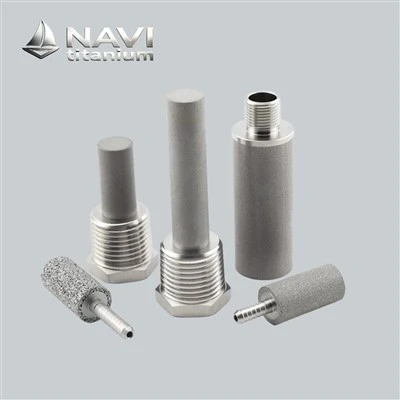
Shapes cover the pneumatic forms buyers ask for most: hex-body plugs, round barrels, domed caps, flat pads, elbows and stepped bodies carrying two thread sizes. Thread systems span NPT, BSP taper and parallel, and metric fine pitch. Send a port drawing or one used sample, and the profile is machined as specified by NAVI Titanium, including spanner flats and shoulder length that seals.


Application
Both duties below are bought for the same reason: somebody complained about noise. Behind that complaint sits an engineering trade rather than a specification - quieter means more restriction, and restriction costs cycle time or throughput. Sintered bronze is where that trade is usually cheapest to settle in practice, because a NAVI Titanium bronze muffler is rigid, machinable and cleanable all at once.
Pneumatic Valve and Cylinder Exhaust Silencing
Walk the length of an assembly line and the loudest points are almost always exhaust ports, not motors. Compressed air released from a valve in a few milliseconds expands violently, and that sharp crack is what operators hear all shift.
A porous body screwed into the port does not absorb sound like foam; it splits the jet into countless small streams, so the energy spreads across a broader spectrum instead of arriving as one peak. The practical question is never "how quiet can you make it" but how much back pressure your cylinder tolerates, because every decibel is bought with restriction.
NAVI Titanium therefore ask for three numbers before quoting: port thread, flow per cycle, and the slowest acceptable actuation time. With those we size pore grade and body area together. Bronze also survives being tightened properly, unlike plastic bodies that split at the shoulder and disappear into the machine.


Compressor, Vacuum Pump and Blower Intake and Exhaust
Larger machines bring a different problem entirely: pulsation. A reciprocating compressor or a vacuum pump discharges in pulses, and the noise that travels furthest is the low-frequency component a simple diffusion element barely touches.
Here surface area matters more than pore grade, so the answer is often a bigger body, a flanged pad, or several units on a manifold instead of a finer media. Intake duty adds a second job, since the same element must stop dust entering a machine that costs far more than the silencer.
Discharge temperatures on these machines also rule out polymer bodies, which is NAVI Titanium where bronze earns its place: it holds geometry at temperatures that soften plastic, and it can be cleaned of oil mist rather than replaced. Tell us flow, pressure, temperature and whether the duty is intake or discharge, and we will propose a size that you can verify on your own meter.
Purchasing guide

Quality control (QC)
Every muffler from NAVI Titanium clears ISO 9001 release only after alloy identity, pore grade, flow at stated pressure, thread gauge and surface condition recorded against its batch. Sound figures are measured on our rig, not copied from a catalogue. Press the button below to open the COA and read the values held for the batch against your order.

Manufacturing Process
Sound performance is not a finishing step added at the end; it is set by six adjustments NAVI Titanium makes along the line. Each one moves either attenuation or flow, and each is recorded so a repeat order behaves like the first.
| Step | Process | Key Control / Verification | What It Secures |
|---|---|---|---|
| 1 | Powder Grading & Selection | Tin-bronze (Cu-Sn) powder is gas-atomised and classified to a locked particle cut before forming | Sets the pore size that governs sound level and flow |
| 2 | Compaction / Forming | Green body is die-pressed for standard shapes, or isostatically pressed for longer thin-walled bodies; wall uniformity checked on the green body | Uniform porosity and density, no weak band |
| 3 | Sintering | Controlled-atmosphere high-temperature sintering bonds the powder grain to grain; temperature, dwell and atmosphere are logged per load | Rigid, open, binder-free porous structure |
| 4 | Machining | NPT, BSP or metric threads, hex heads, spanner flats and flanges are cut directly on the sintered body | One-piece body, no added-on seals or joints |
| 5 | Cleaning & Deburring | Swarf and surface residue removed; pores rinsed so they stay open | Clean surface, full open porosity |
| 6 | Inspection & Release | Air permeability / flow checked, thread gauge acceptance recorded, dimensions and sound performance verified; batch released under a code | Only complete, verified batches ship |
Bronze Muffler - Shape Options
NAVI Titanium sintered bronze mufflers and silencers are offered in a range of standard shapes, each designed to suit a different port, space and noise requirement. All are machined from the same porous body, so the same flow, sound-spreading and chemical resistance apply whatever the form. The table below lists the common shapes and where each fits best.
| Shape | Description | Typical Use |
|---|---|---|
| Straight Tube / Cylindrical | Straight body with NPT, BSP or metric thread at one end, screwed directly into the exhaust port | Most common general-purpose exhaust silencing |
| Domed / Hemispherical | Rounded discharge end that spreads flow across the surface | Lower perceived noise where space allows |
| Stepped Body (two diameters) | Two diameters with a shoulder for positive location and sealing | Mounting with a definite stop |
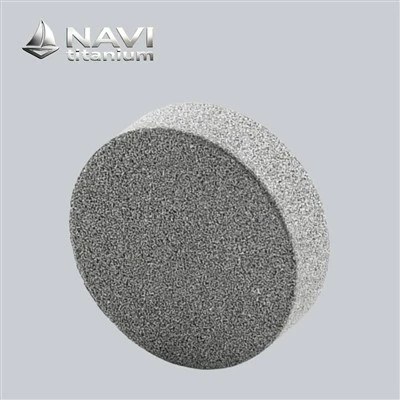
| Button / Disc | Flat disc with thread, low profile | Compact installation points |
| Conical / Tapered | Tapered body for flow guidance | Specific port or mounting geometry |
| Threaded Breather Plug | Threaded plug combining vent and breather duty | Reservoir breathers and valve vents |
| Flanged Assembly | Flanged end for bolted mounting | Large bore, serviceable installations |
| Cartridge | Cylindrical element mounted inside a housing | Integrated filter-and-silencer duty |
NAVI Titanium - Evidence From Lines Already Running
Field Record - An Assembly Line Under a Noise Limit
A machinery builder in Brno had a safety officer, not a buyer, driving the enquiry. Their assembly cells measured above the exposure action level their country enforces, and the exhaust ports on fixture cylinders were the worst contributors, so the fix had to be auditable rather than cosmetic. They sent port thread, cycle count and the slowest actuation time the cell could tolerate. We sized pore grade against that timing rather than against the highest attenuation we could offer, which meant deliberately leaving a few decibels on the table to protect cycle time.
NAVI Titanium bronze muffler samples went on one cell first and were measured with their own meter before the rest of the line was converted. The cells then passed the survey, and maintenance inherited a part cleaned instead of replaced. Their safety officer accepted it because it was measured with their own instrument. Repeat orders run to the same drawing.


How We Measure, and Why Numbers Differ
Attenuation figures between suppliers rarely compare, and the reason is rarely dishonesty: nobody states the conditions. A reading taken ten centimetres from the port looks better than one taken at a metre, and a figure quoted without inlet pressure or flow is not a measurement at all. NAVI Titanium publish ours with pressure, distance, flow band and background subtraction stated explicitly, because a buyer who cannot reproduce a number at all has no reason to believe it.
Our rig holds a fixed microphone distance and a logged inlet pressure, and runs the same reference plastic body before each batch so drift in the instrument shows up before it reaches a customer. Anyone is welcome to repeat the measurement on delivery using their own meter; where results differ we would rather reconcile the method with you than argue about the decibel. Test records for a batch can be supplied with the shipment.
What Two Buyers Reported Back
A distributor stocking pneumatic accessories in the Gulf put the commercial case plainly: the plastic bodies they sold came back cracked at the shoulder often enough to cost them more in credit notes than the margin they earned, and NAVI Titanium bronze mufflers removed that line from the ledger. Their counter staff noticed something smaller too - the threaded body could be tightened properly without the customer asking whether it would split.
On the user side, a maintenance technician at a packaging plant described the change in unglamorous terms: cylinders stopped slowing down unexpectedly, because the element blocked gradually and visibly rather than fracturing and disappearing. He also noted that cleaning takes a solvent rinse and a dry-air blow, which fits between shifts. Neither of these is a technical triumph, and both are reasons people reorder. Returns at the counter fell away, and that is how a distributor decides what stays on the shelf.

FAQ
1. How many decibels will it actually reduce, and why do suppliers quote different numbers?
+
-
Because test conditions differ. Attenuation depends on inlet pressure, flow, microphone distance and background noise, and a figure quoted without all four is marketing rather than measurement. Ours state pressure, distance and flow band, and we run a reference plastic body before each batch so instrument drift shows up first. Ask for distance and pressure behind any figure. Expect somewhere around 15 to 32 dB(A), with the higher numbers only where back pressure is no constraint on the machine.
2. Will it slow our cylinders down?
+
-
Any silencer adds restriction, so the honest answer is yes, slightly. What matters is whether it stays inside your cycle time. Give us port thread, flow and the slowest acceptable actuation time, and we size grade and body area to fit instead of selling the quietest element we make. Where a cycle is already tight, a larger body buys more attenuation than a finer grade ever does. Tell us the actuation time you cannot exceed and we will respect it.
3. It has gone quiet but the machine is sluggish - is it blocked?
+
-
Usually yes. Oil mist and airborne dust close the surface gradually, and the symptom is slower actuation long before anything looks dirty. Remove the body, rinse in solvent, blow dry air outward, then refit; most of the flow returns if the blockage is surface oil. If it does not, replace it, because a blocked muffler keeps raising back pressure. Never brush the surface, which smears metal across the pore mouths. Keep one spare per port and swap it at change-out.
4. Can we use bronze everywhere, or are there prohibited gases?
+
-
Not everywhere. Never fit copper alloys to acetylene service, because copper acetylide forms and is shock-sensitive; that single rule keeps bronze out of welding gas and acetylene generation sets. Avoid ammonia, amines and oxidising acids too. For food-contact or hygienic cleanrooms specify stainless from us instead. Bronze suits compressed air, inert gas and most ordinary industrial atmospheres, which is where nearly all muffler duty sits. Where a site runs both fuel gases, we mark our bronze parts against acetylene use.
5. Which thread do you supply, and can you match a sample?
+
-
NPT for North America, BSP taper or parallel for Europe and much of Asia, and metric fine where machines specify it. Send a drawing or one used part and we reproduce thread, shoulder length and spanner flats exactly, including the shoulder stop that decides whether the body seals at all. Samples are made on production tooling, so repeat orders match the piece you approved, not an approximation of it. Distributors can also have neutral packing and their own part markings.
Hot Tags: bronze muffler, China bronze muffler manufacturers, suppliers, factory, Bronze Filter Element, inline sintered porous metal filter, instrumentation porous metal filter, Sintered Bronze Filter Element, Sintered Metal Disc, Sintered Nickel Filter