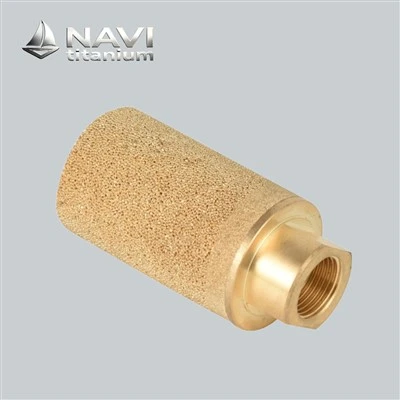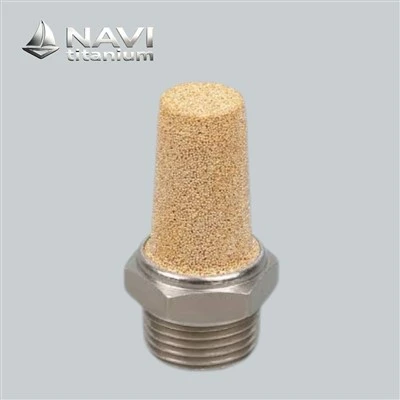


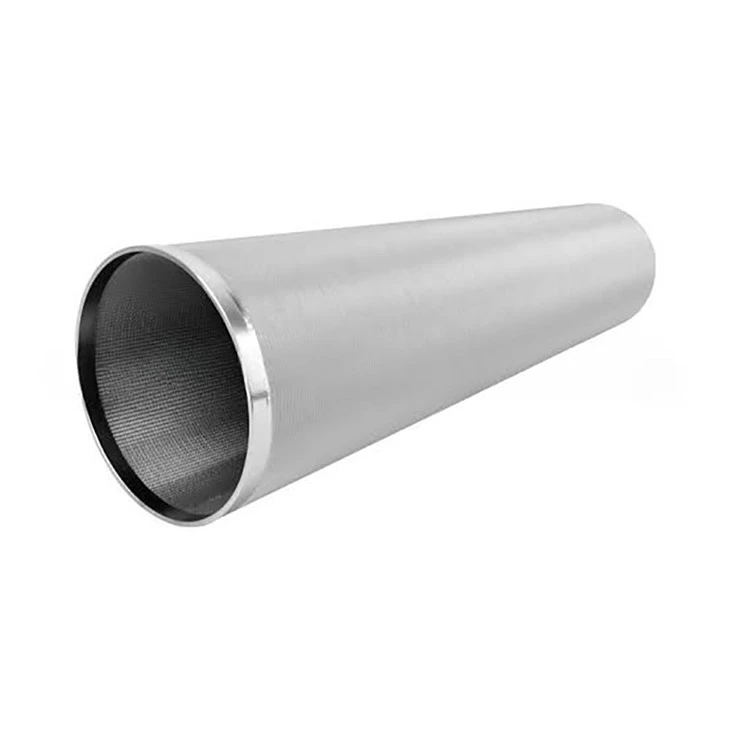
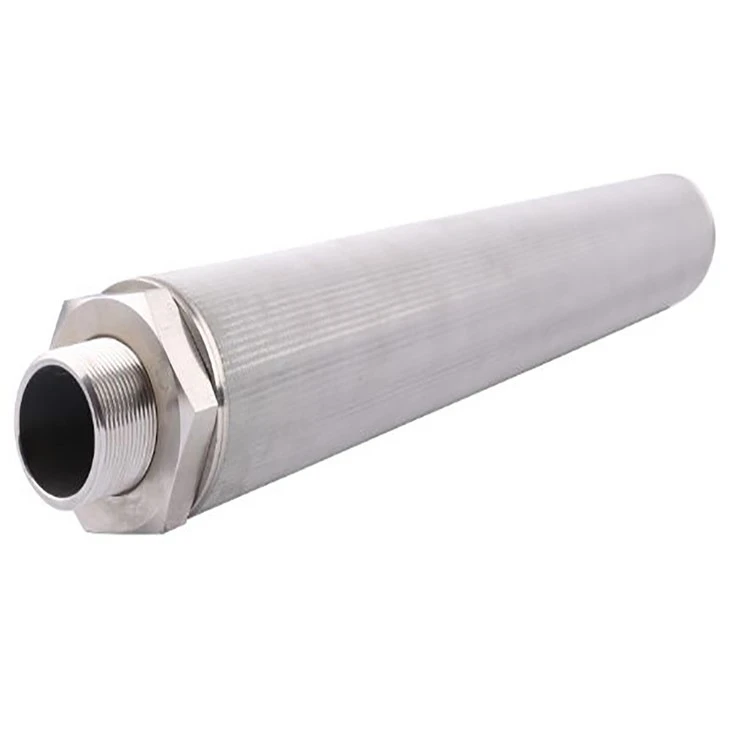

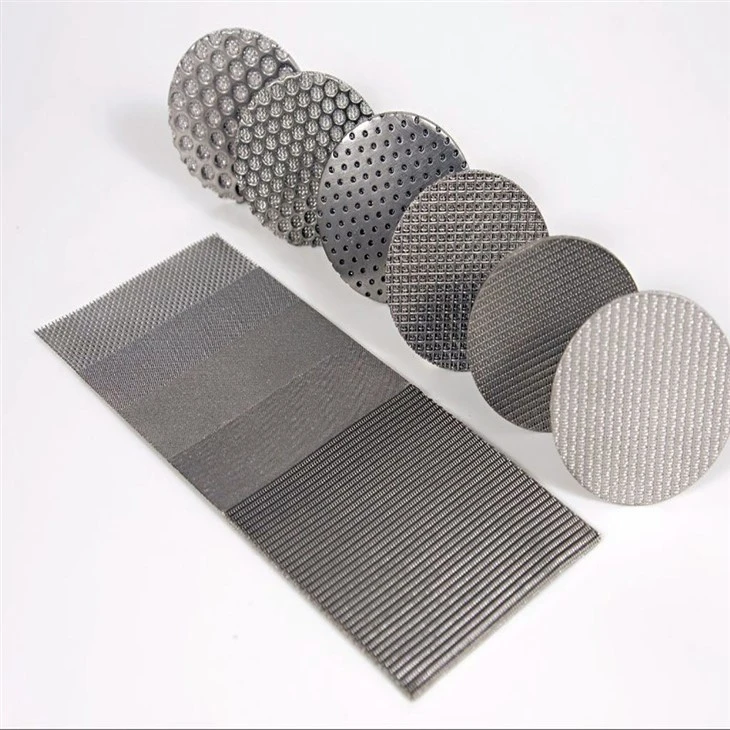
NAVI Titanium sintered mesh filter is built for gas-handling assemblies where cleanliness, consistency, and predictable pressure response matter. It can be fitted upstream of valves, regulators, vacuum pumps, mass-flow controllers, gas cabinets, and analytical instruments, helping protect sensitive hardware during operation. Attention to weld integrity, edge finishing, traceability, and inspection records provides confidence.
Solution of NAVI Titanium
For mesh-based filtration structures, NAVI Titanium combines woven-wire architecture with controlled thermal consolidation to create multilayer configurations with defined openings, mechanical integrity, permeability, and cleanability. Different weave patterns, layer counts, alloy grades, and forming routes can be coordinated according to filtration precision, pressure conditions, fluid characteristics, and installation geometry. This approach is particularly relevant where a conventional single-layer screen cannot provide sufficient rigidity or service stability. The company currently lists multilayer configurations, including 3-layer, 5-layer, and customized structures, with opening ranges selected according to the intended duty.


NAVI Titanium presents a precision-formed porous metallic assembly intended for controlled gas purification and pressure regulation. Its layered configuration provides differentiated aperture distribution, supporting consistent flow characteristics under varying operating loads.


Application
NAVI Titanium sintered mesh filter enables controlled gas passage, particulate interception, and pressure management across semiconductor, vacuum, and pneumatic applications.
In semiconductor fabrication, NAVI Titanium open-cell metallic media serve as upstream and point-of-use barriers for process fluid stream, protecting deposition, etching, doping, and purge operations from particulate intrusion. Their value lies not simply in nominal aperture size, but in the interaction among aperture topology, permeability, particle interception, and pressure loss. A multilayer woven-and-sintered architecture can establish a graded passageway, where larger contaminants are arrested near the upstream region while finer particles encounter progressively smaller flow channels. This reduces the probability of premature surface blockage and helps maintain a more predictable pressure differential during extended service. For nitrogen, argon, hydrogen, and other process fluid stream, material selection must consider corrosion susceptibility, outgassing behavior, thermal exposure, and compatibility with cleaning protocols. Surface finish and fabrication precision are equally important because trapped residues can become secondary contamination sources. From a process-engineering perspective, the objective is therefore to achieve a controlled permeability regime rather than maximize particle retention alone. Properly specified media can support cleaner fluid stream distribution, more consistent chamber conditions, and improved protection of sensitive wafer-processing steps.

2. Vacuum & Pneumatic Systems

In vacuum and pneumatic systems, NAVI Titanium open-cell metallic media function as flow-conditioning and contamination-control interfaces positioned before valves, regulators, pumps, sensors, and actuators. Their interconnected passageways permit fluid stream transport while restricting particulate migration, making them useful where pressure stability and component protection must be maintained together. Unlike simple screens, a consolidated multilayer construction provides depth-based interception, so contaminants can be captured throughout the thickness rather than accumulating exclusively at the exposed surface. This characteristic can moderate localized blockage and preserve flow area under sustained loading. Selection should account for fluid stream composition, operating pressure, and the nature of expected contaminants. For pneumatic circuits, aperture distribution influences response time because excessive resistance can delay pressure equalization. In vacuum service, low outgassing and resistance to thermal cycling become especially significant. Consequently, specification should be based on permeability, retention efficiency, mechanical integrity, and system-level pressure behavior, enabling stable fluid stream transfer without imposing unnecessary energy demand or maintenance frequency.
Purchasing guide

Quality control (QC)
This filter element is manufactured from high-purity titanium metal, formed through a precision sintering process that creates a rigid, porous structure with controlled pore size distribution. The raw titanium powder and the resulting porous body are fully traceable through each production batch, with documented verification of chemical composition and physical properties at every stage.

Manufacturing Process
1. Wire Weaving
Selected alloy wire is woven into a controlled mesh pattern, with wire gauge, weave density, and opening geometry established according to the intended separation duty.
2. Layer Arrangement
Individual woven layers are aligned in a defined sequence. Different mesh grades can be combined to balance retention precision, permeability, and structural rigidity.
3. Thermal Joining
The aligned layers undergo a controlled thermal cycle that bonds intersecting wires and contact points while preserving the designed passage network.
4. Edge Forming
The consolidated structure is shaped to the required profile, followed by checks of opening uniformity, layer alignment, dimensional conformity, and surface condition before final preparation.
Export Documentation & Customs Clearance
For international orders, accurate export documentation helps procurement professional coordinate customs clearance, freight handling, and inbound receiving procedures. The Commercial Invoice should clearly identify the supplied items, quantities, unit values, total value, applicable trade terms, and other transaction details required by the destination country. The Packing List should correspond with the actual cargo and specify package quantity, net weight, gross weight, dimensions, and item distribution where applicable. For ocean transportation, the Bill of Lading provides shipment and consignee information, while an Air Waybill serves the corresponding role for air freight. These documents should be prepared according to the agreed order information rather than using generic descriptions. For B2B purchasers, consistency between commercial documents and the physical cargo is particularly important because discrepancies may cause additional customs inquiries, warehouse delays, or document amendments. Before dispatch, procurement professional can confirm the required document set, consignee details, product description, quantities, weights, and packaging information according to their import procedures.

Origin Certificates, Product Information & HS Code Verification

Depending on the destination market, NAVI Titanium an Certificate of Origin or other import-related documentation may be required to establish manufacturing origin or satisfy local customs procedures. Product information should remain consistent across the Commercial Invoice, Packing List, transport document, and supporting paperwork, including product name, quantity, material grade, intended use, net weight, gross weight, and number of packages. Particular attention should be given to the HS Code. It should not be assigned solely by searching a product keyword because classification can depend on the actual physical form, material composition, principal function, intended application, and customs interpretation in the importing country. Different jurisdictions may apply their own tariff schedules, explanatory notes, and classification practices. For this reason, procurement professional and their customs brokers should verify the appropriate classification before importation. Providing sufficiently precise product descriptions and technical information can help reduce ambiguity when the customs authority reviews the cargo. Where destination-specific certificates, declarations, or compliance documents are required, these requirements should be confirmed before order finalization.
Performance Indicators for Procurement & Integrity Control
NAVI Titanium's sintered mesh filter performance is evaluated through Bubble Point Pressure and Dirt Holding Capacity, providing buyers with practical indicators for pore-path consistency, contaminant loading behavior, maintenance intervals, and integrity acceptance.
Bubble Point Pressure provides procurement professional with a practical indication of the largest effective connected passage within a wetted open-cell assembly. During testing, the sample is thoroughly wetted and fluid stream pressure is gradually increased until a continuous stream of bubbles emerges through the relevant aperture pathway. A lower-than-expected bubble point can indicate an oversized passage, local defect, pore-size deviation, or inconsistency introduced during forming and finishing. Conversely, an unusually high result may suggest restricted passages or changes in the intended permeability range. For procurement teams, the value is therefore more useful when evaluated against an agreed specification rather than treated as an isolated number. Procurement professional can establish an acceptance range based on nominal aperture dimensions, material grade, thickness, and operating requirements, then compare test results across production lots. ASTM E3278 describes a bubble-point method for sintered mesh filter cartridges cloth; for other open-cell constructions, the applicable test method and acceptance criteria should be agreed separately. Recording test conditions alongside the result also improves traceability when comparing suppliers or investigating batch variation. NAVI Titanium can provide the relevant test information according to the agreed specification.

Dirt Holding Capacity

Dirt Holding Capacity describes how much contaminant a open-cell assembly can retain before reaching a defined pressure-drop limit under specified test conditions. For B2B purchasers, this metric can be more informative than a standalone particle-retention rating because it connects laboratory performance with maintenance intervals and operating expenditure. As particulate loading increases, available flow passages gradually become restricted, causing ΔP to rise. The resulting relationship can be evaluated as Particle Loading → ΔP Increase → Cleaning or Replacement Point. A higher capacity does not automatically mean better performance: procurement professional should compare capacity together with particle characteristics, target retention level, and terminal ΔP. Test results should therefore state the contaminant type, concentration, operating conditions, and endpoint used for measurement. This allows procurement teams to compare competing specifications on a consistent basis and estimate cleaning frequency, replacement intervals, and pressure-related energy demand. For continuous-duty systems, such data can also support preventive maintenance planning and help determine whether a selected grade is appropriately matched to the actual contamination burden. NAVI Titanium can provide relevant test information according to the agreed specification.
Welding, Machining & Forming Considerations
NAVI Titanium approaches secondary processing of sintered mesh filter assemblies according to both geometric requirements and pore-path preservation. Welding may involve TIG, laser, or resistance methods, with process selection depending on material grade, joint configuration, thickness, and allowable thermal exposure. Excessive heat input can alter local permeability, distort thin sections, or affect the region adjacent to the joint, so weld placement should preferably remain outside the active separation zone. Machining operations such as cutting, drilling, turning, and edge trimming require controlled feed rates and suitable tooling to minimize burr formation, deformation, and aperture blockage. For forming operations, including bending, rolling, deep forming, and pleating, deformation must be distributed without producing localized collapse, cracking, or excessive densification. Particularly for cylindrical or pleated configurations, the forming radius and compression ratio can influence effective passage geometry and pressure drop. After secondary processing, dimensional inspection should be combined with visual examination and, where specified, permeability or integrity testing. This approach helps confirm that the finished assembly retains its intended flow characteristics rather than achieving dimensional conformity alone.

FAQ
1. What pore-size ranges can be specified?
+
-
The pore range can be specified according to the required particle-retention level, fluid stream or liquid throughput, pressure drop, and physical dimensions. Buyers should not evaluate aperture size as an isolated figure because thickness, layer arrangement, and forming method can also affect actual flow passage.
2. Can the material be supplied in different shapes and dimensions?
+
-
Yes. Flat sections, discs, tubes, rings, cylinders, pleated forms, and other geometries can be considered according to the assembly requirements.
3. Can welding or machining be performed after forming?
+
-
Secondary processing may include TIG welding, laser welding, resistance welding, cutting, drilling, turning, edge trimming, bending, rolling, deep forming, and pleating. The appropriate method depends on material grade, thickness, geometry, and joint requirements. Particular attention should be given to heat input and mechanical deformation because excessive local heating or compression may alter flow passages.
4. How is bubble point pressure used for incoming inspection?
+
-
Bubble point pressure can be used as an integrity-related acceptance indicator when an appropriate test method and specification have been established. After the test piece is wetted, gas pressure is progressively increased until continuous bubbling occurs through the relevant passage. The measured value is associated with the largest effective connected opening under the specified test conditions.
5. How can dirt holding capacity be evaluated before bulk purchasing?
+
-
Dirt holding capacity indicates the quantity of contaminant retained before a predefined pressure-drop endpoint is reached. A meaningful comparison requires controlled test parameters, including contaminant characteristics, loading concentration, flow rate, initial pressure drop, and terminal ΔP.
Hot Tags: sintered mesh filter, China sintered mesh filter manufacturers, suppliers, factory, Porous Media Filter, Porous Metal Filter, Porous Metal Sheet, Sintered Bronze Filter Element, Sintered Bronze Muffler, Sintered Stainless Steel