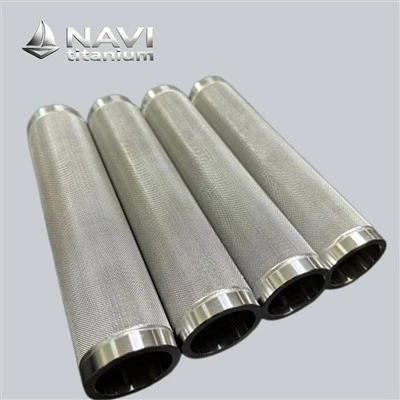
Sintered bronze filter disc from NAVI Titanium is a compact component formed from graded bronze powder through controlled compaction and thermal consolidation. Its rigid yet permeable body supports particle capture and measured media transfer in valve seats, threaded housings, air-control ports, manifolds, and instrument assemblies. We provide made-to-order diameters, thicknesses, opening ranges, and mounting formats to match specific equipment and working requirements.
Solution of NAVI Titanium
NAVI Titanium consolidates tin-bronze feedstock into these filter discs so void paths stay open across the whole face, not only at the center. Bronze turns cleanly, so unusual diameters and gauges arrive without a tooling charge, and sample discs leave inside the week. Give us retention rating, airflow and seat diameter; we quote a disc built to those numbers. The NAVI Titanium Sintered Metal Filter listing below sets out the grades held most often, indicative until confirmed against your drawing.


NAVI Titanium provides made-to-order discs with selectable diameters, wall thicknesses, opening ranges, and connection formats, supporting pneumatic devices, valve assemblies, manifolds, instrumentation, and other fluid-handling components.


Application
The flat profile of a sintered bronze filter disc makes it suitable for applications where installation space is limited and fluid must pass through a precisely defined interface. Rather than functioning only as a traditional separation unit, this compact structure often performs multiple engineering roles within a single assembly, including media conditioning, flow distribution, inlet protection, and exhaust regulation.
Compressed air exhaust must be released without generating excessive noise or unstable airflow. A rigid metallic element installed inside the silencer disperses the outgoing air through countless interconnected microchannels rather than a single unrestricted outlet. This controlled diffusion reduces discharge velocity, minimizes turbulence, and lowers acoustic intensity while maintaining sufficient exhaust capacity for valves, cylinders, and actuators operating under frequent switching cycles.
Another benefit of the flat configuration is its excellent installation flexibility. The unit occupies minimal axial space and can be secured with threaded caps, retaining rings, or simple compression fittings without increasing overall assembly dimensions. Its robust metallic structure also withstands repeated pressure pulses without distortion, making it well suited for automated manufacturing lines, air-powered tools, packaging machinery, textile machines, and precision instrumentation where compact layouts and reliable exhaust performance are required.

2.Hydraulic Valve and Instrument Protection

Precision control assemblies often contain narrow flow passages and accurately machined valve seats that require protection against machining residue, metallic debris, and assembly contaminants. A flat metallic element positioned at the inlet captures unwanted solids before they enter sensitive internal mechanisms. Because of its shallow profile, the unit integrates easily into manifold blocks, cartridge valves, lubrication modules, and compact fluid-control assemblies where installation depth is restricted.
Compared with elongated cylindrical units, the flat geometry simplifies sealing because its entire circumference contacts the housing more uniformly. This allows designers to focus on machining accuracy and compression force rather than additional retaining structures. As a result, this configuration is widely adopted in proportional valves, pressure regulators, instrumentation panels, lubrication distributors, and precision flow-control assemblies requiring compact dimensions and repeatable installation tolerances. In many of these designs, the sintered bronze disc serves as an integral unit rather than an easily visible external accessory.
Purchasing guide

Quality control (QC)
Every sintered bronze filter disc from NAVI Titanium is made under an ISO 9001 system, and each lot is routinely logged with first-gas threshold, conductance and measured gauge before packing. Discs that fail the seating check never reach a crate. Open the COA with the button below and read the actual figures recorded for the lot held against your order.

Manufacturing Process
A disc looks like the simplest part we make. It is not: bronze moves during the thermal cycle, so keeping growth, flatness and void class together is the whole job. Six stations do that, and each one writes to the batch code.

1. Feedstock Selection and Tin Ratio
Tin content drives both strength and how far the disc grows in the kiln, so we lock the ratio and the particle cut before any die is filled. Two lots are never mixed in one batch, which is what keeps repeat orders matching the first shipment.

2. Weighed Die Fill and Pressing
Fill weight, not fill volume, is what we control, because a disc pressed light gives a void class nobody asked for. Pressing runs to net shape, so both faces come out flat and parallel without a later skim cut that would close the surface voids.

3. Sintering and Growth Control
This is where bronze misbehaves: tin diffuses, and the disc can swell unevenly. Our cycle holds ramp and dwell inside a logged window, and we compensate for the predicted growth in the die rather than correcting it afterwards by grinding away the working face.

4. Sizing, Re-Press and Edge Finishing
Discs pass through a sizing operation that tightens diameter and thickness in one stroke, then get their chamfer and seating face finished. Edges are closed at this stage, so no bypass channel is left around the rim once the disc is clamped in a housing.

5. Verification: Threshold, Conductance, Flatness
Each lot is tested for first-gas threshold and conductance, then checked for thickness, flatness and seat diameter. A disc can pass the void test and still be scrap if it rocks on the seating face, so flatness gets read on the same sheet, never as a separate spot check.

6. Anti-Tarnish Cleaning and Packing
Bronze discolours in storage if it is packed damp, so discs are cleaned, dried and wrapped with anti-tarnish interleaving before bagging. Each bag carries the lot code on the outside, so stores can identify a batch without breaking the seal.
Why Disc Geometry Creates Different Engineering Characteristics
The engineering behavior of a sintered bronze filter disc differs fundamentally from that of long tubular units because transport occurs across a relatively short thickness rather than along an extended cylindrical wall. The entire circular surface participates in flow distribution, creating a more uniform loading pattern when the installation design is optimized. Because the passage distance remains relatively consistent across the active area, the risk of uneven flow concentration is reduced and the response behavior becomes easier to evaluate during product development.
The disc depth is therefore a critical design factor. A thicker structure provides longer internal channels and greater mechanical strength, while a thinner configuration minimizes installation space and material usage. Engineers typically determine the optimal geometry by considering assembly limitations, operating pressure, flow requirements, and service conditions rather than relying only on nominal filtration ratings.

Uniform Surface Participation

Another distinctive feature of the flat geometry is the way the entire circular face contributes to media transport. Unlike elongated components that may experience uneven loading because of inlet orientation or housing configuration, a properly installed element distributes incoming flow across a more balanced working area. This minimizes localized accumulation of deposited contaminants and enables a greater proportion of the internal flow network to remain effective before maintenance becomes necessary.
The relationship between the housing and the unit is equally important. If the supporting shoulder is not machined concentrically or compression forces are uneven, portions of the active surface may become ineffective even when the element itself has been manufactured correctly. Engineers therefore evaluate not only the metallic element but also the surrounding mechanical interface, including support surfaces, retaining methods, concentric alignment, and sealing contact. In practical assembly design, these interface details often influence long-term operating consistency as much as the material itself.
Bronze Powder Packing in Thin Disc Components
Producing a thin porous disc presents challenges that differ significantly from manufacturing thicker cylindrical components. During die filling, bronze powder must spread evenly across a relatively large diameter while maintaining a consistent packing condition from the center to the outer edge. Even slight differences in powder distribution before compaction may remain throughout subsequent processing, eventually affecting dimensional accuracy after thermal bonding.
Engineers therefore pay close attention to powder flowability, filling sequence, die vibration, and compaction speed. Rather than simply increasing pressing force, manufacturers seek to establish a balanced powder arrangement that minimizes density gradients before consolidation begins. This approach helps reduce distortion after shrinkage and produces sintered bronze filter with more consistent geometry across successive production batches.

Controlling Edge Density Variation

The outer perimeter of a thin unit often behaves differently from the central region because friction between the metal feedstock and die walls influences material movement during compaction. Material adjacent to the die wall experiences different stress conditions than that near the center, potentially creating subtle density variations that become apparent only after thermal bonding.
Experienced manufacturers compensate for this behavior through optimized tooling, controlled feeding methods, and carefully adjusted pressing parameters instead of relying on corrective machining afterward. Because the bonded metallic structure cannot be re-machined without disturbing its internal architecture, dimensional consistency must be established during the earliest production stages. This emphasis on tooling development, manufacturing control, and validation is one of the key characteristics that distinguishes experienced suppliers from manufacturers focused primarily on production volume.
Thickness Selection Beyond Micron Rating
When selecting a flat metallic element, many buyers initially focus on the nominal micron rating while overlooking overall body depth. In reality, these two specifications serve different engineering functions and should not be treated as interchangeable. Micron classification determines contaminant retention capability, whereas body depth governs flow path length, structural rigidity, installation clearance, and overall mechanical strength. Optimizing one characteristic cannot automatically compensate for changes in the other.
For compact assemblies, available installation space often becomes the primary design constraint before other factors are considered. Engineers therefore evaluate housing dimensions, sealing arrangements, and support conditions before selecting the appropriate pore specification. This design sequence ensures proper fit while maintaining sufficient mechanical strength throughout repeated operating cycles. Considering body depth as an independent engineering variable generally produces more balanced design solutions than relying solely on finer micron ratings.

Balancing Rigidity and Compact Installation

A thinner profile offers clear advantages where mounting space is severely restricted, but continuously reducing the body dimension is rarely the optimal solution. As the unit becomes slimmer, structural rigidity decreases and handling during assembly becomes more challenging. Conversely, increasing the overall dimension occupies valuable installation space and can complicate integration into compact valve bodies or precision instrumentation.
Selection therefore requires balancing structural performance with packaging constraints. Engineers assess support conditions, compression methods, housing geometry, and maintenance requirements before finalizing the component dimensions. By considering the mechanical assembly as a complete system rather than focusing only on the sintered bronze filter disc, designers can achieve better long-term reliability while simplifying production and servicing.
NAVI Titanium – Custom Solutions, Standard Excellence
NAVI Titanium's sintered discs are precision-crafted from high-grade CuSn8 and CuSn10 bronze powders through advanced vacuum sintering technology, producing a rigid, self-supporting porous structure with outstanding ductility, thermal conductivity, and resistance to corrosion. Available in filtration ratings from 3 to 200 microns and standard diameters ranging from 10mm to 500mm, these discs deliver exceptional flow uniformity, high mechanical strength, and excellent anti-clogging performance. The inherently consistent three-dimensional pore network ensures reliable particle capture while maintaining low pressure differentials, making them ideally suited for critical applications including hydraulic system diffusers, analytical instrument filtration, pneumatic silencers, and fluid bed distributor plates where precision and repeatability are paramount.
Recognizing that no two applications are identical, we distinguishes itself through unparalleled customization flexibility and responsive design support. We offer complete freedom in customizing disc diameter (5mm–600mm), thickness (1mm–25mm), porosity levels, flange configurations,


and even multi-layer composite structures with varying pore gradients. Our in-house engineering team utilizes advanced CAD modeling and computational fluid dynamics simulation to predict pressure drop behavior and filtration efficiency for your exact fluid properties and flow conditions, ensuring optimal performance before any production begins. We maintain a dedicated quick-response prototype shop capable of delivering sample discs within 5–7 business days for qualification testing, allowing you to validate fit and function without delaying your project timelines. Moreover, our manufacturing cell system accommodates both low-volume specialty batches and high-quantity production runs with equal precision, ensuring that your custom requirements receive the same meticulous attention regardless of order size.
What truly sets NAVI Titanium apart is our transparent, collaborative engineering process that builds trust at every stage of your custom project. We begin with a comprehensive consultation to document your operating pressures, temperatures, chemical exposure, required flow rates, and interface connections,
then provide detailed technical proposals with 3D renderings, material certification options, and performance prediction curves for your review. Our quality assurance team validates every custom disc against your specifications using automated vision measurement, helium leak testing, and ISO 4003 bubble-point verification, delivering full traceability documentation with each shipment. With over 8,000 successful custom configurations designed and delivered across 40+ countries, we combines deep materials expertise with agile manufacturing to transform your unique specifications into reliable, long-lasting filter discs-because we believe the perfect solution should not come off a standard shelf; it should be built around your process.
Frequently Asked Questions
Can I clean a bronze filter instead of replacing it?
+
-
In many cases, cleaning can extend the usable period of the disc, but the appropriate method depends on what has accumulated inside the material. Gentle backwashing, controlled flushing, or other approved cleaning methods may be considered depending on the process. Aggressive brushing, sharp tools, or uncontrolled chemical treatment may alter the filtration characteristics.
What should I do if a newly delivered filter does not match the previous batch?
+
-
Do not immediately install the part into production. First compare the received dimensions, identification marks, packaging information, and available inspection records with the approved specification.
Can you help select a filter when I only know the existing equipment dimensions?
+
-
Yes. If the customer does not have a complete filtration specification, We can start with available information such as disc diameter, available installation space, operating pressure, temperature, medium, required flow rate, and the type of particles that need to be retained.
Can the same part be used in both prototype and production equipment?
+
-
It may be possible, but prototype equipment often operates under different conditions from final production equipment. A prototype sample should therefore be treated as a validation reference rather than automatically becoming the final purchasing specification.
Does the filter need to be tested under the customer's actual operating conditions?
+
-
For standard purchasing, customers may rely on an agreed specification and inspection method. For a new design or an unusual operating condition, however, sample testing under representative conditions can provide additional confidence before full-scale purchasing.
Hot Tags: sintered bronze filter disc, China sintered bronze filter disc manufacturers, suppliers, factory, Sintered Air Filter, Sintered Bronze Air Muffler, Sintered Porous Metal Filter, Sintered Powder Filter, Sintered Powder Filter Cartridge, Sintered Stainless Steel Sheet