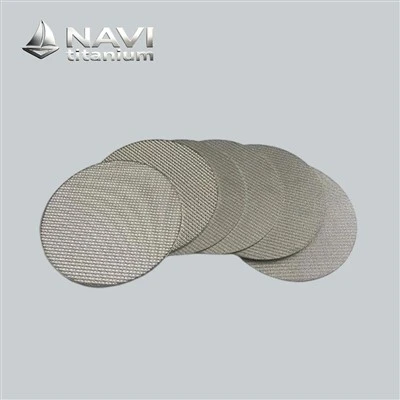
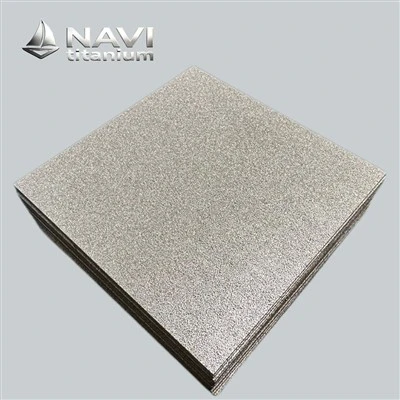
NAVI Titanium titanium sintered filter is a high‑performance porous separation component fabricated through low‑atmosphere consolidation of pure titanium‑base feedstock, boasting monolithic seamless construction, consistent micro‑void dimension and exceptional anti‑corrosion performance. NAVI Titanium delivers custom‑adapted outer geometry, void classification and structural configurations, supplying long‑lived, low‑upkeep and reusable separation assemblies that effectively cut end‑users' long‑run operating and swap‑out expenses within aggressive industrial separation scenarios.
Solution of NAVI Titanium
Stainless alloy offers cost advantages until chloride species emerge; it suffers local corrosive attack and the assembly fails completely. NAVI Titanium consolidates titanium‑base feedstock - Grade 1, Grade 2 and palladium‑modified variants - into porous monolithic bodies for precision separation, electrochemistry, biomedical processing and elevated‑temperature fluid partitioning. Internal void spaces distribute uniformly, are tunable and allow on‑site refreshment, whilst resistance against alkalis and biological media derives from the base alloy. Void proportion and outer contour comply with your engineering drawing, so separation efficiency, medium transmissibility and volumetric output match site operating circumstances. NAVI Titanium porous alloy filter, shown below, outlines available performance envelopes.


Large thin‑wall panels, deep conical shells, flange‑equipped domes, layered gradient wall tubes, threaded end caps and annular gas diffuser rings are fabricated from titanium‑base alloy. Submit CAD geometry files, dimension‑annotated PDF blueprints or worn hardware samples: we carry out metrology checks, confirm wall cross‑section dimension and void classification, then manufacture forming tooling.


Application
Titanium is chosen when the medium eats everything else and when any ion picked up from the filter becomes a contaminant. Both situations appear in electrochemistry, where a stainless element corrodes and colours the product, and in hot oxidising gas, where polymers simply cannot survive. Price comes third, and only after those: one NAVI Titanium titanium element often outlasts three cheaper replacements.
Chlor-Alkali and Chlorate Production
Brine exiting primary treatment still carries suspended solids which foul electrolytic cell hardware, and hardware positioned upstream of electrolytic cells encounters chloride‑saturated media held between 60‑90 °C containing free chlorine. NAVI Titanium supplies titanium sintered filters for this exact placement because self‑repairing passive oxide surface layers regenerate as rapidly as process media inflict chemical attack; accordingly, hardware wall sections do not thin and do not leach iron or nickel contaminants into process media which electrolytic cell hardware cannot tolerate. Void classification spanning 1‑25 μm retains suspended particulate burdens while keeping differential load within pump operational envelopes, and hardware undergoes media‑driven back‑flush renewal instead of physical removal. Tubular shells, circular planar plates and annular gas diffuser rings are bonded using compatible titanium‑base filler material, preventing dissimilar alloy contact within process circuits.


Hydrogen Production and Water Electrolysis
Alkaline and PEM electrolytic stacks demand porous transport substrates and gas partitioning hardware capable of electrical conduction, electrolyte resistance and bubble shedding without internal flooding. NAVI Titanium‑base porous hardware fulfills both functional roles: acting as catalyst‑backing porous transport substrates, and as partitioning barriers segregating hydrogen and gas‑phase oxygen whilst permitting electrolyte transit. Internal void geometry governs bubble detachment behaviour; for this reason gradient‑layer architectures (finer void texture adjacent catalyst interfaces, coarser texture toward flow pathways) are frequently specified. Stack development teams commonly forward flow‑path blueprints, entrusting us to recommend optimal gradient‑layer void partitioning schemes. Titanium‑base alloy resists degradation at oxygen‑evolution electrochemical potentials, and releases no dissolved alloy contaminants capable of poisoning catalytic surfaces - this factor drives widespread displacement of graphite and stainless alternatives in this field.
Purchasing guide

Quality control (QC)
Every titanium lot ships with a grade certificate to ASTM F67 or F136, an oxygen and iron analysis, and measured bubble point, permeability and wall thickness. Independent verification can be added before dispatch, at your request. Claims are cheap to print and slow to prove, so read ours instead: hit the button below for the COA set and inspection reports.

Manufacturing Process
Titanium is worked on a dedicated line, never on tools that have touched steel: iron picked up on a die face becomes a rust spot in service. Pressing, firing and welding all run under controlled atmosphere, and oxygen pickup is checked after every firing cycle. NAVI Titanium eight steps follow before packing.
Step 1 - Titanium Powder Selection
Gas-atomised and hydride-dehydride powders are bought to ASTM grade limits, then screened to a band that sets the final pore size. Oxygen, nitrogen, iron and carbon are analysed on arrival; a powder lot outside limits is rejected rather than blended away.
Step 2 - Clean Room Pressing
Charging and pressing take place in a segregated bay with titanium-only tooling, polymer scoops and separated gowning. Cross-contamination from carbon steel is the most common cause of rust bloom on finished titanium, so the bay is physically separated from the stainless lines.

Step 3 - Forming
Simple plates and discs are die-pressed; deep cones and long tubes are consolidated by cold isostatic pressing, which keeps wall density even where a ram could not reach. Green density is weighed and recorded per part, since it governs how far the part shrinks in the furnace.
Step 4 - High-Vacuum Sintering
Titanium is fired only in high vacuum, never in a hydrogen or dissociated ammonia atmosphere, which the metal would absorb and embrittle. Ramp, dwell and vacuum level are logged per tray, and the furnace is dedicated to titanium work so no alloy carry-over occurs.

Step 5 - Sizing and Machining
Fired parts are sized to diameter and faced to thickness with carbide tooling at low speed, because titanium work-hardens and smears if it is cut hot. Flatness is checked on a granite plate; warped parts are corrected by a second sizing pass rather than by force.
Step 6 - Welding and Assembly
End caps, flanges and spigots are welded in an argon-purged chamber with trailing shields, so the weld zone stays bright silver rather than straw or blue. Discolouration is a rejection criterion, since colour indicates oxygen ingress and a brittle heat-affected zone.

Step 7 - Surface Treatment and Passivation
Parts are pickled in a nitric-hydrofluoric bath, rinsed in deionised water and passivated to rebuild the oxide film. Where the duty is biomedical or food contact, an additional clean-room wash removes loosely held particles before packing.
Step 8 - Testing, Traceability and Packing
Bubble point, permeability, wall thickness and a pressure hold are logged against the heat number. Elements are sealed in plastic, cushioned to prevent titanium-on-titanium fretting, and crated with the certificate set. Records are held for five years.

Technical Data of NAVI Titanium Sintered Titanium Filters
Selection usually turns on four things: how the body is built, what the pores do, whether it fits, and how it connects. For a titanium sintered filter, the tables below answer those in order, as reference values for shortlisting; pore grades are nominal retention, measured by bubble point to ASTM F316. NAVI Titanium confirms each figure against your electrolyte, temperature and cleaning cycle before quoting.
|
Group |
Item |
Titanium Grade 1 |
Titanium Grade 2 |
Titanium Grade 7 (Ti-0.15Pd) |
|
Structure |
Body construction |
Single layer, graded multilayer |
Single layer, graded multilayer |
Single layer, welded assembly |
|
Forms supplied |
Tube, disc, plate, cone, cup |
Tube, disc, plate, ring sparger |
Disc, plate, flanged dome |
|
|
Pore characteristics |
Nominal pore grade |
0.5 – 100 µm |
1 – 100 µm |
5 – 80 µm |
|
Porosity |
35 – 50% |
30 – 45% |
30 – 42% |
|
|
Permeability coefficient |
1.2 – 9.5 ×10⁻¹² m² |
0.9 – 7.0 ×10⁻¹² m² |
0.6 – 4.5 ×10⁻¹² m² |
|
|
Bubble point in IPA |
1.8 – 22 kPa |
2.2 – 20 kPa |
4.0 – 16 kPa |
|
|
Dimensions |
Outside diameter range |
10 – 300 mm |
10 – 320 mm |
20 – 250 mm |
|
Length or thickness range |
20 – 1000 mm / 1 – 8 mm |
20 – 1200 mm / 1 – 10 mm |
15 – 600 mm / 2 – 8 mm |
|
|
Filtration area per element |
up to 0.85 m² |
up to 0.95 m² |
up to 0.60 m² |
|
|
Connection configurations |
End options |
Plain, threaded, tri-clamp, flange |
Plain, threaded, tri-clamp, welded spigot |
Flange, plain, welded spigot |
|
Thread standards |
ISO metric, NPT, BSP |
ISO metric, NPT, BSP |
ISO metric, NPT |
|
|
Flange standards |
DIN 2633, ANSI B16.5, JIS B2220 |
DIN 2633, ANSI B16.5, JIS B2220 |
DIN 2633, ANSI B16.5 |
Three Things Buyers Notice After Ordering
Unique Latent Industrial Advantages
Some advantages never appear on a quotation, which is why price-only comparisons miss them. Titanium forms an oxide film that repairs itself whenever it is damaged, so a scratch or an aggressive cleaning cycle does not start a pit that grows. Titanium weighs roughly 40% less than stainless, so large titanium sintered filter banks need lighter supports and smaller lifting gear. It is non-magnetic and non-sparking, which matters in solvent areas and around instrumentation.
Because the metal matches titanium vessels, pipework and heat exchangers, there is no dissimilar-metal couple to generate a corrosion current at the joint. Spent elements carry scrap value, so disposal is a credit, not a fee - the opposite of a polymer or ceramic element, which must be paid for twice. And titanium contributes no ion that can poison a catalyst or colour a product stream, a saving that shows up in yield rather than in the maintenance budget.


NAVI Titanium Brand Reliability
NAVI Titanium runs titanium as a separate production stream, not an occasional order: dedicated powder store, segregated pressing bay, a furnace reserved for titanium, and welders qualified on titanium procedure tests. Grade coverage runs from Grade 1 through Grade 2 to palladium-bearing Grade 7 and Grade 12 for reducing acid duty, so the alloy is selected for the medium, not the reverse. A chlor-alkali plant near Bilbao replaced its stainless polishers with Grade 2 elements in 2019 and has renewed twice since, each time from the archived die.
A copper electrowinning operation in northern Chile runs Grade 1 sparger rings in hot acidic electrolyte, where the previous material lasted one campaign. Third-party verification of composition, pore distribution and corrosion behaviour is available on request, and the mill certificate always names the heat. Brand reliability here is a narrow claim: the alloy on the certificate is the alloy in the box.
Service Reliability and Response
Reliability after the sale is measurable, so it is tracked. Technical enquiries are answered within a working day by an engineer who reads the duty, not a sales inbox; drawings that cannot be made as drawn are flagged before tooling, with an alternative proposed in the same reply. First articles ship from production tooling in ten to fifteen days for standard geometries, and every quotation states a lead time that has been checked against the furnace schedule rather than copied from a table.
Shipments leave with photographs of the packed crate and a packing list matching the certificate set line by line, which removes the customs correspondence. A Finnish water-treatment group holds a consignment agreement: NAVI Titanium stocks twelve months of its element types and releases against call-off, so the customer carries no working capital. Repeat order rate across the titanium line has held above 80% for three consecutive years.

FAQ
How long does a titanium element last in chloride or seawater service?
+
-
In brine, chlorate and seawater duties, eight to ten years is normal, and longer where the stream is filtered rather than raw. Judge condition by trending clean differential pressure: when a cleaned element cannot return near its original value, pore blocking is permanent and the element is spent.
What damages titanium during cleaning or handling?
+
-
Hydrofluoric acid, hot concentrated sulphuric acid and dry chlorine gas attack it, and hydrogen uptake at high temperature causes embrittlement. Never use carbon steel brushes or tools that have touched steel, and never clean with hydrochloric pickling pastes. Anhydrous methanol and hot halogenated solvents can also stress-crack titanium; ask us before using either.
How is the element regenerated, and how many cycles work?
+
-
Backwash with clean liquid or gas, then ultrasonic cleaning in a warm alkaline bath; nitric acid or oxalic acid removes scale from chloride service. Elements typically recover more than 90% of clean permeability through several hundred cycles before recovery tapers. Log clean differential pressure after each cycle; the trend decides.
What do buyers in Europe, North America and East Asia ask first?
+
-
European buyers open with documentation and end-of-life responsibility. North American buyers ask for ASTM grade equivalence and local stock. East Asian buyers lead with surface roughness, clean packing and dimensional reports. Gulf buyers typically start with temperature and seawater salinity. Answering all three upfront shortens the enquiry cycle.
Can spent titanium elements be returned, and is there scrap value?
+
-
Yes. Titanium is a recoverable metal with an active scrap market, so spent elements are usually bought back or credited against the next order rather than sent to landfill, which changes the true cost of ownership. Rates are quoted at order stage, so the credit is known before disposal.
Hot Tags: titanium sintered filter, China titanium sintered filter manufacturers, suppliers, factory, Bronze Filter Element, coarse pore metal filter disc, Microporous Filter, Sintered Porous Metal Filter, uniform pore metal filter disc, uniform pore porous metal filter