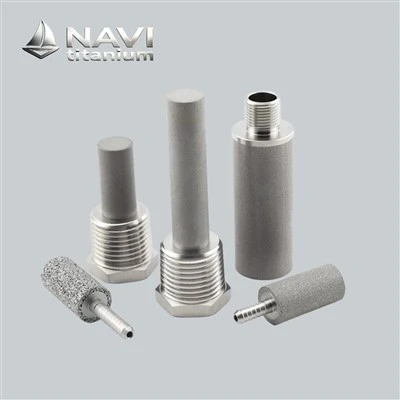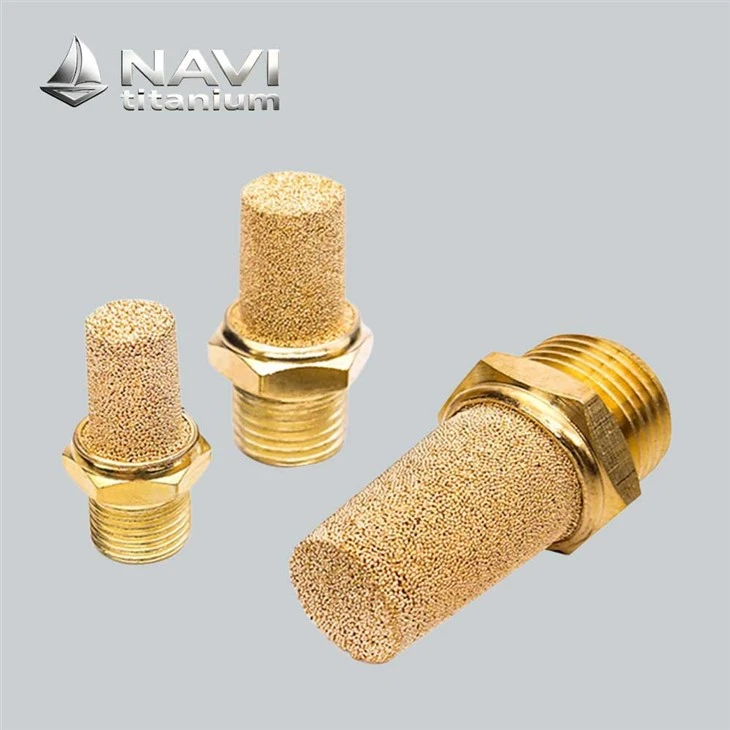
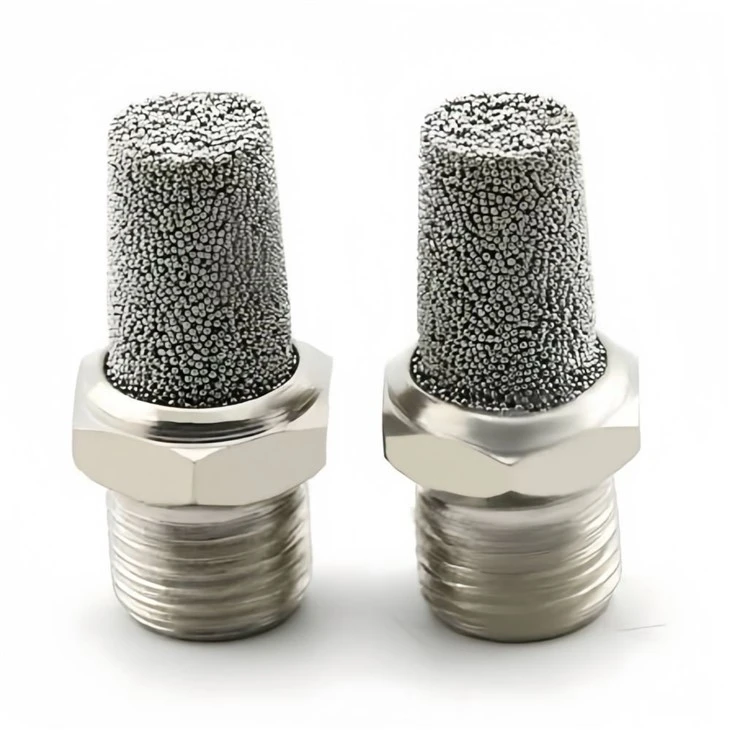
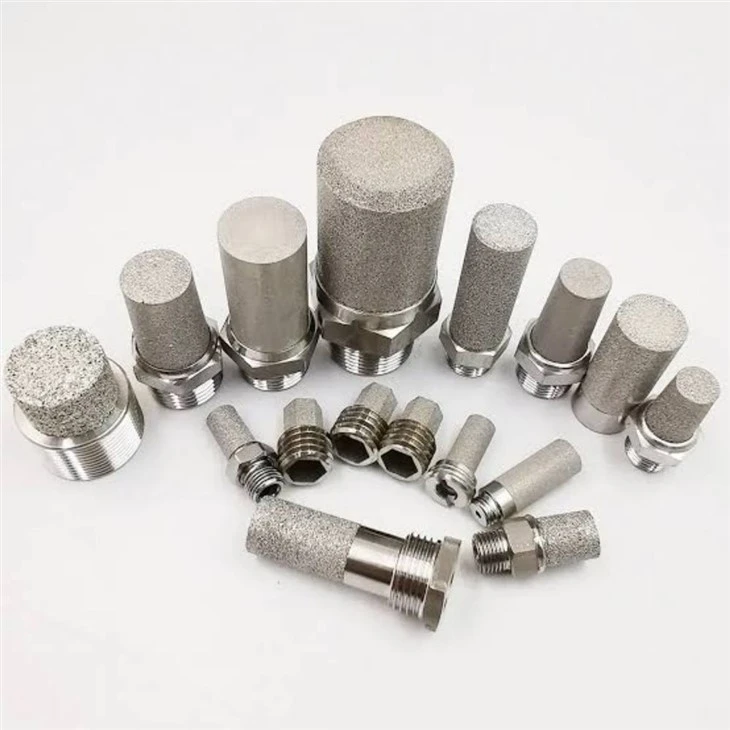
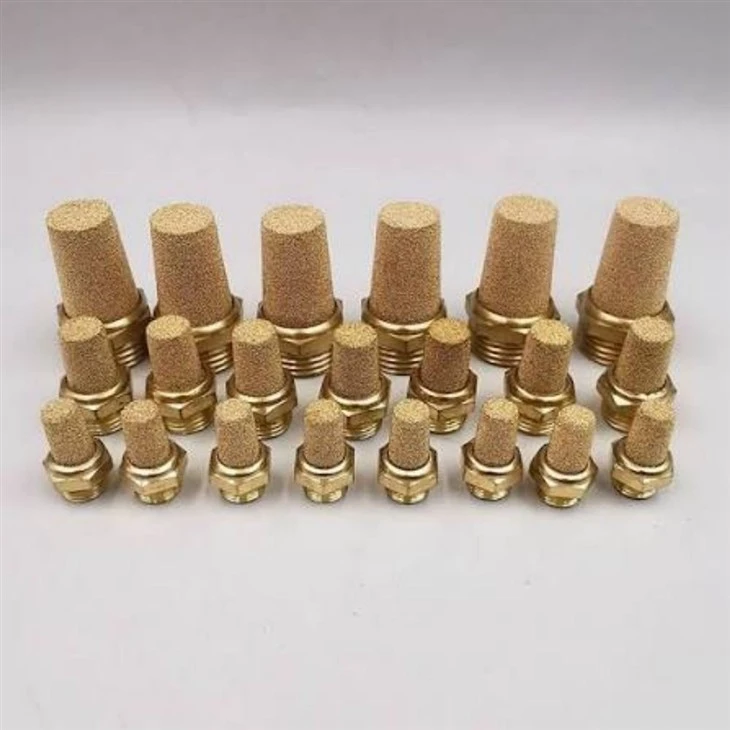
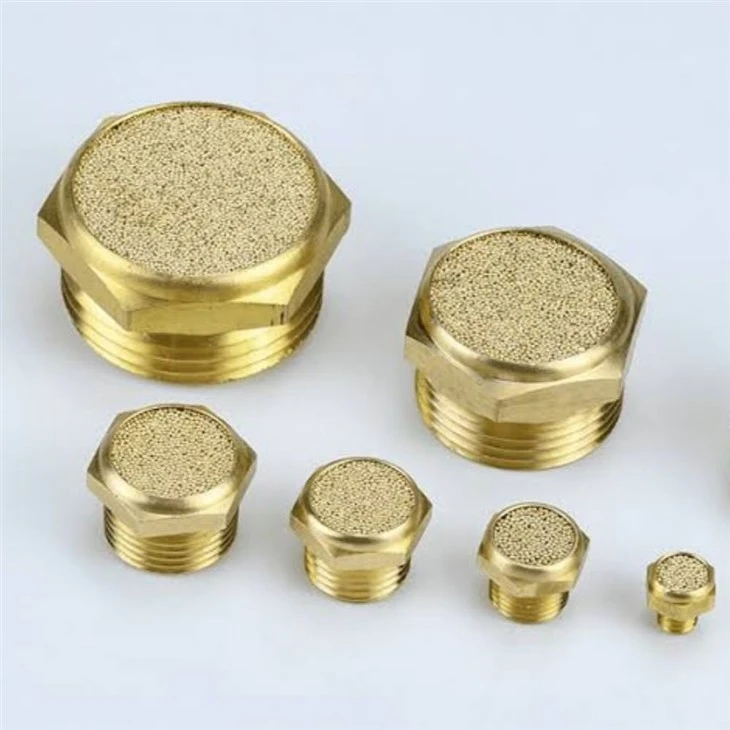
Sintered silencer uses a powder metallurgy sintering process, relying on high-temperature fusion of metal powders to form a continuous, uniform, and controllable porous framework. It not only provides efficient noise reduction but also ensures fluid permeability, filtration protection, and resistance to corrosion, making it a key functional component for high-end industrial noise control. NAVI Titanium has been specializing in porous titanium materials and powder metallurgy metal sintering for years, and now officially launches its own brand of sintered muffler, offering global industrial customers standardized stock, custom R&D, large-scale production, and full-cycle technical support solutions.
Solution of NAVI Titanium
With global industrial upgrades and the iteration of high-end equipment, we continuously optimize our product structure, fine-tune core performance parameters, and upgrade manufacturing processes. Based on real working conditions like corrosion resistance, high temperature, high pressure, and marine environments, we provide tailored titanium solutions for industries such as automation, chemical, marine engineering, water treatment, and precision equipment. The table below systematically organizes the core information of our mainstream titanium products, fully showcasing the key advantages and practical applicability of NAVI titanium materials.


Sintered Porous Silencing, NAVI Titanium Stabilizes Industrial Exhaust
NAVI Titanium has been specializing in porous metal sintering for over ten years. We have our own powder metallurgy production line, and we independently control the whole process from powder mixing, pressing and forming, vacuum sintering, to precision thread machining. We can handle everything from quick sample trials to large-scale stable deliveries.


Application
As a pillar of heavy industry, the metallurgical sector involves a lot of high-pressure gas emission points throughout the entire production process - from raw material pretreatment, high-temperature smelting, and refining, to furnace protective gas delivery, flue gas treatment, pressure reduction, and automatic pneumatic actuators. NAVI Titanium has been focusing on the research and manufacturing of porous metal powder metallurgy and special titanium alloy components for over ten years. Relying on its own vacuum sintering production line and full-process precision machining capabilities, the company offers sintered muffler products in various materials, including stainless steel, bronze, brass, and sintered silencer designed for high-end corrosive environments. These products provide standardized solutions, custom development, stable mass production, and full-cycle technical support for industries like ferrous metallurgy, non-ferrous metallurgy, and powder metallurgy, effectively addressing exhaust noise reduction and equipment protection issues in metallurgical applications.
The steel metallurgy process is long, involving raw material yards, sintering workshops, blast furnaces, converters, continuous casting, and rolling mills, all filled with pneumatic actuators and gas relief points. This makes it the metallurgical field with the highest usage of sintered mufflers.
Blast furnace and hot blast stove pneumatic valve exhaust: Blast furnace top charging bells, vent valves, furnace body purging valves, and hot blast stove switching valves make extensive use of large pneumatic cylinders and solenoid valves. When these valves operate, compressed air is quickly released, generating intense pulse noise, and the dust concentration around the blast furnace is extremely high. Installing NAVI Titanium stainless steel sintered mufflers reduces exhaust noise, prevents blast furnace ore dust and coke dust from backflowing into the cylinders, protects seals from wear, ensures stable valve operation, and avoids furnace pressure loss. Blast furnace conditions involve strong vibrations, and integrated sintered mufflers resist vibration, unlike packed silencers, which may lose filler material.


Steelmaking converter and ladle refining furnace (LF furnace) protective gas system exhaust: Refining furnaces use argon as a protective gas, with pipelines equipped with relief valves and sampling exhaust valves. When furnace pressure exceeds limits, the valves release gas rapidly. The exhaust contains high-temperature steam and trace sulfur oxides. 316L sintered mufflers can withstand exhaust temperatures around 180℃, control the relief airflow steadily, reduce instantaneous noise, and intercept metal oxide dust to prevent it from entering precision pressure regulators. This ensures accurate argon pressure control, reduces molten steel oxidation, lowers slag inclusion defects, and improves steel cleanliness.
Continuous casting and rolling line pneumatic actuators: The continuous caster crystallizer, roller table, shear, and pusher rely on pneumatic cylinders, operating in a high-temperature environment with lots of iron oxide dust. Using NAVI Titanium bronze/stainless steel sintered mufflers in batches decreases persistent workshop exhaust noise, protects solenoid valve components, and reduces pneumatic system downtime. Many steel companies previously had to replace ordinary silencers every 1–3 months, but NAVI Titanium sintered mufflers can be cleaned and regenerated to last 6–12 months, significantly reducing spare parts inventory and maintenance hours.
Purchasing guide

Quality control (QC)
NAVI Titanium implements end-to-end quality control for every stage of manufacturing. Every batch comes with complete test documentation. Our inspection process includes raw material composition spectral analysis, mechanical performance verification, burst pressure testing, and corrosion resistance evaluation. All measured data is archived by batch and traceable, providing verifiable quality evidence for your engineering certifications and project acceptance. The presented data is for reference only.
|
|

Manufacturing Process
Manufacturing capability is the fundamental guarantee for the stable service of porous metal components, and it's also the core competency that NAVI Titanium has been honing over more than a decade in the titanium and powder metallurgy fields. High-end industries such as metallurgy, fine chemicals, chlor-alkali, and seawater treatment have extremely strict requirements for sintered metal products: pore uniformity, mechanical strength, corrosion resistance, and gas permeability-each indicator directly affects the long-term stability of equipment operation. From the very beginning, NAVI Titanium rejected rough batch outsourcing and has insisted on meticulous control over the entire production chain, applying process standards to every step from raw material storage to finished product delivery. Below, we'll break down NAVI Titanium's core manufacturing technologies across its entire product line, step-by-step process flow, process advantages, and technical highlights, introducing in detail the full transformation from metal raw materials to sintered products. We'll also explain the technical principles and process control points of each step, including melting and forging, powder preparation, compaction and forming, vacuum sintering, precision machining, surface treatment, and final product inspection. Click the button to learn more:
|
|
|
|


Selection Guide
There's a wide variety of sintered muffler on the market. Bronze and standard 316L stainless steel sintered mufflers are mostly used in regular pneumatic exhaust scenarios. But in harsh conditions like metallurgy, chlor-alkali, wet chemical processes, or media containing chloride ions, conventional materials can easily face issues like pitting, base material cracking, pore blockage, and short service life. NAVI Titanium, leveraging over a decade of titanium powder metallurgy experience, has developed its own gradient porous titanium sintered mufflers. The table below compares NAVI Titanium with standard bronze and ordinary stainless steel sintered silencers across five dimensions-material properties, process capability, working condition adaptability, quality assurance, and custom service-so that engineers can quickly evaluate product suitability. The basic parameter information is for reference only:
| Comparison Item | NAVI Titanium | Peer Bronze | Peer Ordinary 316L Stainless Steel |
| Base Material | High-purity titanium powder, integrally vacuum sintered titanium substrate | Bronze (copper-tin alloy) | Conventional 316L stainless steel powder |
| Corrosion Resistance | Excellent. Resists chloride ions, organic acids, wet chlorine gas, acid and alkaline media & pitting corrosion. Suitable for chlor-alkali / hydrometallurgy strongly corrosive exhaust | Poor. Rapid corrosion upon exposure to acid, alkali and chloride-containing media. Only applicable for dry & clean compressed air | Moderate. Vulnerable to pitting corrosion in chloride environments, failure under high-concentration acidic media |
| Long-term Operating Temperature | -200℃ ~ 600℃. No oxidation at high temperature, no organic binder shedding | ≤200℃, easy oxidation & softening at high temperature | ≤450℃, rising risk of intergranular corrosion above limit temperature |
| Matrix Structure | Gradient multi-layer sintered structure with surface protective layer + internal noise reduction layer. Gradually transitional pores for anti-clogging | Single-layer uniform pore structure. Dust easily embedded deeply, hard to clean | Mostly single-layer sintered; simple multi-layer available for few models, weak gradient pore control |
| Noise Reduction Performance | Broadband noise reduction, stably 18~32dB(A). Pore parameters customized according to working conditions to realize high-efficiency noise reduction with low backpressure | Mid & high frequency noise reduction, 15~22dB(A). Sharp backpressure rise under large flow rate | Noise reduction 16~25dB(A). Prone to whistling under high-pressure exhaust conditions |
| Shock / Burst Strength | Integrated vacuum solid-phase sintering without binders. Resists pressure impact and thermal shock, applicable for instantaneous impact exhaust of pressure relief valves | Low strength. Easy cracking under large pressure fluctuation, not suitable for intermittent high-pressure relief scenarios | Medium strength. Internal microcracks may form under repeated pressure impact |
| Adjustable Pore Range | 0.2~100μm, porosity 25%~50% precisely adjustable, gradient pores customizable | 3~90μm, narrow pore range with limited fine adjustment | 0.5~100μm, poor pore uniformity for single-layer products |
| Product Traceability & QC | Full batch reports including material spectrum test, burst test, air permeability test. Full-process traceability | Basic factory inspection, incomplete material traceability. Some made from recycled powder | Conventional performance testing. Many suppliers cannot provide independent batch spectrum certificates |
| Customization Capability | Custom shapes, special threads/flanges, adjustable wall thickness. Independent sintering curve developed per working condition | Mainly standard sizes, high cost for non-standard customization, fixed process parameters | Simple dimension modification, sintering curve cannot be flexibly adjusted |
| Application Scenarios | Chlor-alkali, hydrometallurgy, chemical pressure relief exhaust, seawater media, high-temperature corrosive gas noise reduction | Dry air exhaust of ordinary pneumatic valves, normal-temperature clean working conditions | General industrial compressed air, noise reduction in low-corrosion environments |
| Service Life | 3~6 times longer than stainless steel silencers under corrosive conditions, reusable after ultrasonic regeneration | Acceptable service life only in dry environment, rapid failure in corrosive environment, non-regenerable | Durable in neutral environment; service life drastically shortened in chloride-containing media |
Professional services
NAVI Titanium has been deeply involved in the overseas B2B market for porous titanium materials and sintered metal components for over a decade. We mainly deal in sintered silencers, porous filter elements, and titanium-based industrial parts-high-end industrial supplies serving global EPC contractors, equipment manufacturers, and trading wholesalers in industries like metallurgy, chemicals, marine equipment, automation pneumatics, and new energy equipment. Unlike the usual rough-and-ready export approach for industrial products, our brand has built a detailed system for sintered mufflers that considers product features, regional logistics differences overseas, bulk purchases by B-end customers, customized orders, and project-based orders. This includes a tiered packaging system, a cross-border transport risk control system, and a full-chain delivery coordination system.
Unlike the typical foreign trade model of 'shipping marks the end,' we've set up a one-on-one delivery coordination service system specifically for overseas B2B major clients, long-term project orders, and bulk repeat orders. This system covers the entire process-from order confirmation, production scheduling, and custom packaging to logistics selection, milestone tracking, port coordination, inspection assistance, and after-sales support-ensuring a refined delivery experience that boosts customer loyalty and creates a differentiated B2B service advantage.
During the early stages of an order, a dedicated foreign trade project manager follows up throughout the process, accurately confirming the client's packaging requirements, shipping mark style, logistics preferences, delivery milestones, document needs, and any special compliance requirements.


We create a tailored delivery schedule based on the client's project timeline, clearly outlining the timing for production, re-inspection, packaging, shipping, port arrival, and acceptance, then share it with the client so they can oversee the project overall. For bulk orders with staggered deliveries or multi-batch projects, we prepare a detailed batch delivery plan, checking specifications, quantities, packaging standards, and logistics for each batch to avoid mix-ups and ensure the client can manage staged production and project execution smoothly.
Throughout production and delivery, we provide dynamic progress updates. At every key point-production completion, product re-inspection, packaging completion, packing, container loading and departure, and port customs clearance-we share real photos, shipping documents, and progress notes, letting clients track their orders in real time and eliminating information gaps. For special overseas customization needs, we can offer tailored packaging, exclusive shipping marks, client logo printing, and customized packing lists to match clients' branding, centralized acceptance, and storage management requirements.
After the goods arrive at the port, our team helps clients with customs clearance, cargo verification, quantity counting, and defect checks, proactively assisting with warehouse acceptance and project archiving. Any questions that arise during the acceptance process are immediately addressed with technical explanations, additional documentation, or data support. We also have an after-sales mechanism to cover overseas orders, quickly responding to and accurately tracing the rare transport issues, handling claims efficiently-all managed by the NAVI Titanium team in a seamless, one-stop process without the client having to coordinate with multiple parties, maximizing protection of client interests. For long-term strategic B2B clients, we maintain dedicated delivery files noting their packaging preferences, logistics habits, documentation standards, and delivery milestone requirements, so future repeat orders can be standardized without repeated communication, significantly enhancing delivery efficiency and the overall cooperation experience.

Frequently Asked Questions
Q1: Does the NAVI Titanium sintered silencer support customized gradient porous layers, rather than just a single homogeneous pore structure?
+
-
A: Yes. We can customize multi-layer composite sintered structures, independently controlling the pore size for each layer to balance noise reduction and fluid pressure drop, specifically suited for high-pressure pulsating gas conditions. Unlike common single-powder sintered silencers on the market, the gradient structure reduces the risk of airflow blockage and extends the service life of the component.
Q2: For small-batch R&D prototype orders, can NAVI provide actual measured noise attenuation data?
+
-
A: Yes. There is no minimum order for prototypes. We can perform the two core tests-acoustic attenuation and pressure loss-on demand, and provide a COA report for the corresponding batch with the shipment. This fully records the material and fluid performance, making it easier for customers to conduct lab condition verification and technical evaluations.
Q3: How does the titanium sintered silencer core maintain stable pore structure under long-term high-speed fluid flow?
+
-
A: The product uses a vacuum metallurgy integrated sintering process, where the titanium wires form solid sintering necks at contact points, avoiding simple loosely stacked structures. It has stronger resistance to high-speed airflow and pulsating impacts, maintaining stable pore sizes over long service time, with noise reduction performance degrading much less than ordinary sintered silencers.
Q4: For export projects, what specialized technical documents can be provided for overseas third-party audits?
+
-
A: In addition to basic material certificates, we can provide measured pressure drop curves and fluid impact aging test records, supporting multi-language technical documentation. This meets the strict technical document verification requirements of overseas equipment manufacturers for incoming material inspections and pressure vessel compatibility assessments.
Q5: Can the noise reduction frequency band be specifically adjusted according to the customer's pipeline gas pulsation frequency?
+
-
A: Yes, custom development is possible. By considering the customer's medium type, pressure parameters, and gas pulsation frequency, we can adjust titanium wire specifications, component thickness, and pore gradient distribution to accurately optimize the target noise reduction frequency band, avoiding issues of excessive pressure drop or insufficient noise reduction caused by blind product selection.
Hot Tags: sintered silencer, China sintered silencer manufacturers, suppliers, factory, inline sintered porous metal filter, Sintered Bronze Bar, Sintered Bronze Fuel Filter, Sintered Metal Sheet, sintered porous metal filter insert, sintered porous metal filter screen