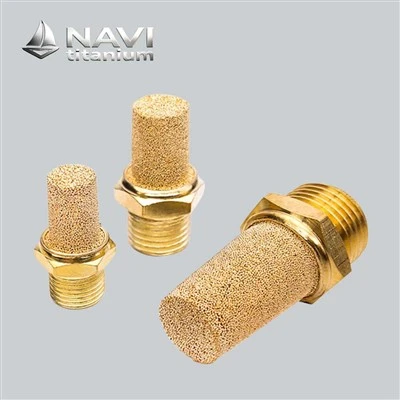
NAVI Titanium sintered porous metal filter disc 20 micron for gas purification and analysis in analytical sampling and process-stream assessment. For international cooperation, documented drawing revisions, retained inspection records, and clear discrepancy-handling arrangements help buyers assess supplier accountability. Customer testimonials should reflect verified project experience, while repeat-customer references can demonstrate sustained cooperation across procurement cycles. Before ordering, buyers may request sample evaluation, specification confirmation, and documented acceptance criteria to reduce uncertainty during supplier qualification.
Solution of NAVI Titanium
NAVI Titanium has established international cooperation through customized manufacturing projects, technical communication, and repeat-order coordination for customers across multiple markets. For buyers evaluating particulate-control discs for analytical sampling, supplier selection involves more than a nominal 20-micron rating; material grades, dimensional tolerances, inspection records, and application compatibility also require review.
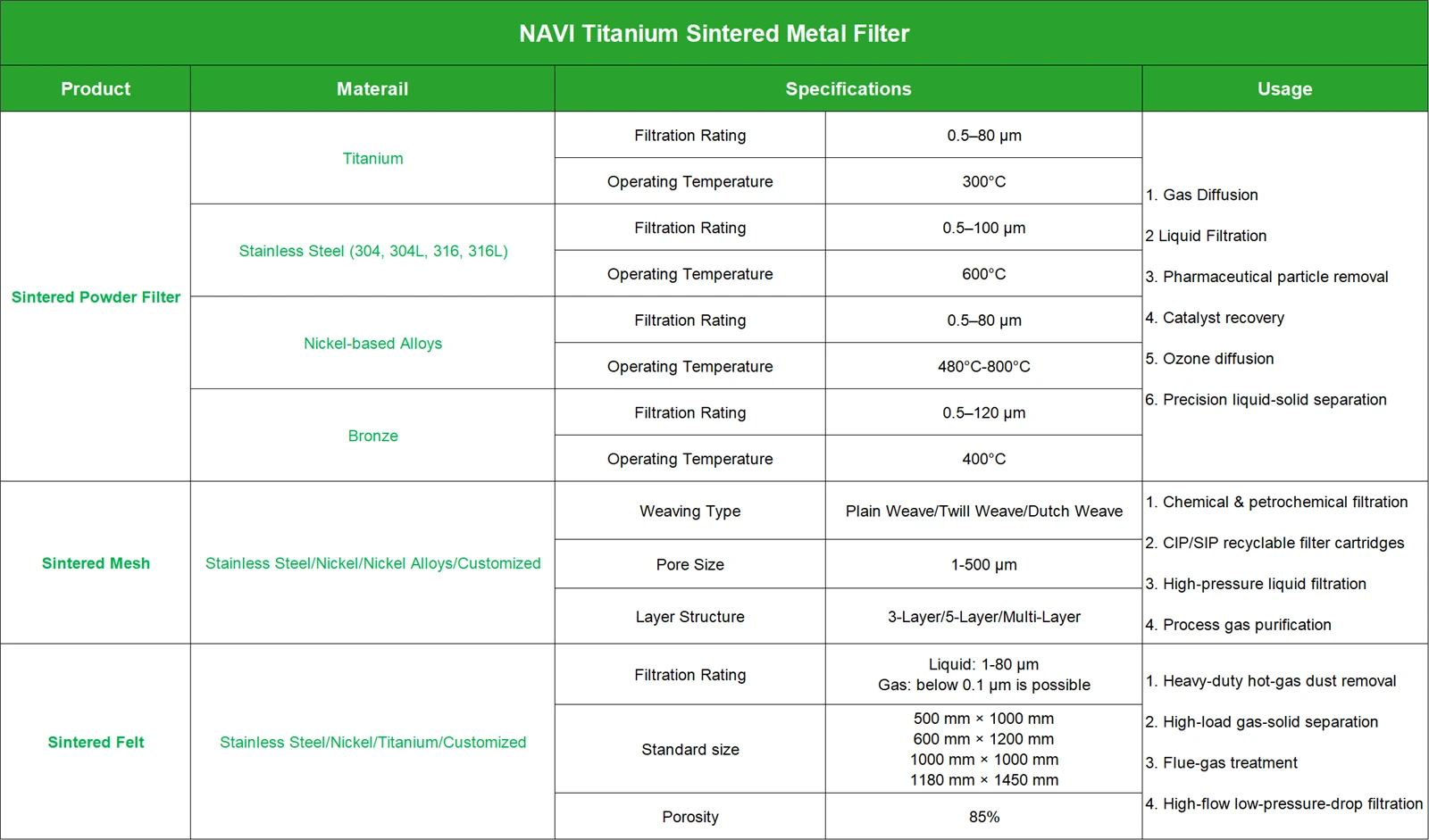


NAVI Titanium 20-micron classification requires careful interpretation within analytical sampling systems, as actual interception depends on particle morphology, passage geometry, and operating conditions. Comparative testing establishes a scientific basis for evaluating suitability across specific sampling applications and repeated measurement cycles.


Application
NAVI Titanium supplies the sintered porous metal filter disc 20 micron for gas purification and analysis, targeting coarse particulate interception in analytical sampling lines and upstream instrument protection while enabling application-specific assessment of flow rate, pressure drop, and particle retention.
Analytical sampling systems require effective control of suspended particulate matter before a sample enters sensitive measurement instruments. A nominal 20-micron rating provides a defined separation threshold for applications where coarse residues, process debris, and particulate carryover may compromise sample representativeness. Within sampling manifolds, pressure-reduction assemblies, and instrument inlet passages, a circular disc can intercept particles according to its rated retention characteristics and the physical properties of the flowing stream. This distinction is important because nominal pore ratings do not establish absolute removal efficiency for every particle diameter.
For laboratory validation, differential pressure should be recorded alongside upstream and downstream particle concentrations. These measurements help establish whether the selected rating maintains adequate throughput without introducing unacceptable sampling bias. The 20-micron specification is particularly relevant when the analytical objective concerns larger suspended residues rather than submicron aerosols. Compatibility testing should also examine chemical exposure, thermal cycling, sealing integrity, and cleaning residues.

2. Instrumental Analysis

Reliable analytical results depend on controlling particulate interference before samples reach measurement cells, pressure regulators, and detection assemblies. A 20-micron retention grade can be evaluated for preliminary clarification of process streams containing relatively coarse suspended solids. Typical assessment scenarios include monitoring sampling loops, laboratory reference streams, and upstream protection for analytical instruments exposed to particulate-bearing process flows. At this rating, the principal objective is to reduce larger contaminant loads while preserving sufficient volumetric throughput for representative sample delivery.
The selection process should distinguish nominal retention from absolute particle exclusion. Particles smaller than 20 microns may still be captured through interception, while some particles near or above the stated rating may pass depending on the actual passage distribution and operating conditions. Consequently, validation should include particle-count comparisons, differential-pressure measurements, and flow-rate monitoring under representative test conditions. Where quantitative concentration measurements are required, sampling-line losses, adsorption, and pressure-induced changes must also be considered.
Purchasing guide

Quality control (QC)
NAVI Titanium documents key inspection parameters for 20-micron discs intended for analytical sampling applications, including nominal retention rating, dimensional conformity, differential pressure, and flow characteristics. These records allow overseas purchasers to assess suitability for particulate control, compare measured results against agreed acceptance limits, and verify whether the specified rating aligns with their sampling requirements.

Manufacturing Process
Particle classification and controlled compaction establish the initial disc geometry and pore distribution. High-temperature consolidation bonds adjacent particles, while subsequent machining refines dimensions and sealing surfaces. For a nominal 20-micron rating, NAVI Titanium maintains attention to pore consistency and flow-path uniformity. Permeability measurements and particle-retention tests verify suitability for analytical sampling under specified operating conditions.


Specification Identification
Discs rated at 10, 20, and 30 microns may appear nearly identical, yet their retention characteristics and hydraulic resistance can differ significantly. For procurement teams handling multiple grades, visual similarity creates a risk of incorrect picking, assembly, or replenishment. A clear identification system should therefore extend beyond nominal diameter and thickness. Grade-specific part numbers, permanent markings where technically feasible, contrasting identification labels, and dedicated storage locations can distinguish adjacent ratings throughout receiving, inventory control, and installation. Purchase orders and technical drawings should state the nominal retention rating alongside dimensional tolerances, connection details, and acceptance criteria. Incoming verification should cross-check the physical marking against the order reference before items enter production or laboratory inventory. Where several grades share one outer profile, barcode identification and segregated storage provide additional safeguards against substitution. NAVI Titanium documentation should also distinguish nominal ratings from absolute retention claims, since these terms describe different performance expectations. For repeat orders, maintaining a controlled specification register reduces the possibility of outdated drawings or similar part numbers causing confusion.

Trace Analysis

Trace-level analytical systems require particular attention to interactions between sample constituents and wetted surfaces. Adsorption may temporarily retain target molecules, reducing the measured concentration, while subsequent desorption can release previously retained species and produce carryover into later measurements. Background contamination from residual processing agents, cleaning chemicals, handling residues, or packaging-derived substances may also obscure low-concentration signals. A nominal 20-micron rating describes particulate retention rather than molecular selectivity; it does not establish chemical inertness or guarantee suitability for trace analysis. Qualification should therefore include blank runs, recovery measurements, sequential sample challenges, and comparisons between inlet and outlet concentrations. Response delay can be assessed by introducing a defined concentration step and recording the time required for the analytical signal to approach its final value. Testing should account for internal void volume, flow rate, and sample composition. Repeated exposure and cleaning cycles can reveal whether retained compounds generate memory effects or whether background levels increase over time. Buyers should request documented test conditions and acceptance limits relevant to their target analytes.
Analytical Sampling Discs
For buyers specifying 20-micron circular discs for analytical sampling lines, mechanical suitability depends on more than the nominal retention rating. Thin sections may deflect under differential pressure, particularly when the unsupported span is large or the clamping force is uneven. Excessive bending can alter the seating geometry, create peripheral leakage, or produce local stress concentrations near the retaining edge. These risks become more significant when a disc is installed between narrow sealing faces or exposed to repeated pressure changes. Procurement specifications should therefore identify the outer diameter, thickness, effective unsupported diameter, maximum differential pressure, and permitted deflection. Where dimensional interchangeability is required, the retaining ring and housing tolerances should also be documented. Buyers should avoid assuming that two discs with identical external dimensions have equivalent load-bearing capacity. A controlled clamping arrangement can distribute contact forces more evenly, while a properly matched backing support can reduce unsupported spans without obstructing the intended flow path. Mechanical qualification should reflect the actual mounting arrangement rather than an isolated flat-disc test.

Balancing Mechanical Support

In analytical sampling applications, the support arrangement must restrain a thin disc without compromising the passage characteristics associated with its nominal 20-micron rating. An excessively restrictive backing surface may reduce the effective open area, increase pressure drop, and create uneven flow distribution. Conversely, insufficient restraint may permit local deformation when the pressure difference across the disc changes during sampling or instrument operation. Buyers should evaluate the open-area ratio of the retaining structure, contact geometry, sealing width, and pressure direction together. For applications involving low-concentration measurements, the supporting parts also require attention because surface residues, trapped contaminants, or extractable substances may introduce background signals. Material compatibility and cleaning validation should therefore cover the complete wetted assembly, not just the disc itself. Useful qualification data include pressure-drop curves at specified flow rates, deflection measurements under representative loading, leakage checks, and repeated pressure-cycle results. Where operating pressure can fluctuate, testing should reproduce the expected range and mounting torque. Clear acceptance limits allow engineering teams to compare quotations on a consistent basis.
Understanding the 20 μm Rating and Its Verification Basis
For sintered porous metal filter disc 20 micron for gas purification and analysis, the 20 μm value must be defined before procurement: it may indicate a nominal particle-retention grade, a maximum pore diameter, or another mutually agreed specification. These definitions are not interchangeable. Pore geometry describes physical openings, whereas particle retention depends on the distribution of interconnected passages, disc thickness, particle shape, flow rate, and differential pressure. NAVI Titanium recommends establishing the rating through documented test criteria rather than relying on the micron value alone. Relevant assessment methods may include bubble-point testing, maximum-pore determination, permeability measurement, and challenge-particle testing. ASTM E128 addresses maximum pore diameter and permeability for rigid porous materials; the selected method must match the claim being verified.
| Specification basis |
|
Evidence to request |
|---|---|---|
| Nominal rating |
|
Particle challenge results and removal efficiency |
| Maximum pore diameter |
|
Test method and measured result |
| Absolute rating | High retention at a stated particle size under defined conditions | Validated retention efficiency and test conditions |
| Permeability |
|
Flow rate and differential-pressure data |
20 μm designation alone cannot guarantee a specific particle-removal efficiency. Buyers should confirm the rating definition, test method, and operating parameters before comparing suppliers or approving the disc for analytical sampling.
FAQ
1. What career development opportunities are available for highly educated technical professionals?
+
-
Technical professionals with master's or doctoral qualifications may participate in cross-disciplinary research, technical documentation, experimental evaluation, and collaborative projects with international customers.
2. What responsibilities should senior engineers address during application qualification?
+
-
Senior engineers should assess flow resistance, pressure fluctuations, mounting tolerances, chemical compatibility, and potential particulate carryover.
3. How can research institutions collaborate on performance validation?
+
-
Universities and research laboratories can establish joint evaluation programs covering pore-size characterization, particle-retention efficiency, surface contamination, and repeatability.
4. What role can patent achievements play in supplier evaluation?
+
-
Patent records may indicate original technical contributions, but they do not automatically establish application suitability or commercial performance. Buyers should examine patent ownership, claim scope, legal status, and the relationship between the patented method and the proposed specification.
5. How can laboratory findings be translated into practical commercial applications?
+
-
Technology transfer typically requires repeatability studies, pilot-scale validation, documented operating limits, and defined acceptance criteria.
Hot Tags: sintered porous metal filter disc 20 micron for gas purification and analysis, China sintered porous metal filter disc 20 micron for gas purification and analysis manufacturers, suppliers, factory, inline sintered porous metal filter, instrumentation porous metal filter, sintered metallic filter media, Sintered Porous Filter, sintered porous metal filter cylinder, Sintered Stainless Filter