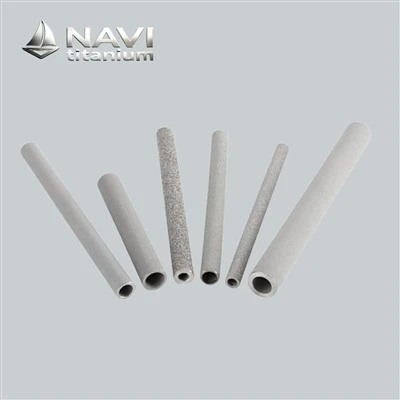
NAVI Titanium provides sintered filter cartridges for medical filtration applications, with technical evaluation focused on retention performance and contamination control. During production reviews, technicians examine wall uniformity, end-face finish, dimensional conformity, and visible surface defects under consistent lighting. Inspection records document sample identification, measurement locations, instrument status, and deviations requiring further assessment. Flow tests compare differential pressure before and after controlled particle loading, while chemical compatibility checks address the intended liquid composition.
Solution of NAVI Titanium
At NAVI Titanium, technical personnel examine cylindrical cartridges intended for clinical liquid clarification, paying close attention to wall uniformity, end-face finish, and dimensional conformity. During inspection, technicians record sample identification, measurement points, instrument status, and any deviations requiring review. This documented approach gives purchasing teams greater visibility into inspection practices and batch-to-batch consistency. Beyond these specialized requirements, NAVI Titanium also handles a broader range of titanium-based materials and fabricated forms.
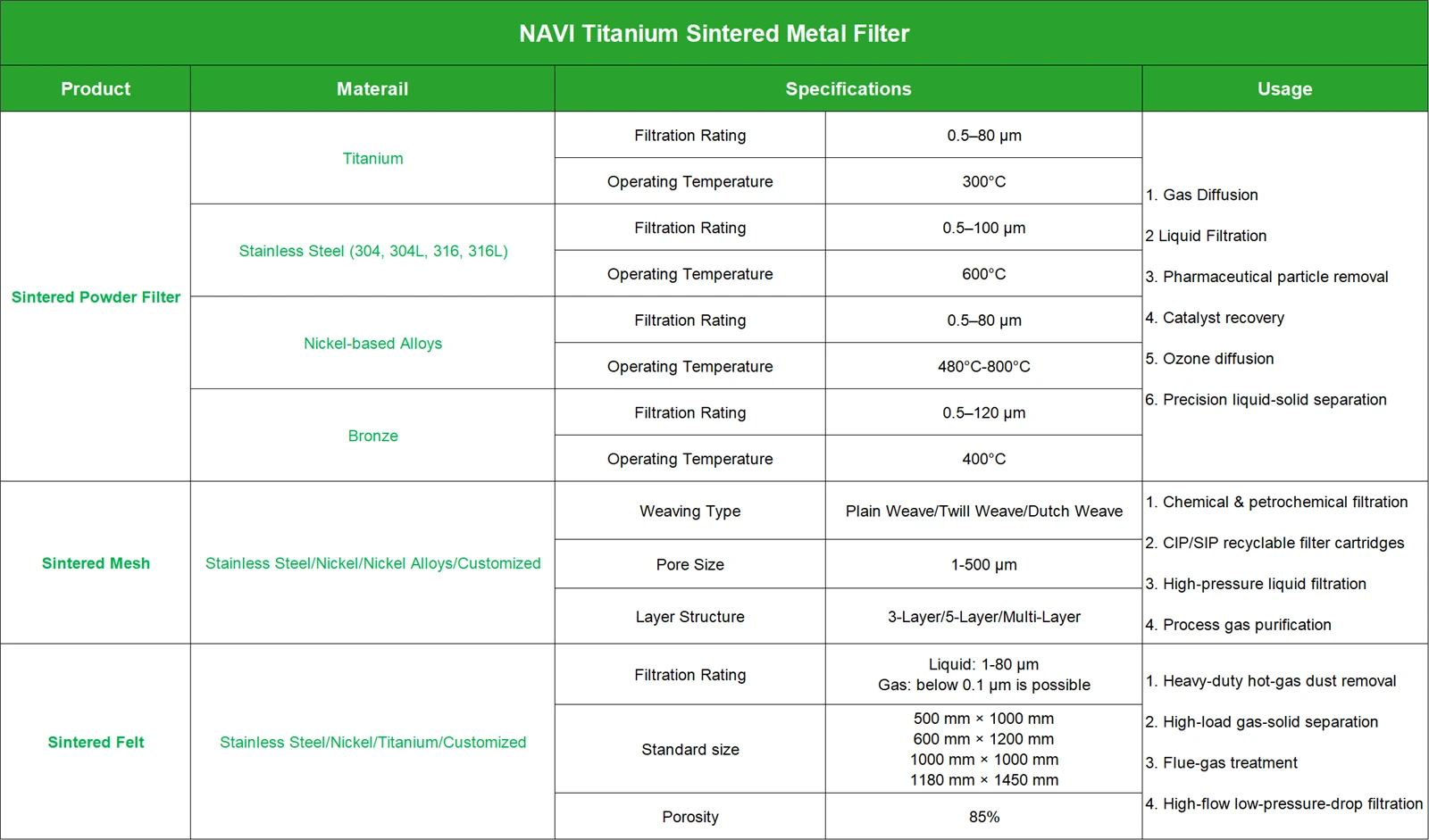


NAVI Titanium approaches clinical liquid handling from a materials evaluation perspective, where surface cleanliness, dimensional consistency, and chemical compatibility require systematic examination.


Application
NAVI Titanium provides sintered filter cartridges for medical filtration applications involving clinical liquid clarification, injectable preparation, laboratory reagent purification, and bioprocess fluid handling.
In clinical fluid preparation, particulate control requires careful consideration of fluid chemistry, suspended matter, and the sensitivity of downstream delivery systems. Reusable cylindrical cartridges with interconnected internal passages can be evaluated for applications involving the clarification of compatible aqueous preparations before subsequent processing stages.
Material selection must also account for extractables, leachable substances, surface cleanliness, and compatibility with the intended formulation. For injectable preparations, a retention rating alone cannot establish microbiological safety or demonstrate suitability for direct patient contact. Where repeated use is intended, cleaning agents, thermal exposure, and sterilization cycles require particular scrutiny because they may alter surface characteristics or release unwanted residues. Procurement teams should establish acceptance criteria before installation, documenting the intended fluid composition, operating temperature, pressure limits, and replacement thresholds. Such controls provide a defensible basis for evaluating process consistency and minimizing contamination risks during clinical fluid preparation.

2. Bioprocess Liquids

Laboratory reagent preparation and bioprocess liquid handling demand control over suspended residues that may interfere with analytical accuracy, reaction kinetics, or subsequent purification stages. NAVI Titanium evaluates cylindrical cartridges with defined retention characteristics for clarification duties involving compatible buffers, aqueous reagents, and selected process liquids. In laboratory settings, even minor variations in particulate loading may affect optical measurements, chromatographic performance, reagent stability, or the reproducibility of experimental results.
Selection should therefore begin with a clear distinction between particle removal, dissolved impurity control, and microbial reduction, since these objectives require different validation methods. A cartridge intended for suspended-solid removal cannot automatically be assumed to eliminate dissolved contaminants, endotoxins, or microorganisms. Extractables testing is particularly important where trace compounds could interfere with sensitive assays or alter reagent composition. For repeated operating cycles, investigators should examine retention consistency after cleaning, changes in hydraulic resistance, and the possibility of cross-contamination between successive batches.
Purchasing guide

Quality control (QC)
For medical liquid-processing applications, documented material characteristics and traceable inspection results are essential when assessing particulate retention, chemical compatibility, and contamination risks. Technical records associated with NAVI Titanium establish a reference for reviewing dimensional measurements, surface cleanliness, and relevant acceptance criteria, enabling purchasing teams to evaluate incoming materials against application-specific requirements and maintain consistent quality expectations across clinical processing operations.

Manufacturing Process
The production sequence begins with the selection and classification of suitable raw particles according to the required retention rating and intended clinical liquid exposure. Controlled blending establishes a consistent particle distribution before the mixture is placed into a cylindrical mold and compacted to achieve the specified dimensions. Subsequent consolidation under carefully monitored process parameters establishes interconnected passages throughout the cylindrical wall. Machining operations refine the end faces, connection interfaces, and external dimensions to match the designated housing. For medical applications, additional evaluations address extractable substances, chemical compatibility, residual contaminants, and the effects of repeated cleaning or sterilization. These manufacturing controls establish a documented basis for determining suitability in clinical liquid preparation, laboratory reagent clarification, and other applications where particulate contamination must be carefully controlled.


Packaging Verification
For cylindrical cartridges intended for clinical liquid handling, residual moisture and cleaning-agent traces require attention before protective wrapping and storage. Technicians should verify that internal channels, end cavities, connection threads, and recessed surfaces are free from visible droplets after rinsing or cleaning. Where aqueous cleaning agents are used, the drying method must suit the base material and surface characteristics without leaving chemical residues. Particular attention should be given to narrow passages, where capillary retention may delay evaporation even when external surfaces appear dry. A documented release check can record the drying method, visual examination results, elapsed drying time, and any remaining concerns before the units enter their protective enclosures. Storage conditions should also be assessed for humidity fluctuations and condensation risks during prolonged warehousing or changes in ambient temperature. Suitable moisture barriers, clean inner wrapping, and desiccants, where compatible with the intended application, can reduce exposure to humid surroundings. However, desiccants must remain physically separated from the cartridges and must not introduce particles or unwanted substances.

Carton Photographs

Photographic records of the initial order provide overseas purchasing teams with a practical way to review protective arrangements before dispatch authorization. NAVI Titanium documents several distinct stages, beginning with the cleaned cartridges before enclosure and continuing through individual separation, internal cushioning, carton placement, and final closure. Close-up photographs can show whether threaded ends, machined interfaces, and exposed openings have suitable protective covers. Wider views should establish the quantity placed in each carton and illustrate how dividers prevent direct contact between adjacent units. For cylindrical items, the arrangement should limit rolling, lateral movement, and repeated impact during handling. Labels visible in the photographs should correspond with the packing list, carton identification, and order reference, allowing buyers to cross-check quantities without opening every container remotely. Where multiple dimensions or configurations are included, separate images of each group can reduce confusion during receiving inspections. A consistent photographic record also helps both parties compare the agreed packaging method with the actual arrangement and resolve discrepancies before collection.
Inspection and Acceptance Criteria
For clinical liquid-processing applications, purchasing teams should establish who is responsible for sterilization validation before approving cylindrical cartridges for routine use. The validation provider may be the cartridge manufacturer, the healthcare organization, a contract sterilization facility, or another qualified party, depending on the agreed responsibilities and intended application. Buyers should request clear documentation identifying the validated cartridge configuration, sterilization method, packaging arrangement, and applicable operating limits. Evidence obtained for one configuration should not automatically be assumed to cover different dimensions, connection types, surface finishes, or protective enclosures. Particular attention should be paid to whether the assessment covers the cartridge alone or the complete assembled device, including associated housings and seals. Where repeated sterilization is anticipated, purchasers should also establish the permitted number of cycles and the acceptance criteria following exposure. Relevant records may include validation summaries, test reports, cycle parameters, and documented approval of the applicable scope. These details help clients determine whether the available evidence matches their intended clinical process rather than relying on a general statement that sterilization is possible.

Quality Agreements and Compliance Records

Changes to cartridge raw material specifications, joining methods, surface treatments, cleaning agents, or production locations may affect previously established acceptance criteria for clinical applications. Buyers should therefore agree in advance which changes require notification, technical review, written approval, or renewed validation before implementation. A change-control agreement should identify the information required from the supplier, the responsible decision-makers, and the records retained for traceability. When a deviation occurs, clients need a documented description of the discrepancy, an assessment of potentially affected orders, an investigation into the underlying cause, and a corrective-action plan with defined completion dates. Where necessary, affected goods should remain on hold until the purchasing organization has reviewed the evidence and authorized disposition. A written quality agreement can further clarify responsibilities for document retention, complaint handling, audit access, record access, and communication deadlines. It should also specify how urgent changes or unexpected production interruptions are communicated and how their impact on previously approved applications is assessed. These arrangements establish a clear decision-making framework, reduce uncertainty when specifications change.
Chemical Compatibility
For sintered filter cartridges for medical filtration applications, chemical compatibility assessment should examine both the base material and the exposed surface under actual operating conditions. NAVI Titanium recommends evaluating reagent concentration, pH, contact duration, exposure frequency, and temperature because these variables can alter surface chemistry, promote corrosion, or cause extractable substances to enter clinical liquids. Compatibility testing should also consider rinsing efficiency, residual chemicals, and repeated cleaning cycles rather than relying solely on short-term immersion results.
| Exposure category |
|
|---|---|
| Cleaning agents |
|
| Disinfectants |
|
| Process liquids | pH, chloride content, viscosity, extractables |
| Rinsing stages |
|
| Repeated cycles |
|
Compatibility should be established through documented, application-specific testing. Before you buy sintered filter cartridges for clinical use, material composition, cleaning conditions, and acceptance limits must be assessed together.
FAQ
1. What are the primary responsibilities of technical directors overseeing projects?
+
-
Technical directors are responsible for defining technical specifications, coordinating material selection, reviewing validation requirements, and assessing risks associated with cleaning agents, disinfectants, and process liquids.
2. Which research directions are relevant to improving cartridge performance in medical applications?
+
-
Potential research priorities include surface chemistry, particle-retention mechanisms, hydraulic resistance, extractables analysis, and resistance to repeated chemical exposure.
3. How can cross-departmental research reduce technical risks before purchasing approval?
+
-
Collaboration among materials specialists, analytical chemists, process engineers, and quality personnel allows compatibility concerns to be assessed from multiple perspectives.
4. What should buyers consider when evaluating industry–academia research partnerships?
+
-
Purchasers should examine the participating institutions' relevant expertise, available analytical capabilities, research deliverables, and data ownership arrangements. Written agreements should clarify confidentiality, publication rights, testing responsibilities, and project milestones.
5. How can cooperation with universities strengthen technical verification?
+
-
University partnerships can provide access to specialized analytical instruments, independent testing, and researchers experienced in surface characterization or fluid dynamics.
Hot Tags: sintered filter cartridges for medical filtration applications, China sintered filter cartridges for medical filtration applications manufacturers, suppliers, factory, industrial metal filter cartridge, Sintered Brass Filter, Sintered Porous Filter, sintered porous metal filter cylinder, sintered porous metal filter screen, Sintered Steel Filter