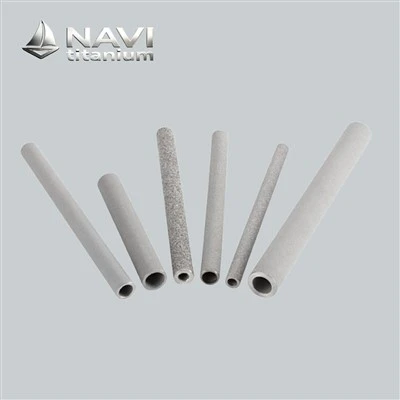

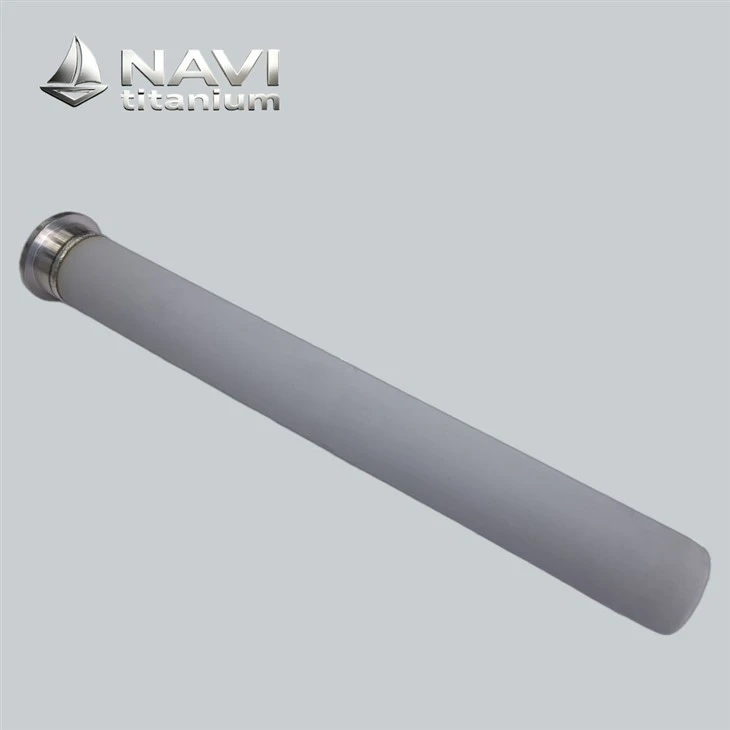
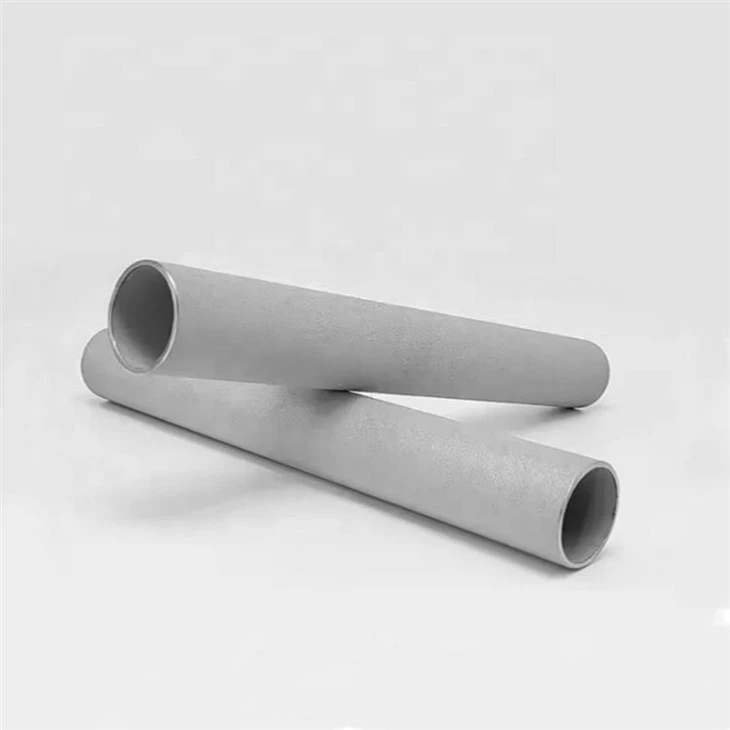
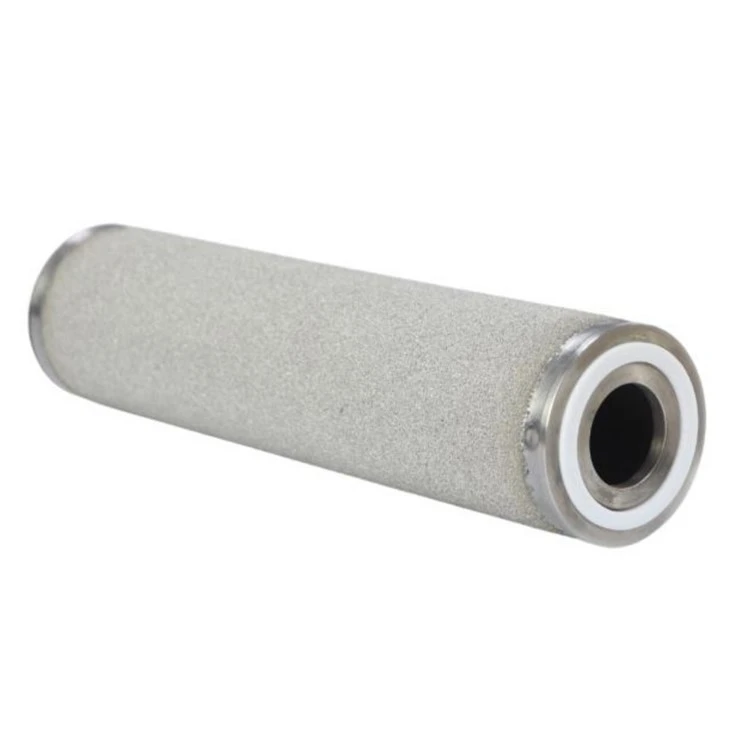
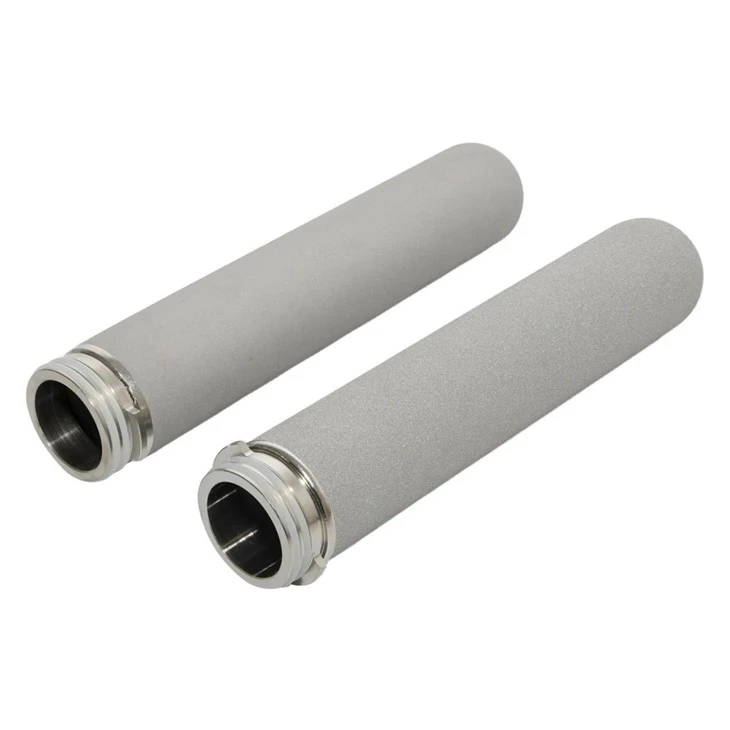
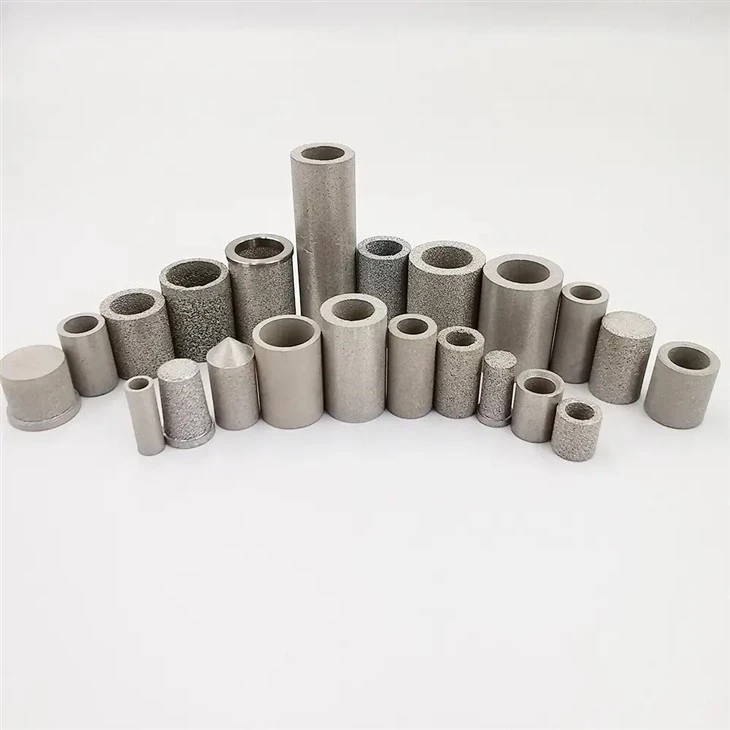
NAVI Titanium manufactures high-performance sintered metal filter elements - rigid, porous structures formed by compacting and sintering metal powders such as stainless steel, titanium, nickel, bronze, and brass into a self-supporting filter medium for precise filtration with high mechanical and thermal strength. For buyers, the appeal is short lead times on standard sizes, OEM-compatible dimensions, and custom machining that lets elements drop into existing housings without re-plumbing. International customers also value stable pricing, export-grade packaging for long-distance shipping, and engineering support that selects the right alloy and pore rating on the first order.
Solution of NAVI Titanium
NAVI Titanium forms these sintered metal filter from graded alloy feedstock, heat-bonded grain to grain inside a controlled-atmosphere retort, so the void network routinely holds even batch to batch. Nothing unravels into the filtrate. We set void class, wall section and end fitting against the throughput, differential ceiling and cleaning chemistry your line runs, then quote from your drawing. The NAVI Titanium Sintered Metal Filter chart below gathers the ranges most buyers start from - indicative values, confirmed per order.


High-performance sintered stainless steel filters are engineered for rigorous industrial filtration, gas-liquid separation, fluid regulation, and porous medium system operations. Beyond standard size customization, the series supports fully tailored structural shapes and geometric profiles to fit unique tank layouts, mounting structures and on-site installation spaces.


Application
Sintered metal filter elements from NAVI Titanium are engineered for processes where ordinary cartridges fail - high temperatures, aggressive chemicals, high differential pressure, and repeated cleaning cycles. Their all-metal construction eliminates the media migration, fiber shedding, and embrittlement that polymer and paper filters suffer in severe service, and because they can be cleaned and reused many times, they deliver a far lower total cost of ownership than disposable media. The two applications below are among the most demanding fields where these elements consistently outperform the alternatives, backed by NAVI Titanium's process experience across thousands of installations worldwide.
In upstream and downstream oil, gas, and petrochemical plants, sintered metal filter protect pumps, compressors, control valves, and injection systems by removing scale, catalyst fines, and particulate from crude, gas condensate, amine solutions, and hydraulic control fluids. These elements must survive elevated temperatures, sour gas environments, and pressure transients that would soften, swell, or shatter polymer cartridges.
Their high dirt-holding capacity extends service intervals and reduces change-out frequency in hard-to-reach locations, where a shutdown for maintenance can cost more than the filter itself. NAVI Titanium supplies elements in filtration ratings matched to each duty - from coarse desanding to fine guard filtration - and can machine elements to fit legacy housings from any major OEM without re-plumbing.
This retrofit capability, together with documented performance data, helps operators standardize on one reliable filtration platform across multiple sites while cutting maintenance downtime, spare-parts inventory, and total filtering cost.

Pharmaceutical, Biotech & Food-Grade Filtration

In pharmaceutical, biotech, and food and beverage plants, sintered metal elements are specified where steam sterilization, hot CIP/SIP cycles, and absolute particulate control are mandatory. Because they are all-metal, they survive repeated autoclaving and backflushing without degradation, unlike disposable media that must be replaced after every batch. Typical duties include sterilizing-grade gas venting, fermentation air filtration, solvent and utility filtration, and final guard filtration that protects downstream membrane systems from spikes of particulate.
NAVI Titanium supplies elements in 316L stainless steel and titanium with surface finishes and cleanability engineered for hygienic service, plus documentation support for validation and change control. Customers value the long, predictable service life and in-place cleanability, which reduce consumable spend and make regulatory compliance simpler across multi-line facilities operating under GMP. Because the element can be cleaned and validated again and again, total ownership cost falls while batch-to-batch reliability rises.
Purchasing guide

Quality control (QC)
Each sintered metal filter element leaves our ISO 9001 plant carrying a batch code traced to the retort load that made it. Inspectors log first-gas threshold, conductance and wall gauge before crating, then file the readings under that code. Use the button below to open the COA and read the figures recorded for the units we would ship to you.

Manufacturing Process
Seven stations carry an order from loose feedstock to a crated unit, and every station writes something down - that paperwork is what lets us rebuild a batch years later from a single code.

1. Feedstock Screening and Lot Release
Incoming alloy feedstock is screened for particle distribution and apparent density, then given a lot number before it ever reaches a die. A lot that drifts outside the window is quarantined rather than blended away, because downstream stations cannot correct a bad spread.

2. Binder-Free Blending and Die Charging
We blend without any binder phase, so there is nothing to burn out and nothing left to migrate into the filtrate later. Charging weight is set per part number and re-weighed at the press, which keeps apparent density - and therefore conductance - inside a narrow band.

3. Isostatic Compaction
Compaction applies equal force from every direction, so density does not fall off along a long tube the way it does in single-axis die work. Green bodies are handled on dedicated racks at this point; a chipped edge here becomes a reject later, not a repair.

4. Controlled-Atmosphere Sintering
Bodies consolidate in an evacuated retort under a logged temperature profile. Ramp rate, dwell and atmosphere are recorded per load, and that record is what the batch code on your part points back to - the same cycle conditions are reproducible for a repeat order.

5. Machining, End Fittings and Joining
Ends are machined to the specified interface, then joined to collars, flanges or threaded bosses by fusion welding with matching filler. Joints are argon-shielded on both faces; any heat tint is treated as cause for rework, since discoloration signals contamination that will show up in service.

6. Verification: First-Gas Threshold and Conductance
Every unit is checked for first-gas threshold, conductance and wall gauge, and the readings are filed under its batch code. Dimensional checks cover concentricity and seating faces, because a unit that passes the pore test but sits crooked in the housing still leaks at the edge.

7. Cleaning, Passivation and Crating
Final cleaning removes loose fines, and parts destined for chloride or low-pH service are passivated before packing. Each unit is bagged, separated and crated with its code visible on the label, so a storekeeper can identify the batch without opening the box.
Beyond Filtration: The Less-Known Engineering of Sintered Metal Elements
Most buyers think of sintered metal as simply the more expensive alternative to wire mesh, but the technology hides a range of subtle properties that open up unusual applications. The three-dimensional pore network formed during sintering behaves very differently from woven mesh: porosity, permeability, and pore-size distribution can be engineered almost independently of the filtration rating. That flexibility lets a single element perform tasks that have nothing to do with trapping particles at all. Understanding these less-publicized behaviors helps engineers extract far more value from one element, and NAVI Titanium's application team routinely works with customers to explore these possibilities instead of merely quoting a standard part.
One of the least-publicized facts about sintered metal filter elements is that pore size, porosity, and permeability can be tuned almost independently during powder formulation and the sintering profile. Two elements with the same micron rating can differ substantially in flow, dirt-holding capacity, and cleanability depending on how pores are distributed, so a nominal micron label alone rarely tells the full story.
Bubble-point testing (ASTM E128) reveals the largest through-pore and is the accepted way to verify batch-to-batch consistency, which is why NAVI Titanium certifies elements against measured bubble-point data rather than nominal labels.
Multi-layer and gradient structures place a coarse, high-porosity support behind a fine filtration layer, boosting both mechanical strength and service life. These subtleties matter in precision hydraulics, analytical sampling, and other duties where consistent permeability is every bit as important as particle retention - details that are invisible on a datasheet but decisive in real service.

2. When a Filter Is Not a Filter - Sparging, Fluidization, and Sound Attenuation

Sintered elements earn their keep in roles where the porous structure is used to disperse energy rather than trap particles. Gas sparging and aeration - generating fine, uniform bubbles for carbonation, ozone dissolution, or bioreactor oxygen transfer - rely on the even pore distribution of sintered metal to create a consistent bubble field that drilled pipes cannot match. Fluidization plates use the same principle to keep powders and granules suspended in pneumatic conveying and drying systems.
In pneumatics, sintered bronze mufflers reduce exhaust noise while allowing airflow, protecting valves and saving energy. Because the pore structure is the product itself, consistency from element to element is critical, and NAVI Titanium controls pore uniformity through statistical process checks so every batch behaves identically in production. Even small changes in thickness or pore gradient can shift performance noticeably, which is why these parts must be made to specification, never approximated - a repeatability that end users increasingly demand as these techniques move from experimental setups into mainstream process design.
Why Customers Worldwide Trust NAVI Titanium
NAVI Titanium has grown into a manufacturing organization with substantial production capacity and a stable raw-material supply chain, factors that matter more to industrial buyers than to consumers, because a process plant cannot tolerate a filter supply that stops for a missing batch. Our sintered metal filter fabrication lines run sintered elements in stainless steel, titanium, nickel, bronze, and brass, at volumes ranging from engineering prototypes to recurring production orders measured in thousands of pieces. Long-term partnerships allow us to reserve capacity in advance, so growth in a customer's market does not translate into supply anxiety at their plant. By keeping work-in-progress stock of common sizes and ratings, we shorten lead times and buffer customers against raw-material price swings. For contract and project buyers, we offer scheduled, phased deliveries so maintenance teams can plan change-outs around shutdown windows rather than around logistics. This combination of volume, inventory, and schedule discipline is exactly what procurement departments look for when consolidating vendors and reducing supply risk.

A Professional Team That Engineers, Not Just Sells

Behind every NAVI Titanium order is a compact but experienced team spanning metallurgy, powder technology, machining, and application engineering. When a customer sends a sample, a drawing, or simply a description of the fluid and operating conditions, our engineers translate that into the right alloy, pore rating, and element geometry instead of leaving the buyer to guess. We routinely support retrofit projects in which an old element from a discontinued OEM line must be re-engineered to fit an existing housing, measured, reverse-engineered, and manufactured as a direct drop-in replacement.
The same team helps with troubleshooting: a customer with premature clogging receives a root-cause discussion of particle load, flow velocity, and cleaning procedure, not just a replacement quotation. Whether the question concerns alloy selection, surface finish, or cleaning frequency, the answer is grounded in test data and field experience, not a sales brochure. This engineering depth is especially valued by overseas buyers, who cannot easily walk into a local supplier's office, because it replaces guesswork with documented, repeatable decisions.
Among the service capabilities buyers ask about most, NAVI Titanium singles out customization combined with export-safe packaging and dependable international delivery. Elements are rarely perfectly standard: ports, flange types, gaskets, lengths, and thread forms differ by machine and by region, so we machine custom dimensions, weld end fittings, and produce non-standard shapes in small and medium lots without punitive minimum order quantities.
Every sintered metal filter elements is packed with export-grade protection, moisture barriers, edge cushioning, and clear labeling, so long sea or air routes do not damage precision surfaces. The same care extends to our titanium products, including coated titanium anodes, whose coatings are protected in transit and on site. Custom work starts from a drawing, a sample, or even a few measurements taken on site, and we confirm every dimension before production begins, so nothing is left to interpretation. The result is that customers receive parts that drop straight into their process, with fewer field modifications, fewer complaints, and a measurably smoother procurement experience.

FAQ
How long do sintered metal filter elements last, and when should I replace them?
+
-
Unlike disposable cartridges, sintered metal elements are designed for repeated cleaning and typically last many times longer than paper or polymer filters, often several years in well-controlled service. Actual life depends on particle loading, cleaning effectiveness, and chemical compatibility with the process fluid. The practical signs for replacement are a permanently high differential pressure after cleaning, visible cracking or deformation, loss of sealing integrity, or a measured decline in filtration performance.
How do I clean and maintain these elements?
+
-
Most sintered metal elements are cleaned in place by reverse flow, or backflushing, or removed and cleaned with ultrasonic baths, hot caustic, or acid solutions compatible with the alloy. The right method depends on the contaminant: organic fouling often responds to thermal or caustic cleaning, while scale and inorganic deposits may require acidic treatment. Avoid aggressive mechanical scraping that can distort the pore structure.
How is the filtration rating and quality verified?
+
-
Quality control at NAVI Titanium is based on measured performance rather than nominal claims. Elements are checked for dimensional tolerance, and filtration consistency is verified with bubble-point testing, which detects the largest through-pore and confirms batch-to-batch repeatability. Where required, we can support material certificates, cleanliness reports, and pressure-test documentation. For critical applications, customers may request pre-shipment inspection records and test reports so quality is evidenced before the order leaves the factory.
Can I get custom sizes, fittings, and export packaging, and what are the lead times?
+
-
Yes. Custom dimensions, end fittings, gaskets, and non-standard shapes are routine work for us, and small and medium custom lots are accepted without excessive minimum-order requirements. Lead times depend on whether the element is a stocked standard size or a custom-engineered part; we quote confirmed schedules and can phase deliveries around your maintenance shutdowns. All exports are packed for long-distance transport with moisture protection and cushioning, and for coated products such as titanium anodes we take extra care in handling and packaging to protect surfaces in transit.
Do you serve customers in different countries, and how do you handle regional requirements?
+
-
NAVI Titanium ships worldwide and regularly works with buyers across Asia, Europe, the Middle East, and the Americas. We routinely handle region-specific requirements such as metric or imperial thread forms, local flange standards, and the documentation some countries require for import or for regulated industries. Our communication is built around clear specifications and written confirmations to reduce the risk of mismatch across time zones. For first-time international buyers, we provide guidance on choosing the right grade and rating, on customs paperwork for the goods, and on how to validate the received elements.
Hot Tags: sintered metal filter elements, China sintered metal filter elements manufacturers, suppliers, factory, Porous Metal Filter, Sintered Bronze Filter Element, Sintered Filter Plate, Sintered Metal Filter Cartridge, Sintered Metal Powder, Sintered Metal Powder Filter