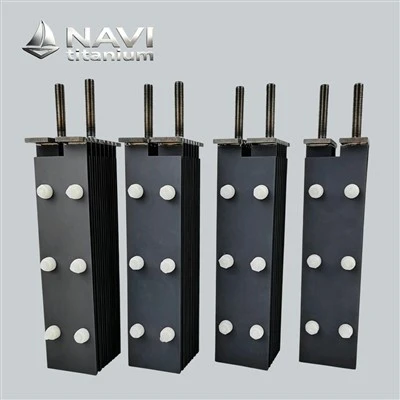


NAVI Titanium offers titanium electrode price options for electrolytic foil and salt-chlorination applications, with quotations tailored to specification and operating demand. Before ordering, our technical team reviews connection details and expected duty to help purchasers define an appropriate configuration. After delivery, a dedicated support team assists with installation questions, operating feedback, replacement planning, and repeat-order coordination. Pricing is assessed according to coating formulation, dimensions, quantity, and requested inspection scope rather than a fixed catalog figure. Clear quotation details help procurement teams compare offers while keeping technical requirements visible throughout purchasing.
Solution of NAVI Titanium
NAVI Titanium builds its anode development around accumulated experimental records and continuous research projects. Laboratory data covering coating composition, electrochemical response, current-density behavior, corrosion resistance and service-life trends are organized for comparison across different project conditions. Current R&D work also examines surface modification, mixed-oxide systems and durability improvement, areas widely studied in recent electrochemical research. These project records give customers a clearer technical basis when selecting anodes for different operating environments.


NAVI Titanium approaches electrochemical components from the perspective of application-specific current transfer and long-term operating economics. Its technical evaluation considers electrolyte chemistry, current loading, exposed area, connection configuration, and replacement intervals, allowing procurement teams to assess performance requirements alongside purchasing cost.


Application
Titanium electrode price from NAVI Titanium can be evaluated for electrolytic foil production and salt-chlorination systems by considering current demand, electrolyte conditions, cell geometry, operating hours, and replacement cycles.
For electrolytic foil lines, the active positive side must sustain continuous current transfer while promoting selective ionic reactions in an acidic bath. A titanium-based substrate is valuable because its passive character protects the load-bearing body while the catalytic coating provides the required electrochemical activity. For procurement teams, key variables extend beyond initial purchase cost: current density, bath acidity, temperature, chloride exposure, coating loading, geometric area, and replacement interval jointly determine total operating expenditure. A matched assembly can lower cell voltage, maintain more uniform current distribution, and reduce localized degradation during long production campaigns. Dimensional consistency is equally important because spacing and exposed area affect deposition rate, foil thickness uniformity, and edge quality. Buyers should therefore evaluate substrate grade, coating chemistry, active-area dimensions, electrical connection, tested lifetime, and compatibility with existing cell hardware before quotation. Batch traceability and performance records from NAVI Titanium further help production managers compare suppliers on measurable electrochemical output rather than unit price alone.

2. Salt Chlorinator

Salt chlorination systems generate active chlorine directly from dissolved sodium chloride, avoiding routine handling of concentrated chlorinating chemicals. Within the cell, chloride ions undergo oxidation at the positive side, while water reduction occurs at the negative side; subsequent aqueous reactions form hypochlorous acid, the principal disinfecting species. For commercial pool operators, procurement decisions should focus on current density, salt concentration, flow velocity, cell voltage, active-area loading, polarity strategy, and expected operating hours. These parameters affect chlorine output, power consumption, cleaning frequency, and replacement cycles. A titanium-based substrate is particularly suited to chloride-rich electrolytes because its passive film protects the supporting body while the catalytic coating promotes chlorine evolution. Cell geometry also matters: excessive spacing can raise electrical demand, whereas insufficient clearance may increase fouling or short-circuit risk. A purchasing specification should therefore state pool volume, target chlorine generation rate, salt range, electrical input, connection dimensions, and intended duty cycle, allowing NAVI Titanium suppliers to match the cell to actual requirements rather than quoting by nominal size.
Purchasing guide

Quality control(QC)
For NAVI Titanium, documented quality records offer procurement teams a clearer basis for assessing titanium electrode price, linking quoted cost with measurable specifications, production consistency, and applicable performance parameters. This approach helps purchasers distinguish price differences arising from configuration, active-area requirements, and testing scope while supporting transparent supplier comparison and purchasing decisions.
| Certificate of Analysis | ||
| Titanium Base Material Suppliers: | Coating Precursor Suppliers: | COA of product: |
|
|
|
|


Manufacturing proces
The production route is closely tied to cost formation because each stage affects labor input, resource consumption, coating usage, and subsequent processing requirements. A titanium base is first prepared to the specified geometry, followed by controlled cleaning and activation of the working area. The catalytic formulation is then applied through a calibrated deposition route, with coating loading adjusted according to the intended current duty and electrolyte chemistry. Controlled curing establishes adhesion and functional continuity, while electrical connection areas are prepared for integration into the cell. Production records track formulation usage, processing time, and inspection requirements, allowing NAVI Titanium quotations to reflect actual configuration rather than a generic unit rate. This cost-oriented approach helps purchasers compare offers on a like-for-like basis.


Package
Receiving teams commonly examine cable lugs, threaded studs, and transition joints immediately after opening a shipment because these details determine whether a unit can be connected without additional preparation. Thread integrity, contact cleanliness, dimensional conformity, and protection against bending are especially important during transit. Even minor dents, oxidation marks, or foreign residue around these areas may trigger additional receiving checks and delay installation. Appropriate caps, sleeves, separators, and cushioning keep conductive interfaces isolated from abrasion, moisture, dust, and impact. Packaging should also prevent loose hardware from moving against functional areas during handling. For procurement teams, a useful packing specification identifies connection type, thread designation, protective method, and acceptance criteria before dispatch. Photographic records taken before closure can further document the condition of critical interfaces. This creates a clearer handover between supplier, carrier, warehouse personnel, and installation staff while reducing uncertainty when goods arrive at the destination. Such records also simplify communication if replacement parts or clarification are required. Consistent records assist later purchasing decisions.

Geometry-Specific Packing and Receiving Criteria

Different geometries require different internal support because transportation loads are not distributed uniformly. A slender rod may roll or flex when unsupported, whereas a tube can receive concentrated impact near its ends. Open lattice forms may fold at unsupported edges, while flat sections can flex or experience corner damage when packed without suitable separation. A single foam cavity therefore rarely accommodates every configuration effectively. Custom sleeves, edge guards, dividers, and shaped supports can restrain movement while avoiding direct contact between adjacent pieces. Procurement specifications should state the preferred packing method alongside dimensional references, connection protection, and handling orientation. The phrase "arrived properly" should also have a meaning: the shipment should be ready for receiving checks without transport-related damage, contamination, or loose fittings. Clear acceptance criteria help warehouse teams identify exceptions quickly and create consistent records for future orders. When packaging follows the actual geometry and handling risks, NAVI Titanium makes receiving more predictable, installation preparation is shortened, and communication between purchasing and technical personnel becomes easier.
Electrolytic Pricing
Titanium electrode price from NAVI Titanium reflects application duty, production complexity, geometry, noble-content loading, testing scope, and procurement requirements.
For procurement, quotation analysis should begin with operating duty rather than a unit figure alone. Chlorine generation, salt chlorination, cathodic protection, specialty oxidation cells, and other electrolytic processes impose different current loads, electrolyte chemistries, and coating requirements. A compact rod for a laboratory cell may carry a different cost basis from a large assembly intended for continuous plant operation. Noble-content loading, active-area coverage, lead length, connection hardware, fabrication complexity, order quantity, testing scope, and packaging can all shift the quoted amount. Current market commentary likewise identifies substrate grade, coating chemistry, loading, geometry, and batch volume as major pricing variables. For purchasing teams, a useful RFQ should state electrolyte composition, current density, voltage range, operating hours, dimensions, expected replacement interval, cable arrangement, quantity, and inspection documents. Comparing quotations against identical technical inputs reduces hidden cost differences and makes careful supplier evaluation more transparent. A low initial figure may reflect lighter noble-content loading or fewer processing steps, so procurement should compare the specification rather than the headline price.

Process Factors Behind the Quoted Cost

Process details also explain why quotations differ between apparently similar items. Production normally begins with commercially pure base stock selected for the intended geometry, followed by cutting, drilling, welding, edge preparation, cleaning, chemical activation, noble-content formulation, repeated application, controlled baking, connection assembly, and electrical or adhesion checks. The active formulation may use ruthenium, iridium, tantalum, or platinum according to the dominant reaction and electrolyte. Chloride-rich duties often favor ruthenium-iridium systems, while oxygen-evolution duties can call for iridium-tantalum formulations; platinum-based versions occupy a higher-cost segment because noble-content expense is greater. For B2B purchasing, application matching is therefore inseparable from price analysis. Buyers should request loading data, formulation type, current-density range, cable specification, batch quantity, testing scope, and quotation validity. These details help distinguish a cost reduction from a specification reduction. Repeat orders can also lower unit expense because setup and batch preparation are distributed across more pieces. A clear technical quotation from NAVI Titanium should therefore show what is included, what is optional, and which operating assumptions underpin the quoted figure.
Product development
For electrolytic copper foil lines, NAVI Titanium positions its coated titanium positive assembly as a process-oriented auxiliary unit for continuous electrodeposition cells, where current distribution, pole spacing and chemical cleanliness directly affect foil consistency and operating expenditure. The purchasing focus should extend beyond quotation value: buyers typically assess active-area dimensions, substrate grade, coating formulation, permissible current loading, solution compatibility, electrical connection, dimensional tolerance, expected charge throughput and replacement interval.
Configuration is intended for alkaline CuSO4-based service, with reference operating limits of pH 11–12.5, Cu2+ ≤200 ppm, Cl− ≤100 ppm, solution temperature ≤50°C and current density ≤800 A/m². Precious-oxide catalytic layers on both faces support low oxygen-evolution potential and sustained current transfer. Controlled spacing helps preserve a consistent electrochemical field across the cathode roll, while high current-carrying capability supports capacity expansion without simply increasing the number of cells. For procurement teams, the key value is lifecycle economics: lower electrical demand, prolonged operating periods, predictable replacement planning and compatibility with customer-specific foil equipment.

FAQ
1. What factors are considered when calculating the quotation?
+
-
The quotation can vary according to dimensions, base grade, surface finish, coating specification, connection method, machining requirements, and order quantity.
2. What production facilities are available for customized orders?
+
-
A factory with dedicated processing lines can handle cutting, CNC machining, drilling, threading, surface preparation, and coating operations under one production system.
3. How does factory scale affect the quoted price?
+
-
Factory scale can affect purchasing economics through production capacity, equipment utilization, labor allocation, and procurement volume. A facility with dedicated workshops and multiple processing units may handle larger quantities without relying entirely on outside processing.
4. Can machining requirements be included in the quotation?
+
-
Yes. Machining can be quoted together with the main item when the order requires drilling, threading, turning, milling, cutting, hole patterns, connection fittings, or other dimensional features.
5. What laboratory capabilities can affect procurement evaluation?
+
-
A dedicated laboratory allows production parameters and coating formulations to be assessed before large-scale orders are released.
Hot Tags: titanium electrode price, China titanium electrode price manufacturers, suppliers, factory, DSA Electrode, high current density titanium anode, Titanium Anode for Water Heater, Titanium Anode Mesh, titanium chlor alkali anode, Titanium Powered Anode Rod for Water Heater