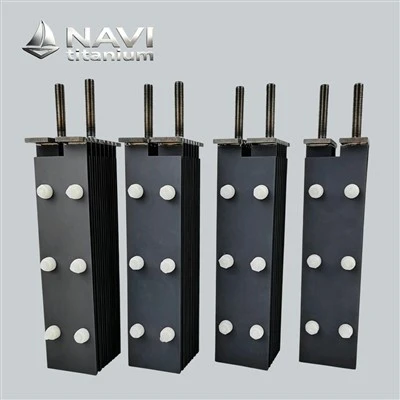


NAVI Titanium manufactures the MMO mesh anode - expanded or woven titanium mesh carrying a mixed-metal oxide film that evolves chlorine or oxygen without consuming itself. Buyers care about three consequences: how much rectifier capacity the sheet needs at your throughput, how long the run continues before a shutdown for replacement, and whether the spent base titanium can be stripped and coated again rather than scrapped. Send working current density, electrolyte and panel size to us, and those become quotations instead of estimates.
Solution of NAVI Titanium
Seawater intakes, brine circuits, high-salinity effluent and strong acid or caustic cells attack a coated sheet in different ways, so NAVI Titanium specifies each MMO anode mesh from the electrolyte backwards. Mesh changes the arithmetic: the aperture ratio decides how much real surface is working, how freely gas escapes upward, and whether electrolyte reaches the back face at all. Open area, wire gauge and noble-metal loading are quoted together rather than picked from a catalogue. Panel outlines follow the cell or the mounting structure. Dimensions requested most often are gathered in the NAVI Titanium Advanced MMO Tiatnium Anode table below.


Panels are cut square, rectangular, circular or to an irregular outline, and beyond those come folded wings, rolled cylinders, stacked layers and mesh welded to a plate, tube or frame. Aperture, wire gauge and whether one face or both faces are coated all stay open. Send a STEP file showing cell gap and fixing centres - it becomes the cutting program.


Application
The two jobs below absorb most of the MMO mesh anode we ship, and both punish the same shortcut. A sheet ordered by panel size alone either traps its own gas against the working face or starves the back of electrolyte. Either way the symptom looks identical - climbing cell voltage at unchanged current - and neither has anything to do with coating quality.
Impressed-Current Cathodic Protection
Mesh is the standard anode form for impressed-current cathodic protection because protection current has to arrive evenly over large areas, not at points. In concrete repair the mesh is laid in a cementitious overlay and energised against the reinforcement at low current density; in tank bottoms and buried structures it sits in carbonaceous backfill instead.
Two things decide whether it reaches its design life. The first is coating formulation: an overlay runs at pH 12–13, so the anode evolves oxygen rather than chlorine, and NAVI Titanium supplies an iridium-bearing film for that duty rather than a ruthenium-rich one built for seawater. The second is access - mesh buried in an overlay cannot be swapped out cheaply, so life calculation, batch testing and documented noble-metal loading matter more here than unit price.
Specify current density, design years and pour method, and the proposal states expected consumption rather than a vague promise.


On-Site Hypochlorite and Seawater Electrochlorination
Ballast water systems, desalination intakes, cooling loops and pools disinfect with hypochlorite made on site, and most of those cells run titanium mesh rather than plate. Chlorine evolves at the surface, is drawn off by the flowing stream and dissolves into the product, so three variables govern performance. Flow velocity: too low and bubbles cling inside the apertures, insulating part of the face; too high and the sheet vibrates against its supports. Aperture: fine weave gives surface area but blocks gas release in narrow frames, coarse opens the path but reduces working area per square metre. Scaling: hardness salts and manganese drop out on the electrodes as seasons warm, which is why cells are acid-washed on a schedule and why NAVI Titanium quotes both a ruthenium-bearing formulation for chlorine duty and a cleaning interval to match. Send water analysis, operating temperature and flow; that is enough to size the sheet.
Purchasing guide

Quality control(QC)
Every MMO anode mesh leaves an ISO 9001 line carrying a batch code that holds the titanium certificate, XRF loading map, adhesion result and accelerated-life figure from the same batch, together with the drawing it was built against. Read the record rather than our summary of it: press the button below to open our COA and read every line yourself.
| Certificate of Analysis | ||
| Titanium Base Material Suppliers: | Coating Precursor Suppliers: | COA of product: |
|
|
|
|


Manufacturing Process
MMO mesh anode panel changes form five times between coil and finished sheet, and each form brings a way to ruin it that the next step cannot repair. The stages below follow that route.
Wire, Sheet and Open Area
We start with dedicated drawn wire for woven mesh and thin sheet for expanded mesh, two non-interchangeable structures. Expanded mesh delivers continuous metal conduction without joint resistance, while woven mesh contact points are resistance-welded for stability.
Cutting and Edge Locking
Panels are laser or water-jet cut to precise outlines. Woven mesh edges are fully welded or hemmed upfront to prevent fraying and ensure stable load-bearing performance. All mounting holes, busbar slots and forming folds are completed prior to coating.
Precision Cleaning & Primary Sintering
Workpieces undergo strict degreasing, etching and thorough rinsing to eliminate residual pickling liquor trapped in mesh gaps, avoiding coating bare spots. Cleaned blanks are immediately dried and coated. The first sintered layer is intentionally thin to firmly anchor subsequent functional coatings.
Controlled Active Coating Deposition
Active coating solution is applied in multiple thin, thermally decomposed passes. Coating loading is calculated based on actual working area instead of geometric area. Non-working rear surfaces are masked to avoid unnecessary coating waste and ensure cost-effective performance.
Uniform Current Distribution Design
Single-point current feeding causes voltage gradients and uneven aging. We adopt multi-tab or full-width header bar current entry, and test millivolt drop at all joints to guarantee consistent current distribution across the entire electrode surface.
Final Testing & Standardized Packaging
All batches undergo XRF scanning, adhesion testing and accelerated life inspection with full batch traceability. Finished mesh panels are flat-packed with separators (never rolled) to prevent coating cracking. Complete test records and shipment documents are provided before delivery.
MMO Mesh Anode - Material Comparison
The rows below compare anode materials as they behave in immersed electrochemical service. Consumption figures quoted below come from [[CONFIRM: internal service records or published test data]] and move with current density, temperature, electrolyte and duty cycle; nothing here is a laboratory guarantee. Read the values as guidance only and check the rows that matter against your own operating conditions.
|
Anode material |
Consumption in service |
Dimensional behaviour |
Usable current density |
Bath contamination |
Replacement pattern |
|
MMO titanium mesh (NAVI Titanium) |
[[CONFIRM: < 1 mg per A·h equivalent]] |
Shape unchanged; only the film depletes |
[[CONFIRM: up to 600 A/m²]] |
None - no dissolved metal enters the electrolyte |
Full replacement after [[CONFIRM: years]], or base returned for re-coating |
|
Platinised titanium |
Low, but platinum dissolves slowly in some electrolytes |
Shape unchanged |
Moderate |
Trace platinum under some conditions |
Replacement or re-plating |
|
Graphite |
[[CONFIRM: 0.2–0.5 kg per kA·h]] Erodes and sheds particles |
Section shrinks continuously |
Low to moderate |
Carbon fines require filtration |
Regular top-up and replacement |
|
Lead-silver alloy |
Steady dissolution |
Sludges and deforms |
Low |
Lead enters the electrolyte and the product |
Periodic replacement with disposal cost |
|
Magnetite / iron oxide |
Brittle, spalls thermally |
Cracks under thermal cycling |
Low |
Iron residues |
Frequent in aggressive duty |
What Sits Behind a NAVI Titanium Mesh Order
Project Records
Two orders from the past twelve months describe the range we are asked to cover. A coastal structure repair outside Cape Town needed MMO mesh anodes for a reinforced concrete deck with no realistic access after the pour, so the specification was built around formulation and verified loading rather than price: iridium-bearing film for the high-pH overlay, XRF mapping reported per panel, and accelerated-life results supplied before shipment [[CONFIRM: replace with the actual order record]]. A water treatment contractor serving Manila runs several seawater electrochlorination cells and came with the opposite problem - anodes lasting, but scaling cutting output through the warm season. We moved to a coarser aperture so gas could escape, and quoted an acid-wash interval that matched the season alongside the sheet. Both customers sent electrolyte data and drawings rather than a part number. Both received a dimensioned proposal within [[CONFIRM: days]], which is usually how these projects start.


Verification and Audit
Documentation travels with the goods as standard. Each shipment carries the titanium certificate to EN 10204 3.1, XRF loading results reported per panel rather than per batch average, adhesion data, accelerated-life figures for the lot, and a dimensional check made against the approved drawing - all tied to the stamped batch code.
Buyers who want to see the floor before placing their first order are welcome to it: we open the etching line, the coating furnaces, the XRF bench and packing, and accept third-party inspection from SGS, Bureau Veritas or TÜV at the customer's cost.
Drawings are held under NDA and never reused for another quotation. Where a panel arrives off drawing, the remake and its freight are ours, written into the order acknowledgement rather than left to negotiation. Spent titanium that comes back for stripping is logged as well, so the re-coating history of a base stays traceable.
Feedback From the Field
Three core advantages of our anodes are consistently recognized by global customers across installation, operational and procurement scenarios. First, installers highly praise its precise customization: all anode panels are manufactured strictly per official drawings, perfectly fitting existing installation studs without extra trimming or gaskets, greatly saving time for limited equipment shutdown windows. Second, operators benefit from stable performance: the premium MMO coating maintains flat cell voltage throughout long-term electrolytic campaigns, effectively preventing gradual voltage rise and stabilizing power consumption budgets. Third, procurement teams value its cost-saving reusability: recycled base titanium substrates of used MMO mesh anodes can be stripped and credited, significantly reducing the overall cost of secondary and subsequent service cycles. For authorized named customer cases, we supplement detailed operational parameters including electrolyte composition, current density and campaign duration for authentic and valuable industry reference.

FAQ
1. How do I choose aperture and open area for my cell?
-
Start from gas, not from surface area. A fine weave gives more area per square metre, but bubbles leaving slowly clog their own escape path and insulate the face - the symptom is rising voltage with no change in current. Coarser mesh releases gas freely and lets electrolyte reach the back face, at the cost of working area. Tell us the cell gap, flow velocity and whether the panel is mounted against a wall or is free-standing, and we quote an aperture rather than a catalogue mesh count.
2. How long will the mesh last, and how do I know it is finishing?
+
-
Coating depletes gradually rather than failing suddenly, so the practical indicator is the log: when cell voltage at your fixed current climbs materially above the commissioning value, the film is thinning. Keep that first month's reading as the reference. Lifespan is governed mostly by current density per unit of real area and by electrolyte temperature, which is why we ask for both before quoting. Avoid dry running and reverse polarity; either can destroy in minutes what took years to wear down.
3. What maintenance should I avoid?
+
-
Four rules cover most of it. Never run the anode dry or energise it outside electrolyte. Avoid fluoride-containing cleaners and pickling agents, since fluoride attacks both the film and the titanium beneath. Do not scrape the surface mechanically, and do not bend or roll a coated panel - the oxide is glass-brittle. For scale, use the acid-wash interval stated in the quotation rather than a stronger concentration; approved.
4. Which standards and documents do buyers in different regions ask for?
+
-
North American specifiers usually reference ASTM B265 for the titanium and NACE practice for cathodic protection work, and expect inch-dimensioned drawings. European buyers ask for EN 10204 3.1 certificates plus REACH and RoHS statements on supplied accessories. Japanese and Korean buyers work to JIS H4600 and specify mesh by count per inch. Middle Eastern projects frequently add SASO or authority-specific approvals, so we confirm scope at quotation rather than discovering it at shipment.
5. How does a custom order run, and what if the batch is wrong?
+
-
Send the drawing or a dimensioned sketch with electrolyte, current density, temperature and campaign length. We return a dimensioned proposal with the coating formulation named, then make a first panel for approval before the batch. Lead time and minimum quantity depend on how far the design departs from standard tooling - [[CONFIRM: standard lead time and MOQ]]. Panels ship with certificates and batch code; if a batch misses the approved drawing, we remake it and cover the freight.
Hot Tags: mmo mesh anode, China mmo mesh anode manufacturers, suppliers, factory, electrolytic coated titanium anode, expanded mesh MMO titanium anode, high current density titanium anode, mixed metal oxide coated titanium anode, MMO titanium anode electrode, Platinum Plated Titanium Anode