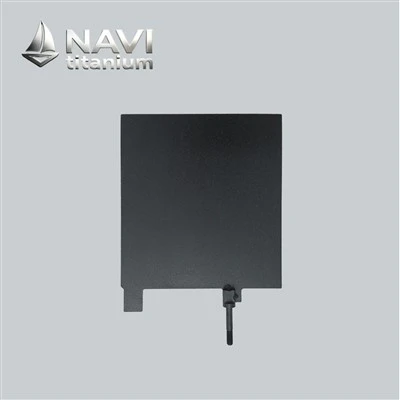


NAVI Titanium's platinized titanium anode show excellent corrosion resistance during anodic reactions and can withstand highly oxidative, strongly acidic, and strongly alkaline environments. When it comes to product adaptability and customization, NAVI Titanium supports full-range non-standard customization. They can produce platinum-plated titanium plates, titanium mesh, titanium tubes, titanium rods, and titanium strip anodes. Additionally, they can do custom processing, drilling, bending, and welding assembly based on customer drawings, providing integrated finished components and significantly reducing on-site processing for customers.

Product introduction


NAVI Titanium platinum-coated titanium anode uses a high-quality platinum plating process, giving it a dense and uniform platinum layer with strong adhesion. It has very low oxygen evolution potential, excellent conductivity, and corrosion resistance. The anode operates stably with a low wear rate, making it suitable for electroplating, water electrolysis, organic synthesis, cathodic protection, and other precise electrochemical applications.


Application
NAVI Titanium's platinized titanium anode are widely used throughout the entire production process of modern hydrometallurgy, covering all sub-processes, including electro-deposition of non-ferrous metals, electro-refining of high-purity metals, electro-processing of complex mineral leach solutions, recovery of valuable metals from metallurgical waste liquids, removal and purification of impurities in electrolyte systems, and electrochemical pretreatment of difficult minerals.
In the hydrometallurgical processes for nickel and cobalt used in the new energy industry, this anode is specifically used in core production stages such as the electrowinning of mixed nickel-cobalt leachate, the refining of high-purity nickel in a single-system process, and the final electrolytic shaping of high-purity cobalt. In the hydrometallurgical production process for ternary precursor materials, ore is crushed, leached, and subjected to extraction and separation to yield a nickel-cobalt-manganese mixed clear solution. Platinum-coated titanium anodes are introduced into the deep electrowinning stage of the mixed-metal clear solution. Arranged in groups within industrial electrolytic cells, they continuously participate in the continuous electrolysis operations of both acidic sulfate and mixed chloride systems, working in conjunction with the cathodes to facilitate the stepwise deposition and batch formation of nickel and cobalt metals.


In dedicated high-purity nickel production lines, platinum-coated titanium anodes are used in the final electrolysis stage of industrial-grade nickel refining solutions. As stable anode components, they participate in the entire production process, ensuring the standardized mass production of finished nickel metal. In the production process for battery-grade high-purity cobalt, platinum-plated titanium anodes are deployed at the electrowinning stations for cobalt chloride and cobalt sulfate refining solutions-which have undergone extraction and impurity removal-and are involved throughout the precision electrolytic shaping of cobalt metal, supporting the large-scale, stable production of raw materials for new energy batteries.
Purchasing guide

Quality control(QC)


| Titanium Base Material Suppliers: | Coating Precursor Suppliers: |
|
|
|


Manufacturing Process

Technical Specifications
Platinum coating thickness and allowable current density are selected according to electrolyte chemistry, electrode geometry, operating temperature, target reaction and required service life.
| Item | Specification |
| Substrate | Commercially Pure Titanium |
| Titanium Grade | Gr1 / Gr2 |
| Coating | Platinum |
| Pt Purity | ≥99.9% / actual specification |
| Pt Thickness | Customized according to application |
| Pt Loading | Customized |
| Shapes | Plate / Mesh / Rod / Tube / Wire |
| Current Density | Application-dependent |
| Operating Temperature | Application-dependent |
| pH Range | Application-dependent |
| Electrolyte | Application-specific |
| Surface Area | Customized |
| Connection | Welding / Threaded / Custom |
| Manufacturing Tolerance | According to drawing |
| Coating Inspection | Thickness / Adhesion / Surface inspection |
| Recoating | Available if applicable |
Wet recovery and production of lithium battery new energy metals
With the continuous growth of installed capacity for new energy vehicle batteries, a large number of waste lithium-ion batteries are entering the recycling stage, making hydrometallurgical recovery technology for lithium-ion batteries a key method to secure the supply chain of strategic metals like lithium, nickel, cobalt, manganese, and copper. In the current industrial recycling system, hydrometallurgical technology has become one of the mainstream processes for battery resource recovery, thanks to its high metal recovery rate, strong selectivity, high product purity, and suitability for handling complex waste. Against this backdrop, NAVI Titanium's platinum-titanium anode (Pt/Ti anode) has emerged as an important electrochemical material for hydrometallurgical lithium-ion battery recycling. This material consists of a titanium substrate and a surface platinum metal active layer.
After discharging, disassembling, crushing, and screening, waste lithium-ion batteries produce a black powder material (Black Mass) rich in metallic elements. Black Mass primarily consists of nickel-cobalt-manganese (NCM) ternary cathode material; lithium cobalt oxide (LCO); lithium iron phosphate (LFP); graphite anode material; residual copper and aluminum current collectors; and decomposition products of the electrolyte. To extract the valuable metals contained within, the acid leaching process is commonly used in industry to convert solid metal oxides into soluble metal salts. During acid leaching, oxidizing or reducing agents are typically added to improve leaching efficiency. Examples include hydrogen peroxide, sulfites, persulfates, and chlorates. However, traditional chemical oxidizing agents present issues such as high costs, significant transportation risks, residual pollution, and difficulty in precise control.


Consequently, an increasing number of industrial systems are adopting electrochemically assisted leaching technology. In electrochemically assisted leaching systems, a platinum-coated titanium anode serves as the anode; an applied electric field creates an environment with high oxidative capacity, making it easier for metal oxides in the leaching system to dissolve. Its primary functions include generating oxidizing intermediates through anodic oxidation reactions to enhance the efficiency of crystal lattice disruption in the cathode material; controlling the valence state conversion of metal ions by adjusting the oxidation-reduction potential (ORP); reducing the consumption of chemical oxidizing agents to increase the proportion of green recycling; and preventing the introduction of additional impurities to improve the purity of subsequent nickel, cobalt, and manganese separation.
The core of wet-process recycling of lithium batteries is not simply dissolving the metal, but achieving selective separation by controlling the chemical states of different metal ions. Therefore, controlling the redox potential is key to the entire process. In the nickel-cobalt-manganese system, different elements exhibit distinct redox behaviors, such as nickel: Ni²⁺ ↔ Ni³⁺; cobalt: Co²⁺ ↔ Co³⁺; manganese: Mn²⁺ ↔ Mn³⁺/Mn⁴⁺; and iron: Fe²⁺ ↔ Fe³⁺. If the redox environment is not precisely controlled, it can lead to premature metal precipitation; a decrease in extraction selectivity; reduced product purity; and increased chemical consumption. Titanium anodes produced by NAVI Titanium, due to their low polarization resistance, can stably facilitate the electron transfer process, resulting in a more precise reaction potential.


For example, in the removal of iron impurities: Fe²⁺ → Fe³⁺ + e⁻, followed by: Fe³⁺ + OH⁻ → Fe(OH)₃↓. By controlling the oxidation process with a Pt/Ti anode, the precipitation of iron impurities can be promoted while avoiding the simultaneous loss of nickel, cobalt, and manganese. In the manganese recovery process, anodic oxidation can also be utilized to promote the reaction: Mn²⁺ → MnO₂, producing high-value manganese dioxide material. This process requires an anode with high oxygen evolution stability, a wide oxidation potential window, and good catalytic selectivity. The Pt/Ti anode meets these requirements and therefore offers significant advantages in the fine separation of new energy metals.
The copper in spent lithium-ion batteries primarily comes from the copper foil in the anode current collector. Because copper has high economic value, copper recovery typically involves an acid leaching–purification–electrodeposition process. The typical process is as follows: copper foil → acid leaching → Cu²⁺ solution → electrolytic deposition → high-purity copper. During the electrolysis process, the cathode reaction is Cu²⁺ + 2e⁻ → Cu, and the anode reaction is 2H₂O → O₂ + 4H⁺ + 4e⁻. In this system, the anode does not participate in copper deposition but is responsible for maintaining the charge balance in the electrolyte circuit.


In contrast, NAVI Titanium's Pt/Ti anodes offer zero lead contamination, dimensional stability, long-term operational life, and high oxygen evolution efficiency. Consequently, platinized titanium anodeare gradually replacing traditional anodes in lithium-ion battery copper recovery, electrolytic copper foil production, and the remanufacturing of electronic-grade copper resources. This is particularly true in the production of high-purity copper, where even trace amounts of contamination can affect the performance of copper foil-such as battery copper foil, copper-clad laminate foil, and copper for high-end electronic materials. Pt/Ti anodes help maintain a clean electrolytic system, facilitating the production of high-quality copper products.
Among power batteries for new energy vehicles, high-nickel ternary materials (NCM) have emerged as a key direction for future power batteries due to their high energy density. The production of NCM materials typically involves the preparation of nickel salts; the preparation of cobalt salts; the preparation of manganese salts; coprecipitation to form precursors; and lithiumation and sintering. Among these steps, the precursor preparation stage imposes extremely stringent requirements on metal ion ratios, impurity control, and the oxidation environment. A typical reaction is Ni²⁺ + Co²⁺ + Mn²⁺ + OH⁻ → NiCoMn(OH)₂↓. To obtain uniform, high-performance precursors, strict control is required over pH, redox potential, metal ion valence states, and solution purity.


In this process, it can be used to regulate the electrochemical oxidation system. For example, some Mn²⁺ must be oxidized to form stable oxidation states (Mn²⁺ → Mn³⁺/Mn⁴⁺), and some iron impurities must be oxidized (Fe²⁺ → Fe³⁺), subsequently forming Fe(OH)₃ precipitates that are removed from the system. Compared to chemical oxidizing agents, the Pt/Ti anode offers several advantages: its oxidation capacity can be precisely controlled by current; it does not introduce new anionic impurities; it does not produce large amounts of by-product salts; and it is suitable for continuous, automated production.
Lithium iron phosphate (LiFePO₄) has seen rapid growth in the energy storage battery sector due to its low cost and high safety. Although LFP materials do not contain high-value elements such as nickel and cobalt, their recycling value is attracting increasing attention as the volume of end-of-life energy storage batteries grows. LFP wet recycling typically involves acid leaching; separation of lithium and iron; phosphorus recovery; and lithium salt preparation. During the acid leaching process, LiFePO₄ + H⁺ → Li⁺ + Fe²⁺ + PO₄³⁻, where iron typically exists in the form of Fe²⁺ and requires further oxidation treatment. Pt/Ti anodes can be used for Fe²⁺ oxidation, iron-phosphorus separation, and waste liquid purification.

Applications in the Advanced Oxidation Treatment of Waste Liquids from Battery Recycling

The wet recycling process of lithium-ion batteries generates large volumes of complex wastewater. The main sources include acid leaching waste liquid, extraction residue, equipment washwater, and organic waste liquid. These contain COD pollutants, fluoride ions, organic solvents, surfactants, and heavy metal ions. Traditional treatment methods include chemical precipitation, adsorption, membrane filtration, and biological treatment. However, wastewater from the new energy sector is characterized by complex composition and difficulty in biodegradation; therefore, advanced oxidation technologies are receiving increasing attention.
NAVI Titanium platinized titanium anode is a core material in electrocatalytic oxidation technology. Its mechanism of action primarily involves direct anodic oxidation, in which pollutants directly lose electrons at the anode surface: Organic → CO₂ + H₂O; and indirect oxidation, in which the anode generates active species such as ·OH, O₃, Cl₂, and H₂O₂. These species further oxidize the pollutants. Due to platinum's excellent electron transfer capability, the Pt/Ti anode is able to maintain a high reaction efficiency. Its advantages include no need for large amounts of chemical reagents; low sludge production; continuous operation; and ease of automated control. In future lithium-ion battery recycling plants, the Pt/Ti electrocatalytic oxidation system is expected to become a key technological component for zero liquid discharge (ZLD) of wastewater.

Frequently Asked Questions
Is there a risk of metal leaching during the operation of electroplating processes related to medical and food applications?
+
-
A: Under standard operating conditions, the complete platinum coating isolates the titanium matrix, resulting in extremely low platinum leaching and meeting the North American precision electroplating cleanliness requirements. Once the platinum layer is damaged, the titanium matrix will corrode and produce titanium ions to contaminate the plating solution. Prohibit long-term overcurrent or over-temperature operation. Third-party leaching test reports can be provided for end-user compliance audits.
How to select platinum-plated titanium anodes and Ir-TA MMO anodes?
+
-
A: Platinum-titanium anodes: resistant to organic acids and low-chlorine acidic plating solutions, with high oxygen evolution overpotential, suitable for gold plating, rhodium plating, and hard chrome plating; Not suitable for long-term high chloride ion conditions.
Ir-Ta MMO Anode: Suitable for oxidation of high-chlorine seawater and wastewater; However, precious metal electroplating carries the risk of coating leaching, which can easily contaminate the high-purity plating solution. After providing plating solution components, temperature, and current density, we offer professional selection solutions.
Is a scrapped platinum-titanium-plated anode considered hazardous waste? How to handle compliance with regulations?
+
-
A: Titanium and platinum have recycling value; waste anodes are not considered hazardous waste, can be recycled and refined into precious metals, and comply with EU circular economy regulations. NAVI Titanium provides recycling guidance documents to help customers complete environmental records, prohibiting arbitrary landfill and disposal.
For tropical intermittent electroplating production lines, what is the recommended anodizing cleaning interval?
+
-
A: For typical plating solution filtration conditions, it is recommended to inspect for scaling every 30–45 days and clean centrally every 2 months. During long-term shutdowns, be sure to remove the anod, rinse and dry it to prevent impurities from drying out, solidifying, and corrode the coating.
Jewelry gold plating and small PCB project inquiry: What parameters are required?
+
-
A: Plating type, plating solution composition, pH, maximum temperature, continuous/intermittent operation, anode size, installation method, expected lifespan, target platinum layer thickness. Standard specifications support small batch samples.
Hot Tags: platinized titanium anode, China platinized titanium anode manufacturers, suppliers, factory, Mixed Metal Oxide Anodes, MMO Electrode, MMO Titanium Anode, Platinum Titanium Electrode, Titanium Anode Basket, Titanium Anode Mesh