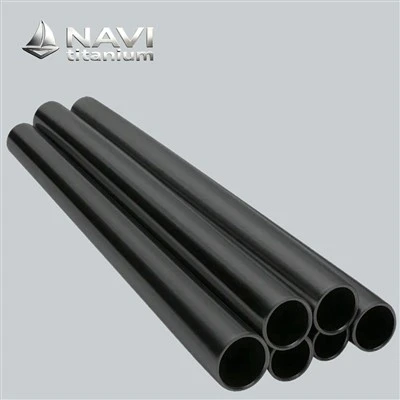


NAVI Titanium's platinum anode is essentially a highly chemically stable precious metal anode, used only for electron transfer and catalytic interfaces, and it doesn't wear out. It can be used for scientific research and monitoring, electrochemical oxidation and wastewater degradation, as well as applications like disinfecting swimming pools or drinking water. NAVI Titanium can customize different platinum layer thicknesses and process plans based on the customer's actual working conditions, current density, medium composition, operating temperature, and running time.

Solution of NAVI Titanium


NAVI Titanium supplies reliable Platinum Anodes. Benefiting from uniform, well-adhered platinum plating, our anodes maintain stable operation under diverse working media with low wear and excellent anti-corrosion capability. They serve a wide range of electrochemical scenarios including precision plating and electrolysis. Should you have any inquiry or technical requirement, please feel free to contact us.


Application
As a high-performance noble metal electrode material,NAVI Titanium's platinum anode plays a crucial role in proton exchange membrane (PEM)-based electrochemical devices, facilitating catalytic reactions and charge transfer while ensuring interfacial stability. In PEM systems, the anode is typically responsible for the oxidation reaction. Taking PEM water electrolysis for hydrogen production as an example, the oxygen evolution reaction (OER: 2H₂O → O₂ + 4H⁺ + 4e⁻) occurs at the anode; this process involves complex multi-electron and multi-proton transfers and represents one of the slowest and most energy-intensive electrochemical steps in the overall electrolysis process. Consequently, anode catalytic materials must possess high OER catalytic activity, stability at high oxidation potentials, resistance to long-term corrosion, excellent electrical conductivity, and good interfacial compatibility with the proton exchange membrane.

In PEM systems, electrochemical reactions primarily occur at the interface of gas, liquid water, and solid catalyst-a region known as the triple-phase boundary. The core value of high-performance platinized titanium anodes lies in maximizing the effective area of this triple-phase interface. Conventional metal electrodes typically have smooth surfaces, limiting the area actually available for reactions. Consequently, industrial PEM electrodes often utilize platinum nanoparticles, platinum black, platinum alloys, or platinum-loaded carbon materials. Forming a porous catalyst layer enhances the active surface area, the number of reaction sites, and the capacity for water molecule adsorption. For instance, reducing platinum particle size to the nanoscale increases the surface area per unit mass, exposes more active sites, and accelerates the rate of electrochemical reactions. Therefore, in the design of PEM electrodes, a platinized anode represents not merely a material, but a catalytic interface with a high specific surface area.
Purchasing guide

Quality control(QC)


| Titanium Base Material Suppliers: | Coating Precursor Suppliers: |
|
|
|


Manufacturing Process

Engineering Specification Table
To support accurate anode selection and project evaluation, NAVI Titanium provides key engineering specifications for our Platinized Titanium Anodes. Parameters such as titanium grade, platinum coating, dimensions, current density, operating conditions, and connection design can be customized according to your specific application.
| Parameter | NAVI Platinum / Pt-Ti Anode |
| Product Type | Solid Pt / Platinized Ti |
| Titanium Grade | Grade 1 / Grade 2 |
| Platinum Purity | ≥99.9% / actual value |
| Platinum Thickness | Customized |
| Platinum Loading | Customized |
| Substrate Thickness | Customized |
| Shape | Plate / Mesh / Rod / Tube / Wire |
| Mesh Opening | Customized |
| Current Density | Application dependent |
| Operating Temperature | Application dependent |
| pH Range | Application dependent |
| Electrolyte | Customized |
| Connection | Thread / Welding / Bolt / Custom |
| Surface Treatment | Sandblasting / Pickling / etc. |
| Coating Adhesion | Test method + result |
| Coating Thickness Test | XRF |
| Dimensional Tolerance | ±X |
| Service Life | Application-dependent |
| Recoating | Available / Not available |
Platinum Anode vs Platinized Titanium Anode
| Feature | Solid Platinum Anode | Platinized Titanium Anode | MMO Titanium Anode |
|---|---|---|---|
| Substrate | Platinum | Titanium | Titanium |
| Active Surface | Pt | Pt | MMO |
| Precious Metal Cost | Very High | Lower | Lower |
| Weight | High | Lower | Lower |
| Mechanical Strength | High | High | High |
| Custom Geometry | Limited/expensive | Excellent | Excellent |
| Recoating | Limited | Possible | Possible |
| Electroplating | Excellent | Excellent | Application-dependent |
| Water Treatment | Application-specific | Excellent in selected conditions | Excellent |
| Cost Efficiency | Low | High | Very High |
The best anode is not determined by platinum content alone; it depends on electrolyte chemistry, current density, temperature, electrode geometry and required operating life.
Application
Proton Exchange Membrane (PEM) technology is one of the most critical electrochemical technologies in the new energy sector, finding widespread application in PEM water electrolysis for hydrogen production, fuel cells, electrochemical energy conversion, and green hydrogen production systems. Among these, PEM water electrolysis is regarded as a key technological pathway for future industrial-scale green hydrogen production, owing to advantages such as high current density, high hydrogen purity, rapid dynamic response, and the ability to directly couple with intermittent renewable energy sources like wind and solar power. Platinum (Pt) is a noble metal catalyst with an exceptional electronic structure; its d-orbital electrons effectively adsorb and activate water molecules while facilitating the formation and transformation of oxygen intermediates. Consequently, NAVI Titanium's platinum anode can lower the energy barrier for the oxygen evolution reaction and enhance the operating efficiency of PEM electrolyzers.
While the anode primarily facilitates the oxygen evolution reaction in industrial PEM water electrolysis for hydrogen production, platinum-coated anodes have long served as the core catalytic material in another vital PEM technology: proton exchange membrane fuel cells (PEMFCs). PEM fuel cells generate electricity through the electrochemical reaction of hydrogen and oxygen, with the anodic reaction being H₂ → 2H⁺ + 2e⁻. Although theoretically simpler than the oxygen evolution reaction, this process requires a highly efficient catalyst to lower the activation energy, as the H-H bond in the hydrogen molecule must be broken. Platinum exhibits excellent capabilities for hydrogen adsorption and dissociation (H₂ + 2Pt → 2Pt-H), followed by the step Pt-H → Pt + H⁺ + e⁻; electrons flow through an external circuit to generate current, while protons migrate through the PEM to the cathode, where they combine with oxygen to form water.


Consequently, within the anode catalyst layer of a PEM fuel cell, platinum serves to facilitate rapid hydrogen dissociation, accelerate hydrogen oxidation reaction (HOR) kinetics, minimize anodic polarization losses, improve startup response times, and maintain high power output despite low noble-metal loading. In the automotive fuel cell sector, the frequent start-stop cycles and rapid load fluctuations inherent to vehicle operation demand that anode catalysts possess not only high activity but also resistance to poisoning. Platinum's ability to withstand a certain level of carbon monoxide (CO) exposure has established it as one of the most mature catalytic materials for PEM fuel cell anodes.
Industrial PEM electrolyzers do not operate in a steady state; instead, they require dynamic adjustment based on the input of renewable energy. For instance, photovoltaic systems operate at high power during the day, wind power fluctuates with wind speed, and energy storage systems demand rapid response. Consequently, PEM hydrogen production equipment undergoes frequent startup, shutdown, load ramping up, and load ramping down. However, startup and shutdown are the phases where electrolyzers are most susceptible to performance degradation. Key causes include gas crossover, localized potential spikes, catalyst oxidation, and damage to the membrane-electrode assembly.


During shutdown, in particular, residual hydrogen and oxygen can trigger a localized reverse-current effect-such as the presence of hydrogen in the cathode region and oxygen accumulation in the anode region. Upon restart, a transient high-potential state occurs, which can lead to catalyst dissolution, support oxidation, and structural damage to the membrane. Platinum, owing to its high stability, enhances the electrode's resilience against transient stresses. In certain advanced PEM designs, the incorporation of a platinum-based protective layer mitigates the risk of transient oxidation, reduces catalyst loss, and extends dynamic cycle life. This is crucial for future large-scale renewable energy-based hydrogen production systems, as industrial equipment is expected to withstand tens of thousands of load cycles.
The performance of platinum anode stems fundamentally from their unique electronic structure. Platinum is a metal with a face-centered cubic (fcc) structure, and its 5d-orbital electrons can interact with reaction intermediates. The oxygen evolution reaction (OER) at PEM anodes involves adsorbed intermediates such as OH, O, and OOH. The complete reaction pathway is typically represented as follows: first, H₂O + Pt → Pt-OH + H⁺ + e⁻; second, Pt-OH → Pt-O + H⁺ + e⁻; third, Pt-O + H₂O → Pt-OOH + H⁺ + e⁻; and fourth, Pt-OOH → Pt + O₂ + H⁺ + e⁻. Key factors determining the reaction rate include the adsorption strength of Pt-OH, the binding capability of Pt-O, and the electronic state of the Pt surface. Excessive adsorption strength hinders oxygen desorption and leads to catalyst coverage, whereas insufficient adsorption strength makes water molecule activation difficult. Platinum possesses an optimal balance regarding the adsorption of oxygen intermediates, thereby exhibiting superior catalytic performance; this is a primary reason why platinum has long been utilized in PEM electrochemical systems.

Application of Different Structural Configurations in PEM

The Pt/C composite catalyst anode represents the most mature structural design for PEM fuel cells. It is composed of platinum nanoparticles, a carbon support, and an ionomer. Key characteristics include a high specific surface area, high catalytic utilization efficiency, and low platinum loading; it is primarily used in the anode catalyst layer of PEM fuel cells.
The Pt-black anode features a structure of pure platinum particles without a carbon support, characterized by high stability and strong corrosion resistance. It is utilized in experimental PEM electrolyzers and for specialized durability testing.
The Pt-coated titanium anode consists of a titanium substrate, a platinum coating, and an electrochemically active surface, combining the strength of titanium with the stability of platinum. It is primarily used for PEM electrolyzer anodes and for the protection of porous transport layers.
The membrane electrode assembly (MEA) is the core component of a PEM electrolyzer, and its performance directly determines hydrogen production efficiency. An MEA primarily consists of a proton exchange membrane, a catalyst layer, and a gas diffusion layer. Although the catalyst layer is typically only tens of microns thick, it is responsible for the entire electrochemical reaction. The primary function of the coated anode within the MEA is to provide a highly active interface for the oxidation reaction; the PEM anode reaction involves a multi-electron transfer process (H₂O → O₂) that proceeds through several adsorbed intermediate states. These steps include water molecule adsorption, O-H bond cleavage, oxygen intermediate formation, O-O bond generation, and oxygen desorption. Platinum surfaces exhibit excellent catalytic activity for these processes.


Furthermore, the material enhances electron transport efficiency within the catalyst layer, which is composed of catalyst particles, proton conductors, and electron conductors. Platinum particles form a continuous electron network, enabling rapid electron transfer to the external circuit. Insufficient electron transport can lead to localized polarization, reduced current density, and increased energy consumption. Additionally, it improves the structural stability of the catalyst layer; electrochemical fluctuations inevitably occur during PEM operation due to startup, shutdown, and load variations. Platinum materials possess excellent structural stability, helping to mitigate catalyst migration, particle agglomeration, and the loss of active surface area.
Frequently Asked Questions
How to clean deposits on the electrode surface? Can hard tools be used for grinding?
+
-
Loose deposits can be rinsed off with ultrapure water; stubborn deposits can be soaked briefly in low-concentration dilute sulfuric acid, then thoroughly rinsed with water. Never use steel brushes or sandpaper to grind platinum surfaces, as mechanical scratches will increase the specific surface area, accelerate platinum loss, and cause uneven current distribution. NAVI Titanium can provide a standardized cleaning SOP.
How can solid platinum anodes stabilize the plating process and achieve energy savings and carbon reduction?
+
-
Plated platinum titanium and MMO anodes carry the risk of failed or contaminated plating solutions, which can produce large amounts of defective products if problems occur. Solid platinum electrodes offer a stable electrochemical interface, small cell voltage fluctuations, and a wide process window, reducing defect rates. Stable operation also reduces extra energy consumption, and energy data can be used for corporate carbon accounting and energy-saving reporting.
What is the service life of solid platinum anodes in the high-temperature, high-salinity environment of the Middle East, and how do they compare to plated platinum titanium anodes?
+
-
Ordinary plated platinum titanium anodes in high-temperature, salty environments tend to develop coating blisters and peeling within 12–24 months. Solid platinum anodes have no coating interface, so they do not peel or fail. When operated under standard maintenance conditions, their service life can reach 6–10 years, greatly reducing downtime and replacement losses for coastal and offshore equipment.
What should be noted when choosing solid platinum anodes for offshore platforms?
+
-
Offshore systems often have stray currents and current surges. Continuous reverse current can quickly consume platinum. Before ordering, confirm whether reverse current conditions exist. We can then design thicker platinum anodes to allow sufficient loss margin.
What information do I need to provide for a quote, so I can get a quick and accurate selection?
+
-
Application field; Electrolyte composition, pH, halogen/fluoride content; Maximum operating temperature; Current density, continuous/intermittent operation; Anode structure, dimension drawings, and installation method; Target thickness and expected service life; Purchase quantity, delivery time, and destination port.
Hot Tags: platinum anode, China platinum anode manufacturers, suppliers, factory, MMO Titanium, MMO Titanium Anode, Ruthenium Iridium Titanium Anode, titanium anode, Titanium Anode Rod for Water Heater, Titanium Electrodes for Electrolysis