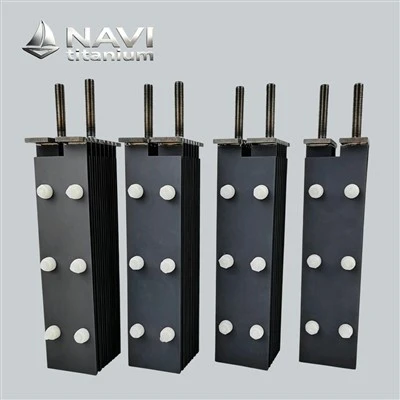
NAVI Titanium MMO tubular anode are coated cylindrical active elements developed for electrochemical systems requiring stable surface activity and dependable operation. Backed by a private technology-oriented enterprise established in 2008 and based in Baoji's High-tech Zone, the company operates automated facilities covering more than 49,000 square meters, with a registered capital of US$2.8 million excluding its two subsidiaries.
Solution of NAVI Titanium
NAVI Titanium integrates dedicated heat-treatment equipment with batch-oriented production management for titanium anode manufacturing. Five industrial hot-air circulation trolley furnaces support repeated heating cycles, while automated electrochemical equipment helps maintain consistency across larger production runs. For tubular electrode configurations, controlled thermal processing is particularly important for stabilizing the interface between the titanium substrate and active oxide layer, helping preserve dimensional integrity and electrochemical behavior from batch to batch.


NAVI Titanium produces cylindrical coated electrodes where stable surface activity and chemical resistance are essential.


Application
MMO tubular anode represents a specialized cylindrical format developed for electrochemical processing, where current transfer at the active surface drives oxidation or reduction reactions within the electrolyte. This configuration is used in water purification and non-ferrous metal recovery, including copper, nickel, and zinc electrowinning. Overall geometry and the functional material formulation can be selected according to electrolyte characteristics, current demand, and service parameters, helping maintain consistent reaction behavior during continuous processing.
Built for purification plants, these tubular active bodies are suitable for effluent treatment and oxidation systems handling different liquid compositions. Ir-Ta tube units are available with tailored material formulations and electrical connection arrangements to match various reactor layouts. The cylindrical configuration allows convenient installation within treatment systems while accommodating different flow rates and liquid characteristics. Careful selection of geometric parameters and electrical specifications helps maintain continuous pollutant removal and resource recovery. This configuration also supports diverse system capacities, offering greater installation flexibility for both newly constructed plants and existing purification systems undergoing capacity expansion or structural modification.

2.Metal Extraction And Electrowinning

Tubular catalytic units are used in metal extraction processes, particularly for non-ferrous metal electrowinning applications such as copper, nickel, zinc, and cobalt recovery. NAVI Titanium Ir-Ta / Ru-Ir catalytic tubular units are selected according to electrolyte composition, service parameters, and production capacity. Tailored specifications allow the units to fit different extraction cells and circulation systems. The tubular format supports optimized installation in large-scale tanks, providing a dependable catalytic solution for continuous metal recovery, resource utilization, and modern wet-metallurgy production lines.
Purchasing guide

Quality control(QC)
Fabricated as a seamless cylindrical body with a catalytically active oxide surface, this tubular anode delivers uniform current distribution and low consumption rates in cathodic protection and water treatment installations. Its hollow geometry maximizes surface area while minimizing weight, and the noble-metal oxide layer resists passivation under continuous polarization. Every lot is supported by documented verification of wall thickness, coating loading, and dimensional tolerances for full traceability.
| Certificate of Analysis | ||
| Titanium Base Material Suppliers: | Coating Precursor Suppliers: | COA of product: |
|
|
|
|


Manufacturing process
The tubular substrate begins with precision tube preparation, where wall continuity, straightness, and dimensional uniformity are carefully controlled along the entire length. Particular attention is given to the inner and outer cylindrical surfaces because uneven treatment can affect electrical transfer and electrolyte contact during operation. After surface preparation, the tube is positioned with controlled rotation so the active oxide layer can be applied evenly around the circumference, including areas close to the ends and joints. Repeated coating cycles build a stable catalytic interface while minimizing localized accumulation or uncovered zones. The cylindrical geometry is then preserved during subsequent conditioning, with checks focused on concentricity, surface continuity, adhesion, and electrical response. This approach helps produce tubular electrodes suited to electrolytic systems where compact installation, extended active area, and consistent current distribution are important.


Batch Consistency
NAVI Titanium checks key specifications across repeat batches so that replacement orders can remain closely aligned with previous supply. Dimensional details such as overall length, width, thickness, hole position, spacing, and connection dimensions can be reviewed against the approved production specifications. Coating coverage and surface condition are also checked according to the agreed requirements, while the exposed active area is kept consistent with the specified working range. For recurring orders, these reference points help reduce unexpected differences between earlier and later batches and make replacement planning easier for purchasing teams.

Connection Matching & Inspection Records

For each production batch, NAVI Titanium can maintain inspection records covering dimensional checks, surface or coating checks, active-area requirements, and connection details according to the agreed specifications. Connection points can be checked for position, size, fit, and other buyer-defined requirements before dispatch. Production specifications provide a reference for repeat orders, while batch-related inspection information gives buyers a clearer basis for reviewing incoming goods. When the same configuration is reordered, previous specifications and inspection requirements can be used as a reference to keep subsequent batches aligned with the approved version.
Application
MMO tubular anode supports electro-flotation treatment through refined structural configuration and coordinated parameter adjustment. During purification, it assists fine bubble formation and impurity separation by matching electrical input with reactor arrangement and working settings. Ongoing improvements in material composition and fabrication methods strengthen equipment flexibility while lowering maintenance needs. This approach enables water treatment facilities to achieve better contaminant removal and resource recovery in complex liquid environments.
In electro-flotation treatment, the cylindrical catalytic configuration serves as a key element for producing micro-sized gas bubbles and assisting contaminant removal. During use, dissolved substances and suspended particles undergo electrically induced changes, allowing impurities to gather and move toward the separation area. Different effluent characteristics require adjustments in unit size, spacing arrangement, electrical input, and reactor structure to obtain suitable purification results. The cylindrical configuration offers flexible installation options and can be tailored for various water compositions, equipment layouts, and treatment capacities, providing a practical choice for diverse purification plants. Its structural versatility also supports tailored configurations for specialized treatment projects involving different flow rates.

2.Innovation Design and Treatment Performance

Modern tube-type catalytic unit development emphasizes material utilization, structural flexibility, and service life improvement through refined manufacturing approaches. By adjusting material composition and upgrading connection methods, the catalytic unit maintains consistent output when facing complex effluent conditions. In practical purification plants, this innovation contributes to stronger contaminant removal capability, fewer replacement intervals, and better resource recovery during treatment activities. These units provide a compact configuration for electro-flotation equipment, combining tailored sizing with dependable working characteristics. Their adaptable form allows engineers to select suitable formats according to reactor arrangement, liquid properties, and operational targets, making them suitable for diverse purification projects requiring continuous treatment capability.
Product development
NAVI Titanium has developed a gradient multi-element material approach for tubular electrode assemblies, focusing on improved functional characteristics through controlled composition adjustment and layered configuration. By balancing various active components and refining manufacturing procedures, the electrode structure achieves better interaction with treated media and promotes the formation of useful reactive substances during purification. Through continuous improvement of formulation methods and production control, pollutant removal capability has increased by approximately 50%, delivering greater value for wastewater treatment facilities and supporting more effective resource utilization in purification operations.

2.Replaceable Electrode Structure Design

To overcome maintenance challenges in practical applications, NAVI Titanium has introduced a replaceable structure for MMO tubular anode, simplifying inspection, renewal, and equipment management. The configuration allows individual components to be exchanged without replacing the entire assembly, helping reduce material waste and service expenses by approximately 50%. By separating functional sections while preserving overall suitability with existing reactor arrangements, this approach offers greater flexibility for equipment modification and future upgrades. The structural characteristics also support easier maintenance planning, shorter replacement procedures, and improved resource utilization throughout the service period, providing a practical technical approach for various treatment facilities.
NAVI Titanium has established a tailored material configuration platform according to different electrolyte properties, working environments, and project specifications. By adjusting material combinations, thickness ranges, and structural parameters, each active unit can be prepared to meet specific purification targets and equipment layouts. This flexible manufacturing capability allows diverse configurations for laboratory devices, pilot facilities, and large-scale treatment installations. Through tailored selection methods and controlled fabrication procedures, specialized electrode options are provided with improved flexibility, dependable output, and better resource utilization, helping customers achieve suitable solutions for various treatment scenarios.

FAQ
1. How can harsh conditions affect the service performance?
+
-
Salt deposits, suspended solids, acidic or alkaline electrolytes, and prolonged immersion can gradually change the working surface. In marine applications, accumulated deposits may interfere with the reaction interface, while aggressive chemical conditions can accelerate surface wear.
2. What should be checked before deciding whether to reuse or replace it?
+
-
A used unit should first be examined for surface discoloration, deposits, scratches, edge damage, exposed base material, and areas where the functional surface has deteriorated. The connection points and mounting areas should also be checked for corrosion or mechanical damage.
3. What factors should be considered when selecting a cylindrical reaction member for a treatment system?
+
-
The selection process mainly depends on operating conditions, equipment design, electrolyte characteristics, and required service expectations. Key parameters include tube dimensions, connection method, material combination, and working environment. A suitable configuration can improve compatibility with the system structure and provide better overall performance during continuous operation.
4. How does tailored design improve the performance of this electrode solution?
+
-
Customized design allows manufacturers to adjust material composition, structural format, and production parameters according to different project requirements. By matching the electrode configuration with reactor conditions, the system can achieve improved pollutant removal capability, reduced maintenance needs, and better resource utilization.
5. What can cause uneven wear of the active material during continuous operation?
+
-
Uneven wear may result from excessive current density, poor electrical contact, localized heating, electrolyte impurities, or uneven flow around the working area. Inconsistent current distribution can place a higher reaction load on certain sections, accelerating local deterioration. Regular checks of voltage trends, electrical connections, liquid composition, and gas evolution can help identify abnormal loading before it affects overall process performance.
Hot Tags: mmo tubular anode, China mmo tubular anode manufacturers, suppliers, factory, DSA Anode, Iridium Oxide Coated Titanium Anodes, Platinized Titanium Anode, Platinum Coated Titanium Electrodes, Titanium Anode Manufacturer, Titanium Anode Plate