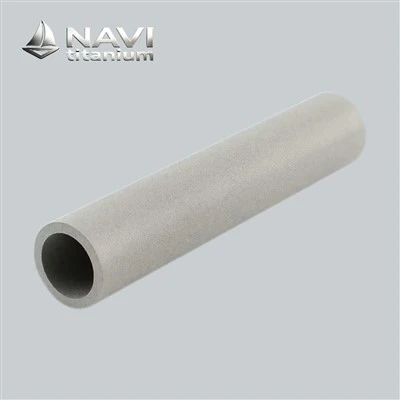
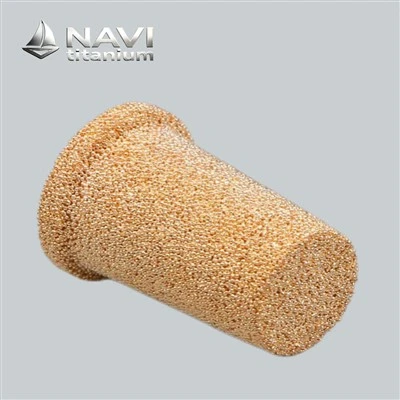
NAVI Titanium produces precision sintered filter discs using multi-layer metal mesh and fine powders, creating strong, uniform-flow filtration components for demanding industrial solid-liquid and gas-liquid separation. Beyond the product itself, NAVI Titanium brings the commercial advantages buyers care about most: proven production scale, stable batch-to-batch consistency, competitive export pricing, dependable lead times and responsive technical consultation.
Solution of NAVI Titanium
NAVI Titanium sintered disc is produced through carefully selected alloy powders and controlled thermal bonding, creating a uniform and adjustable flow network for filtration, air permeability, and fluid movement. Depending on application needs, different alloy grades, flow ratings, thicknesses, and overall dimensions can be specified for precision purification, gas handling, electrochemical processes, and demanding temperature or differential-load applications. The following table presents key characteristics, available options, and performance data for NAVI Titanium Porous Filter products to support informed purchasing decisions globally.


Sintered metal filter discs are engineered for industrial purification, gas-liquid separation, flow regulation and permeable-medium system operations. Beyond standard size adjustment, the series supports fully tailored structural shapes and geometric profiles: discs, rings, cones and cartridges. Based on customer drawings, each edge, mounting detail and profile can be tailored to fit unique tank layouts and on-site spaces.


Application
Sintered filter discs are installed wherever process fluids carry particles that damage machinery or contaminate product quality. They polish chemical solutions, clarify plating baths, refine hydraulic and lubrication fluids, protect spray nozzles and regulating valves, and diffuse gas into liquid as fine, uniform, stable bubbles. Because the all-alloy structure is bonded into one strong piece, NAVI Titanium filter discs tolerate high loads, thermal cycling and corrosive environments while remaining cleanable.
In High-Pressure Environments
High-load loops punish conventional filter elements. Sudden pressure spikes and aggressive fluids can tear woven cloth, damage cartridge pleats or push media fragments downstream. Bonded stainless-steel porous mesh filters solve this because every layer is metallurgically joined into one continuous structure, so nothing unravels and no binder degrades. In gas applications, bonded discs remove rust, scale and pipe debris from compressed air, natural gas and instrument lines, protecting valves, analyzers and control instruments against erosion and blockage. In liquid applications, they polish hydraulic oil, cooling water and chemical feeds at loads where disposable elements may collapse. Because the structure is inherently rigid, a bonded disc holds its flow geometry even near its design differential load, delivering predictable particle retention with no media migration. Discs are available in 316L stainless steel with filtration ratings matched precisely to the system's particle target; every unit is bubble-point tested to confirm flow-path integrity before shipment.


Electroplating and Chemical Bath Filtration for Titanium Anode Systems
Electroplating lines are only as clean as the solution they run. Suspended particles, carbon fines generated during carbon treatment, coagulated additives, anode-generated sludge and airborne dust settle on workpieces and on the anode surface, causing roughness, pitting, haze and faster coating degradation on titanium anodes. Bonded alloy filter discs installed in the circulation loop remove these contaminants down to the required micron range while delivering high, stable flow with low pressure loss.
Unlike pleated cartridges that soften and swell in aggressive baths, NAVI Titanium bonded discs resist acid copper, nickel, chrome and alkaline chemistries, and they can be backflushed or chemically regenerated rather than discarded. For buyers already running our anodes, combining the same supplier for anode and filtration components creates one accountable partner: our engineers size flow rating, disc area and stack arrangement to your exact bath turnover rate, and one quality team supports both components from a single factory.
Purchasing guide

Quality control (QC)
NAVI Titanium sintered disc is supplied with quality documentation to help buyers verify alloy and batch uniformity. Our manufacturing facility is ISO 9001 certified, and relevant inspection records can be provided for technical review and traceability. Click the button below to view the available COA and inspection documentation for this product before purchasing.

Manufacturing Process
The production of NAVI Titanium Porous Filter Disc begins with carefully selected alloy powder according to the required grade, flow characteristics, and operating environment. Powder preparation is followed by controlled forming, where the feedstock is shaped into the required disc profile while maintaining the intended particle distribution.
The formed compact then undergoes a controlled thermal bonding process under appropriate atmospheric and temperature conditions. During this stage, individual powder particles bond together without completely eliminating the spaces between them, creating interconnected flow channels required for fluid passage and particle retention.
After thermal bonding, each unit is processed according to its specified size and connection requirements. Subsequent operations may include surface treatment, machining, edge finishing, interface preparation, and dimensional adjustment. For tailored orders, NAVI Titanium can manufacture discs according to customer drawings, samples, thickness targets, diameter, flow rating, and other technical specifications.
Final inspection focuses on dimensional accuracy, visual condition, alloy uniformity, and relevant performance characteristics. Inspection records and batch documentation can be prepared for customer review and traceability before shipment.


Material Comparison of Sintered Filter Disc
Different alloys provide distinct advantages in corrosion resistance, temperature tolerance, mechanical strength and application compatibility. NAVI Titanium offers bonded disc filter options in SS316L, SS904L, bronze, titanium and nickel alloys, allowing buyers to select the most suitable grade according to operating environments. From economical pneumatic applications to aggressive chemical environments and elevated-temperature duties, each alloy grade provides a different balance between durability, chemical compatibility and investment requirements.
| Parameter | SS316L | SS904L | Bronze | Titanium | Nickel Alloy | Plastic |
|---|---|---|---|---|---|---|
| Corrosion Resistance | Excellent | Outstanding | Moderate | Outstanding | Outstanding | Excellent |
| Max. Temperature | ~540°C | ~600°C | ~300°C | ~500°C | Up to 900°C+ | ~80–260°C |
| Mechanical Strength | High | High | Moderate | High | Very High | Low–Moderate |
| Chloride Resistance | Good | Excellent | Limited | Outstanding | Excellent | Excellent |
| Typical Rating | 0.5–100 μm | 0.5–100 μm | 1–100 μm | 0.5–100 μm | 0.5–100 μm | 1–200 μm |
| Typical Applications | Chemical, food, water | Acidic chemicals | Pneumatics, lubrication | Seawater, electrochemical | Extreme chemical & thermal duties | Chemical, water & general filtration |
Inside the Sinter: Media Details That Save You Downtime
Two sintered filter discs can carry the same micron number yet behave completely differently in operation. Raw wire quality, weave density, bonding temperature, edge sealing and testing discipline decide whether a filter truly holds its rating for years or drifts within months. Brochures rarely discuss these differences, yet they are exactly what NAVI Titanium engineers investigate before recommending a flow rating, because the printed micron value matters less than the channel distribution behind it. These details extend element life.
The micron number on a filter tells only half the story. A nominal rating removes most particles above a size; an absolute rating guarantees the largest opening does not exceed that size, where one oversized particle can ruin a batch.
We verify each production lot by bubble-point testing, measuring the largest open channel from the pressure needed to push air through a wetted element, and every result is logged.
Channel-size distribution matters just as much. Wide distribution can pass an acceptable bubble point yet let mid-range particles through and blind quickly; a tight, uniform structure filters more consistently and holds more dirt before pressure drop forces maintenance.
We never quote a disc from a catalog: we ask about your particle-size distribution, acceptable downstream particle, maintenance interval and pressure budget, then select or develop an alloy grade matched to the real duty rather than trusting a generic micron label alone.


Alloy filter elements are designed to be maintained, and how you maintain them decides how many cycles a disc delivers. Reverse backflushing removes surface cake, ultrasonic baths lift deep-channel deposits, and solution-based washing dissolves oil, salts or oxides when the alloy permits. Because bonded discs tolerate treatments that destroy polymer cartridges, a well-run set serves for years.
End-of-life is a measurement, not a guess. Rising pressure drop after thorough maintenance, a bubble-point that drifts above its original value, edge damage or weight loss from repeated pickling all signal that the element no longer guarantees its rating; continuing to run it risks contamination and higher energy cost. Alloy selection is equally subtle: titanium excels in seawater, hot chloride and oxidizing fluids where stainless steel pitting is a risk, yet titanium demands care in strong reducing acids where other alloys are safer. We state these limits honestly and document them with every quotation.
One Responsible Partner: The NAVI Titanium Standard
NAVI Titanium is not a trading desk; we manufacture. Bonded filter elements, permeable components and titanium anodes are produced in our own integrated facility, where dedicated vacuum bonding furnaces, precision weaving and cutting lines, and specialized in-house testing stations all operate under one quality system. This integration lets us manage raw inputs, process parameters and final inspection rather than relying on third-party blanks, which is why batch-to-batch uniformity stays stable even as order volume grows.
Supply reliability matters as much as product quality to our customers. We plan capacity around scheduled and repeat orders, keep popular media grades and pore ratings in stock, and document every shipment with lot numbers and test reports.
From a sintered filter disc to container-scale programs, we deliver on the same terms, the same lead-time promises and the same quality paperwork - a supply relationship that lets our customers run their own processes without surprises.


Behind every quotation is a team, not just a price list. Engineers come from powder metallurgy, electrochemistry and filtration backgrounds, and they stay involved through alloy selection, drawing review, commissioning, troubleshooting and routine operation. If an alloy grade underperforms in your process fluid, we want the sample back, not an argument: we analyze the deposit, check the channel condition and revise the specification until the duty is met.
For customers running titanium anodes, our technical support extends to the whole electrochemical loop. We advise on anode maintenance schedules, electrolyte upkeep, voltage monitoring and filter change-out planning, and we offer recoating, repair and replacement programs that return deactivated anodes to operation at a fraction of new cost. The same discipline applies to filter elements: documented maintenance guidance, regeneration procedures and honest replacement advice keep both components working as one reliable system, with a single point of accountability.
Bonded media arrives damaged more often from handling than from operation, so we pack defensively. Every disc filter is individually protected, cushioned and separated to prevent edge impact and surface abrasion, then packed in moisture-resistant wrapping and export-grade wooden cases built for sea freight. Long transit, rough handling and humid climates are assumed, not exceptions. Customs-ready documents, clear labeling and lot traceability travel with each consignment, so goods clear inspection smoothly in Europe, North America, Southeast Asia and the Middle East.
Tailoring is routine, not exceptional. Our engineers work directly with your drawings - disc diameter, hole patterns, edge treatment, frames, ferrules or welded assemblies - and we produce short custom runs without the lead times typical of special orders. Air, sea, rail and express options are quoted transparently, and replacement programs can be scheduled around your maintenance calendar, making NAVI Titanium straightforward to work with, wherever your plant sits.

FAQ
We are importing from overseas. Can you meet our documentation, compliance and delivery expectations?
+
-
Yes. NAVI Titanium exports regularly to Europe, North America, Southeast Asia and the Middle East, and we tailor paperwork to your destination: EN 10204 3.1 material certificates, bubble-point and permeability test reports, certificates of origin, packing lists and customs-friendly labeling. RoHS/REACH-related declarations can be provided on request, and our packaging is designed for long sea freight with moisture protection and full lot traceability.
How long does a sintered filter disc last compared with disposable cartridges?
+
-
There is no fixed calendar life, because service life depends on the fluid, particle load and cleaning discipline - but the difference in cost per year is usually dramatic. A sintered metal disc that is properly backflushed, ultrasonically cleaned or chemically regenerated typically serves for years and many filtration cycles, where pleated cartridges are discarded after each use.
How should we clean and maintain the discs?
+
-
Start with the least aggressive method that works. Reverse backflushing with clean fluid removes most surface cake while the disc stays in the housing. For deeper fouling, remove the disc and clean it in an ultrasonic bath; for oils, salts or oxides, chemical cleaning is effective when the reagent suits both the media alloy and the foulant - our team provides a written matrix for your fluid chemistry. Avoid wire brushes, sharp tools and bending the disc, which damage the sintered structure. After cleaning, dry thoroughly and store flat. If pressure drop does not return near its original value after cleaning, the disc has reached the end of its service life.
We need to replace discs from another supplier. What information should we send you?
+
-
Send whatever you have, and we will fill the gaps. The most useful items are: outer and inner diameter, thickness, pore rating or micron marking, media material (stainless steel grade, titanium, etc.), any markings on the disc, and a photo or drawing of the housing with the connection type - flange, ferrule, threaded hub or welded frame. If the original specification is unknown, we can reverse-engineer from a used disc and confirm the rating by bubble-point testing.
How is quality assured, and can you support us if we already run your products?
+
-
Quality is verified by measurement, not by claim. Each production lot is bubble-point tested, checked for dimensional accuracy and visually inspected, and every shipment can include test reports and material certificates with full lot traceability; our quality system follows ISO 9001 practices.
Hot Tags: sintered filter disc, China sintered filter disc manufacturers, suppliers, factory, Porous Metal Filter, Porous Stainless Steel Plate, Sintered Bronze Bar, Sintered Bronze Filter Element, Sintered Porous Filter, Sintered Stainless Steel Tube