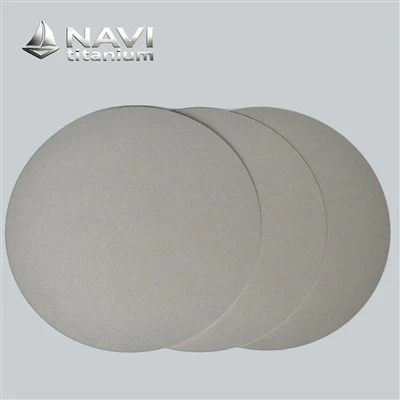
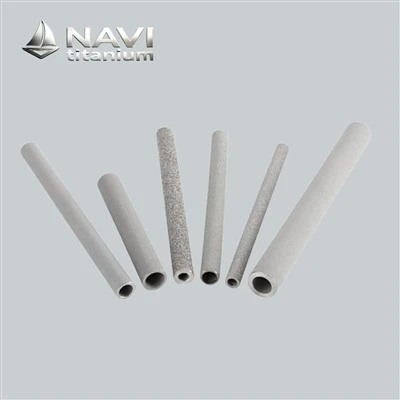
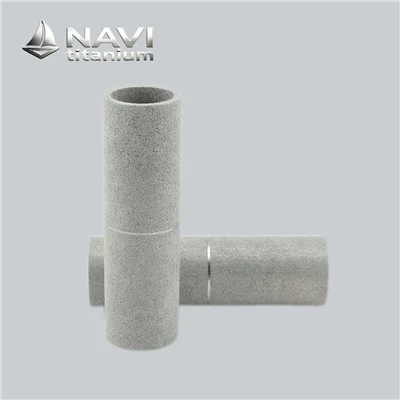
NAVI Titanium sintered filter cartridge for process gas is a one-piece cylindrical porous metal element, vacuum-sintered from high-purity titanium, 316L stainless steel or Hastelloy powder, built to strip dust, catalyst fines, aerosol and oil mist from industrial process gas streams before they reach valves, sensors, reactors and analysers. NAVI Titanium turns a recurring consumable into a regenerable asset: one unit survives dozens of blowback and wash rounds, so change-out intervals stretch, waste volume shrinks, and unplanned stops become genuinely rare.
Solution of NAVI Titanium
NAVI Titanium makes these porous bodies from metal powder through a controlled vacuum sintering route, the same platform used for precision separation, electrochemical substrates, biomedical devices and high-temperature fluid handling. Bonded grain to grain without binders or organic coatings, the structure keeps a uniform, adjustable void network, shrugs off acidic and alkaline attack, and stays biologically inert. Because the body is one fused mass, it tolerates thermal shock, pressure cycling and repeated regeneration while holding its rated retention. For gas work we tune powder class, wall section and void fraction against your gas composition, temperature, dust loading and allowable differential. Grades shipped most often sit in the table below, indicative figures confirmed against each order.
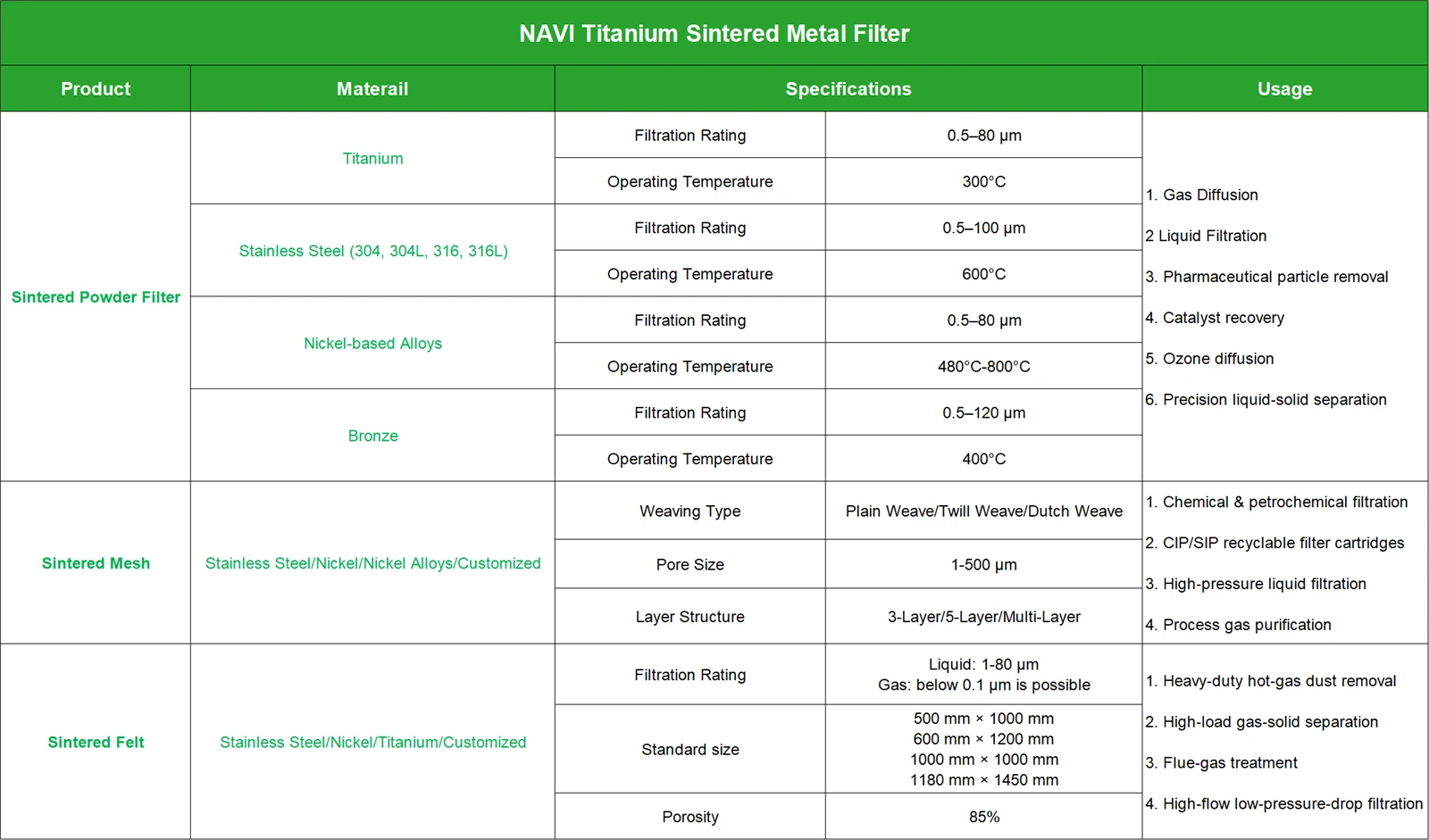


Shapes routinely run from straight open-ended tubes and closed-bottom thimbles to flanged bodies, conical sections, stepped multi-diameter tubes and flat wafers. Ends take plain faces, threaded spigots or custom flanges. Where a housing or analyser nozzle imposes an awkward envelope, we work straight from your CAD file and press the profile to fit, including wall steps and integrated mounting shoulders


Application
Gas duty punishes disposable media in two ways. Fibrous depth media sheds lint downstream once differential rises, and that lint reaches analyser cells. Polymer membranes blind under oil mist and force an unscheduled stop to protect the compressor. NAVI Titanium sintered filter cartridge for process gas sheds nothing and is cleaned in place, so gas purity and pipeline pressure hold steady between planned shutdowns.
Point-of-Use Polishing for High-Purity Gas in Semiconductor and PV Fabs
Specialty gas sticks feeding CVD chambers, etch tools and polysilicon reduction lines cannot tolerate a particle excursion after every filter swap, yet disposable membranes do exactly that: the first hours online are the dirtiest, because fresh media releases fibres while the housing settles. In a fab the cost sits in the wafers, not the cartridge, and metrology hours for requalifying a tool never appear on a consumables report.
NAVI Titanium supplies titanium bodies, vacuum baked, particle-counted and double-bagged under cleanroom conditions, so the cartridge moves from bag to stick with no conditioning purge. Titanium stays chemically silent against silane, ammonia, nitrous oxide, hydrogen and chlorosilane vapour, and sheds no iron fines at the wrench flats. Being one fused mass, it can be pulsed back with dry nitrogen between runs without opening the stick. Fabs report recovery under an hour rather than a shift, with intervals moving from weekly to quarterly.


Hot Flue Gas and CEMS Sampling Pre-Treatment
Emission monitoring on waste incinerators, lithium cathode kilns, coke ovens and non-ferrous smelters asks a filter to handle a stream that is hot, wet, acidic and loaded with sticky sub-micron fume. A blinded probe gives a flat reading regulators treat as a compliance gap, not maintenance.
Two details decide real service life. The first is acid dew point: alkali and heavy metal fume with moisture and SOx condenses into an aggressive film as the probe cools, attacking metal faster than dry gas. The second is the purge gas: cold, wet instrument air drives condensate into the wall, where dust bakes into a cake no wash reverses.
NAVI Titanium fits heated purge connections and recommends blowback gas dried to at least −40 °C, held above the dew point. Titanium and C276 shrug off the condensed film that pits 316L in the same position, and the rigid wall takes every retraction shock.
Purchasing guide

Quality control (QC)
NAVI Titanium runs its gas filter line under an ISO 9001 controlled system. Each cartridge ships with a bubble point reading, a clean differential loss record and a certificate traced to the powder lot and the furnace run. We publish the actual inspection documents instead of describing the system. Click the button below to open representative COA and test reports.

Manufacturing Process
NAVI Titanium sintered filter cartridge for process gas adopt strict standardized manufacturing workflows to stabilize pore structure, mechanical strength and corrosion resistance. Every procedure from powder screening to final clean packaging is traceable by batch code, eliminating inconsistent filtration performance and contamination risks for industrial process gas.
1. Powder classing and lot release
Feedstock arrives with a mill certificate and is screened to a tight cut. Oversize and fines are rejected at this point, because particle size distribution sets both the retention band and the final void fraction. No lot enters blending without a released code.
2. Blending and apparent density control
Blends are tumbled to a fixed schedule and sampled for apparent density and flow behaviour. Variation here shows up later as soft end zones, so the blend ticket travels with the batch rather than staying in the lab.
3. Forming the green body
Powder is filled into the tool and pressed under isostatic load. Filling is vibrated and stepped, which prevents the low-density band that otherwise forms at the closed end and later becomes the first place a pulse cracks the wall.
4. Vacuum sintering cycle
The green body is taken through a controlled ramp, a hold plateau and a slow cool under vacuum. The plateau decides neck growth between grains, and therefore the balance between permeability and strength. Each run is logged against the lot code.
5. Machining and end-cap joining
Bodies are turned, faced and threaded to the drawing. End caps are joined under argon shielding, and any discolouration on the bead is grounds for rejection, since oxide colour tracks directly with loss of corrosion resistance at the joint.
6. Testing, cleaning and clean packing
Finished units are checked for retention, clean differential, collapse resistance and joint integrity. Cartridges destined for high-purity gas are ultrasonically cleaned, vacuum baked, particle-counted and double-bagged before release.
Technical Parameters
This table compares key performance indicators of common filter materials to help you select the optimal cartridge for your process gas conditions. All data is for reference only.
| Material Grade | Max Working Temp | Chloride & Acid Gas Resistance | Particle Shedding Risk | Reusable Regeneration Cycles | Typical Process Gas Application |
|---|---|---|---|---|---|
| High Purity Titanium | ≤300℃ | Excellent, anti-corrosion | Zero | Over 30 cycles | Polysilicon, semiconductor corrosive process gas |
| 316L Stainless Steel | ≤450℃ | Fair, prone to chloride pitting | Zero | 20–25 cycles | Conventional compressed air, neutral industrial gas |
| Hastelloy Alloy | ≤550℃ | Outstanding halogen resistance | Zero | Over 25 cycles | Chlor-alkali plant, highly corrosive tail gas |
| PP/PTFE Disposable Membrane | ≤80℃ | Moderate acid resistance | Severe lint shedding | Single-use only | Low-temperature non-critical gas lines |
| Fiberglass Filter Cartridge | ≤200℃ | Weak acid tolerance | Serious fiber falling off | Non-cleanable | Temporary low-precision coarse filtration |
Why Choose NAVI Titanium
Case Record - A 200 mm Fab Rebuilds Its Specialty Gas Sticks
A 200 mm analogue and power device fab near Dresden, Germany, was replacing point-of-use filters on its specialty gas sticks every seven days and still losing yield to particle excursions after each swap. Two separate causes sat behind those same numbers. The disposable membrane released fibres during its first hours online, and the 316L electropolished bodies picked up surface iron at the wrench flats, NAVI Titanium sintered filter cartridge for process gas cut recovery from eight hours to under one, moved changes to quarterly, and cut spend about 71%. NAVI Titanium supplied titanium bodies, vacuum baked, particle-counted and double-bagged, built to the existing housings from the customer's own drawing. Time from cartridge change to on-spec particle count fell from roughly eight hours to well under one, and the change interval moved to quarterly on the same gas load. Consumable spend on those sticks dropped about 71 percent year on year, though the plant's maintenance lead actually quoted the recovered metrology hours first.


Verification Record - What Auditors Are Shown on Arrival
Buyers in the chemical and semiconductor sectors rarely accept a certificate without seeing the bench behind it, so we open the inspection room during audits. Retention is read on a bubble point rig calibrated against traceable reference standards. Clean differential is logged at the design face velocity rather than at a convenient point, and the figure is printed on a baseline card that ships with the cartridge, so maintenance holds the reference reading before installation.
Joint tightness is verified by helium leak check to the stated rating, and metal ion release by ICP where the gas contacts a catalyst bed. Every reading is stored against the lot code, which leads back through blending to the powder certificate and the furnace run, so one cartridge can be reconstructed years later. Where independent confirmation is required, we ship duplicate samples from the same lot to a third-party laboratory and hand over both.
Customer Feedback - Three Comments Worth More Than Our Own Claims
"We had written the post-change particle spike off as unavoidable. Once the titanium bodies went in, recovery became a non-event and we stopped scheduling swaps around production windows. Two years on, those same bodies are still in service." - Maintenance supervisor, specialty gas distributor, Central Europe. "Probe filters used to blind within a fortnight on the incineration line.
Moving the purge to heated dry nitrogen and switching to C276 took us to twelve weeks between changes, which matters more to us than unit price. Our quarterly data availability figure went with it." - Service engineer, CEMS integrator, Southeast Asia. "We sent a drawing of a discontinued European housing expecting a long negotiation.
We had a priced proposal in four days, and the samples dropped straight into the existing flange. That was the whole negotiation." - Procurement officer, petrochemical complex, Arabian Gulf.

FAQ
How long does a cartridge last in continuous gas service, and when should I change it?
+
-
Record the clean differential at commissioning, then track the rise against throughput rather than against the calendar. Change-out is due when the running differential reaches roughly two to two-and-a-half times that baseline at constant flow. After each back-pulse, note where the differential lands: if it no longer settles within about 1.3 times the clean value, the pore structure is loaded beyond recovery and the element has reached end of life.
What should I check before back-pulsing?
+
-
Three things decide whether a pulse restores the element or damages it. The purge gas must be dry, typically to −40 °C dew point or at least 20 °C below the process dew point, and free of oil. Its temperature must sit above the process dew point, since cold gas condenses inside the wall and bakes dust into a hard cake. And the pulse pressure must stay inside the window quoted for your wall thickness: too low and only part of the depth clears, too high and you fatigue the end-cap weld root.
Which documents come with cartridges for high-purity gas lines?
+
-
Each shipment carries an EN 10204 3.1 material certificate tied to the powder lot, plus the bubble point and clean differential readings for the batch. RoHS and REACH statements, a country-of-origin certificate and a packing list are standard. For semiconductor and photovoltaic service we add a particle shed count taken after cleaning, confirmation of the vacuum bake-out cycle, and cleanroom double bagging, with SEMI-aligned reporting available where the specification calls for it.
Can titanium be used for dry chlorine or anhydrous HCl?
+
-
No, and this is the one limitation we always raise early. Titanium depends on a thin oxide film that needs a small amount of moisture to keep repairing itself. In dry chlorine or anhydrous hydrogen chloride that film does not reform, and titanium can react violently, in extreme cases igniting. In wet chlorine and aqueous hydrochloric acid the same metal performs extremely well, which is why it is standard in chlor-alkali cell gas.
How do I replace an OEM cartridge, and what should happen at shutdown?
+
-
Send a drawing, or a used sample with the housing make and model, and we will quote against it, including non-standard threads and flanges. Samples are built on the same production route as volume orders, not on a bench, so test results carry over. At shutdown, blow the element down with dry gas while it is still hot, then hold it under a dry nitrogen blanket until the housing cools.
Hot Tags: navi titanium sintered filter cartridge for process gas, China navi titanium sintered filter cartridge for process gas manufacturers, suppliers, factory, controlled porosity porous metal filter, Sintered Air Filter, Sintered Bronze Filter Element, Sintered Metal Tube, sintered metallic filter media, Sintered Stainless Steel Tube