
When it comes to precision filtration, the material you start with determines everything downstream. Sintered metal powder sits at the heart of modern porous metal filter design - and understanding how its properties interact with porosity and filtration efficiency can be the difference between a component that lasts years and one that fails in months.
This guide walks through the science and engineering logic behind sintered porous metal filters, written for engineers, procurement specialists, and anyone exploring reliable filtration solutions for demanding industrial environments.
How Does Sintered Metal Powder Control Porosity and Filtration Efficiency?
The Relationship Between Powder Properties and Pore Formation
The porosity of a sintered metal filter is not accidental; it is designed from the ground up. When metal powder particles are crushed and subjected to controlled heat below the melting point, they bind at points of contact with empty spaces between the particles being inter-connected. The size, shape and distribution of such voids are intimately related to the properties of the initial powder. Powder morphology is key. Spherical particles pack more consistently, leading to consistent pore channels. Irregular powders contribute to sinuous routes that enhance particle interception but may compromise flow rates. Another important aspect is purity: the oxygen-rich powder surfaces create oxide layers which hinder the formation of good sintering necks, leading to a weak porous skeleton and poor structural integrity and electrical conductivity, vital for electrochemical applications like PEM water electrolysis.


How Oxygen Content Shapes Filter Performance
The performance liability of high oxygen concentration in titanium powder is well established. Oxide coatings on the surfaces of powder particles oppose the diffusion bonding that forms strong sintering necks. In PEM electrolysis systems, filter elements are required to enable ion transport and resist harsh acidic conditions, and even small increases in oxygen concentration may lead to a reduction in conductivity and accelerate surface corrosion.
NAVI Titanium sources 0A-grade pure titanium powder with tightly controlled oxygen levels to address this precisely. The result is a sintered metal powder with uniform pore walls, stable electrochemical behavior, and a longer operational lifespan - characteristics that matter enormously when the filter is embedded in a multi-million-dollar hydrogen generation stack.
Sintered Metal Powder Particle Size Design for Optimized Filter Performance
Why Particle Size Distribution Is a Design Variable, Not a Default
The particle size distribution (PSD) is perhaps the most important variable in the design of sintered filter elements. The compact and uniform pore apertures of the narrow PSD are suitable for very precise filtering. The greater the dispersion, the more the smaller particles may fill the interstices between the coarser particles. This results in a higher mechanical density, but a lower mean pore diameter. Powder metallurgical studies have shown that the mean particle diameter is directly proportional to the mean pore size of the sintered structure. A D50 of 45 µm gives filtration ratings generally between 10 and 30 µm depending on the compaction pressure and sintering temperature. NAVI Titanium sintered metal filters are available with pore structures from 5 to 80 µm, custom-made to match the flux and retention requirements of a given application.


Gradient Powder Compounding for Multi-Layer Filtration
Simple applications are ideally suited to single layer filters with homogenous powder. Compared to this, elements for gradient filters have a designed gradient of coarse to fine powder layers, which allows for graded filtering. The outer layer removes bigger particles, while the inner layers remove finer and finer pollutants. This design eliminates differential pressure build up and increases service intervals. The coarse-and-fine powder compounding is based on the controlled layer interfaces. In the case of a rapid change in powder grades, there is the possibility of delamination under cyclic pressure. NAVI Titanium's process engineering considers interfacial bonding at each layer border, ensuring structural cohesiveness across the gradient profile.
Balancing Pore Size and Flow Capacity With Advanced Powder Selection
Navigating the Porosity-Permeability Trade-Off
Every filtration engineer encounters this tension: increasing pore size improves flow capacity but reduces interception efficiency. Decreasing pore size captures finer particles but restricts flow and elevates differential pressure. Sintered metal powder selection is the primary lever for navigating this trade-off without compromise.
By selecting powder with a narrow, precisely calibrated PSD and applying optimized sintering schedules, manufacturers can produce porous metal components where pore size and permeability are independently tunable within defined ranges. This decoupling - achieved through material science rather than geometric compromise - allows filter elements to meet dual performance targets simultaneously.
Material Composition Choices for Specific Operating Environments
Titanium powder dominates PEM and semiconductor applications due to its corrosion resistance in acidic and oxidizing media.
Nickel-based alloys including Hastelloy C22 and C276 address high-temperature, high-chloride, or chemically aggressive environments. SS316L stainless steel powder offers cost-effective performance for general industrial filtration where extreme corrosion resistance is not the primary requirement.
Matching material composition to operating chemistry is not optional - it is foundational. A filter element that dissolves, passivates incorrectly, or contaminates the process fluid defeats the entire purpose of precision filtration.
Sintered Metal Powder Structure Design for Precision Filtration Applications

Geometric Form Factors and Their Influence on Filter Behavior
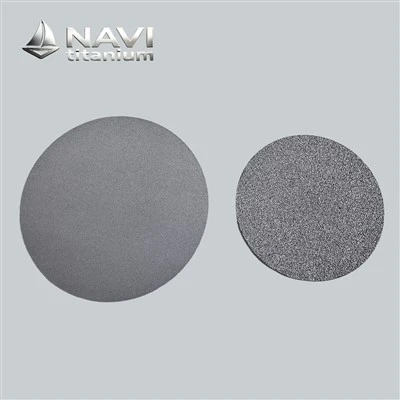
Sintered metal powder can be formed into discs, tubes, caps, sheets, bars, and custom geometries. Each form factor creates a different flow path geometry through the porous structure. Tubular filter elements, for example, offer high surface area per unit volume and allow backflush cleaning - advantages that translate to longer service life in continuous-process applications.
Disc and sheet geometries suit inline flow configurations and are common in semiconductor process gas filtration and pharmaceutical fluid management. The compaction tooling and sintering fixture design must preserve dimensional accuracy across the entire form, since deviations in wall thickness directly alter local pore size distribution and flow uniformity.
Batch Consistency as a Quality Metric
Precision filtration is only as reliable as the consistency of the filter elements deployed across an installation.
Batch-to-batch powder variability- in PSD, morphology, or purity - propagates directly into inconsistent pore structures and unpredictable filtration performance. Rigorous powder qualification protocols, including incoming particle size analysis and oxygen content verification, are prerequisites for producing sintered filter elements that perform identically from one production run to the next.
Creating Efficient Porous Metal Filters Through Controlled Sintered Metal Powder
Process Parameters That Govern Final Pore Architecture
Sintering temperature, hold time, atmosphere, and compaction pressure each influence the final pore architecture of a sintered porous metal filter. Higher sintering temperatures increase neck growth between powder particles, reducing porosity but improving mechanical strength. Lower temperatures preserve more open pore volume but may yield insufficient interparticle bonding for pressure-bearing applications.
Atmosphere control during sintering is particularly critical for titanium. Exposure to atmospheric oxygen or nitrogen at elevated temperatures can alter surface chemistry and introduce embrittlement. Vacuum or inert atmosphere sintering is standard practice for high-performance titanium filter components.
Connecting Powder Sintering Activity to Skeleton Density
Sintering activity-the tendency of powder particles to bond readily under thermal treatment-depends on surface area, surface energy, and the absence of passivating oxide films.

Fine, high-purity powders with high surface area sinter more actively, forming denser skeletal networks at lower temperatures. This allows manufacturers to achieve target strength levels without over-sintering, which would collapse the pore structure.
For large-scale green hydrogen projects requiring thousands of identical filter elements, this sintering activity consistency translates directly into mass production reliability - a capability that NAVI Titanium has refined since its establishment in 2008.
Conclusion
The performance of any porous metal filter traces back to the quality and precision of the sintered metal powder used to build it. Pore size, permeability, structural strength, and corrosion resistance are all outcomes of deliberate powder selection, particle size engineering, and process control - not fortunate coincidence. For applications where filtration precision and component longevity are non-negotiable, starting with the right powder substrate is the most important decision in the design process.
FAQ
1. What pore size range can sintered metal powder filters achieve?
+
-
Sintered porous metal filters manufactured from controlled metal powder systems can achieve pore sizes ranging from 5 µm to 80 µm. The specific pore size depends on powder particle size distribution, compaction parameters, and sintering conditions. NAVI Titanium offers customized pore structures across this range to match application-specific filtration accuracy and flow rate requirements.
2. Why is titanium powder preferred for PEM electrolysis filter elements?
+
-
Titanium offers exceptional corrosion resistance in the acidic, oxidizing environment inside a PEM electrolyzer. High-purity, low-oxygen titanium powder produces sintered filter elements with stable electrochemical behavior, minimal contamination risk, and structural durability under the differential pressures typical of PEM water electrolysis stacks. These properties make titanium the material of choice for high-performance hydrogen energy filtration components.
3. How does powder particle size affect filtration efficiency?
+
-
Smaller powder particles produce finer pore structures with higher interception accuracy but lower permeability. Larger particles yield more open pore networks with greater flow capacity but reduced filtration precision. Gradient powder designs combine multiple particle size ranges to balance these competing demands within a single filter element, achieving both high flux and fine particulate retention.
Get Custom Sintered Metal Powder Filter Solutions From NAVI Titanium
If you need a dependable sintered metal powder supplier for precision filtration components, NAVI Titanium delivers more than just parts - we deliver engineered solutions built on 16+ years of powder metallurgy expertise in the China Titanium Valley. From PEM electrolysis to semiconductor-grade gas filtration, our customized porous metal filters feature controlled pore structures (5–80 µm), high-purity low-oxygen titanium powder substrates, and batch-consistent manufacturing that scales with your project. Whether you need a prototype or full-volume production for a green hydrogen facility, our team provides one-on-one technical support from material selection through finished product delivery.
Reach out to our engineering team at sales@navititanium.com to discuss your specific filtration requirements.
References
1. German, R. M. Sintering: From Empirical Observations to Scientific Principles. Butterworth-Heinemann, 2014.
2. Tong, H. H., et al. "Effect of Particle Size Distribution on the Pore Structure and Filtration Performance of Sintered Metal Filters." Powder Technology, Vol. 312, 2017, pp. 120–129.
3. Lefebvre, L. P., et al. "Porous Metals and Metallic Foams: Current Status and Recent Developments." Advanced Engineering Materials, Vol. 10, No. 9, 2008, pp. 775–787.
4. Smolders, K., and Baeyens, J. "Gas Fluidization and Porous Metal Media: Relationship Between Powder Properties and Pore Architecture." Powder Technology, Vol. 190, 2009, pp. 296–303.
5. Debe, M. K. "Electrocatalyst Approaches and Challenges for Automotive Fuel Cells and PEM Water Electrolysis." Nature, Vol. 486, 2012, pp. 43–51.
6. Jiang, P., et al. "Influence of Titanium Powder Purity and Oxygen Content on the Mechanical and Electrochemical Properties of Sintered Porous Titanium." Journal of Materials Science & Technology, Vol. 35, No. 7, 2019, pp. 1388–1395.