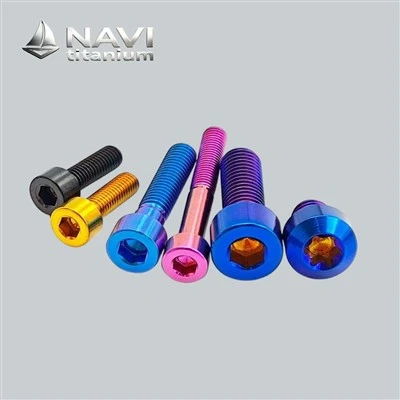
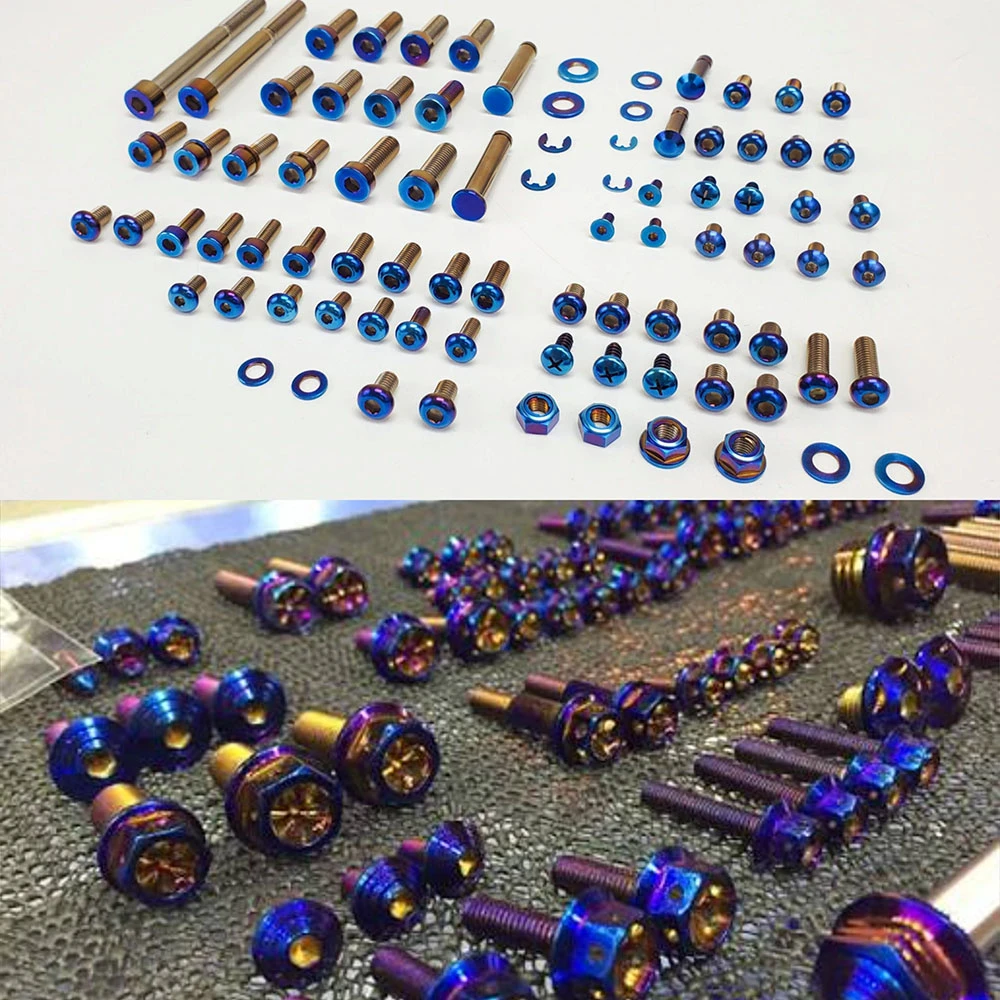
NAVI Titanium YZ250 titanium bolt kits replace rust-prone OEM steel hardware with Grade 5 Ti-6Al-4V bolts - 45% lighter, rust-free, and rolled threads for vibration fatigue life. Made in our own ISO 9001:2015 certified lines since 2008, configured against Yamaha OEM positions for 1989–current YZ250 models, and shipped with per-heat mill certificates and a torque card. Kits cover body, engine, chassis, rotor and sprocket positions in raw titanium or PVD black, gold, blue and rainbow finishes, and every fastener is available as a single replacement from stock. Torque values are supplied per position, and anti-seize is a mandatory step on installation. Send your model year and get a fitment-checked quote within 24 hours.
Solutions of NAVI Titanium
With experience dating back to 2008, NAVI Titanium has developed integrated capabilities in material processing, precision finishing, and customized workpiece production. Drawing on experience with motorcycle and electric off-road vehicle workpieces, the company offers CNC-machined fastening solutions in multiple Ti grades, with customized head configurations, thread geometries, and installation dimensions. From prototype evaluation to batch production, material traceability, dimensional inspection, and technical documentation help address procurement requirements.


NAVI Titanium applies precision-finishing expertise to lightweight fastening workpieces for electric off-road motorcycles, with attention to alloy selection, machining accuracy, head configuration, load distribution, and assembly compatibility. Ti-6Al-4V is commonly considered where high specific strength and corrosion resistance are important.


Quick Fit Check
We would rather tell you upfront whether this product is right for you than process a return. Here is exactly when a YZ250 titanium bolt kit pays off, and when it does not.
✅ Ideal if you need:

1. Corrosion-proof hardware on a bike that sees mud, water and wash cycles
OEM zinc-plated and black-oxide steel fasteners rust from the first wet ride, and rusted hex heads round off during maintenance. Titanium forms a self-repairing oxide film on contact with air - no plating to chip, no rust to seize, no stripped heads in a swingarm.
2. Weight reduction on a race bike where every gram counts
Grade 5 titanium is roughly 43–45% lighter than steel by density (4.43 g/cm³ vs 7.85 g/cm³). A typical full-bike kit removes 300–700 g depending on scope. That is real, measurable mass - but be realistic about it: it is a handling and refinement gain, not a horsepower gain.
3. Consistent torque rather than torque that drifts with corrosion
Rusted or galled steel hardware gives inconsistent preload readings. Clean titanium threads with the correct lubricant return repeatable torque values, which matters when you are torquing the same fastener every service interval.
4. Restoration builds and long-term ownership
If you are rebuilding a YZ250 to keep, titanium hardware is a one-time spend. It will outlast several sets of plated steel bolts and will not look tired after two seasons.
5. Aesthetic upgrade for show builds and resale
Raw titanium, PVD black, PVD gold, blue and rainbow finishes hold their colour far better than anodised aluminium, which fades under UV and cleaning chemicals.
6. Distributors looking for a repeatable, specifiable product line
Consistent heat lots, repeatable thread quality and per-batch documentation make titanium kits viable as a stocked product line rather than a one-off custom order.

❌ Not the right fit if you need:

1. A substitute for a torque-to-yield or single-use OEM fastener
If your workshop manual specifies a stretch bolt or a single-use fastener, do not replace it with titanium unless the joint has been engineered for it. A YZ250 two-stroke does not use stretch bolts in normal service, but always check your specific manual before substituting.
2. A fix for a stripped or damaged thread
Titanium will not repair a damaged female thread. If the thread in your engine case or swingarm is compromised, repair it first - otherwise you will simply strip the more expensive titanium bolt instead of the cheap steel one.
3. Maximum weight saving on a tight budget
Aluminium alloy fasteners are lighter still and cheaper, and are perfectly adequate for low-stress, non-structural positions such as bodywork and seat bolts. If cost per gram is the deciding metric, use aluminium where the load allows and titanium only where strength and durability matter.
4. Fasteners for safety-critical single-shear joints without engineering review
Brake caliper mounts, suspension linkage and steering components sit in a different risk category. Many race teams do use titanium in these positions, but that decision requires a defined load case and a qualified engineer - not a catalog order. We will tell you plainly when we think you should stay with the OEM fastener.
5. Bolts that will be installed without a torque wrench and anti-seize
Titanium galls when threaded dry against steel or against itself. Installed without the correct lubricant, it will seize - sometimes immediately. If your workshop cannot follow a torque sheet, this is not the right product for you yet.

Purchasing guide
Quality control (QC)
NAVI Titanium maintains material documentation for Ti-6Al-4V alloy workpieces supplied for electric off-road motorcycle applications. The documentation records key chemical and mechanical characteristics, helping purchasing teams verify alloy grade, tensile properties, yield strength, elongation, and material traceability before procurement.

Manufacturing Process.
Alloy Bar Selection: YZ250 titanium bolt kit is selected according to the required mechanical characteristics, cleanliness, and production grade.
CNC Turning: Precision CNC equipment removes excess stock and establishes the basic shank, head, and connection features.
Head Machining: The bolt head is machined according to the specified drive style, such as hex socket, Torx, flange, or conical-head configuration.
Thread Cutting: Precision cutting equipment produces the required pitch, diameter, and engagement profile while controlling finishing consistency.
Deburring & Cleaning: Machined workpieces undergo edge treatment and thorough cleaning to remove chips, burrs, and processing residues.
Marking & Packing: Identification is applied according to order specifications, followed by protective packing to prevent contact damage during storage and transportation.
What Is in the Kit
Kit contents are configured by application, not sold as an undifferentiated bag of bolts. Every kit is built from the same Grade 5 material and the same inspection process.
| Model |
Typical Contents
|
Best For
|
| Rotor & Sprocket Kit | 6 × M6×10 mm tapered-head rotor bolts, plus sprocket bolt set | Brake disc and sprocket refresh, weight reduction at the hub |
| Body & Plastics Kit | M6×16 and M6×20 flange button heads, seat bolts, fender bolts, shroud bolts, number plate bolts, matching washers | Side panels, fenders, shrouds, seat, radiator and fuel tank hardware |
| Engine Cover & Case Kit | M6×16 to M6×25 socket head cap screws | Ignition cover, clutch cover, water pump and case hardware |
| Chassis Kit | M8 flange bolts for footpeg, engine mount and triple clamp positions | High-wear chassis positions where corrosion matters most |
| Cylinder Head Stud Kit | M8 threaded studs (equivalent to OEM 90116-08027) | Top-end rebuilds, YZ85 / YZ125 / YZ250 fitment |
| Full Bike Kit | 60–120 pcs depending on scope, covering body, engine, chassis, rotor and sprocket positions | Complete rebuilds, race prep, restoration projects |
| Custom Kit | Built to your parts list, quantities and finish | Distributors, race teams, workshop stock |
Every kit ships with a printed contents card showing position, thread size, length and torque value for each fastener - so your mechanic is not guessing.
| Item | Specification |
| Material | Grade 5 titanium (Ti-6Al-4V), UNS R56400, ASTM Grade 5 |
| Standard compliance | ASTM B348 / AMS 4928, heat-lot certified |
| Density | 4.43 g/cm³ - approximately 43–45% lighter than steel |
| Tensile strength (annealed) | Min. 895 MPa, typical 950 MPa |
| Service temperature | Stable to roughly 425 °C (800 °F), far above any MX operating condition |
| Thread form | Rolled threads as standard for improved fatigue life; cut threads available on request |
| Thread classes | 6g / 6H, verified with go / no-go gauges |
| Head styles | Socket head cap, button head, flange button, tapered countersunk |
| Drives | Hex socket, Torx available on request |
| Finishes | Raw titanium, PVD black, PVD gold, blue, rainbow, polished |
| Corrosion resistance | Immune to rust; suited to mud, salt, water crossings and repeated washing |
| Documentation | Mill certificate per heat, dimensional report, hardness and thread gauge report |
How Titanium Compares to the Alternatives
| Attribute | Grade 5 Titanium (Our Kit) | OEM Plated Steel | 7075 Aluminium Alloy |
| Weight vs steel | ~45% lighter | Baseline | ~65% lighter |
| Tensile strength | Min. 895 MPa | 400–1,200 MPa depending on grade | ~570 MPa |
| Corrosion resistance | Excellent - no rust, no plating to fail | Poor - plating chips, heads rust | Moderate - anodising fades, galvanic risk with steel |
| Fatigue life under vibration | Excellent - rolled threads resist crack initiation | Good | Poor - notch sensitive, can snap without warning |
| Head durability | Very high - resists rounding | Low once corroded | Medium - soft alloy rounds easily |
| Thread galling risk | High if installed dry - needs anti-seize | Low | Medium |
| Torque repeatability after service | High | Declines as corrosion develops | Medium |
| Best application | Body, engine, chassis, rotor, sprocket | Baselines and torque-critical OEM joints | Bodywork and low-stress positions |
The honest summary: aluminium wins on weight and cost, steel wins on price and familiarity, titanium wins on the combination of strength, corrosion resistance and fatigue life. Use each where it belongs.
Fitment - Confirm Before You Order
Our YZ250 titanium bolt kits are configured against Yamaha OEM part positions rather than generic size assumptions. Current coverage:
| Model | Years Covered | Note |
| Yamaha YZ250 (two-stroke) | 1989 – current | Year-specific kit variants; fork guard, radiator and body mounting changed across generations |
| Yamaha YZ250 50th Anniversary Edition | 2024 | Same kit coverage |
| Yamaha YZ250X | 2016 – current | Off-road variant kit configuration |
| Yamaha YZ250FX | 2015 – current | Four-stroke variant kit configuration |
| Yamaha YZ125 / YZ85 | Selected years | Shared positions, kit scaled to fastener count |
Fitment verification: send us your exact model year, submodel and a photo of the positions you want to replace. We confirm thread size, pitch and length against your machine before the order is released, and we will tell you if a position should stay with the OEM fastener. If we get a fitment wrong, we replace the affected fasteners at our cost.
Manufacturing and Traceability
Every fastener we ship is produced and inspected in-house, with no subcontracted heat treatment or anonymous material:
Material intake - Grade 5 bar stock is verified against the mill certificate for chemistry and mechanical properties before release to production. Non-conforming heats are rejected outright.
Machining - CNC turned and milled at controlled cutting speeds with dedicated coolant, because titanium concentrates heat at the tool edge and will surface-harden if cut too fast.
Thread forming - rolled threads as standard, which produce a continuous grain flow and measurably better fatigue life than cut threads. Threads are gauged with go / no-go inspection.
Heat treatment and stress relief - controlled cycles with logged parameters per batch.
Finishing - pickling, passivation or PVD coating, with coating thickness and adhesion checked.
Final inspection - dimensional check, hardness testing, thread gauge verification, visual inspection for head and drive defects. Every kit is sealed with documentation, and records are retained for five years.
Supplied documents - mill certificate per heat, certificate of conformity, dimensional and thread inspection report, and a torque and installation sheet. If your quality team needs additional documentation or a specific format, tell us at quotation stage and we will build it into the order.
Frequently Asked Questions
Q: How much weight does a titanium bolt kit actually save on a YZ250?
+
-
A: It depends entirely on kit scope. Replacing bodywork and engine hardware typically saves 150–350 g; a full-bike kit covering body, engine, chassis, rotor and sprocket positions typically saves 300–700 g. Titanium is roughly 43–45% lighter than steel by density, so the saving scales directly with the mass of hardware you replace.
Q: Will titanium bolts seize in the aluminium cases and forks?
+
-
A: Titanium is far less prone to galvanic corrosion with aluminium than steel is, but it will gall if installed dry. Use an anti-seize compound on every thread and titanium hardware will release cleanly years later. This is the single most important installation step.
Q: Can I reuse titanium bolts after removing them?
+
-
A: Yes, if they were correctly torqued and show no visible stretch, thread damage or head deformation. Titanium does not work-harden the way some steels do, but it gives little warning before yield, so discard anything that has been over-torqued or dropped onto a hard surface.
Q: Do you supply individual bolts if I lose or damage one?
+
-
A: Yes. Every fastener in every kit is available as a single replacement from stock, and we keep kit configurations on file so a replacement matches your original order.
Q: Is titanium safe for brake rotor bolts?
+
-
A: Grade 5 titanium at the correct torque, with the correct thread engagement and anti-seize, is widely used in MX and road-racing rotor applications. Follow the kit torque value (12 Nm / 9 ft-lb for M6 rotor bolts), use medium-strength threadlocker, and inspect after the first heat cycle.
Hot Tags: yz250 titanium bolt kit, China yz250 titanium bolt kit manufacturers, suppliers, factory